Chapter 7
 Call Kai
 Learn
Learn Practice Test
 Spaced Repetition
 Match
Match Flashcards
 Knowt Play
1/42

There's no tags or description
Looks like no tags are added yet.
Name | Mastery | Learn | Test | Matching | Spaced | Call with Kai |
|---|
No analytics yet
Send a link to your students to track their progress
43 Terms
Sternberg steps in ethical reasoning
1. recognize that there is an event to which to react;
I saw my roommate cheat on an internet-based test.
2. define the event as having an ethical dimension;
It is wrong to cheat and it is a violation of my university’s
honor code not to report it.
3. decide that the ethical dimension is of sufficient
significance to merit an ethics-guided response;
The honor code says that someone who does not
report cheating is equally guilty to someone who
cheats.
4. take personal responsibility for generating an
ethical solution to the problem;
That would be me: I would have failed to report the
cheating
5. figure out what abstract ethical rule(s) might apply to
the problem;
The rule is clear: “Cheating and tolerance of cheating are
not permitted….Violations of the honor code will be subject
to judicial review with penalties ranging up to expulsion.”
6. decide how these abstract ethical rules actually apply to
the problem so as to suggest a concrete solution;
I am required to report the violation to the Dean of Student
Affairs.
7. prepare for later possible repercussions of having acted in what one considers an ethical manner;
If I report my roommate, I will lose his friendship and will antagonize
his friends and some of mine. If I do not report my roommate, I will
have committed an ethical offense and also will be subject to
discipline.
8. enact the ethical solution.
I have to report my roommate and bear the consequences. I have
no realistic other option.
kholbergs cognitive dev theory
Central to Kohlberg’s work on moral development:
Interviews with individuals of different ages
In the interviews, individuals presented with a series of
stories in which characters face moral dilemmas
After reading the story, interviewers asked a series of
questions about each moral dilemma
From the answers interviewees gave, Kohlberg
hypothesized three levels of moral development:
• Preconventional reasoning
• Conventional reasoning
• Postconventional reasoning
A key concept in understanding progression through
these levels: morality becomes more internal or
mature
• Individuals’ reasons for their moral decisions or values begin
to go beyond the external or superficial reasons they gave
when they were younger
kholbergs 3 levels
Level 1: Preconventional reasoning—the lowest
level of moral development, at which moral thinking is
often tied to punishment
1. Obedience and punishment orientation
2. Self-interest orientation ( What's in it for me?)
Level 2: Conventional reasoning—an intermediate
level during which individuals abide by certain
standards (internal), but they are the standards of
others (external), such as parents or the laws of
society
3. Interpersonal accord and conformity ( The
good boy/good girl attitude)
4. Authority and social-order maintaining
orientation ( Law and order morality)
Level 3: Postconventional reasoning—the highest
level of moral development, at which morality is more
internal; the individual recognizes alternative moral
courses, explores the options, and then decides on a
personal moral code
5. Social contract orientation
6. Universal ethical principles (Principled
conscience)
kholberg ways kids learn about reasoning
Before age 9, most children reason about moral dilemmas in a
preconventional way
• By early adolescence, they reason in more conventional ways
• By early adulthood, a small number of individuals reason in
postconventional ways
kohlberg on parenting
certain types of parent-child
experiences can induce the child and adolescent to think at
more advanced levels of moral reasoning
• Parents who allow or encourage conversation about value-laden
issues promote more advanced moral thought
• Unfortunately, many parents do not systematically provide their
children and adolescents with such experiences
related to parents discussion style
critics of kohlbergs
Kohlberg’s theory: Has been criticized for placing too
much emphasis on moral thought and not enough
emphasis on moral behavior
• Moral reasons: Can always be a shelter for immoral behavior
• Less advanced moral reasoning in adolescence related to
antisocial behavior and delinquenc
Parents play more important roles in children’s and
adolescents’ moral development than Kohlberg
envisioned
people who critiszie kholberg
Jonathan Haidt: Argues that a major flaw in Kohlberg’s
theory is the view that moral thinking is deliberative
and that individuals go around all the time
contemplating and reasoning about morality
• Haidt believes that most moral thinking is more of an intuitive
gut reaction and the deliberative moral reasoning is often an
after-the-fact justification
Carol Gilligan, who argues that Kohlberg’s
theory reflects a gender bias
• Kohlberg’s theory is based on a male norm that puts abstract
principles above relationships and takes a justice
perspective toward morality
Carol Gilligan
Kohlberg’s theory is based on a male norm that puts abstract
principles above relationships and takes a justice
perspective toward morality
• Gilligan argues for a care perspective, which views people in
terms of their connectedness and concern for others
• Gilligan believed that Kohlberg greatly underplayed the care
perspective, perhaps because he was a male, because most
of his research was with males rather than females, and
because he used male responses as a model for his theory
haidts theory of moral foundations
Care: cherishing and protecting others; opposite of
harm
Fairness or proportionality: rendering justice
according to shared rules; opposite of cheating
Loyalty or ingroup: standing with your group,
family, nation; opposite of betrayal
Authority or respect: submitting to tradition and
legitimate authority; opposite of subversion
Sanctity or purity: abhorrence for disgusting things,
foods, actions; opposite of degradation
higher order clusters of hiadts theory
The person-focused Individualizing cluster of Care
and Fairness, and
The group-focused Binding cluster of Loyalty,
Authority and Sanctity.
poltiical ideolgy and haidts theory
Liberals consistently showed greater endorsement and use of the Harm/care and Fairness/reciprocity foundations compared to the other 3 foundations
• Conservatives endorsed and used the 5 foundations more
equally.”
basic processes for morals
Reinforcement, punishment, and imitation: Have been
invoked to explain how and why adolescents learn
certain moral behaviors and why their behaviors differ
from one another
• The effectiveness of reinforcement and punishment depends
on how consistently they are administered and the schedule
that is adopted
• The effectiveness of modeling depends on the characteristics
of the model and the presence of cognitive processes to
enhance retention of the modeled behavior
behaviorlaists say what about moral behvaior
situationally dependent
• In a classic investigation, adolescents were more likely to
cheat when their friends pressured them to do so and when
the chance of being caught was slim
• Other analyses suggest that some adolescents are more
likely to lie, cheat, and steal than others—an indication of
more consistency of moral behavior in some adolescents
than in others
operant conditioning
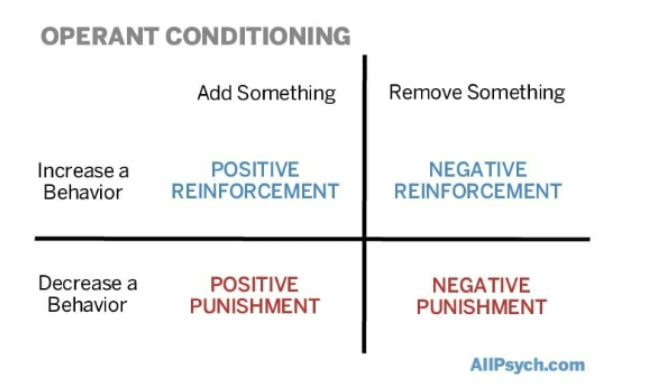
is pos or neg reinforcmenet more powerful
positive overall
social cognitive theory on more development
emphasizes a distinction between adolescents’ moral
competence and moral performance
• Moral competence: the ability to produce moral behaviors;
primarily an outgrowth of cognitive-sensory processes
• Moral performance: performing those behaviors in specific
situations; determined by motivation and incentives to act in a
specific moral way
albert bandura view on social cog on moral
In Albert Bandura’s view, self-regulation rather
than abstract reasoning is the key to positive
moral development
prosocial behavior
involve altruism, an unselfish
interest in helping another person
• Although adolescents have often been described as
egocentric and selfish, adolescent acts of altruism are,
nevertheless, plentiful
• Altruism
• Public
• Emotional
• Dire
• Anonymous
• Compliant
Forgiveness: an aspect of prosocial behavior that
occurs when the injured person releases the injurer
from possible behavioral retaliation
Gratitude: a feeling of thankfulness and appreciation,
especially in response to someone doing something
kind or helpful
moral in psycoanalytic theory
the moral branch of the
personality—develops in early childhood when the
child resolves the Oedipus conflict
• Being self-punitive and feeling guilt keeps children, and later
adolescents, from committing transgressions
• Ego ideal: the component of the superego that involves
standards approved by the parents
• Conscience: the component of the superego that involves
behaviors not approved of by parents
the dark triad
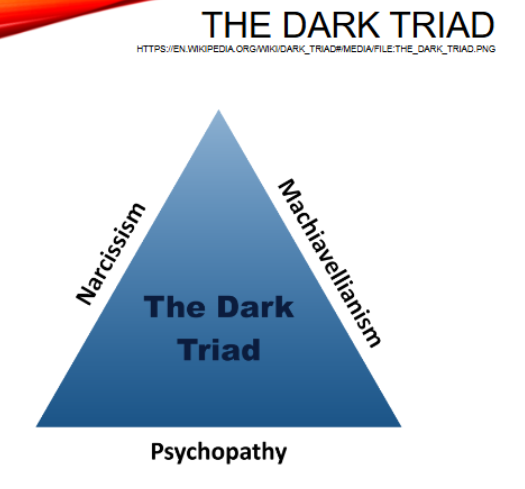
machiavellianism
people who score high on this trait are cynical (in an
amoral self-interest sense, not in a doubtful or skeptical sense), unprincipled, and cold, believe in interpersonal manipulation as the key for life success, and behave accordingly. Scores on measures of Machiavellianism correlate negatively with agreeableness (r = −.47) and conscientiousness (r = −.34). Machiavellianism is also significantly correlated with psychopathy
narcissim
Individuals who score high on narcissism display grandiosity,
entitlement, dominance, and superiority. Narcissism has been found to correlate positively with extraversion (r = .42) and openness (r = .38) and negatively with agreeableness (r = −.36). Narcissism has also been found to have a significant correlation with psychopathy.
psycopathy
Considered the most malevolent of the dark triad, individuals who score high on psychopathy show low levels of empathy combined with high levels of impulsivity and thrill-seeking. Psychopathy has been found to correlate with all of the Big Five personality factors: extraversion (r = .34), agreeableness (r = −.25), conscientiousness (r = −.24), neuroticism (r = −.34), and openness (r = .24).
erik erikson on moral dev
• Specific moral learning in childhood
• Ideological concerns in adolescence
• Ethical consolidation in adulthood
moral identity
an aspect of personality that is present
when individuals have moral notions and commitments
that are central to their lives
• Behaving in a manner that violates this moral commitment
places the integrity of the self at risk
moral personality ( people in it )
James Rest
Darcia Narváez: A mature moral individual cares
about morality and being a moral person
Sam Hardy and colleagues: Identity is a way of
caring about morality
Moral identity predicts five health outcomes:
anxiety, depression, hazardous alcohol use, sexual
risk-taking, and self-esteem
james rest
Moral character presupposes that the
person has set moral goals and that achieving
those goals involves the commitment to act in
accord with those goals
• Moral motivation involves prioritizing moral values over
other personal values.
what characterizes moral exemplars
• Brave: characterized by being dominant and extraverted
• Caring: characterized by being nurturant and agreeable
• Just: characterized by being conscientious and open to
experience
social domain theory
states that there are different
domains of social knowledge and reasoning, including
moral, social conventional, and personal domains
According to social domain theory, key aspects of
morality involve judgments about welfare, justice, and
the rights and struggles individuals have with moral
issues in their social lives
elliot turiel
Social conventional reasoning focuses on conventional
rules that have been established by social consensus in
order to control behavior and maintain the social system
Children construct moral concepts based on social
interactions that involve violations of welfare or justice
Social convention and morality are distinguished.
The social conventional approach is a serious challenge to
Kohlberg’s approach because Kohlberg argued that social
conventions are a stop-over on the road to higher moral
sophistication
contexts of moral dev in parenting
Discipline techniques:
• Love withdrawal: a parent withholds attention or love
from the adolescent
• Power assertion: a parent attempts to gain control over
the adolescent or the adolescent’s resources
• Induction: a parent uses reason and explains how
antisocial activities are likely to affect others
Induction appears to be more positively related to moral
development than is love withdrawal or power assertion,
although the findings vary according to developmental level
and socioeconomic status
schools and moral devleopment
Values clarification: a second approach to providing
moral education that involves helping individuals to
clarify what their lives are for and what is worth
working for
• Unlike character education, which tells students what their
values should be, values clarification encourages students to
define their own values and understand the values of others
Service learning: A form of education that promotes
social responsibility and service to the community
• Adolescents become less self-centered and more strongly
motivated to help others
• Service learning benefits adolescents in a number of ways:
• Higher grades
• Increased goal setting
• Higher self-esteem
• Improved sense of being able to make a difference for others
• Increased likelihood that they will serve as volunteers in the future
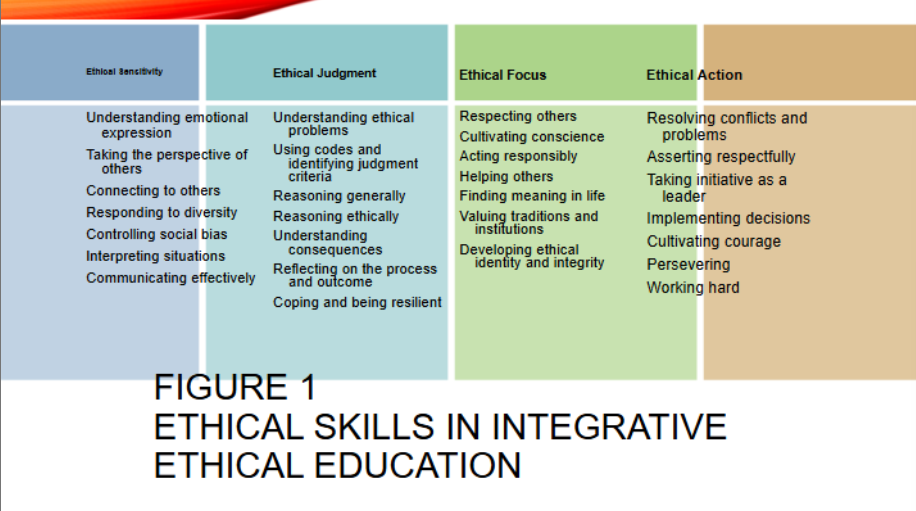
Darcia Narváez
emphasizes an integrative approach
to moral education that encompasses:
• The reflective moral thinking and commitment to justice
advocated in Kohlberg’s approach
• Developing a particular moral character as advocated in the
character education approach
william damon
concluded that a major difficulty confronting today’s
youth is their lack of a clear sense of what they want to
do with their lives
• Too many youth are essentially “rudderless”
• He argues their goals and values too often focus on the short
term
In Damon’s view, one long-standing source for
discovering purpose in life is religion
pamela king and religion
• Religion is an organized set of beliefs, practices, rituals,
and symbols that increases an individual’s connection to
a sacred or transcendent other
• Religiousness refers to the degree of affiliation with an
organized religion, participation in its prescribed rituals
and practices, connection with its beliefs, and
involvement in a community of believers
• Spirituality involves experiencing something beyond
oneself in a transcendent manner and living in a way that
benefits other and society

