Midterm 3 - Sequences and Series
 Call Kai
 Learn
Learn Practice Test
 Spaced Repetition
 Match
Match Flashcards
 Knowt Play
1/25

Earn XP
Description and Tags
UVA APMA 1110 Sequences and Series Review
Name | Mastery | Learn | Test | Matching | Spaced | Call with Kai |
|---|
No analytics yet
Send a link to your students to track their progress
26 Terms
Sequence
A list of numbers in a particular order. A sequence of numbers converges of lim a→n = L, where L is a finite number
Series
An infinite sum of a sequence. A series converges if it’s sequence of partial sums sn converges to a finite number
Geometric Series
A constant raised ot the power of n
Converges if |r|<1, diverges otherwise
Sum: If it converges, it adds up to S = a over 1-r
p-series
The sum of 1 over n^p
n raised to constant power in the denominator
Converges if p>1, diverges of p<=1
Divergence test
Take limit of terms as n → infinity
If lim an does not = zero, series diverges
Alternating series test (AST)
Looks like (-1)n-1 bn, converges if:
The terms decrease in magnitude
The limit of the terms is zero
*AST only proves conergence, not divergence
The Ratio Test
Best tool for factorials + mixed exponential/polynomial terms
Used for power series
L = limn→Infinity | an+1 / an|
If L < 1 → Converges
If L > 1 → Diverges
If L = 1 → Inconclusive
The Root Test
Use when something is being raised to the n
L = limn→infinity of the nth root of |an|
If L < 1 → Converges
If L > 1 → Diverges
If L = 1 → Inconclusive
Conclusions for ratio and root test (convergence or divergence)
If L < 1 → Converges
If L > 1 → Diverges
If L = 1 → Inconclusive
Direct comparison test
Compare to simpler p-series or geometric series. All terms must be positive
Limit comparison test
If innequality in DCT goes the wrong way
limn→infinity an over bn = C
If C>0 and finite, both series share the same fate
The integral test
If an = f(n) and f(x) is:
Positive
Continuous
Decreasing
Then
The sum and integral eihter both converge or both diverge
Absolute Convergence
Apsolutely convergent: The sum of |an| converges
Conditionally Convergent
The series an converges but it’s apsolute value |an| diverges
Power series
A series that has a variable cn(x-a)n centered at a
How to find the interval of convergence?
Use the ratio test and force the limit to be < 1
Solve the resulting inequality to find the radius of convergence (R)
Manually plyg endpoint values back into the original series and test using the convergence toolkit to see if they need [] or ()
Taylor and Maclaurin Series
Allow you towrewrite common functions as infinite polynomaials
Taylor Series Formula:
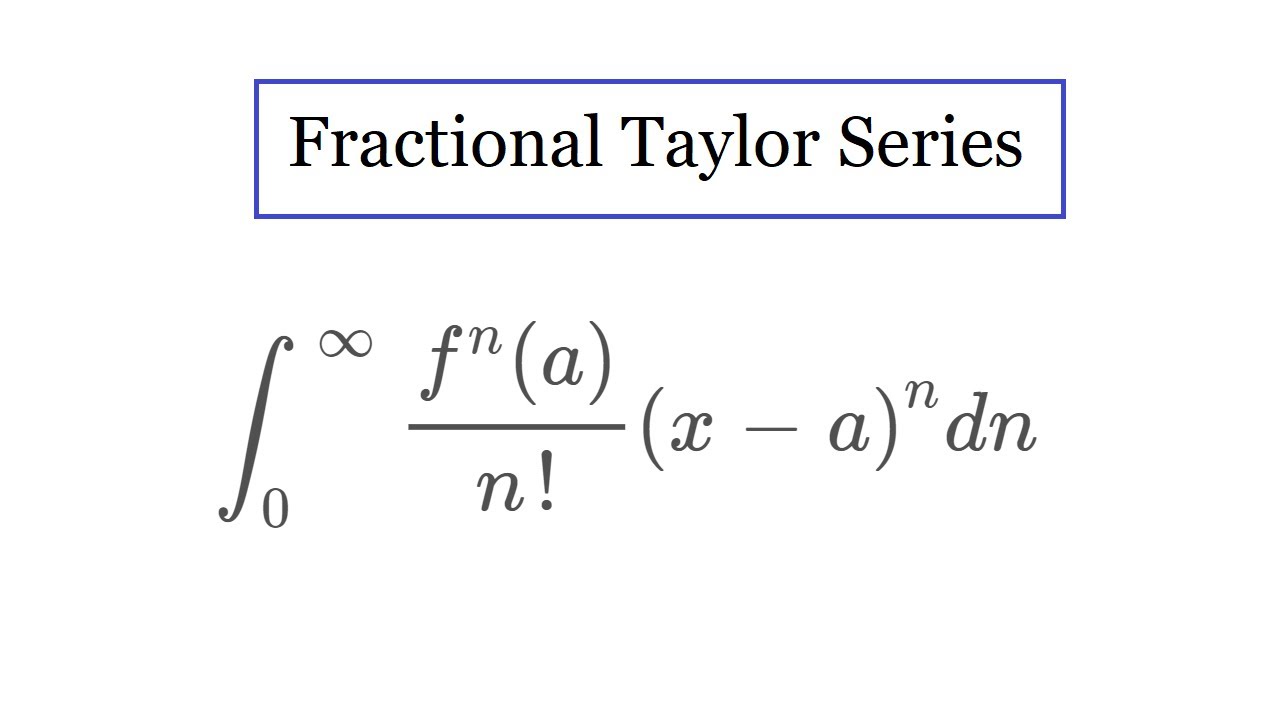
Maclaurin Series Definition
A taylor series centered at a = 0
Taylor Series: ex
ex = xn over n!
R = infinity
Taylor Series: cos(x)
cos(x) = (-1)n times x2n over (2n)!
R = infinity
Taylor Series: sin(x)
sin(x) = (-1)n times x2n+1 over (2n+1)!
R = infinity
Taylor Series: 1/1-x
1/1-x = xn
R = 1
Taylor Series: ln(1-x)
ln(1-x) = xn+1 over n+1
I = [-1,1]
Taylor Series: arctan(x)
arctan(x) = (-1)n times x2n+1 over 2n+1
I = [-1, 1]
Estimating Error: Alternating Series Estimation
the error |En| is less than or equal to the magnitude of the very next term you left off (bn+1)
Estimating Error: Taylor Polynomails
|Rn(x)| <= M|x-a|n+1 over (n+1)! where M is the apsolute maximum of the next derivative, |fn+1(u)|, on the interval between your center a and estimate x

