Gender identity & sexuality in neurodevelopmental conditions
 Studied by 0 people
 Call Kai
 Learn
Learn Practice Test
 Spaced Repetition
 Match
Match Flashcards
 Knowt Play
1/26

There's no tags or description
Looks like no tags are added yet.
Name | Mastery | Learn | Test | Matching | Spaced | Call with Kai |
|---|
No analytics yet
Send a link to your students to track their progress
27 Terms
Gender, sexuality & neurodevelopmental conditions
Historical view - individuals with neurodevelopmental conditions as asexual or childlike
Led to a lack of research and clinical attention
Ethical concerns limited research
Informed consent? Vulnerability? Exploitation?
Biases hindered early studies
Example: focus on victimisation
Moving foward
Focus on sexual education, consent, and health relationships
Studies on the impact of neurodevelopmental conditions on sexual development and expression
Research on gender identity and sexual orientation within neurodivergent populations
Emphasis on the need for tailored support
Basics of sexuality
Sexual attraction: Refers to who a person is physically attracted to
Can also involve romantic and emotional involvement
Sexual Identity: how a person identifies their sexual attraction and orientation
heterosexual, homosexual (gay/lesbian), bisexual, asexual, and pansexual
Sexuality is diverse and can be fluid, meaning it may change over time
Cultural and societal norms play a significant role in shaping how sexuality is understood and expressed
Sexual development
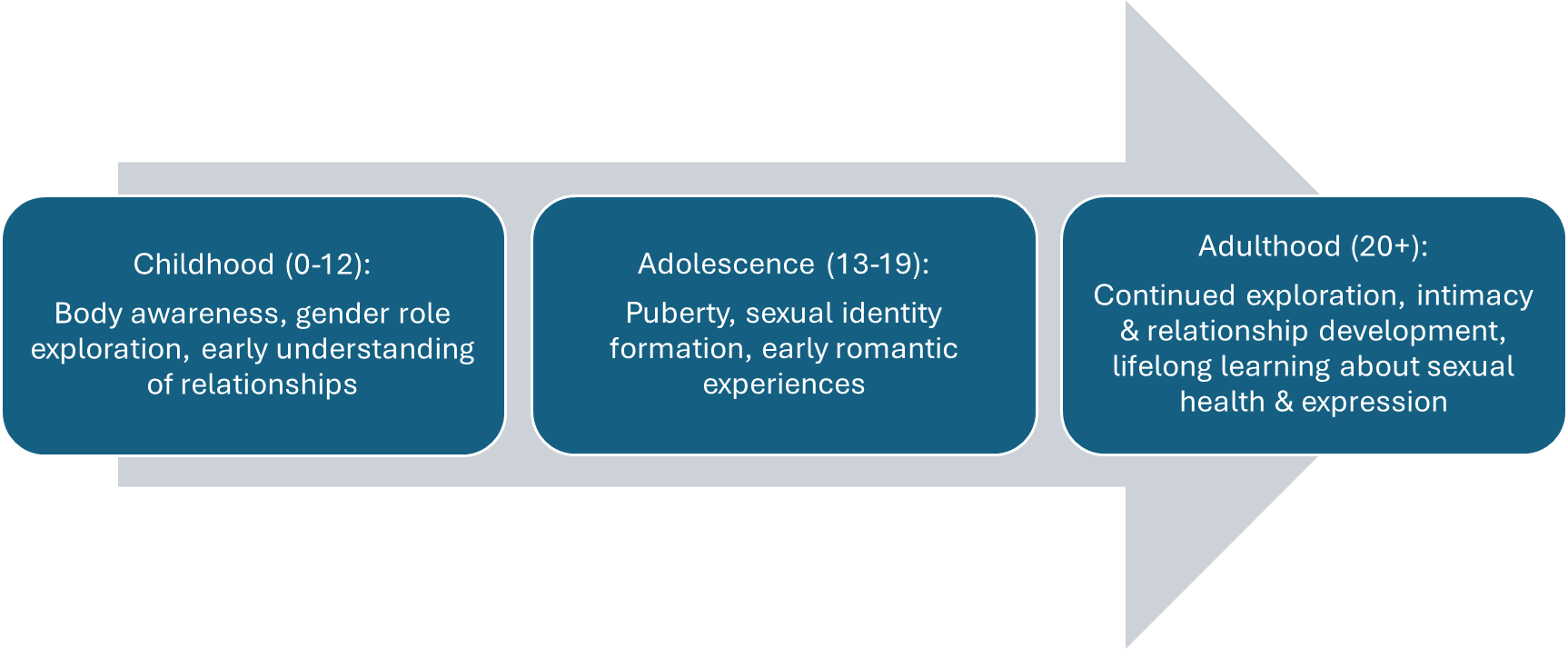
Sexuality
Sexual orientation typically emrges between middle childhood and early adolescence
UK 2021 Census
89.4% of the general population identify as heterosexual
3.2% of the population aged 16 and over identified as lesbian, gay, bisexual, or another sexual orientation (LGBT+).
1.5% identify as gay or lesbian
1.3% identify as bisexual
0.3% identify as another sexuality
Autism & sexuality
Weir et al., 2021
Anonymous, self-report survey
1,183 autistic and 1,203 non-autistic adolescents and adults (aged 16-90 years)
Eight times more likely to identify as asexual and ‘other’ sexuality than their non-autistic peers
Sex differences in sexual orientation:
autistic men are 3.5 times more likely to identify as bisexual than non-autistic men
autistic women are 3 times more likely to identify as homosexual than non-autistic women
ADHD & sexuality
Research suggests that women with ADHD are more likely to have had homosexual experiences (Young & Cocallis, 2023)
However, generally, individuals with ADHD do not differ from neurotypical peers in their self-reported sexual orientation
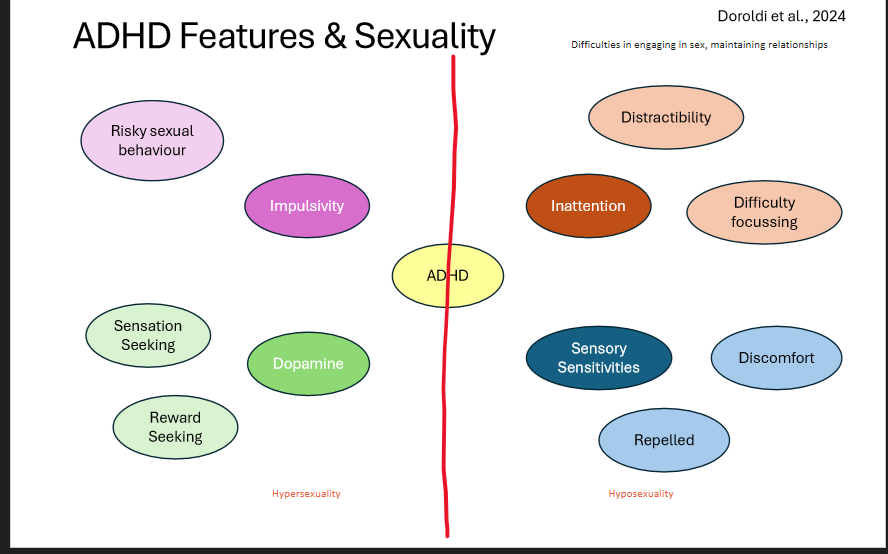
BUT the potential to show more hypersexual behaviours (Hertz et al., 2023; Soldati et al., 2021)
ADHD features and sexuality
Basics of gender
"sex" vs "gender"
"Sex" typically refers to biological attributes, such as chromosomes, hormones, and anatomy
"Gender" is largely understood as a social construct:
Involves the norms and expectations that societies create around what it means to be a "man," "woman," or other gender identities
These norms vary across cultures and change over time
Gender identity
An individuals internal sense of their own gender
Deepy personal experience that may or may not align with the sex they were assigned at birth
Gender identity exists on a spectrum and people may identify as male, female, non-binary, or other gender identities
Gender diversity = experiencing aspects of your gender as different from your assigned sex at birth
Gender diversity can result in gender incongruence where a person’s gender identity differs from their sex assigned at birth
Gender is a complex interplat of social, cultural and personal factors, distinct from the biological concept of sex
The general population
Survey-based research estimates that as many as 1% to 2% of adolescents identify as gender diverse (i.e. gender nonconforming or transgender; Rider et al., 2018)
In the 2021 UK Census 0.5% of the general population indicated that their gender identity differed to their sex registered at birth
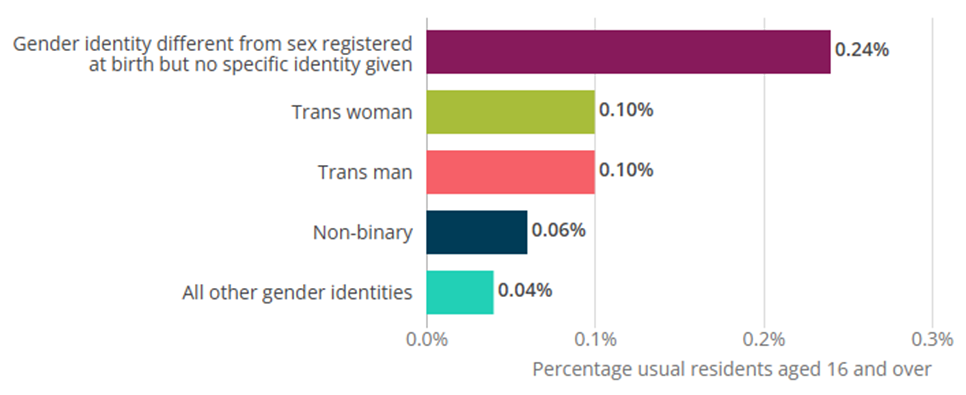
Gender dysphoria
People may experience discomfort or distress when their assigned sex is different from the gender they identify with
This is known as gender dysphoria
In the UK, transgender people must be assessed for gender dysphoria before physical interventions such as gender affirming hormones and surgery can be accessed on the NHS
NB. Not all trans people have dysphoria
While many trans individuals do experience gender dysphoria, it not universal experinece, and some trans poeple may not experience it at all
CIs people can also experience dysphoria
DSM-5-TR - children
A marked incongruence between one’s experienced/expressed gender and assigned gender, lasting at least 6 months, as manifested by at least six of the following (one of which must be the first criterion):
A strong desire to be of the other gender or an insistence that one is the other gender (or some alternative gender different from one’s assigned gender)
In boys (assigned gender), a strong preference for cross-dressing or simulating female attire; or in girls (assigned gender), a strong preference for wearing only typical masculine clothing and a strong resistance to the wearing of typical feminine clothing
A strong preference for cross-gender roles in make-believe play or fantasy play
A strong preference for the toys, games or activities stereotypically used or engaged in by the other gender
A strong preference for playmates of the other gender
In boys (assigned gender), a strong rejection of typically masculine toys, games, and activities and a strong avoidance of rough-and-tumble play; or in girls (assigned gender), a strong rejection of typically feminine toys, games, and activities
A strong dislike of one’s sexual anatomy
A strong desire for the physical sex characteristics that match one’s experienced gender
DSM-5-TR - adolescents and adults
A marked incongruence between one’s experienced/expressed gender and their assigned gender, lasting at least 6 months, as manifested by at least two of the following:
A marked incongruence between one’s experienced/expressed gender and primary and/or secondary sex characteristics (or in young adolescents, the anticipated secondary sex characteristics)
A strong desire to be rid of one’s primary and/or secondary sex characteristics because of a marked incongruence with one’s experienced/expressed gender (or in young adolescents, a desire to prevent the development of the anticipated secondary sex characteristics)
A strong desire for the primary and/or secondary sex characteristics of the other gender
A strong desire to be of the other gender (or some alternative gender different from one’s assigned gender)
A strong desire to be treated as the other gender (or some alternative gender different from one’s assigned gender)
A strong conviction that one has the typical feelings and reactions of the other gender (or some alternative gender different from one’s assigned gender)
Gender diversity in autism
The first systematic study was led by de Vries et al
Investigate the incidence of autism in children and adolescents referred for gender diversity services
7.8% of the samle met strict diagnostic criteria for autosm - 10x higher than the prevelance of autism in the general population at the time
Strang et al
Identified studies of gender diverse and trangender youth that included only clincial autism disgnoses or autism diagnosed through comprehensive methods
In all 7 available studies rates of clincial diagnoses were significantly greater compared to the general population
Corbett et al - 2023
Gender diversity research with autistic children has typically relied on parent-report based on a single question
Used the Gender Diversity Screening Questionnaire (Self-Report and Parent-Report)
Two domains: Binary Gender Diversity and Nonbinary Gender Diversity
244 children (140 autism and 104 neurotypical)
Self-report: Autistic children showed higher Gender Diversity (both binary and non-binary) than neurotypical children.
Parent-report: A significant difference in gender diversity between the groups on body incongruence
Underscores “the need to better understand and support the unique and complex needs of autistic children who experience gender diversity.”
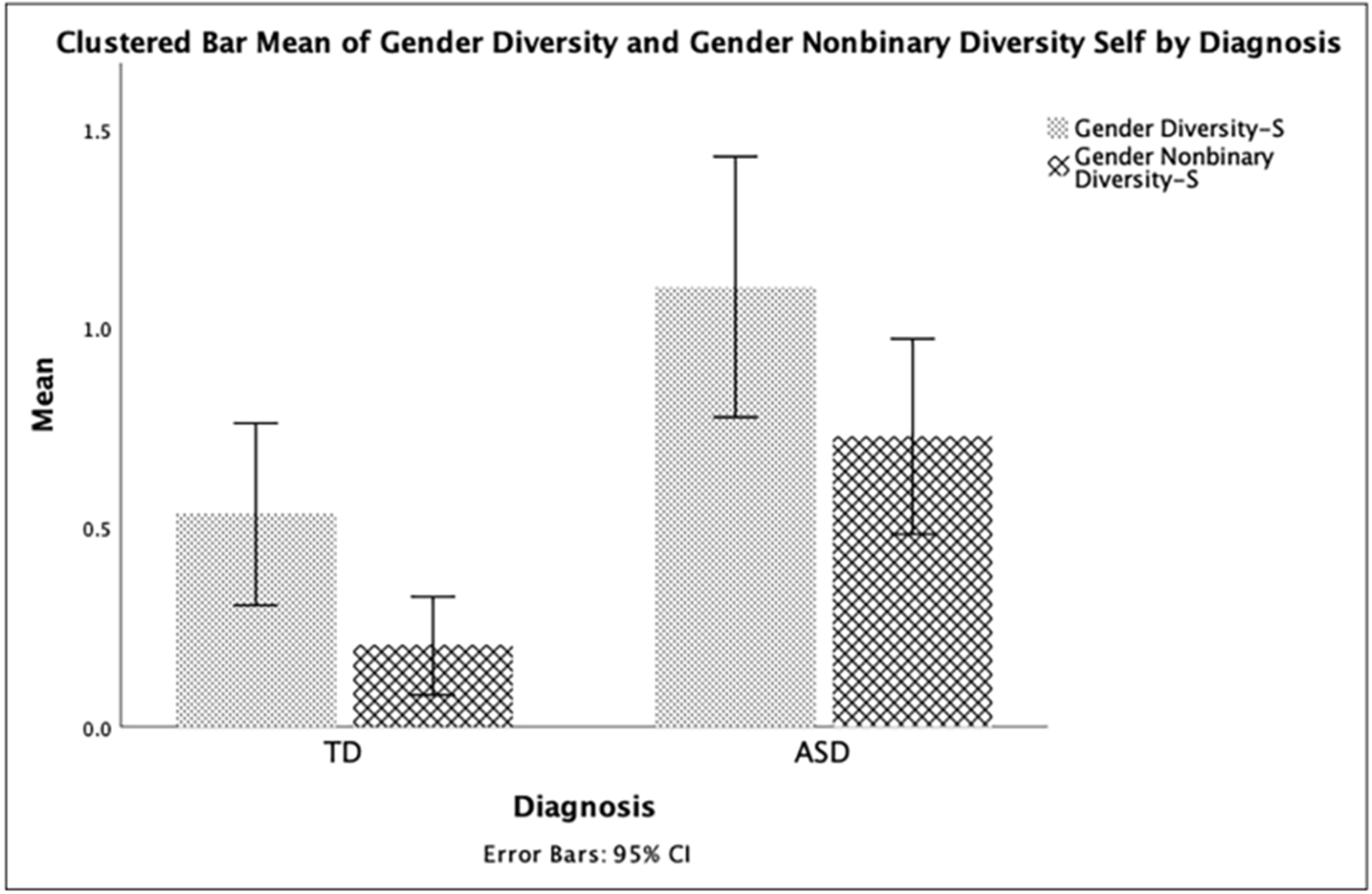
Gender diversity & ADHD
Very limited, few studies specifically look at ADHD
Warrier et al., 2020 – Transgender & Gender diverse individuals had elevated rates of ADHD
Prevalence rate of 8.3% in children and adolescents referred for gender care (Holt et al., 2016)
Prevalence rate of 4.3% in TGD adults (Cheung et al., 2018).
Ignatova et al., 2025:
10,277 ADHD & Transgender early adolescents (12-13 years)
Data taken from the longitudinal Adolescent Brain Cognitive Development (ABCD) study (based in the US)
Methods: “Are you transgender?” Yes (TG), no (CG) or maybe (GQ)
Gender diverse individuals showed higher levels of ADHD traits
Results reduced when controlling for stress
Authors linked to current climate in the US
Lived experience - autistic and transgender
Cooper et al., 2022
21 autistic adults took part in semi-structured interviews
All participants identified as transgender and/or non-binary
Main Findings:
Distress due to their bodies not matching their gender identities, while managing complex intersecting needs
Societal acceptance of gender and neurodiversity
Barriers in accessing healthcare for their gender needs
Tension between need to undergo a physical gender transition versus a need for sameness and routine
Positive experiences
“We see the world differently” (Participant 22), referring to the idea that being autistic allows one to step outside of societal norms and follow your own path
“I have never tried to fit in with people, or very rarely. So whilst now my gender presentation is very stereotypically male, there are some things that I do are intentionally more feminine, but I don't care” (Participant 12)
“Then after having a [autism] diagnosis a lot more of my experiences have come to light again and there's things that I do actually make me really uncomfortable or things that really don't suit me that I have edited to ignore a long time ago.” (Participant 17), found the diagnosis comforting and this allowed new coping strategies to be implemented
DSM-V-TR autism
“Hyper- or hyporeactivity to sensory input or unusual interests in sensory aspects of the environment (e.g., apparent indifference to pain/temperature, adverse response to specific sounds or textures, excessive smelling or touching of objects, visual fascination with lights or movement)”
Dysphoria & sensory sensitivities
Cooper et al., 2022:
Some participants described ‘sensory dysphoria’ - distress linked to sensory experiences
Wearing uncomfortable fabrics and shapes associated with girls’ clothes
Sensory challenges of puberty including periods, and growing facial hair
‘I was stuck between having really bad gender dysphoria not wearing a binder or feeling really uncomfortable sensory wise.’
Biological theories
Prenatal Hormone Exposure:
Variations in prenatal hormone exposure could contribute to differences in how individuals perceive and experience gender
not a simple cause-and-effect relationship
Brain Structure and Function:
Differences in structure and function could influence how individuals process and internalise social constructs like gender
Differences in brain regions involved in social cognition and self-perception might play a role
Increased self identification
Autistic individuals may be less influenced by societal norms and expectations surrounding gender & sexuality
Leading to a greater likelihood of expressing their authentic gender or sexual identities, even if it deviates from societal norms
In other words, they may be less likely to suppress or conform to traditional gender roles or sexual identities due to social pressures
Differences in social cognition & sensory processing
Systemising and Pattern Recognition:
a more analytical approach to gender, breaking down its components and questioning traditional norms
Intense Focus and Special Interests:
Increased depth, leading to a more profound understanding of their own identity & less influence from outside sources
Sensory sensitivities/sensation seeking:
Certain clothing textures or social environments associated with specific genders might be intensely uncomfortable
Preference for certain gendered presentations due to the sensory input it provides
Gender identity, sexuality & down syndrome
Limited to no studies investigating gender diversity in Down Syndrome
Parent-report regarding more general views of sexuality in DS
No studies directly speaking to individuals with DS
Instead, studies focus on the need for and improvement of sexual education for individuals with DS
Sex ed in down syndrome
The World Health Organization advocates for SE as a human right
BUT adolescents and young adults with intellectual or developmental disabilities are frequently excluded
Often focuses on safety and abuse prevention rather than a holistic approach
healthy relationships, consent, and sexual fulfilment
Need to work with these individuals to develop implement more accessible and effective SE programs
Schmidt et al - 2021
Improving the accessibility of sexuality education (SE) for individuals with intellectual or developmental disabilities.
Qualitative data collection through interviews and focus groups
Individuals, parents, healthcare providers, and educators.
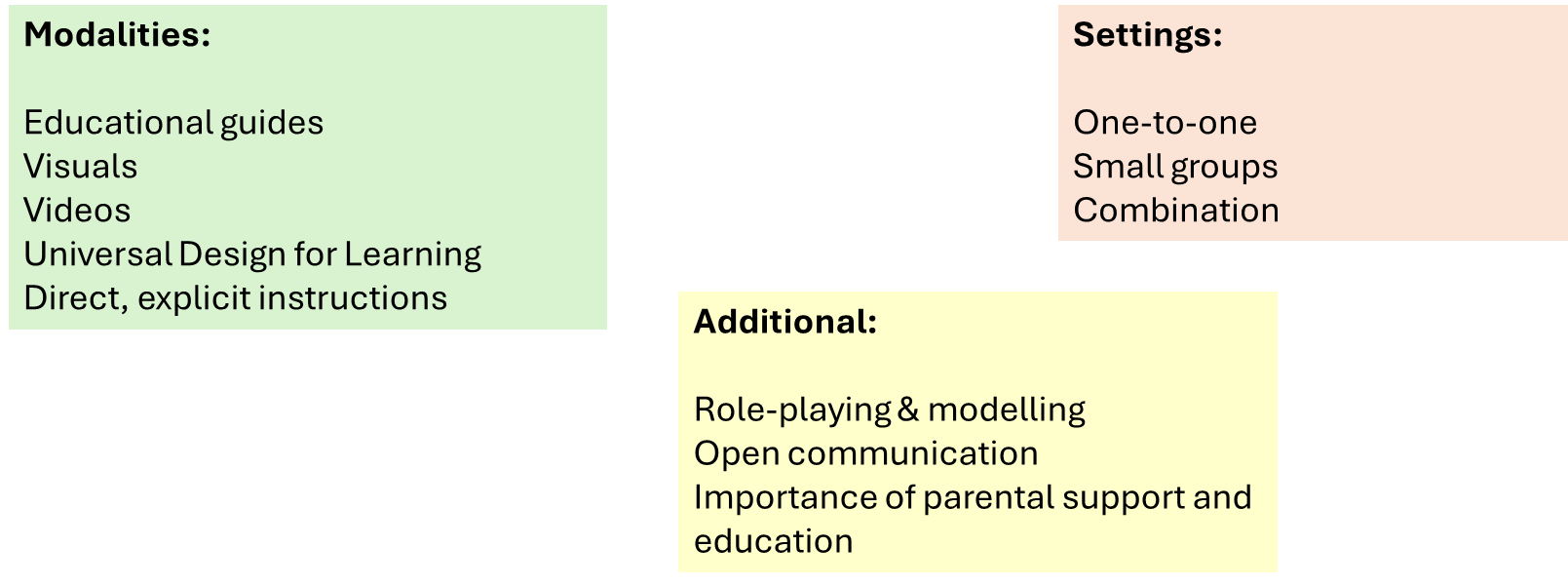
Universal design for Learning (UDL)
UDL adapts education to fit diverse learner needs
The 3 UDL Principles
Representation (the "what"): Offer information in varied formats (e.g., visual, auditory).
Action/Expression (the "how"): Provide different ways for learners to interact and express themselves.
Engagement (the "why"): Increase motivation through choice, relevance, and collaboration.
UDL in Sexuality Education
UDL makes SE accessible and engaging for all
 Note
Note  Flashcards (40)