Lecture 16: Spinal control of movement Locomotion
 Studied by 0 people
 Call Kai
 Learn
Learn Practice Test
 Spaced Repetition
 Match
Match Flashcards
 Knowt Play
1/40

There's no tags or description
Looks like no tags are added yet.
Name | Mastery | Learn | Test | Matching | Spaced | Call with Kai |
|---|
No analytics yet
Send a link to your students to track their progress
41 Terms
What will be the two main topics in motor control discussed?
mechanisms producing locomotion
Mechanisms producing more complex movements such as writing, typing, speaking (motor cortex)
What are some themes across both categories?
there is modular organization
There is topographical organization.
specifically control systems are mapped somatotopically, that is across the body surface
What are some mechanisms producing locomotion?
these mechanisms are general to all types of locomotion: walking, swimming in fish, flying in birds, slithering in snakes
Where are locomotion systems localized?
In the brain stem
spinal cord
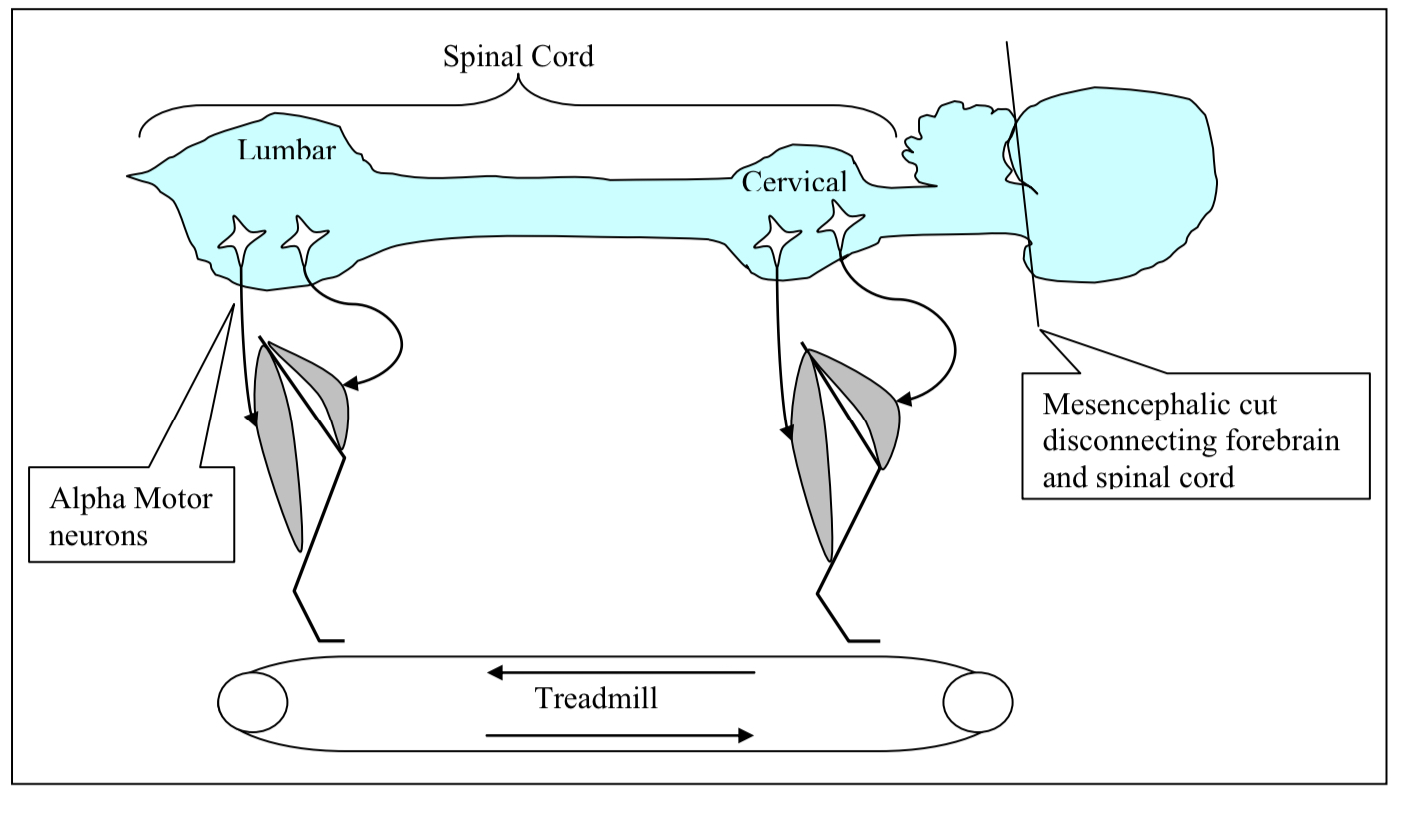
What does this diagram show?
Side view of a cat brain and spinal cord (with the legs also )
What are walking, trotting, and galloping?
different patterns of locomotion produced by different contraction patterns of muscles
What would happen if you were to cut across the anterior portion of the midbrain?
animals are paralyzed and can’t consciously move their lower body
What would happen if a cat’s body is supported in a sling and its legs are placed on a treadmil?
Treadmill at Slow Speed: if the treadmill is turned on at a slow speed, the “paralyzed” animal slowly walks with nearly perfect limb coordination and foot placement
Treadmill at Fast speed: If the treadmill is turned up to a higher speed ,the cat trots faster with proper coordination
Treadmill at Faster Speed: if treadmill is turned up to even an higher speed the cat gallops with the proper coordination
What conclusion can be made from the treadmill experiment?
even though the brain is dissociated from the spinal cord, the animal still produces several forms of well-coordinated locomotion
the neural mechanisms necessary to produce several forms of locomotion are in the brainstem and spinal cord
that input from the forebrain is necessary
What is one simple neuronal mechanism that can produce patterns of behavior?
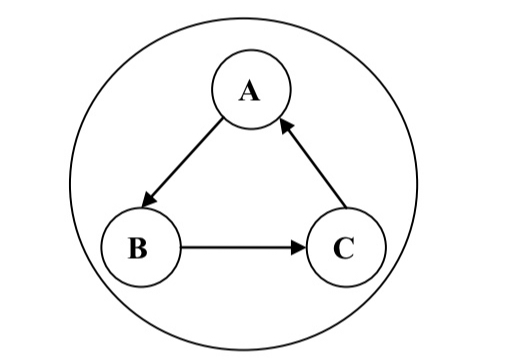
Central Pattern Generator (CPG)
symbol for CPG represents 3 neurons (A, B, C) firing in a cycling pattern
Definition: a CPG is a network of neurons that produces rhythmic output by its anatomical and synaptic interactions added to the intrinsic properties of its individual neurons (spontaneously active neuron(s))
A CPG can generate a complex patterned output even if the CPG is isolated from any patterned input
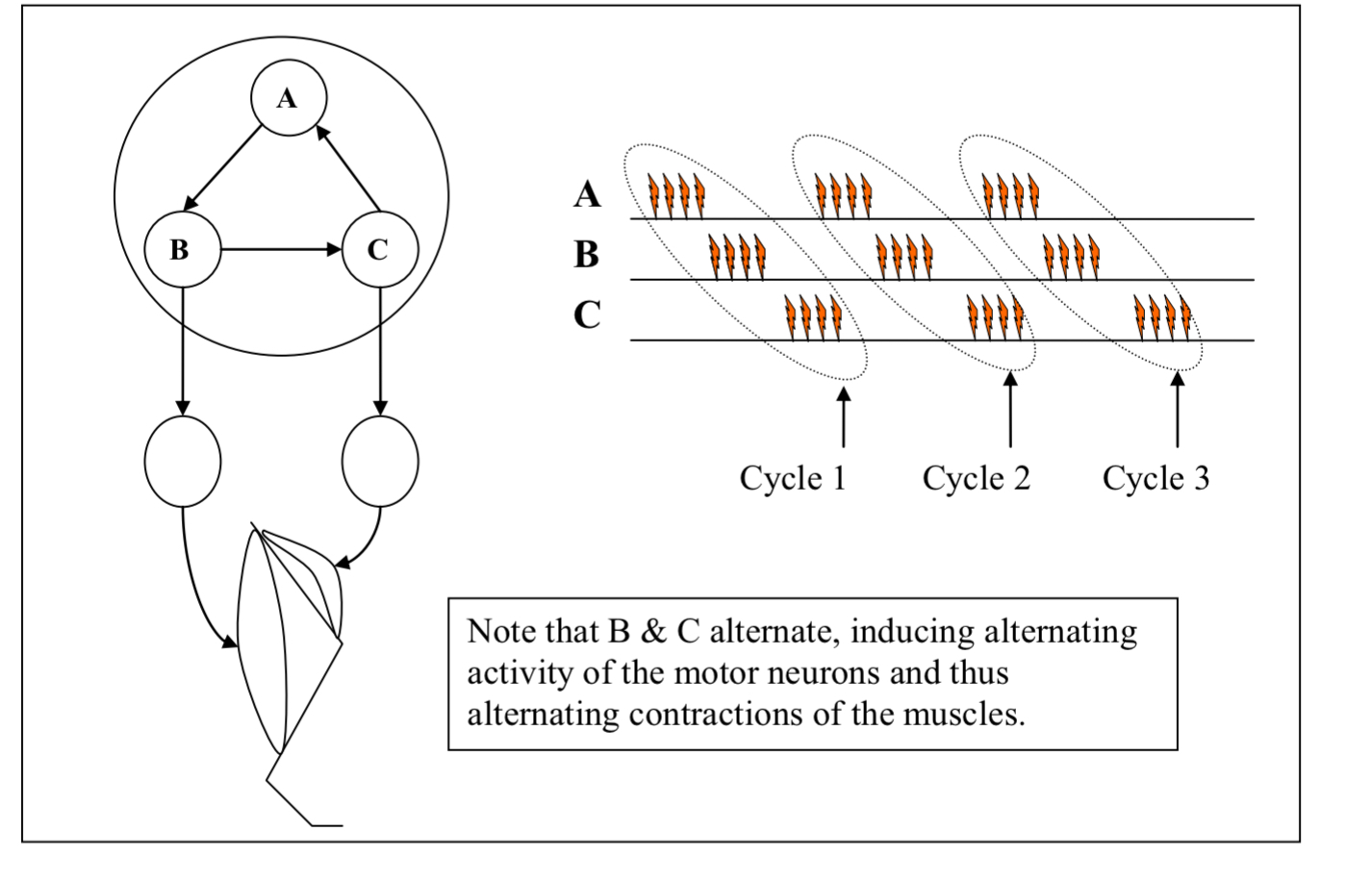
What does this diagram show?
its a diagrammatic example of the firing pattern produced by a CPG
What’s another mechanism for producing behavioral patterns?
Command Neuron
Definition: It is a single neuron that generates a complex behavior by its synaptic effects on the neurons to which it projects
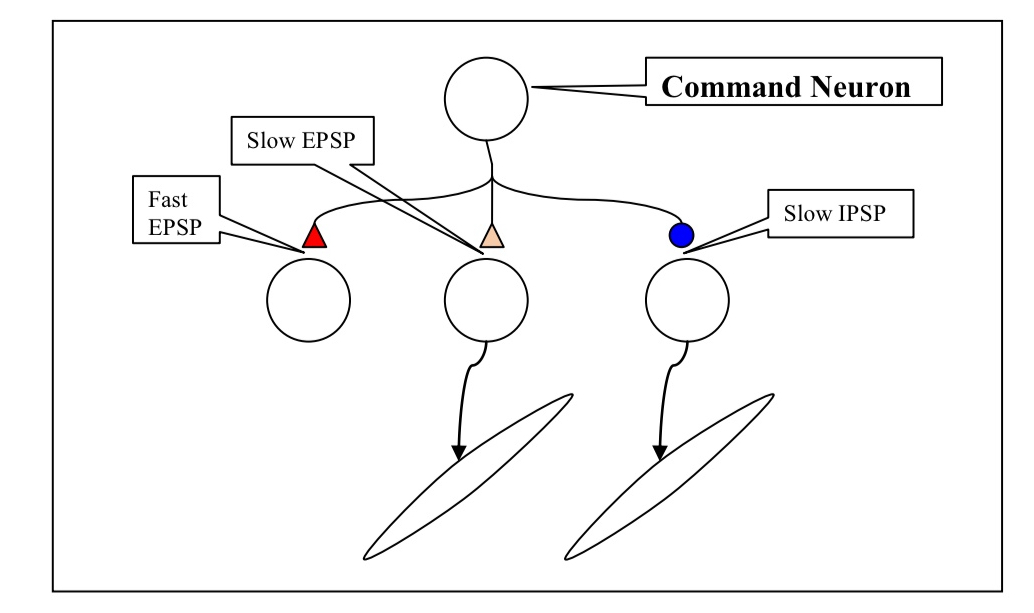
Explain what is happening in this example of a command neuron?
How patterned Behavior is generated using Command Neurons
different synaptic effects produced by the command neuron can generate different patterns of activity in the alpha motor, thus generating a patterned behavior
Even though this command neuron secretes one NT, different effects are produced in the recipient cells due to different receptors for the NT
What is a command group?
a set of neurons with similar properties that together generate a complex behavior
command group does that same thing as a command neuron but consists of multiple neurons
What evidence suggests that mechanisms for locomotion reside in the brain stem and spinal cord and not in the forebrain?
evidence from mesencephalic animals
Experiment:
The mesencephalic animal is put in a sling to support its body weight, and its legs are placed on a treadmill
Findings
At low Treadmill Speeds: the animal will walk with the appropriate coordination
At higher speed: the animal will trot with the appropriate condition
At even higher speed: the animal will gallop with the appropriate coordination
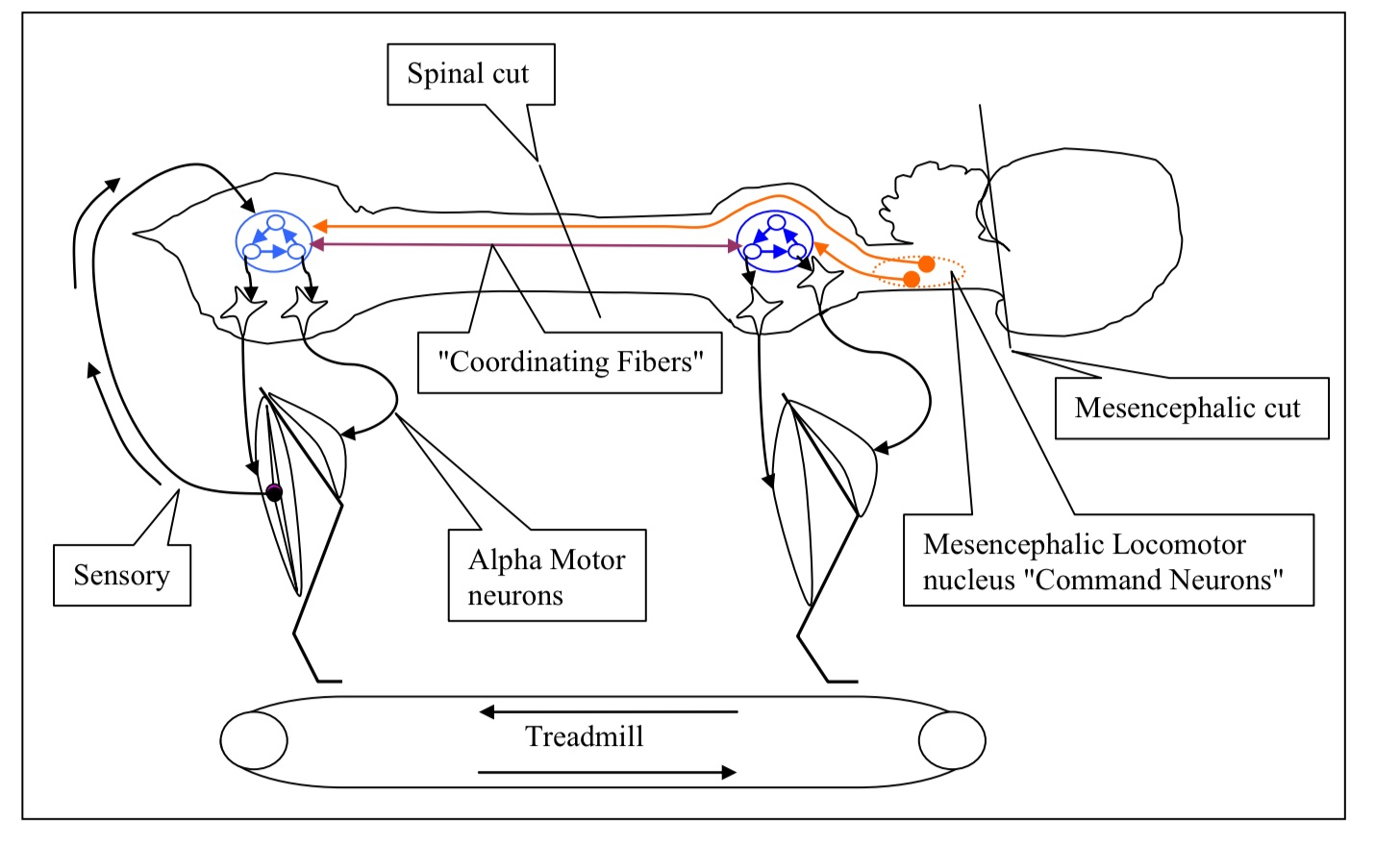
What does the diagram depict?
the main components of the neurocircuitry generating locomotion
What is a mesencephalic animal?
animal with a cut at the anterior portion of the midbrain, which will separate the forebrain from the brainstem and spinal cord
these animals are paralyzed and can’t consciously control their body
What are the results if you electrically stimulate in an area in the midbrain called mesencephalic locomotor nucleus (MLn)?
Experiment:
The mesencephalic animal is put in a sling to support its body weight with its legs hanging in the air
Results:
Low intensity stimulation: in the mesencephalic animal’s legs will move in a walking pattern
With Medium intensity stimulation: the animal’s legs will move in a trotting pattern
High intensity stimulation: the animal’s legs will move in a galloping pattern
What are the conclusions about the experiment?
Evidence with mesencephalic animals suggests that neural mechanisms sufficient to produce patterned locomotion reside in the brainstem and spinal cord and not in the forebrain
What are the mechanisms generating locomotion ?
There are multiple CPGs in the spinal cord and the neurons of the CPGs project to alpha-MNs
The fundamental rhythm of locomotion is produced by these spinal CPGs
What turns the CPGS on in mesencephalic animals?
when the treadmill is turned on feedback from the moving legs turns on the CPGs
There is a command neuron (command group) projection from the mesencephalic locomotor nucleus that synapses onto CPGs in the spinal cord
What is proprioception?
sensory information that provides information about the location of parts of your body
it turns on
What do muscle spindles do?
one of the several types of sensory receptors that provide different types of proprioceptive information
They are embedded in muscles and provide info about muscle length
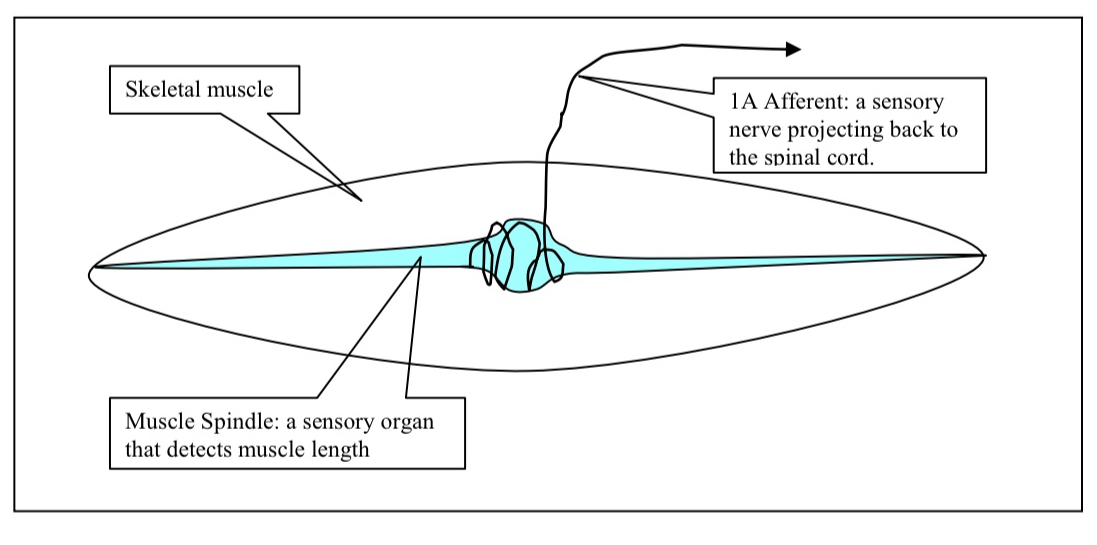
What does this diagram depict?
There are sensory organs embedded in ligaments that tell about the angle of rotation of a joint, and other sensory organs
embedded in the tendons that provided info about muscle tension
What do Properioreceptors do?
their combined info is integrated, largely without awareness, to provide info about the location of our body parts
What happens when the treadmill is turned back on?
the legs are dragged backwards which changes the sensory feedback info from the muscle spindles and other proprioreceptors
This info is sent to the spinal cord and this switches on the CPGs, and the patterned movement is generated
Proprioreceptive info can also regulate the rate of CPG activity
How can you still get coordinated movement?
You can remove sensory feedback information to the spinal cord
And stimulate in the mesencephalic locomotor nucleus
What is the presumed mechanism for the voluntary initiation of locomotion in a “normal” animal?
neurons in the forebrain that project to command neurons in the mesencephalic locomotor nucleus
What are the several different mechanisms to initiate locomotion?
You can consciously decide to locomote (forebrain pathway)
Sensory info allows you to react to the environment
What evidence suggest that there are multiple CPGs?
Take a mesencephalic animal and cut the spinal cord, and then put the animal on the treadmill. The animal will still generate a locomotion pattern
The front legs will move in alternation with each other, and the back legs will move in alternation with each other, BUT forelimbs and hind limbs no longer move in correct coordination with each other
Findings
Suggest that there is at least one CPG that generates the rhythm produced by the front legs
Another CPG generates the movement produced by the back legs
How do you get coordinated activity between CPGs?
there are coordinating fibers that connect CPGs together
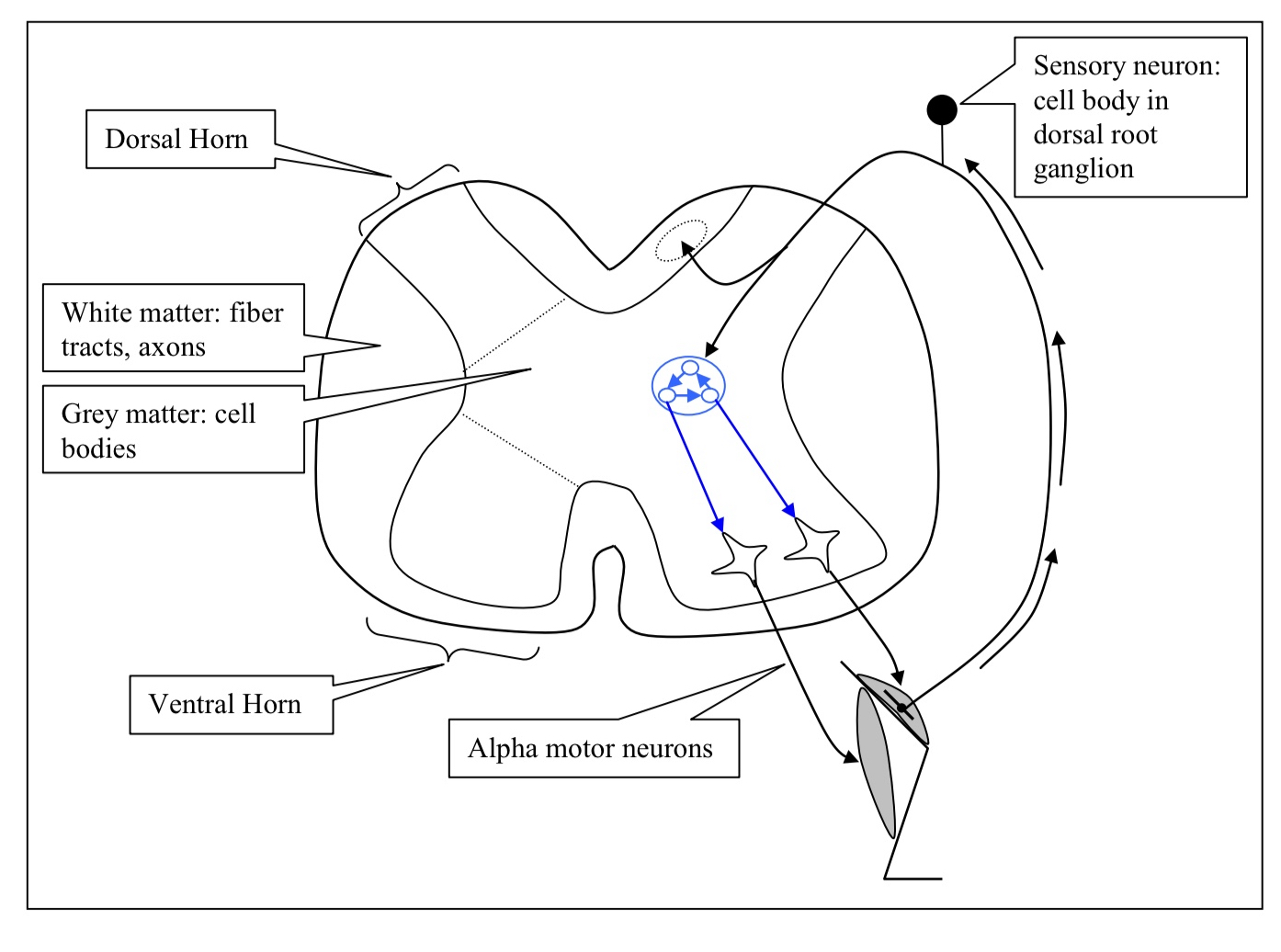
What does this diagram depict?
a cross section through the spinal cord
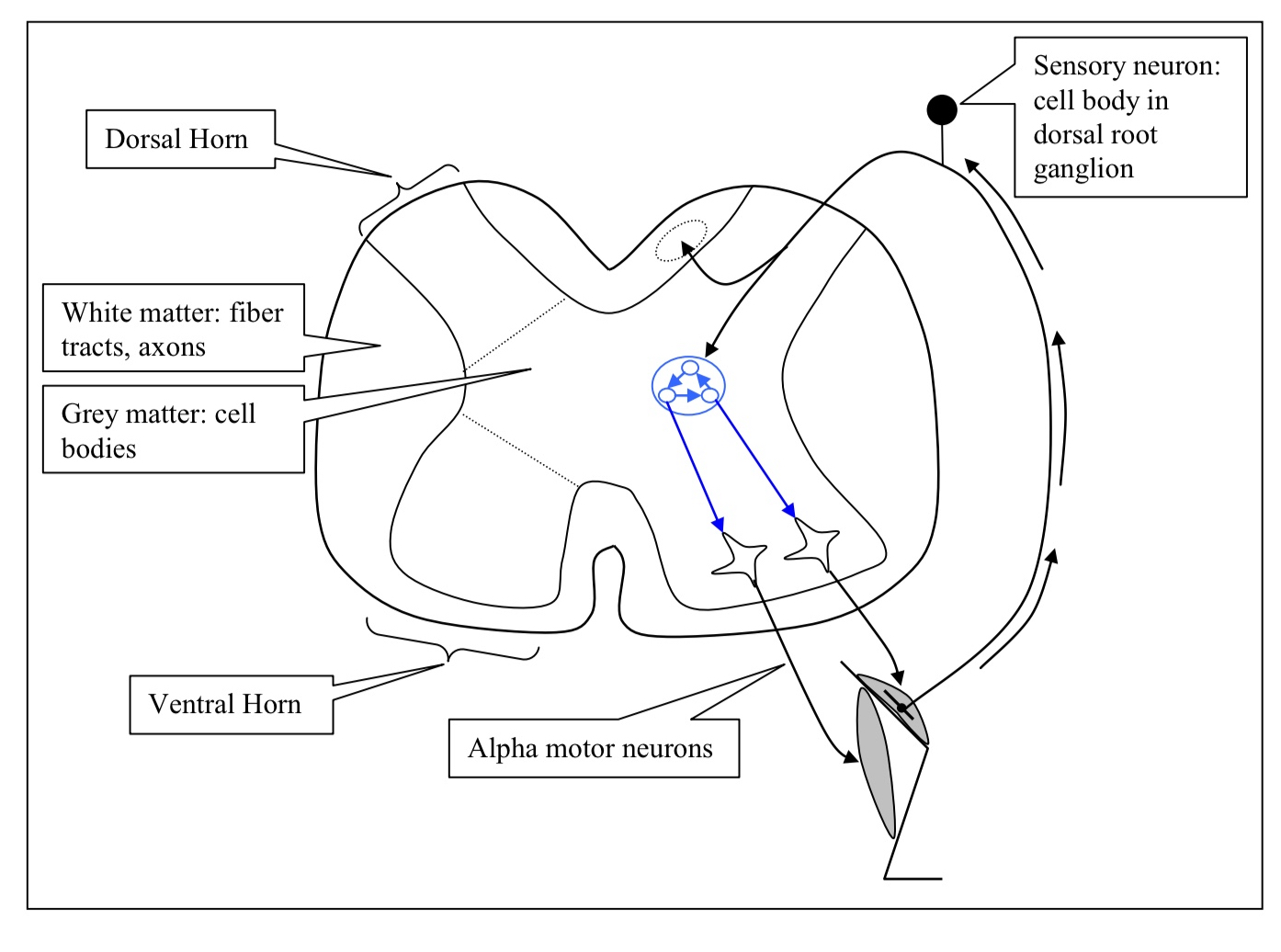
Explain more vividly whats occurring in this diagram?
There is anatomical separation of sensory input (which enters the dorsal horn) and motor output (which exits the ventral horn)
Many sensory organs in the skin, muscle, tendons, ligaments, etc, providing info about: heat, cold, light touch, etc (somatosensory system)
Cell bodies of the neurons carrying sensory info from the sensory receptors are all in the dorsal root ganglion (ganglion=collection of neuron cell bodies in the PNS, same structure in CNS is called nucleus)
Where does this sensory input project to and what happens to it?
projects to spinal CPGs (and to various other areas in the brainstem) from where it is relayed from the thalamus to sensory cortex
How many CPGs are there?
many CPGs and they are distributed throughout the spinal cord particularly in the cervical and lumbar enlargements
What evidence is there that there are many CPGs?
if you take a thin section anywhere in the spinal cord and put it in a dish, patterned output from the alpha motor neurons can be generated
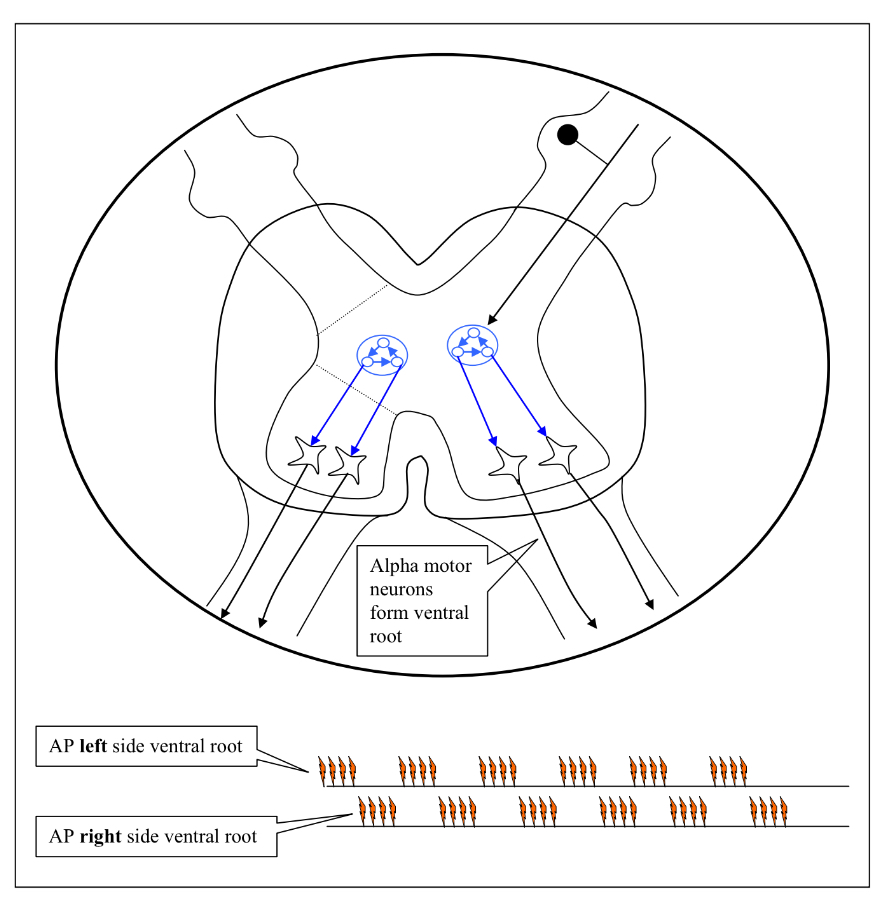
What does this diagram depict?
A thin slice of spinal cord in a dish
Recording from left and right ventral roots
Stimulating one of the dorsal roots (or adding glutamate to the bath)
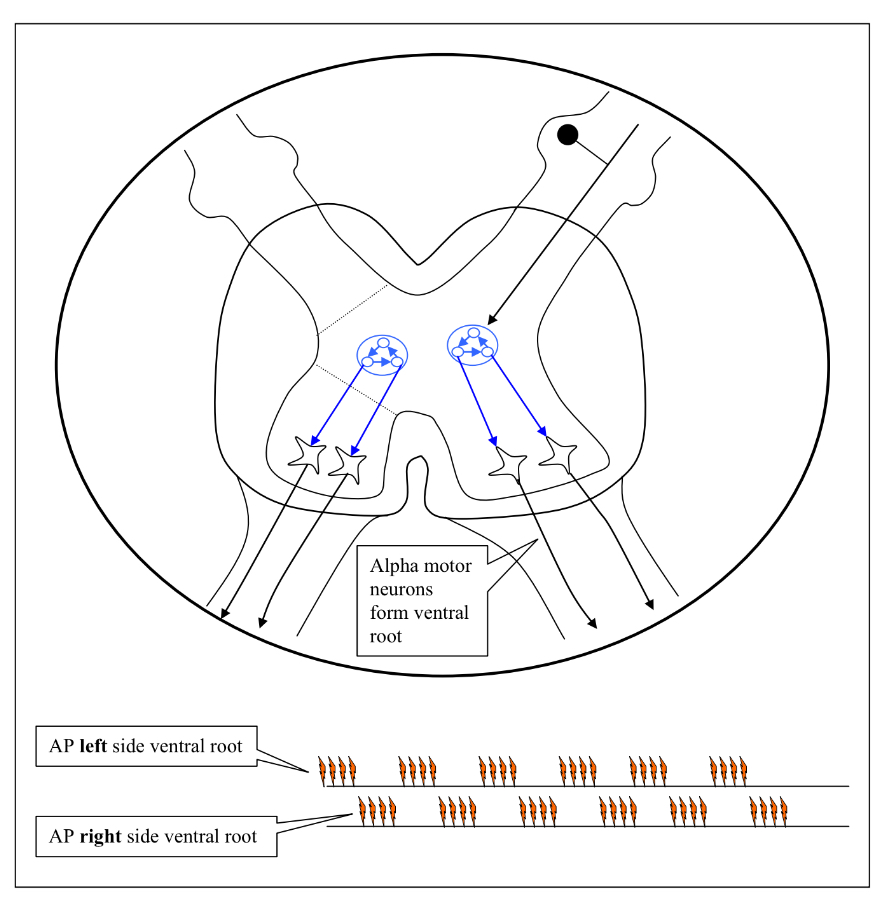
What does the patterned motor output suggest?
suggests that the mechanisms for producing patterned output exist within even a thin slice of spinal cord
Can be done with sections throughout the spinal cord
Therefore, there multiple CPGs in the spinal cord and their activity can be initiated by sensory stimulation (dorsal root stimulation)
How can CPGs be turned on?
can be turned on by adding glutamate into the bath
Glutamate will generate rhythmic ventral root activity
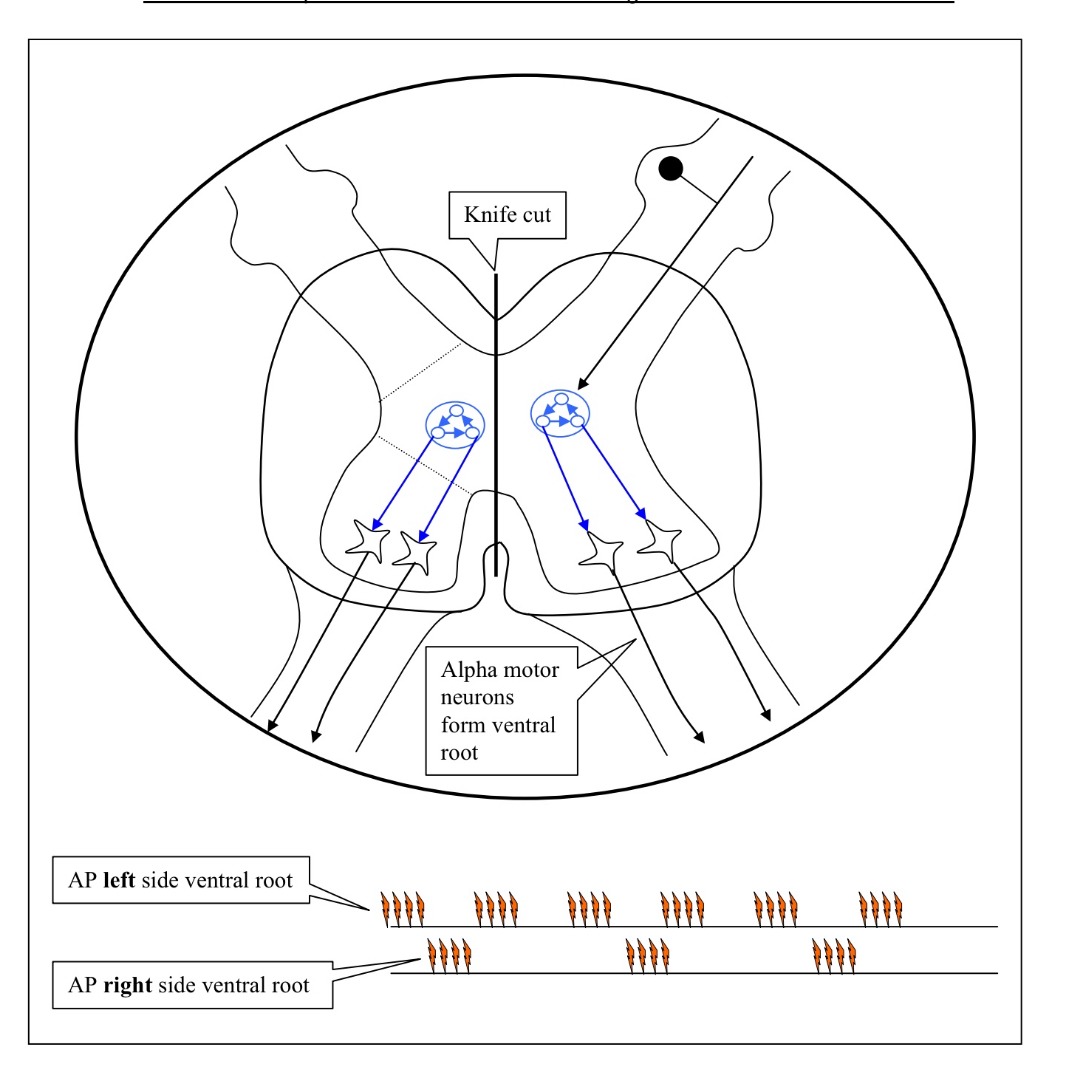
What is shown in this figure?
bisect the thin spinal cord
Rhythmic motor output is still produced from the left and right sides
The output from the 2 sides is no longer coordinated with each other
Conclusion
Therefore, there are CPGs in both the left and the right sides of the spinal cord
Why was the activity from the left and right sides coordinated before bisection?
because of “coordinating fibers” connecting the CPGs together
 Note
Note  Flashcards (96)