Eduqas Alevel RS Ethics Free Will 4D
 Studied by 0 people
 Call Kai
 Learn
Learn Practice Test
 Spaced Repetition
 Match
Match Flashcards
 Knowt Play
1/17

There's no tags or description
Looks like no tags are added yet.
Name | Mastery | Learn | Test | Matching | Spaced | Call with Kai |
|---|
No analytics yet
Send a link to your students to track their progress
18 Terms
what is Pelagius
an ascetic monk who had chosen a religious path that priorities abstention from worldly pleasures to pursue spiritual goods. On a visit to Rome he was concerned with the moral standards there and blames the abundance of sin linked to the catholics predestination theology - later formalised by Augustine's doctrine of original sin
what was Pelagius concerned with predestination, moral standards and sin in Rome
he said that people were trying to not control their urge to sin because they felt that the urge to swim was predestined and therefore they had no choice but to sin. Pelagius argued that people had free will to resist sin.
what is part one of Pelagius argument for free will
INFLUENCE:
- Pelagius theories was partly influence by the early christian writer saint Justin (100-165). Justin ha written "every created being is so constituted as to be capable of vice or virtue. For he can do nothing praise worthy if he had not the power of turning either way" Morality, every human is created good or bad.
- Therefore Julian believed that humanity had to be free because otherwise good actions would have no Godly moral worth.
what is part two of Pelagius argument for free will
THE ROLE OF ORIGINAL SIN:
- Pelagius argued an omnibenevolent God would not punish all of humanity for the sins of Adam and Eve. In contrast to Augustine he believed that Adams sin only affected Adam and not inherited by all of humanity. meaning that people did not need to get baptised to be saved from sin
- Pelagius supported this argument by considering evidence found in deutronomy 'parents are not to be put to death for their children, nor their children be put to death for their parents; each will die of their own sins.
- therefore according to Pelagius, humanity does not inherit original sin and is therefore not desiring to sin, there is no concupiscence an d not a lump of sin. As pelagius stated ' we may not seem to be forced to do evil through a fault in our nature'
- the fall can be seen as a good thing for humanity, Adam and Eve had free will to decide to pick the fruit or not meaning that by sinning they grew in maturity like how a child disobeys their parent and grows in maturity
- original sin was good for the human race and lead to development and growth, linking to the irenaean theodicy by saying you have to do bad to appreciate the good
- this illustrated Pelagius' view because Adam and Eve chose to eat from the forbidden tree which illustrated to God that they were mature enough for free will. It is free will which humans inherit from Adam and Eve not their sin
what is part 3 of Pelagius' argument for free will
FREE WILL IS USED TO FOLLOW GOD'S LAWS
- Therefore Pelagius believed that people can use their free will to follow God's moral law; such as following commandments
- Pelagius believed that following the commandments was within human free will capabilities because a loving God would not create commandments that human did not have the capacity to follow. As Pelagius stated No one knows better the true measure of our strengths than He who gave it to us'
- When humanity freely chose to resist a temptation and thus keep to a commandment Pelagius referred to it as doing good works, achieving salvation through merit rather than through grace which was beloved by Augustine
- We have a natural capacity to seek God, this is biblical evident through the gospels "be perfect therefore, as your Heavenly Father is perfect. Matthew"
- We are saved by our acts and not simply by faith alone
what is part 4 of Pelagius' argument for free will
- argued that all good works were carried out only with the grace of God. However Pelagius saw Gods grace as enabling, not forcing, good works
- God allows us the free will and acts as the guide to show us how to act in a way to get to heaven, merit through grace
- what he means is that God is acting as a guide to do good works. God tries to guide humanity towards doing good but within the constraints of human free will
- humanity though does have the ability to ignore God's guidance and act in a sinful way, he believes this ability to sin is actually a good thing because it emphasises the good that someone does through free will. "the very capacity to do evil is also good, because it makes the good part better by making it voluntary and independent
- he in the end believed that people do have the free will to choose good works or to be sinful, when they freely chose to do good woks out is through the guiding grace of God as Pelagius said 'free will is in all good works associated by divine help'
what is part 5 of Pelagius' argument for free will
THE ROLE OF GODS GRACE IN SALVATION:
- Pelagius believed that if people, with their free will, chose not to follow God's commandments they can still seek forgiveness through gods grace they can still be forgiven
- this is because Pelagius stated that God grants atonement through the sacrifice of Jesus to al those who freely have faith in him
- Pelagius is putting forward the idea of universal atonement through the sacrifice of Jesus Christ, but this opens up the idea that people can still do bad things and be allowed into heaven which is unfair and unjust compared to those who do their best not to sin and follow Gods rules
- he argued that simply using for forgiveness us nit enough to receive God's atonement, repentance must be more than freely asking for forgiveness it should also be choosing not to sin again
who was Arminius
A dutch theological who was a student of Beza
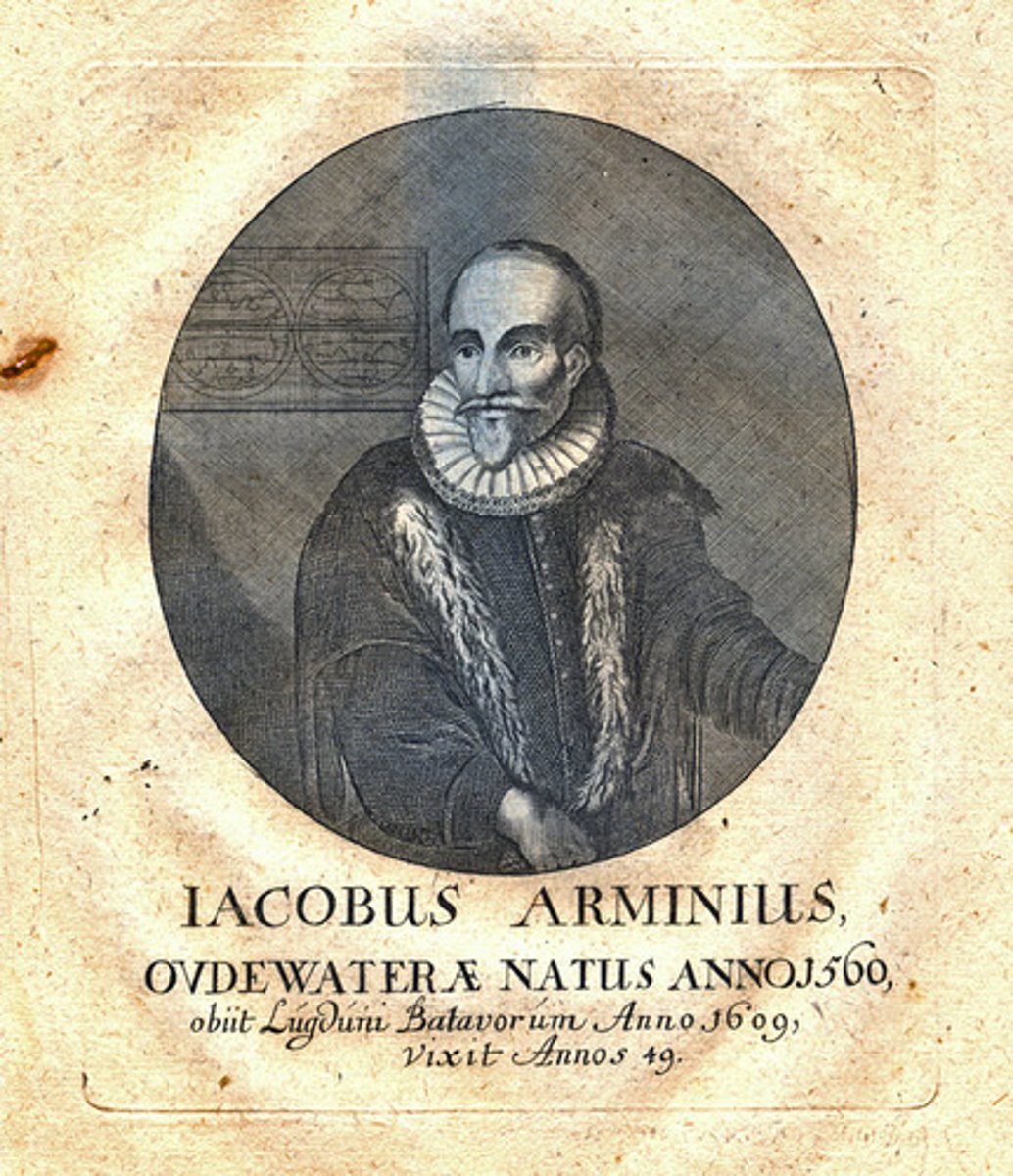
What did Arminius believe about predestination?
1. Christ is the formation and power behind salvation
2. election and reprobation are conditional upon human faith
3. election and reprobation occur with God's foreknowledge
4. Grace is given by God but is still utilised by humanity
what was part 1 of Arminius' theory
- arminius rejected calvinism, this is because he came to believe that God needed to defended against the calvinist predestination claims.
- he believed that Calvinist predestination ideas reduced humanity to God's pre-programmed humans that God used humanity to do as he pleased
- Arminius highlighted was that if predestination was correct then God must be responsible for evil carried out by humanity, if humans only do as God wills then it must be Gods will that caused evil
- therefore he needed to defend God against predestination theories so that "God might not be considered the author of sin nor man the automation in the hands of God'
- he believed in Conditional election, middle knowledge, not coercive because he knows who will freely choose God and who will reject christ
what is part two of Arminius' theory
THE EFFECT OF ORIGINAL SIN ON FREE WILL
- unlike Pelagius Arminius beloved that original sin is bad for humans
- this is because we do inherit original sin from Adam so he believes that humanities free will is compromised, “in this fallen state the free of man towards the true good is wounded, infirm, bent and weakened’ these adjectives are al reversible states suggesting that the sin isn’t permanent and that we can revise the damage of the original sin and gain salvation
- left in this state a persons natural impulse would be to sin but you can override this unlike what Calvin said that we are predestined to sin.
what is part three of Arminius' theory
God'S PREVENIENT GRACE ALLOWS HUMANS TO EXERCISE FREE WILL
- Arminius believed that the fall did not completely fill humanity with he predestination to sin, therefore humanity was not necessarily predestined to continually sin
- This is because of God's grace, it is associated with the holy spirit. This link is called prevenient grace, meaning that gods grace precedes each moral decision
- Arminius believed that within all humanity God has placed His holy spirit and is ever present as part of the trinity
- the HS encourages all people to do good works and will allow humanity to 'fight against satan, sin, the world and their own flesh'
- he believed the HS is ever present to aid and assist all people through the v variety of temptations they may face
-
what is part 4 of Arminius' theory
THE ELECT AND POSSIBILITY OF REJECTING GOD'S GRACE
- the guidance provided by the Holy Spirit is based on personal will to follow on the guidance from the HS, if you follow the HS you will be able to be saved from hell
- therefore the impulse to in which comes from original sin is balanced by the HS
- it does not override it it simply balances it and it must be accepted by th person, the HS will not force itself
- all humanity have the freewill to decide whether to follow the will of God's holy spirit or give in to their natural inclination to sin, thus all moral agents have the ability to be saved from sin but only if they freely follow the guidance of the HS
- God has provided the possibility of salvation but it only becomes accessible for those of their own free will cooperate with the HS
- God gave up some power so man kind can have free will out of love. Only through faith of God, and atonement can you go and be saved through salvation
why is Calvins predestination rejected by the church
the gospel consists partly of an induction to repent and believe and partly of a promise to bestow forgiveness of sins, the grace of the spirit and life eternal. But thus predestination belongs neither to the injunction to repent or believe, nor to the added promise.
why is God repugnant in Calvins predestination
according to this doctrine, God moves to sin by an act that is unavoidable and according to his own purpose and primary intention, without having received any previous inducement to such as from any preceding sin or demerit in man, it is said that God is therefore the only sinner
what did Arminius' followers propose after his death
The five remonstrants:
article 1: foreseen faith. God sent Jesus and He knew the effect that that would have and saw the faithful and therefore selected the elect.
article 2: humanity is tainted by original sin and deprives us from goodness so we cannot choose God by ourselves. Free choice is possible only because the cross empowers us with the gift of grace to all, universal merit to all who believe
artice 3: atonement requires Jesus' assistance, through his death on the cross. The Holy Spirit was given to allow us to be free despite original sin. This is known as prevenient grace, which is given to anyone regardless of the action of mankind.
article 4: resistible grace: through the grace of God is a necessary condition of human effort but it does not act irresistibly to man. God has to give us grace but ut is up to us to accept it and follow in faith.
article 5: salvation requires our own efforts combined with God's assistance. We have to cooperate with God and should strive for his help through faith and works. This gives the people to be protected and not pulled into evil.
what is some scripture to support free will
- Corinthians 3:8 'He who plants and he who waters are one and each will receive his wages according to his labour"
- Proverbs 16:9 'in their hearts humans plan their course but the lord establishes their steps
- Galatians 5:1 it is for freedom that christ has set us free, stand firm and do not let yourself be burdened again by the yoke of slavery
- John 3:16
- John 4:9 in this the love of God was made manifests among us that God sent out his own lyrics son into the world so that we might live through him
- Colossians 3:13 bear with eachother and forgive one another if any of you has a grievance against someone, forgive as the lord forgave you
 Note
Note  Flashcards (342)