Tablets
 Call Kai
 Learn
Learn Practice Test
 Spaced Repetition
 Match
Match Flashcards
 Knowt Play
1/96

Earn XP
Name | Mastery | Learn | Test | Matching | Spaced | Call with Kai |
|---|
No analytics yet
Send a link to your students to track their progress
97 Terms
Tablet
May or may not contain medicinal substances with or without diluents and prepared either by compression or by molding
compression
molding
Tablet are prepared by either ____ [2]
Gelcap
Capsule-shaped tablets that allow the product to be smaller than a capsule filled with an equivalent amount of powder.
Bolus
Very large, often capsule-shaped, tablet designed for easy oral administration to large animals like cattle, sheep, and goats.
Dispensing
Milling
Mixing
Granulation
Tabletting
Coating
TABLET MANUFACTURING PROCESS [6]
1. Hand scooping and weighing
2. Weighing with material lifting support
3. Automated dispensaries
Dispensing Methods [3]
Milling
Principal means of Size Reduction
Cutting or shearing
[MILLING]
Size reduction occurs by fracture of particles between two sets of knives.
1. Mortar and pestle
2. End-runner mill
3. Edge runner mill
Name of Compressing Tools used in Milling [3]
End-runner mill
[Compressing Tools used in Milling]
Weighed pestle is turned by the friction of material passing beneath it as the mortar rotates under power.
Edge runner mill
[Compressing Tools used in Milling]
Pestle equivalent (muller) mounted horizontally and rotating against a bed of powder.
Hammer Mill
Vibration Mill
Name the Tools used in Milling that have an Impact Mechanism [2]
Hammer Mill
[Tools Used in Milling that have an Impact Mechanism]
Consists of a series of 4 or more hammers, hinged on a central shaft.
Vibration Mill
[Tools Used in Milling that have an Impact Mechanism]
The whole body is vibrated and size reduction occurs by repeated impaction.
Roller Mill
Name the Tools used in Milling that have an Attrition Mechanism [1]
Roller Mill
[Tools Used in Milling that have an Attrition Mechanism]
Used for the size reduction of solids in pastes, suspensions, and ointments.
Roller Mill
[Tools Used in Milling that have an Attrition Mechanism]
Rollers rotate at different speeds, so the material is sheared as it passes through the gap and is transferred from the slower to the faster roll.
Ball Mill
Pin Mill
Fluid Energy or Jet Mill (Micronizer)
Name the Tools used in Milling that have Combined Impact and Attrition Mechanism [3]
Ball Mill
[Tools used in Milling that have Combined Impact and Attrition Mechanism]
Contains balls of different diameters that occupy 30-50% of the total volume.
Pin Mill
[Tools used in Milling that have Combined Impact and Attrition Mechanism]
Consists of 2 discs with closely spaced pins that rotate against one another at high speeds.
Fluid Energy or Jet Mill (Micronizer)
[Tools used in Milling that have Combined Impact and Attrition Mechanism]
Consists of a hollow toroid (diameter 20-200 mm) in a loop up to 2 m high, using high-velocity air or steam jets for particle collision and size reduction.
Jet Mill
Micronizer
Fluid Energy is also known as ___ [2]
Blending / Mixing
A critical step before granulation or compression
Proper mixing
In Blending / Mixing:
______ prevents segregation of powders.
segregation of powders
In Blending / Mixing:
Proper mixing prevents _____of powders.
Over-mixing
In Blending / Mixing:
_____ may cause demixing or affect lubricant efficiency.
demixing
lubricant efficiency
In Blending / Mixing:
Over-mixing may cause ______ or affect ______ ?
V-blender
Ribbon blender
High-shear mixers
In Blending / Mixing:
Common mixers includes [3]
V-blender
[Common Mixers]
For gentle, uniform blends
V-blender
[Common Mixers]
Often used for final mixing
Ribbon blender
[Common Mixers]
For cohesive powders.
High-shear mixers
[Common Mixers]
For more intensive granulation blending or wet granulation
High-shear mixers
[Common Mixers]
Often used for premixing
Granulation
Prevent segregation of the constituents of the powder mix
To prevent segregation of the constituents of the powder mix.
To improve the flow properties of the mix.
To improve the compaction characteristics of the mix.
Primary reasons for granulation [3]
Granulation
_____-
Prevent segregation of the constituents of the powder mix.
Improve the flow properties of the mix.
Improve the compaction characteristics of the mix.
Wet Granulation
Dry Granulation
Fluid Bed Granulation
Hot Melt Granulation
Manufacturing Process for Granulation [4]
Wet Granulation
[Manufacturing Process for Granulation]
Involves the massing of a mix of dry primary powder particles using a granulating fluid.
Wet Granulation
[Manufacturing Process for Granulation]
The fluid contains a solvent which must be volatile (so it can be removed by drying) and non-toxic.
Wet Granulation
[Manufacturing Process for Granulation]
Typical liquids include water, ethanol, and isopropanol, either alone or in combination.
Wet Granulation
[Manufacturing Process for Granulation]
The granulation liquid may be used alone or, more usually, as a solvent containing a dissolved adhesive (also called a binder or binding agent), which ensures particle adhesion once the granule is dry.
adhesive
[Manufacturing Process for Granulation]
In Wet Granulation:
The granulation liquid may be used alone or, more usually, as a solvent containing a dissolved ________ (also called a binder or binding agent), which ensures particle adhesion once the granule is dry.
binder or binding agent
[Manufacturing Process for Granulation]
In Wet Granulation:
The granulation liquid may be used alone or, more usually, as a solvent containing a dissolved adhesive (also called a ______), which ensures particle adhesion once the granule is dry.
adhesive (also called a binder or binding agent)
[Manufacturing Process for Granulation]
In Wet Granulation:
______- ensures particle adhesion once the granule is dry.
Dry granulation
[Manufacturing Process for Granulation]
The primary powder particles are aggregated under high pressure.
Dry granulation
[Manufacturing Process for Granulation]
Used for drugs that do not compress well after wet granulation, or those which are sensitive to moisture.
1. Slugging
2. Roller compaction
Dry Granulation Two Main Processes
slug
“Large tablet” is also known as ___ ?
Slugging
[Type of Dry Granulation Process]
A large tablet (known as a 'slug') is produced in a heavy-duty tableting press.
Roller compaction
[Type of Dry Granulation Process]
The powder is squeezed between two rollers to produce a sheet of material.
Fluid Bed Granulation
[Type of Dry Granulation Process]
Fluidized-bed granulators (e.g. Aeromatic, Glatt) have a similar design and operation to fluidized-bed driers, i.e. the powder particles are fluidized in a stream of air
fluidized-bed dryers
[Type of Dry Granulation Process]
In Fluid Bed Granulation:
Fluidized-bed granulators (e.g., Aeromatic, Glatt) have a similar design and operation to _____; the powder particles are fluidized in a stream of air
Fluid Bed Granulation
[Type of Dry Granulation Process]
The powder particles are fluidized in a stream of air.
Aeromatic
Glatt
Example of Fluidized-bed granulator [2]
Fluid Bed Granulation
[Type of Dry Granulation Process]
In addition the granulation fluid is sprayed from a nozzle on to the bed of powders
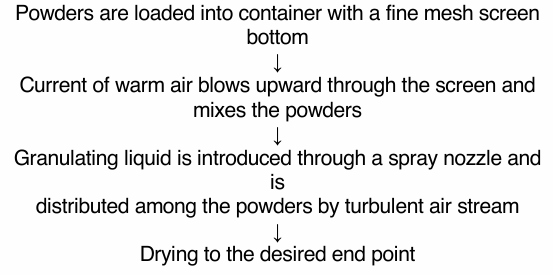
Manufacturing Process for Fluid Bed Granulation
1. Wet Granulators:
Shear granulators
High-speed mixer/granulators
Fluidized-bed granulators
Spray-driers
2. Spheronizers / Pelletizers
3. Extrusion / Spheronization
4. Rotor Granulation
5. Dry Granulators:
Sluggers
Roller compactors
Pharmaceutical Granulation Equipment:
Pre-compressed granules
[Effect of Granulation Method on Granule Structure]
_______ granules consisting of compressed drug and binder particles, are held together by simple bonding during compaction.
wet massing
[Effect of Granulation Method on Granule Structure]
Granules prepared by ____ consist of intact drug particles held together in a sponge-like matrix of binder.
sponge-like matrix
[Effect of Granulation Method on Granule Structure]
Granules prepared by wet massing consist of intact drug particles held together in a_____ matrix of binder
Fluidized-bed granules
[Effect of Granulation Method on Granule Structure]
_____are similar to wet massed granules but possess greater porosity and have a granule surface covered by a film of binding agent.
spray-dried system granules
[Effect of Granulation Method on Granule Structure]
With ____ ,the granules consist of spherical particles with an outer shell and an inner core of particles.
Funneling
Ratholing
Bridging / Arching
Flooding
Problems in Fluidity of Granules [4]
Hopper
[PARTS OF A TABLET PRESS]
For storage
Die
[PARTS OF A TABLET PRESS]
For the volume and shape of the tablet
Feed frame
[PARTS OF A TABLET PRESS]
Also known as “feed shoe”
Punches
[PARTS OF A TABLET PRESS]
For compression
Feed frame
[PARTS OF A TABLET PRESS]
Contain the materials
Cam tracks
[PARTS OF A TABLET PRESS]
Guides the movement of the punches
Coating
Principle:
Application of this material to a moving bed of solids with concurrent use of heated air to facilitate evaporation of solvent
✓ Optimum convexity
✓ sufficient hardness
✓ minimal friability
✓ rapid disintegration
✓ dust-free
Requirements for Coating [5]
Film Coating
Enteric Coating (a subtype of film coating)
Sugar Coating
Types of Coated Tablet [3]
Enteric Coating
A subtype of film coating
Film Coating
[Types of Coated Tablet]
Purpose:
Protects tablet
Controls drug release
Enteric Coating
[Types of Coated Tablet]
Purpose:
Protects drug from stomach acid, releases in intestine
Sugar Coating
[Types of Coated Tablet]
Purpose: Improves taste, aesthetics
Film Coating
[Types of Coated Tablet]
Materials Used:
Polymers (HPMC, PVP)
plasticizers
Enteric Coating
[Types of Coated Tablet]
Materials Used:
Cellulose acetate phthalate (CAP)
Methacrylic acid copolymers
Sugar Coating
[Types of Coated Tablet]
Materials Used:
Sugar
Gelatin
Calcium carbonate
Film Coating
[Types of Coated Tablet]
Advantages:
Thin
durable
fast coating process
Enteric Coating
[Types of Coated Tablet]
Advantages:
Prevents stomach irritation
Targeted release
Sugar coating
[Types of Coated Tablet]
Advantages:
Glossy appearance
Masks taste
Blistering
[Type of Problem in Coating]
Detachment of film from the substrate.
Chipping
[Type of Problem in Coating]
Film becomes chipped and dented, usually at the edges
Cratering
[Type of Problem in Coating]
Coating whereby volcanic-like craters appear, exposing the tablet surface.
Picking
Isolated areas of film are pulled away from the surface when the tablet sticks together and then parts.
Pitting
[Type of Problem in Coating]
Pits occur in the surface of a tablet core without any visible disruption of the film coating.
Blooming
[Type of Problem in Coating]
Coating becomes dull immediately or after prolonged storage at high temperatures.
Blushing
[Type of Problem in Coating]
Appearance of whitish specks or haziness in the film.
Orange Peeling
[Type of Problem in Coating]
Film is rough and nonglossy.
Cracking
[Type of Problem in Coating]
Cracks across the crown of the tablet.
Splitting
[Type of Problem in Coating]
Split across the edges of the tablet.
Wrinkling
[Type of Problem in Coating]
Indicates improper drying during the coating process
Mottling
[Type of Problem in Coating]
Uneven distribution of color on the tablet surface
Flaking
[Type of Problem in Coating]
Coating material is easily removed from the product in sheets or large flakes after coating.
Spotting
[Type of Problem in Coating]
Presence of mottled areas on the coat.
Sweating
[Type of Problem in Coating]
Presence of an oily film or droplets of liquid on the surface.

