Exam 3 Practice Questions
 Call Kai
 Learn
Learn Practice Test
 Spaced Repetition
 Match
Match Flashcards
 Knowt Play
1/34

There's no tags or description
Looks like no tags are added yet.
Name | Mastery | Learn | Test | Matching | Spaced | Call with Kai |
|---|
No analytics yet
Send a link to your students to track their progress
35 Terms
Which of the following is a correct difference between prokaryotes and eukaryotes?
a. prokaryotes have linear chromosomes, eukaryotes have circular ones
b. prokaryotes have a cell wall, eukaryotes don’t
c. prokaryotes have flagella, eukaryotes don’t
d. eukaryotes have membrane-bound organelles, prokaryotes don’t
e. all of the differences is correct
D
Which of the following is NOT predicted to occur as climate change continues?
a. ocean acidification will increases as more CO2 is absorbed
b. glaciers and polar ice will continue to melt, causing sea levels to rise
c. storms will become more frequent and more severe
d. all habitats will become warmer and drier
e. species distributions will continue to shift upward in latitude and altitude
D
Toxins tend to become concentrated in the tissues of species at the top of food chains. What is it called when this happens?
a. biotoxicity
b. biomagnification
c. toxic invasion
d. bioremediation
B
which of the following is true of Milankovich cycles?
a. they are most likely responsible for current climate trends
b. they involve changes to the planet’s axial tilt and orbit around the sun
c. they operate on time scales ranging from about 20,000 to 100,000 years
d. B and C only
e. all of the above
D
Which of the following would be considered an example of bioremediation?
a. adding nitrogen-fixing microorganisms to a degraded ecosystem
b. adding seeds of a chromium-accumulating plant to soil contaminated by chromium
c. re-inoculation of soil with indigenous microorganisms
d. reconnecting a main river to side channels to improve water quality
B
Bull kelt is a species that creates underwater forests. These kelp forests provide habitats for many species that would otherwise not exist in that area. Bull kelp is a(n):
a. umbrella species
b. keystone species
c. foundation species
d. dominant species
C
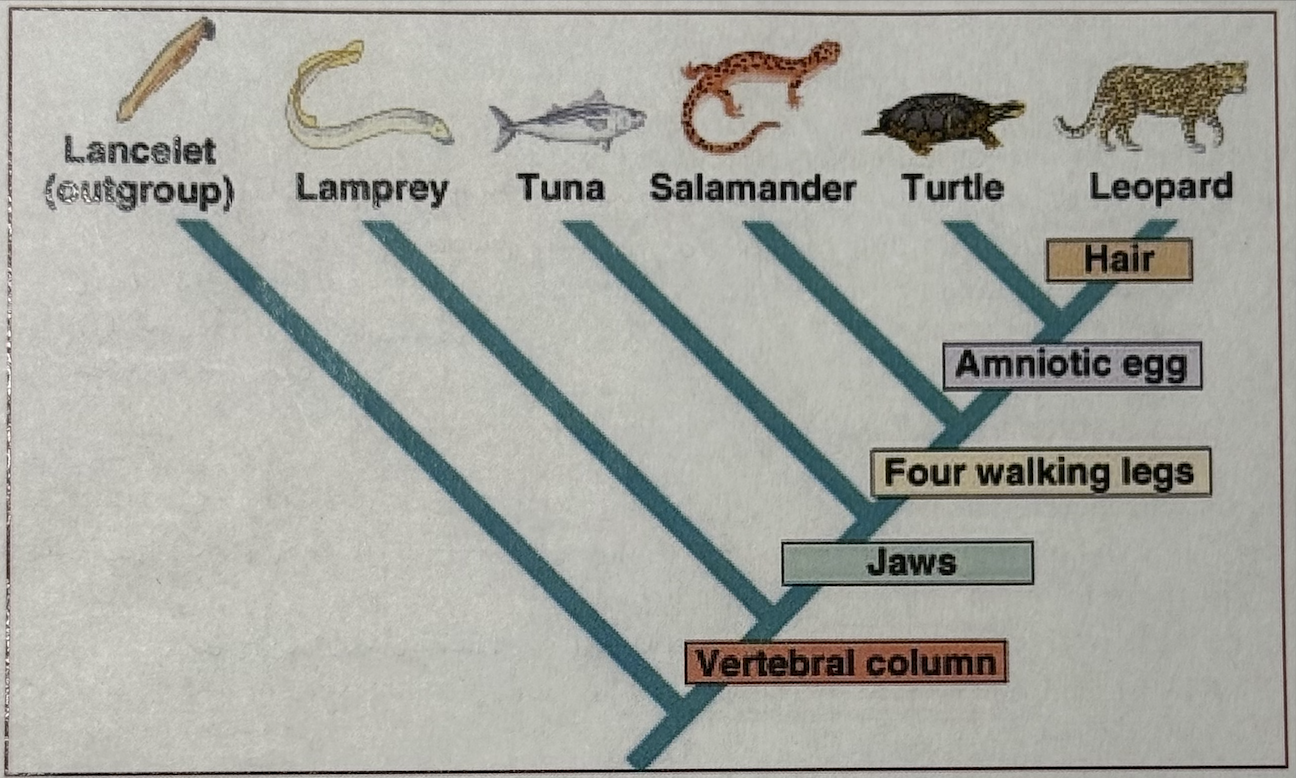
According to this cladogram, ______ is a shared derived character for both the turtle and the leopard.
a. four walking legs
b. amniotic egg
c. hair
d. jaws
B
Different types of Bacteria are quickly acquiring immunity to different types of antibiotics. Which of the following helps explain this?
a. horizontal gene transfer
b. short generation time
c. mutations caused by antibiotic exposure
d. A and B only
e. all of the above
D
On a phylogenetic tree, a polytomy includes:
a. which taxa are most closely related
b. where two lineages diverged
c. where evolutionary relationships are unresolved
d. which taxa share a more recent common ancestor
C
Looking through your microscope eyepieces after performing a gram stain, you notice many pinkish bacteria. This result tells you that this bacteria:
a. will likely be more resistant to antibiotics
b. has a lot of peptidoglycan in its cell wall
c. has a more complex cell wall compared to other bacteria
d. A and C only
e. all of the above
D
Which of the following is NOT predicted to occur as the ocean continues to absorb CO2?
a. carbonic acid will decrease the availability of calcium carbonate
b. the ocean’s ability to absorb additional CO2 will increase
c. changes in nutrient availability will lead to population declines in secondary and tertiary consumers
d. acidification will occur more quickly in the Arctic because cold water holds more dissolved CO2
e. all of the above are predicted to occur
B
You perform a gram stain on a bacteria culture and notice lots of round, dark purple bacteria. Based on this, you conclude these bacteria:
a. may be Stapholococcus or Streptococcus
b. have cell walls made of mostly peptidoglycan
c. may be more resistant to antibiotics based on the structure of their cell wall
d. A and B only
e. all of the above
D
Why is the Arctic experiencing more warming than the rest of the planet?
a. it’s not; all parts of the planet are warming equally
b. it’s not; the equator is warming more quickly since it receives mroe solar radiation
c. melting sea ice exposes the ocean surface which absorbs radiation rather than reflecting it, leading to more warming
d. Milankovich cycles have increased our axial tilt, so the Arctic is receiving more solar radiation than normal
C
The bacteria in many biofilms are often resistant to multiple antibiotics. Which of the following does NOT help explain how this is possible?
a. different bacteria species living closely together may engage in conjugaiton
b. bacteria in biofilms are exposed to more antibiotics so they mutate because they need to be resistant
c. the genetic material from deceased bacteria may be in the immediate environment so bacteria may pick it up via transformation
d. bacteria in biofilms fuse their capsule layer, which provides them additional protection from antibiotics
e. all of the above help explain how this is possible
B
Which of the following is NOT true of Proteobacteria?
a. they include sulfur bacteria that were the first photosynthetic prokaryotes
b. they include Salmonella and E. coli
c. the folds in their membranes are identical to those of chloroplasts
d. they include Rhizobacteria and are important nitrogen fixers
e. all of the above are true of Proteobacteria
C
Which of the following is true of prokaryotes and eukaryotes?
a. prokaryote cell walls and eukaryote cell walls are homologous
b. prokaryote ribosomes are different from eukaryote ribosomes
c. prokaryotes and eukaryotes have membrane-bound organelles
d. A and B only
e. all of the above are true
B
What data should NOT be used to construct a phylogenetic tree?
a. gene sequence that are horizontally transferred
b. unique feature of otherwise homoplasious trats
c. similar characteristics that evolved independently in different lineages
d. A and C only
e. none of the above should be used
D
The Plasmodium parasite which causes malaria is a member of:
a. Euglenozoa
b. Archaeplastida
c. Apicomplexa
d. Protozoa
e. Protista
C
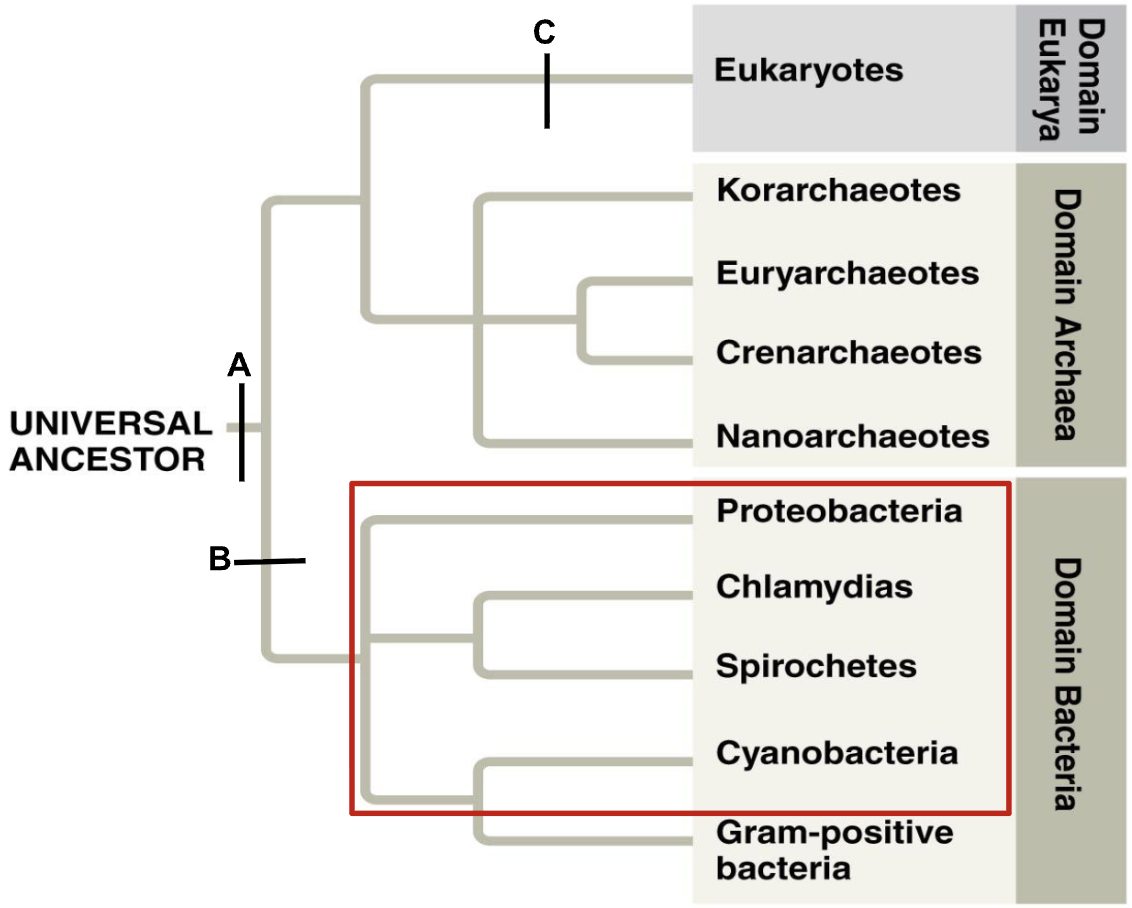
This tree indicates that:
a. eukaryotes evolved from bacteria
b. eukaryotes share a more recent common ancestor with Archaeans than with Bacteria
c. Proteobacteria is the basal taxon of Domain Bacteria
d. B and C only
e. all of the above
B
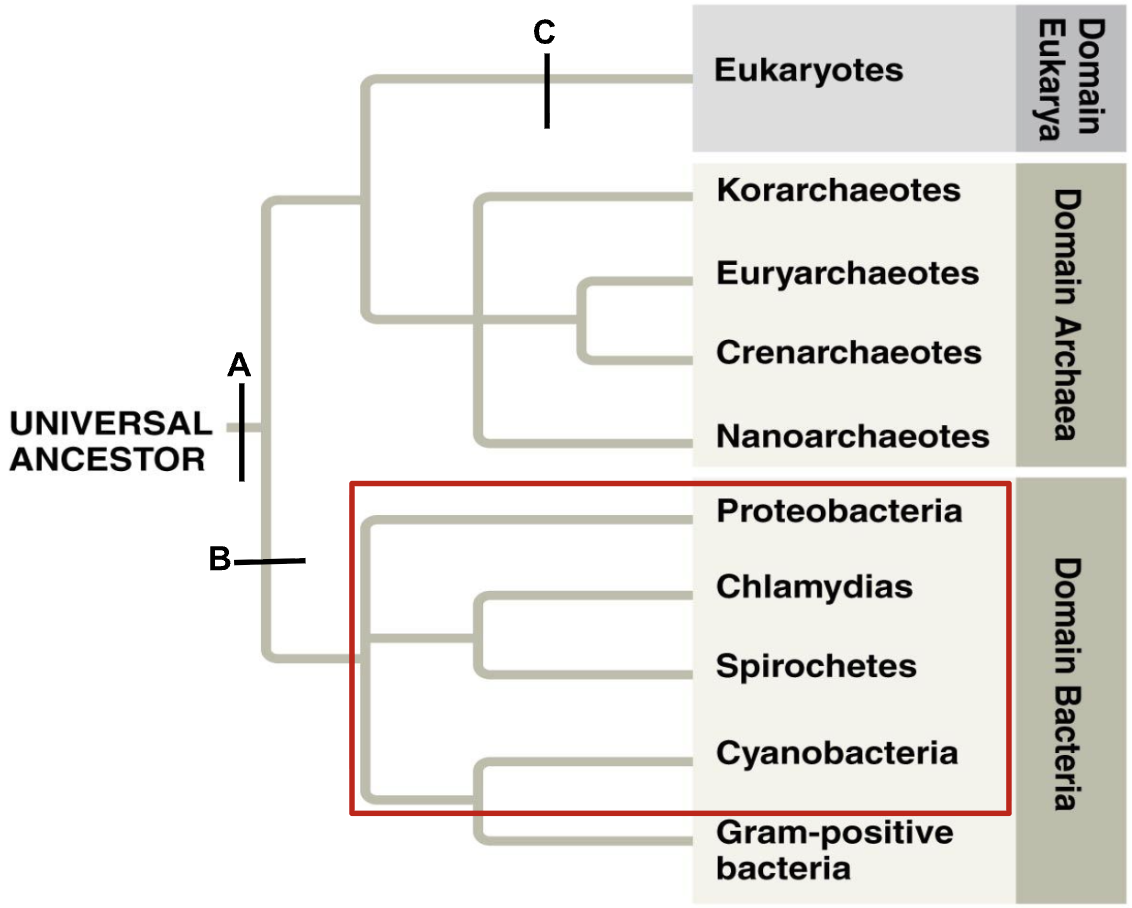
The trait represented by the letter ‘B’ is:
a. circular chromosome
b. peptidoglycan
c. linear chromosomes
d. flagella
B
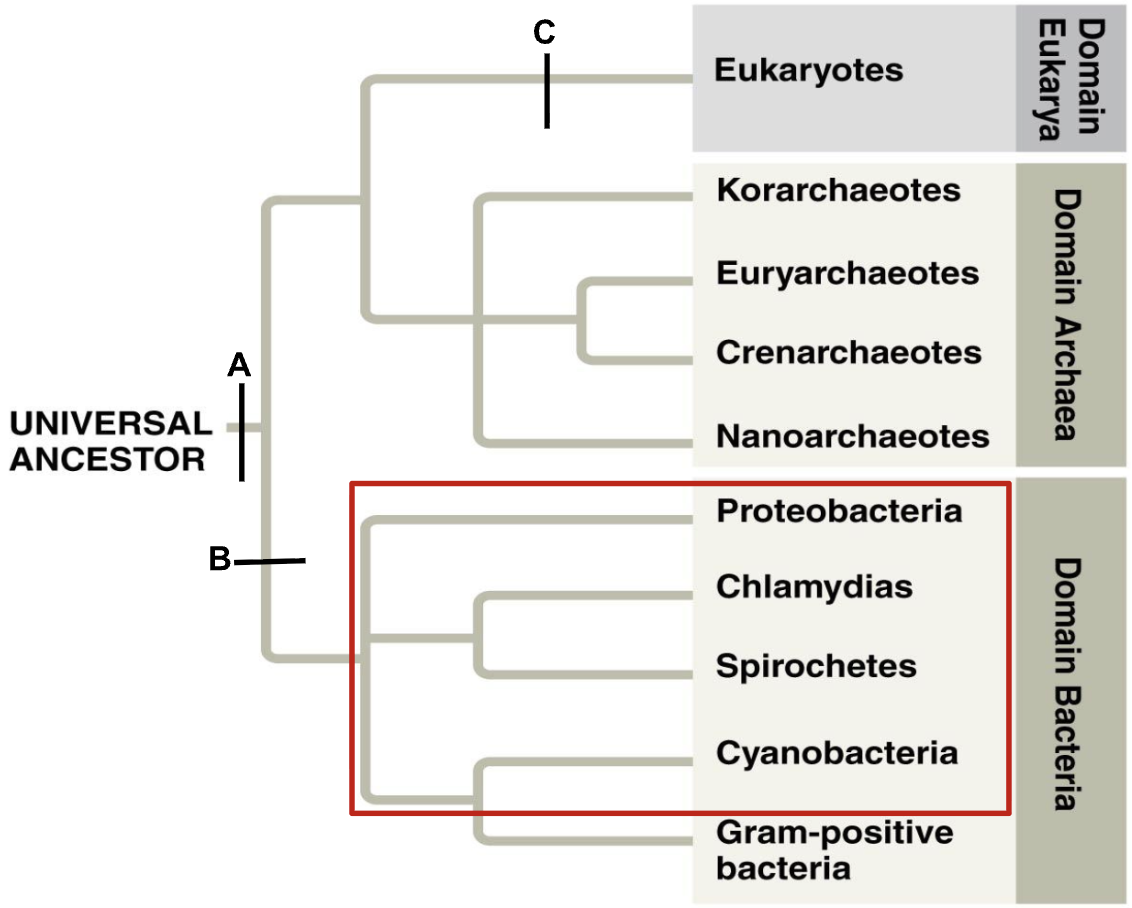
If Domain Bacteria was changed to only include the taxa inside the square on the diagram above, the new domain would be:
a. a paraphyletic group
b. a polyphyletic group
c. a monophyletic group
A
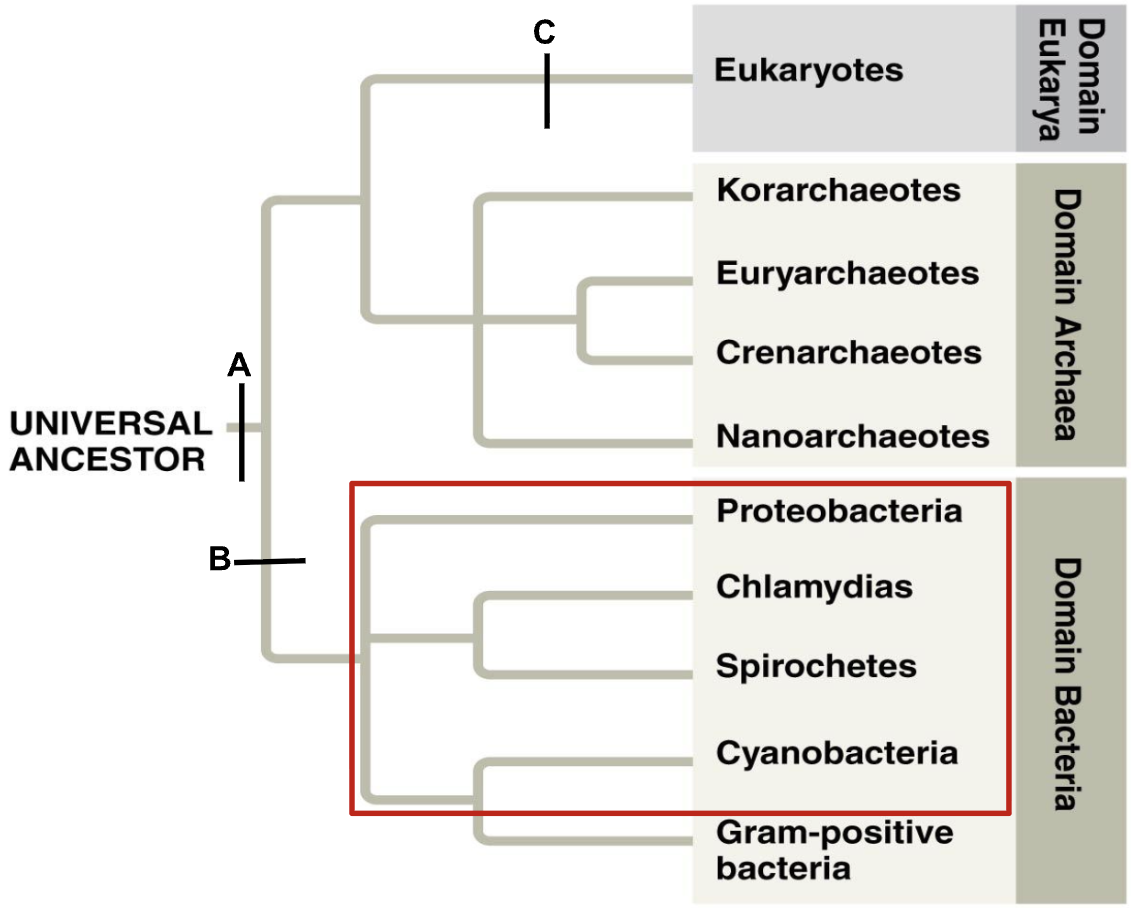
Within Domain Bacteria there is a node with three lineages diverging from it. Which of the following is true of this node?
a. it is a polytomy
b. we need more information to determine which taxon diverged first
c. it represents a point where multiple species have formed simultaneously
d. A and B only
E. A and C only
D
Sea otters greatly increase the diversity of the communities they inhabit. Managing habitat to recover sea otters will likely also benefit other species that depend upon the same habitat. This makes sea otters:
a. habitat specialists
b. foundation species
c. umbrella species
d. A and C only
e. all of the above
C
Which of the following is NOT true of the oxygen revolution?
a. it was created by Cyanobacteria which used water as a source of electrons instead of hydrogen sulfide
b. it led to the extinction of many prokaryote species
c. it led to the adaptive radiation of species which could function in an aerobic environment
d. it was caused by the inability of prokaryotes to process oxygen, which led to a buildup of atmospheric oxygen
e. all of the above are true
D
When wolves were reintroduced to Yellowstone National Park in 1995, they caused dramatic changes in the trophic dynamics of the park’s ecosystem.
Wolves are a keystone species which means they significantly impact community diversity based on their ecological role. In particular, wolves:
a. prevent competitive exclusion by acting as a disturbance
b. keep their prey populations below carrying capacity by removing individuals
c. trigger a trophic cascade, thus altering resource availability
d. B and C only
e. all of the above
E
When wolves were reintroduced to Yellowstone National Park in 1995, they caused dramatic changes in the trophic dynamics of the park’s ecosystem.
which of the following is a bottom-up trophic dynamic that occurred as a result of the reintroduction of wolves?
a. willows increased which allowed beavers to return
b. grasses and shrubs increased which allowed populations of rabbits and rodents to increase
c. elk populations decreased which allowed vegetation to increase
d. A and B only
e. all of the above
C
When wolves were reintroduced to Yellowstone National Park in 1995, they caused dramatic changes in the trophic dynamics of the park’s ecosystem.
The reintroduction of wolves also allowed other predators, such as foxes and badgers to return. How was this possible?
a. wolves reduce the populations of coyotes, which had outcompeted foxes and badgers in the past
b. wolves triggered a trophic cascade, which resulted in increased food for the prey of foxes and badgers
c. wolves don’t compete directly with badgers or foxes because wolves take larger prey
d. A and B only
e. all of the above
D
Biomagnification:
a. occurs when toxins become concentrated in the tissues of apex predators
b. is used in habitat restoration to clean up toxic spills
c. occurs when toxins accumulate in an individual’s tissues over its lifetime
d. is used to see extremely small organisms under the microscope
A
Which of the following is NOT true of secondary endosymbiosis?
a. it has occurred multiple times in different protist lineages
b. it involves the ingestion of an autotrophic eukaryote by a heterotrophic eukaryote
c. it results in a plastid which is often surrounded by three plasma membranes
d. all of the above are true of secondary endosymbiosis
D
Environments with high or low levels of disturbance have low species diversity. Which of the following helps explain why this is true?
a. high disturbance environments result in more competition
b. high disturbance environments prevent K-selected species from completing their life cycles
c. low disturbance environments allow competitive exclusion to occur
d. B and C only
e. all of the above
D
Which of the following is NOT true of flagella?
a. the molecular components used to build it are different in each Domain
b. the mechanism by which the flagella creates motion is different between eukaryotes and prokaryotes
d. it is a homoplasious characteristic between the Domains but not homologous within each Domain
e. all of the above are true of flagella
C
Which of the following is an example of bioaugmentation?
a. using bacteria to absorb and detoxify hydrocarbons after an oil spill
b. adding nestboxes and artificial burrows or dens to a habitat
c. restoring natural water flow through a grove of giant sequoias
d. B and C only
e. all of the above
B
About 10% of biomass in one trophic level is available for conversion to biomass in the next. This means that:
a. the length of food chains is limited by inefficiency of energy transfer between trophic levels
b. communities with lower primary productivity have shorter food chains
c. communities with higher primary productivity have longer food chains
d. A and C only
e. all of the above
E
Persistent Organic Pollutants (POP’s) are a problem because:
a. they often bioaccumulate in individual organisms
b. the same chemical can function as a carcinogen, a neurotoxin and/or an endocrine disruptor
c. they were designed to resist breaking down in the environment
d. B and C only
e. all of the above
E
The fastest animal alive is a:
a. cheetah
b. pronghorn antelope
c. flying dinosaur
d. velociraptor
C

