06. Imports and Exports, Domestic and International : IATA. USDA. CDC guidelines
 Call Kai
 Learn
Learn Practice Test
 Spaced Repetition
 Match
Match Flashcards
 Knowt Play
1/102

There's no tags or description
Looks like no tags are added yet.
Name | Mastery | Learn | Test | Matching | Spaced | Call with Kai | Chat |
|---|
No analytics yet
Send a link to your students to track their progress
103 Terms
Which 2 laws identify standards for humane care during transportation?
1. AWA
-standards for animal care during transport
2.Lacey Act
-provides that wildlife be transported IAW IATA Live Animal Regs
Lacey Act (1900) authorizes ____ to regulate what?
FWS to regulate
-Importation, exportation, transportation, sale, receipt, acquisition, or purchase of
-dead and live wild animals and their tissues and products imported into or exported from the United States
What is the difference between the AWRs and AWA? Where in the code of federal regulations (CFRs) is the AWA written?
-AWA is the act that brought about the AWRs. The AWR is what is written into the CFRs as a result of the AWA.
-CFR Title 9, Chapter 1
AWR- CFR, Title 9, Chapter 1 authorizes what branch of USDA?
APHIS Veterinary Services and National Center for Import and Export (NCIE)
USDA - APHIS Vet Services NCIE is responsible for regulating import of what?
Animals/animal products that could pose a disease threat to US livestock
Infectious organisms and vectors
Cell cultures and recombinant products
USDA permits are required for (receiver / sender) (importing / exporting) material derived from any animal potentially subject to USDA regulation. This person is ultimately responsible for what is being shipped.
receiver importing
Does USDA oversee import of laboratory animals
-Yes/No
-No regulatory authority if NOT inoculated with or exposed to livestock or poultry disease agents exotic to the United States.
-Must also make sure they are not coming from a facility where work using exotic disease agents are being used.
USDA Animal import does NOT cover what animals/animal products?
-Primates, dogs, cats, livestock*, poultry, hedgehogs, tenrecs, minipigs
-monoclonal antibodies, hybridomas, cell lines, and material for commercial purposes.
When a USDA animal permit required?
Required for swine, ruminants, other hoof stock, poultry/birds, and dogs not immunized for rabies
Regulatory authority of importing live laboratory animals or laboratory mammal material that have been inoculated w/ or exposed to livestock or poultry disease agent exotic to US and do not originate from facility working w/ exotic disease agents affecting livestock or avian species
Lab animals or material include: transgenic/KO mice and rats, hamsters, gerbils, g. pigs, rabbits, ferrets and their blood, tissue DNA, extracts, antibodies, feces, sera and antisera for research purposes
Blood, sera, antibodies, antisera <1 L
When is USDA animal permit NOT required (doesn’t mean something else doesn’t regulate it)?
lab animal derived material needs the following written statement:
Identify material and name animal species
Material derived only from lab mammals not inoculated w/ exotic dz
Material derived only from lab mammals not originate in facility where work w/ exotic dz done
Identifies immunogen for antibodies/antiserum if applicable
NHP material (excluding cell culture), feline or canine material, amphibians, fish, reptiles, & aquatics
NHPS - material no obtained from NHP inoculated or exposed to any livestock/poultry foreign dz
Cat/Dog - Material not derived from feline or canines species inoculated or exposed to any infectious agents of USDA ag concern
Exotics and fish – may need to consult FWS bc CITES
Recombinant microbes and their products
Vector used cannot be considered pathogenic for livestock or avians AND organism does not contain genes or express antigens of livestock or poultry disease agents
No animal derived additives (like albumin) or if it does, declaring the additives will only be used in vitro
Cell cultures & their products for IN VITRO use only
Cannot be exposed to livestock or avian agents exotic to US
Does not produce antigens or contain genes of livestock or avian disease or does not produce monoclonal antibodies directed against livestock or avian disease agents
USDA has special import permit for import of COVID-19 isolates exposed to livestock or poultry products (like eggs, fetal bovine serum, etc.). What is the form name?
VS Form 16-3
Per USDA - Permits for COVID-19 exposed to fetal bovine serum from countries considered as affected with Foot and Mouth Disease will require _____ (BSL level) handling (see "Country Animal Disease Status")
BSL3 handling
The ____ regulates import of Vero cells (cells derived from kidney of African green monkey) under ____ (legal thing)
-US FWS (Fishery and Wildlife)
-CITES
USDA does NOT regulate ____ movement of COVID 19 isolates.
interstate
USDA does not regulate interstate movement of human diagnostic samples. This is covered by the ____.
CDC
USDA- Dogs for imported commercial Sale, what paper work needs to accompany the dog?
Health and rabies certificate (7041 - specific to dogs)
Import permit issued by APHIS (7005 - acquisition form?)
Most animals require food and water during transportation. What agency can inspect the feed to ensure it’s within federal regulations?
USDA - APHIS Plant Protection and Qaurantine (PPQ)
Who must consult with the PPQ to ensure feed of imported animal is within US regulations?
the importer
If you are in the business of exporting or re-exporting CITES or ESA regulated plants and plant products, USDA regulation___ requires that you possess a valid ____ permit
7 CFR 355
USDA Protected Plant Permit
What health certificate must accompany each animal shipment (if USDA has to oversee import)?
Who must endorse it?
Where must it be affixed to?
What must it state?
USDA APHIS 7001 form
veterinarian or person responsible for animal health at originating facility
affix to outside of animal transport unit
Animals are clinically healthy, have not been exposed/inoculated with infectious disease agents, have not originated from a facility where work with viruses affecting poultry or livestock is performed
USDA - to import a dog into the US the dog must be:
Age?
Vet exam?
Vaccinated for rabies when? How old must they be when they were vaccinated
Vaccinated for what else and when?
What paperwork must accompany the dog?
6 months
examined by vet in country of export and found to be in good health
rabies 30d BEFORE date of entry
must be at least 84d old at time of vaccine, 30d wait not applicable if previously vaccinated for rabies after 84d of age w/o lapse in rabies vaccine status
DHLPP w/in 12mo of entry
Health and rabies certificate (APHIS 7041 form) and Import permit (issued by APHIS animal care)
USDA- Dogs for Commercial Sale Coming from Countries affected with African Swine Fever, what additional requirements are needed?
1. no dirt or wooden shave bedding
2. dispose all bedding/ pad upon entry into US
3. microchip
4. animal to be bathed within 2 days of entry and documented in record
USDA- Dogs for Commercial Sale Coming from Countries affected with Foot and Mouth Disease, what additional requirements are needed?
Fur & bedding free of excessive dirt, hay, straw
Bathed ASAP as soon as it reaches destination, separate from all livestock for 5 days after US entry
If for livestock handling – if imported from anywhere EXCEPT (Canada, Mexico and certain regions of central American and west indies) have no evidence of tapeworm infection
USDA- Dogs for Commercial Sale Coming from Countries affected with Screwworm, what additional requirements are needed?
Certificate from full time salaried Vet of region or origin
The dog has been inspected for screwworm within 5 days prior to shipment to the United States, and
The dog is either free from screwworm OR
The dog was infested with screwworm, held in quarantine, and treated until free from screwworm prior to leaving the region.
How long is the USDA quarantine period for poultry, swine, and ruminants
30 days
USDA - No birds or hatching eggs can be imported if: What country is an exception?
-originated from highly pathogenic avian influenza or newcastle dz country
-been vaccinated for H5 or H7
-Canada - must be in QT for 28d then held for 60d
USDA - Ruminants cannot be imported from country with what?
-Bovine spongiform encephalitis
-Foot and Mouth Disease
-Rinderpest
USDA - what should cows be tested or treated for before entry into US
Ticks
Tick free status for min 60d prior to export,
Treat for ticks w/in 10d prior to export
Free from communicable dz or exposure to dz 60d prior to transport
Tests
Test negative twice 60d prior to export for
Brucella abortus
Tuberculosis
Dz of concerns specific to region of export
USDA - Swine cannot be imported from what country?
-only import from Canada, EU, or UK
-don’t import if from region affected w/ FMD, CSF, ASF, Pseudorabies, or SVD (swine vesicular dz)
-Cannot be vaccinated against FMD, CSF, ASF, AD, or SVD and cannot be progeny of vaccinated sows
Fish cannot be imported if the species is susceptible to what 2 disease? How far in advance should port be notified about fish import? Who else regulates fish import?
-Spring Viremia of Carp (SVC) and Tilapia Lake Virus (TiLV)
-72hr
-FSW and CDC
When exporting animals when is a USDA APHIS endorsed Vet needed?
-exporting hatching eggs, germplasm (semen, embryos, oocytes), and live animals other than pet
-every animal needs international health certificate by certified veterinarian
What category Vet? All animals
Category II
What category Vet? All animals except food and fiber species, horses, birds, farm-raised aquatic animals, all other livestock species, and zoo animals that can transmit exotic animal diseases to livestock.
Category I
USDA export form - the TB test date should be the date what? When should the TB test be conducted on livestock?
-that the test was read
-w/in 90d before export
USDA - For interstate movement of animals - each state has different requirements, but essentially every animal needs what?
CVI - certificate of veterinary inspection and individual animal identification
USDA - Animals should be imported within _____ days after the proposed date of arrival stated in the import permit
Must be imported within 30 days after the proposed date of arrival stated in the import permit
FWS - What possible regulations might apply for transportation of wildlife? Who oversees their import?
US FWS
CITES, Lacey Act and Lacey Act Amendment of 1981, Marine mammal protection Act (MMPA), IATA, DOT, CDC
FWS - What animals are covered until US FWS that might be lab animal species?
mammals
NHP
elephants and ungulates
marine mammals
other terrestrial mammals - marsupials, rodents, sloths, bats, dermopteras, wild birds
FWS - What act allows US FWS to regulate transportation, importation, exportation, sale or purchase of any fish, wildlife, or plants that may harm humans or US horticulture, forestry or wildlife resourced?
Lacey Act of 1981
-wildlife means any wild animal whether alive or dead
CDC - The ___ under the direction of the ___, through the ____ enforces regulation to prevent introduction, transmission, or spread of zoonotic diseases in the US
-PHS - DHHS (Department of Human Health & Services) - CDC office of Health and Safety
CDC - What guidelines does the PHS/CDC use to enforce regulations?
42 CFR Part 71 Subpart F
CDC - The CDC regulates ___, ___, and ___. It does NOT regulate welfare or care of animals. What animals/prodcuts does the CDC regulate?
-permitting, registration, and quarantine
-any animal or product capable of carrying a zoonotic dz
CDC - What animals or animal products specifically does the CDC NOT regulate import of?
-Snakes and lizards
-does not regulate, but supports USDA/APHIS in prohibiting or restricting import of birds, poultry, and products from confirmed HPAI H5N1 countries
CDC - What animals or products DOES the CDC specifically regulate import of?
-Dogs, cats
-small turtles, tortoises, terrapins and their viable eggs
-any etiologic agent or arthropod, animal host or vector of human disease
-Special permit for NHPs
CDC - What animals or products are specifically prohibited from entering per the CDC?
-African rodents
-Viverridae spp. (civet, binturong, etc.) - SARS
-Asian birds (HPAI)
-animals known to be vectors for human dz (bats, insects, snails etc.) - can get special permit to import
AWA? - No more than ______ live dogs or cats, 8 weeks of age or older, that are of comparable size, may be transported in the same primary enclosure (ground transport, boat, private jet)
four
CDC - PHS import of dogs
Dogs can only enter via where?
Dogs - any airport, land port, or sea port IF
If from low risk or rabies free country in last 6 mo
OR US issued rabies vaccine
Dogs - CDC airport w/ CDC QT and AC facility IF
high risk rabies country in last 6 months with foreign rabies vaccination and microchip form
Dogs - No airport entry IF
high risk rabies country in last 6 months and no valid US rabies OR foreign rabies vaccination
Dogs - No land or sea import IF
high risk rabies country in last 6 months & no US issued rabies form
Dogs - special sea import IF
Service dog only - high risk rabies country in last 6 months & foreign country rabies vaccine & serological titer from CDC approved lab
Cats - can be imported into any airport or land port
CDC - PHS import of dogs
Microchip requirements for rabies vaccine and dogs
All dogs presenting for import must have a microchip implanted PRIOR to arrival (whether they got a US or foreign rabies vaccine)
Microchip MUST have been implanted PRIOR to current rabies vaccine administration
CDC - PHS import of dogs
Certificate of US rabies vaccine administration
must be 84d (12wk) old or OLDER when first rabies if given
Microchip MUST be given same day or before rabies vaccine
Rabies vaccine form cannot be filled out until 28d after first valid rabies vaccine administered
initial vaccine is valid for 1 year
Boosters are immediately valid if given in dogs over 15 months and there is no lapse in coverage. Boosters can be valid for 1 to 3 years IF no lapse in coverage.
If lapse in coverage next vaccine is considered “initial” vaccine (and same restrictions apply)
CDC - PHS import of dogs
Certificate of FOREIGN rabies vaccine administration
Pretty much everything else from US vaccine applies but now add serological testing
must be sent to CDC approved rabies serology laboratory
Blood taken at least 30d AFTER valid rabies vaccines
Blood taken at least 28d BEFORE entry to US
If multiple vaccines given and vaccines given after microchip placed and no lapse in coverage - serological sample can be taken at any time after vaccine booster
If lapse in coverage, take sample 30d after booster vaccine
CDC - PHS import of dogs
What happens if the dog arrives from high risk country with a foreign rabies vaccine and microchip, but the serological testing was not done at the right time or sent to a CDC registered care facility?
28d QT at CDC facility after US rabies vaccine administered
CDC - PHS import of dogs
When can the requirement for a rabies vaccine 30+ days prior to entry be bypassed?
< 6mo old, from a rabies free country for at least 6 months, or it will be taken straight to a research facility.
CDC - PHS import of dogs
Dogs from a rabies free or low risk country in the past 6 months can enter with what stipulations?
CDC Dog import form
Dogs are healthy on arrival
At least 6mo old at time of entry
Universal microchip
CDC - PHS import of dogs
Dogs from a high risk country within the last 6 months and were vaccinated in the US can be imported under what conditions?
CDC Dog import form
Certification of US Issued Rabies Vaccination form or USDA (USDA endorsed health cert is only valid if issues no later than July 31st, 2025)
Dogs are healthy on arrival
At least 6mo old at time of entry
Universal microchip – MUST be implanted BEFORE rabies vaccine or vaccine is invalid
CDC - PHS import of dogs
Dogs from a high risk country in the last 6 months and were vaccinated in a foreign country?
CDC import form
Certification of US Issued Rabies Vaccination form
Rabies serology titer report from CDC approved lab (must be 30d after rabies vaccine and 28d before entry to US)
CDC facility for 28d quarantine (if no serological titer or invalid titer)
Dogs are healthy on arrival
At least 6mo old at time of entry
Universal microchip – MUST be implanted BEFORE rabies vaccine or vaccine is invalid
CDC - PHS import of dogs
Dogs from a high risk country in the last 6 months and are not vaccinated?
Will NOT be allowed
CDC - PHS import of dogs
When will dogs be denied entry?
No valid CDC dog import permit OR
Arrives w/ permit but at a non-approved port of entry OR
Dog does not match the permit presented
Foreign rabies vaccine and microchip given AFTER vaccine
Dog is not 6 months old
CDC - import requirements for cat? What about if cat is imported to Hawaii or Guam (even if from US mainland)?
-No rabies vaccine requirement, it may be a state requirement
-subject to locally imposed quarantine requirements
CDC - when importing turtles or their eggs what are the limits?
-no turtles w/ carapace length <4in and eggs for commercial purposes
-limit of 6 turtle/egg combination if imported non-commercially
CDC NHP import - Notify CDC ___ before importing shipment of NHPs.
7d
CDC NHP import - A separate special permit is no longer required for importing what monkey species?
AFGs, Cynos, and Rhesus
CDC NHP import - OWMs that die or euthanized during 31-day quarantine must be tested (Ag capture) for ____________
filovirus
CDC - NHPs import: During quarantine, all NHPs must be monitored for signs consistent with what zoonotic illnesses?
Yellow fever, monkeypox, or filovirus.
CDC NHP import - What testing is required for OWM that exhibit signs consistent w/ filovirus during quarantine? Testing should be done at end, day ____ of quarantine prior to release.
-antibody testing
-31d
CDC NHP import - NHP port entry ONLY at ________________, unless written approval is obtained in advance
CDC Quarantine Stations
CDC NHP import - Quarantine can be removed for lab to lab movement if the following criteria are met:
Lab has foreign based ____ facility
NHPs are apart of ____ research project approved by an IACUC
Recipient lab must be registered with ___ and must submit veterinary medical records documenting primates’ current and past health history, including testing for ____.
US based lab must be ____ and ___
Foreign based lab must be ____
____ must be provided to CDC describing reason a transfer to US lab is necessary (diagnostic equipment only in US, etc.)
A specific and detailed ____ must be submitted to CDC
US facility
ongoing
CDC, tuberculosis
licensed by USDA, accredited by AAALAC international
comparable accrediting agency
Justification
itinerary
CDC NHP import - all NHPs are tested for tuberculosis
What test is required, how many times, where should it go?
How much time between tests?
when are they read?
What if positive or suspicious seen?
TST using old mammalian tuberculin, 3, eyelid
2 weeks
24, 48, and 72hr
5 additional TST tests 2 weeks apart for cohort after all affected NHPs leave
CDC NHP import - Eye lid reaction grades 0 is least and 5 is worst
Reaction Grade Description of Changes | |
0 | No Reaction |
1 | Bruise - extravasation of blood in the eyelid associated with the injection of tuberculin |
2 | Varying degrees of erythema of the palpebrum |
3 | Moderate swelling with or without erythema |
4 | Obvious swelling of the palpebrum with drooping with or without erythema |
5 | Necrosis of the eyelid with varying degrees of swelling, including eyelid partially or completely closed |
Interpretation: Grades 0, 1 and 2: considered negative; Grade 3: is suspect; Grades 4 and 5: considered positive | |
CDC NHP import - Abdominal skin injection using MOT, how to interpret?
read induration at widest point
<5mm - negative
5-10mm suspect
>10mm positive
CDC NHP import - What should be done if granulomatous lesions are found during necropsy of monkey in CDC quarantine?
submit to lab for mycobacterial culture
CDC NHP import - How often do institutions/individuals registered with the CDC to import NHP need to renew their registration?
Renew registration every 2 years
CDC NHP import - Importers must notify CDC within how many hour(s) of any illness or death of NHPs in quarantine facilities or during/after transfer?
24 hrs
CDC NHP import - How much time do you have to tell CDC about positive filovirus antigen or antibody and positive or suspicious TST result?
24 hours
CDC NHP import - for quarantine of monkeys - you must have a written ____ for anyone whose duties result in exposure to NHPs which should include a _____. Must ensure personnel are educated on risks and have proper ___.
-worker protection plan
-response plan to emergencies
-PPE
Regulates the importation and transportation within the US of live bats, as well as animals, insects, or animal tissues that contain etiologic agents
Etiologic Agent Import Permit Program (EAIPP)
The Lacey Act authorizes which federal agency to regulate what activities?
a) CDC; Prohibit import, export, or interstate commerce of listed species
b) FWS; Transportation, importation, or sale or purchase of any fish, wildlife, or plant
c) PHS; Imported dogs and cats must be free of rabies
d) USDA; Transfer of toxins that have the potential to pose severe threat to animal health
b) FWS; Transportation, importation, or sale or purchase of any fish, wildlife, or plant
All of following apply to the CDC guidelines for importation of nonhuman primates EXCEPT?
a) Workers in direct contact with imported NHPs must wear, at minimum, a N95 respirator for respiratory protection
b) The minimum quarantine period for imported NHPs is 31 days
c) Animals with suspect positive TST reactions must remain in quarantine and receive at least 3 additional TSTs, administered 2 weeks apart
d) An importer must notify the CDC within 24 hours if any NHP tests positive for filovirus antigen or antibody
Must receive 5 addt'l TSTs
According to the Final Rule on Regulations for the Importation of Nonhuman Primates (42 CFR Part 71.53), which of the following is 𝐍𝐎𝐓 correct regarding quarantine of non-human primates (NHPs)?
a) All non-human primates that are imported from outside of the U.S. must be quarantined for at least 31 days after arrival at an HHS/CDC approved quarantine facility.
b) Any Old World NHPs that die or are euthanized during the 31-day quarantine period must be tested for filovirus antigen.
c) An importer registration certificate is valid for 3 years beginning from the date HHS/CDC issues the registration certificate.
d) An importer must contact CDC immediately (within 24 hours) by telephone, text, or e-mail to report any suspected zoonotic illness in an employee.
c. An importer registration certificate is valid for 3 years beginning from the date HHS/CDC issues the registration certificate. - 2 years
What does IATA stand for?
International Air Transport Association

What does IATA regulate?
-Global standard for transporting animals by commercial airlines
-Up-to-date airline and government requirements
-Requirements on handling, marking and labeling
-Information on necessary documentation needed
-Classification of animal species and their container specifications
-Guidelines for non-air transport
IATA - shipper responsibilities?
Finalizing route and arranging special care
Obtaining documents and providing accurate information
Compliance with national, carrier and IATA regulations
Providing common name, scientific name and quantity of animals
Providing instructions for feeding, care and medication administration
Providing the time and date of last feeding
Providing dose, route, date, time and name of any medications given
Declaring the condition of animals that are pregnant or gave birth within 48 hours
Providing a 24-hour emergency contact on the waybill
IATA - when can a shipper not ship animals?
Animals with an unhealed navel
Mammals with nursing young unless the veterinary certificate declares that it's OK
Newly weaned animals, unless environment is appropriate and a feeding schedule can be worked out
Pregnant animals unless the vet certificate states that there's no risk of birth
Nursing female monkeys with young
Infected live animals, unless exempted by other regulations
IATA - Carrier responsibilities - must decline if:
Animals that aren't healthy
Deer in velvet: risk of damage to antlers
3rd trimester of pregnancy
Deer in roar (heat)
IATA - Carrier responsibilities - documents needed
Air waybill
Shipper's certificate
Import/Export Permit
Health Certificate
CITES permit
IATA - Carrier responsibilities - shipping container confirms to regulations
Carrier is only responsible for the outside of the container when the safety of the animals or carrier staff would be compromised by opening the container, to include:
Fish
Immunocompromised mice
IATA - Cargo space - laboratory animals must be placed where in cargo?
segregated from all other cargo
IATA - Carrier is not liable for what?
Animals that are injured or die due to natural causes or normal animal behavior including aggression
Unavoidable changes in environment
Changes in route/schedule
IATA - species specific special considerations
Regurgitation is normal in ____, so feed a smaller meal before transport
Overfeeding of ___ prior to shipment can lead to injury to gastric compartments
Large ____ should not be watered within 2 hours of departure due to potential for bladder injury
____, especially smaller species, should have food and water shortly before dispatching due to high metabolic rate
____ should be fasted for a few days prior to shipment to avoid potential food rot in the GI tract
____ should be provided during transport
____ should NOT be fed by the carrier staff
carnivores
ruminants
ungulates
Birds
Snakes
Water
Unauthorized foods
IATA - repro considerations during transport
Avoid shipping females if ___
___ males and females as far apart as possible
Avoid shipping animals with suckling young as ____ may result
in heat
Separate mature
cannibalism
IATA - should sedation be used to ship animal?
-not unless for a specific problem
-effects unpredictable
IATA - what should be included in shipper’s animal certifications?
__ copies must be completed and signed by shipper
What name must be entered on form (name for animal)
What animals only require the common name be on form?
Two
Common name and scientific name
Lab animals that are not covered by CITES, dogs, cats, farm animals
IATA - what information should be included on an air waybill?
document issued by a carrier giving details and instructions relating to the shipment of a consignment of goods
Live animals must not be entered on the same waybill as other commodities
Common name and quantity of animals must be listed
24 hour emergency phone number goes in the "Handling Information" box
What label wording and dimensions is required by IATA on the transport container?
At least one label must be attached
"Live Animals"
"Laboratory Animals"
Minimum dimensions - 10 x 15 cm label
Letter height - 2.5cm (1 inch)
"This way up" labels - Must be placed on at least 2 opposite sides
Minimum dimensions - 7.4 x 10.5 cm
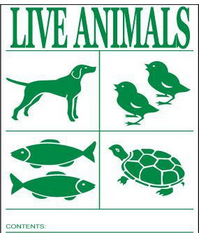
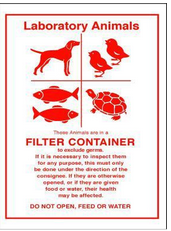
IATA - When should this sticker be used over the “live animals” sticker?
SPF or gnotobiotic animals for laboratory use
IATA - What are the three Health Status Classifications?
Conventional (unknown health status such as wild caught, no physical methods are undertaken during shipment to prevent infections)
Conditioned Specific Pathogen Free (had testing, vaccine but not maintained in specialized/filtered housing such as dogs, cats and NHP)
Barrier raised SPF (rodent in ventilated housing)
BMBL - Appendix C: Transportation of infectious substances are regulated as hazardous materials by
-US Department of Transportation (DOT)
-Foreign governments
-International Civil Aviation Organization
BMBL - to import select agents of toxins into the US the intended recipient must be ____ and must submit a ___ form to ____. What CFR is it subject to?
-registered with select agent program
-Form 2
-APHIS/CDC
-42 CFR
BMBL - to import etiologic agents of Livestock, Poultry, and Other animal diseases or materials derived from livestock, poultry, or other animals, these 3 institutions require a permit be issued prior to import or domestic transfer. What CFR is it subject to?
USDA
APHIS
VS
9 CFR
BMBL - Category A Infectious Substance (UN 2814 / UN 2900) what is the different between the two ID number?
"UN2814" cause disease in humans or both humans and animals
"UN2900" cause disease in animals only
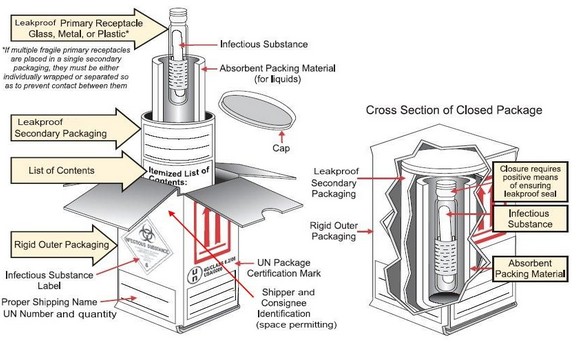
BMBL - Category A infectious substance packing requirement? ______package system
Triple packaging system
Watertight primary receptacle(s)
watertight secondary packaging (for liquids, secondary packaging must contain absorbent material to absorb all material); and rigid outer packaging
Each surface of the external dimension must be 100 mm (3.9 in) or more.
Completed packaging must pass specific performance testing
Drop test and water-spray test
Capable of withstanding an internal pressure producing a pressure differential of not less than 95 kPa (0.95 bar, 14 psi)
withstand temps in the range of -40C to +55C (-40F to 131F).
Needs to be on label
marked infectious substances affecting humans UN 2814 or affecting animals UN 2900
Division 6.2 infectious substance label
shipping paper and emergency response info