L4- cell cycle regulation and evasion of anti growth signalling

0.0(0)
studied byStudied by 0 people
call kaiCall Kai
learnLearn
examPractice Test
spaced repetitionSpaced Repetition
heart puzzleMatch
flashcardsFlashcards
GameKnowt Play
Card Sorting

1/44

encourage image

There's no tags or description

Looks like no tags are added yet.

Last updated 8:21 PM on 2/3/26
Name
Mastery
Learn
Test
Matching
Spaced
Call with Kai

No analytics yet

Send a link to your students to track their progress

45 Terms

1
New cards

what 3 interrelated processes control cell growth

cell proliferation

cell differentiation

cell apoptosis

cancer- elevated cell growth

cells in the mass have diminished differentiation, reduced apoptosis and/or increased proliferation

2
New cards
3
New cards

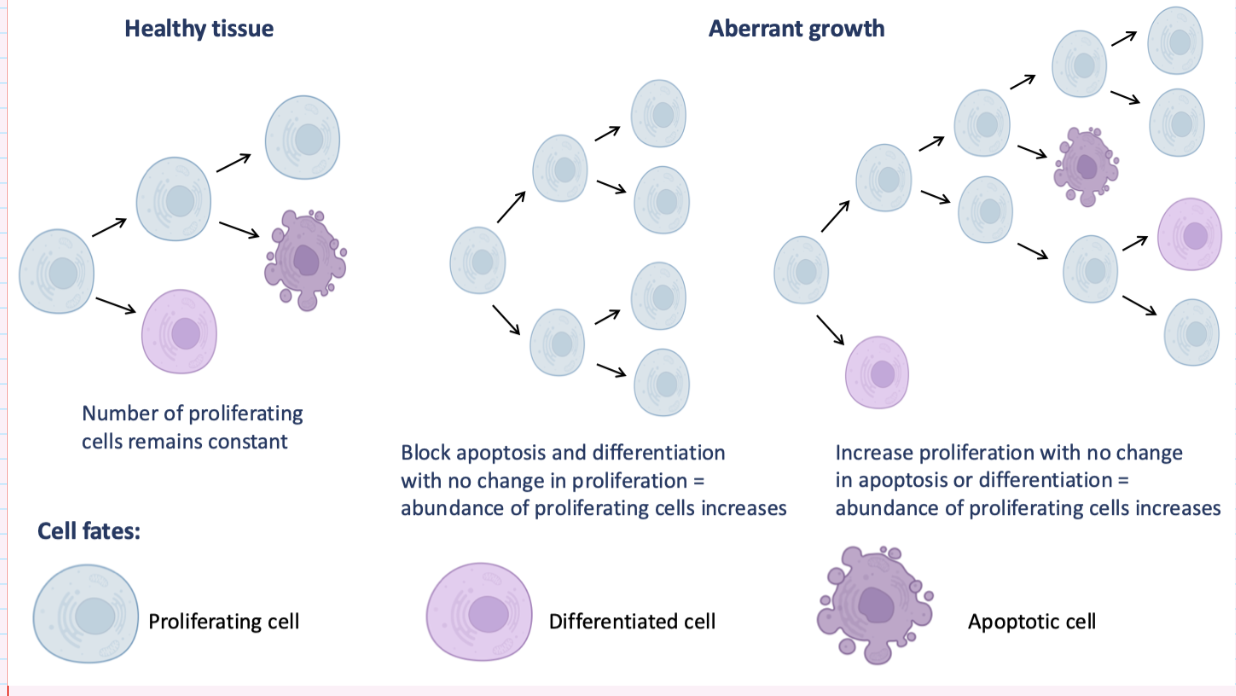
describe cell growth in healthy tissue

number of proliferating cells remains constant
<p>number of proliferating cells remains constant </p>
4
New cards

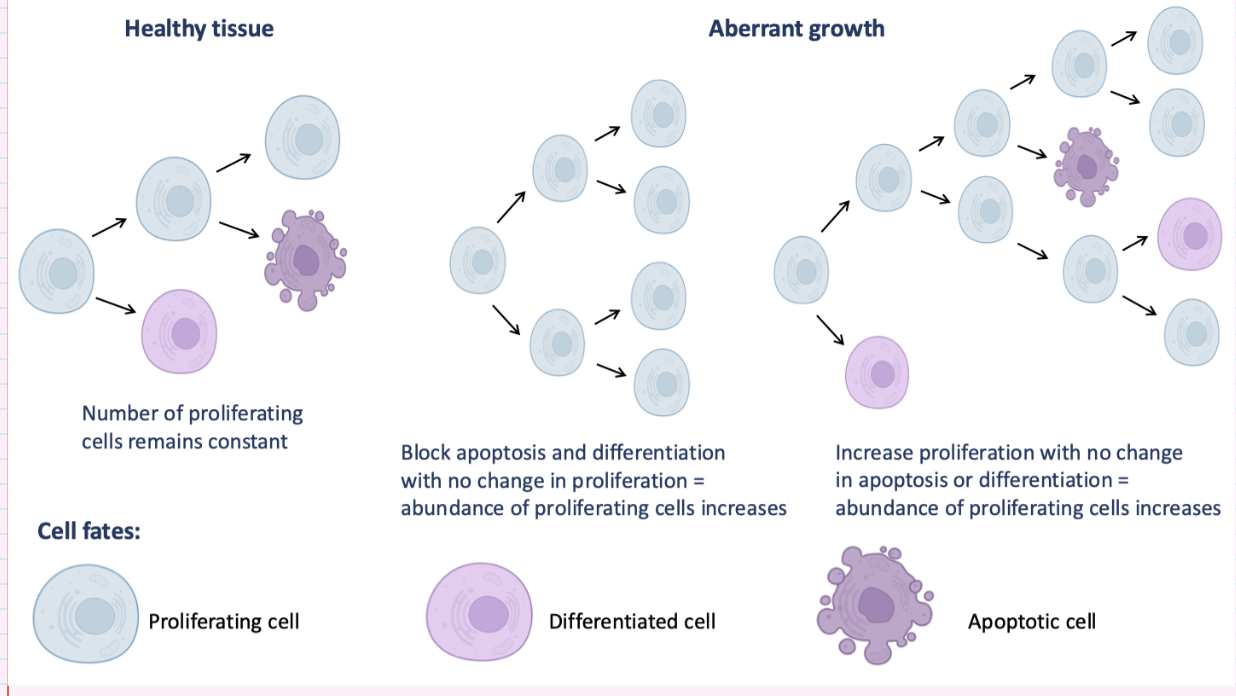
How does blocking apoptosis and differentiation lead to aberrant growth?

  • Proliferation rate remains unchanged

  • Apoptosis is blocked

  • Differentiation is blocked

  • Cells continue cycling instead of exiting the cell cycle

  • Result: abundance of proliferating cells increases, causing aberrant growth
<ul><li><p>Proliferation rate remains <strong>unchanged</strong></p></li><li><p><strong>Apoptosis is blocked</strong></p></li><li><p><strong>Differentiation is blocked</strong></p></li><li><p>Cells continue cycling instead of exiting the cell cycle</p></li><li><p>Result: <strong>abundance of proliferating cells increases</strong>, causing aberrant growth</p></li></ul><p></p>
5
New cards

How does increased proliferation lead to aberrant growth without changes in apoptosis or differentiation?

  • Proliferation rate increases

  • Apoptosis remains unchanged

  • Differentiation remains unchanged

  • More cells enter and remain in the cell cycle

  • Result: abundance of proliferating cells increases, causing aberrant growth
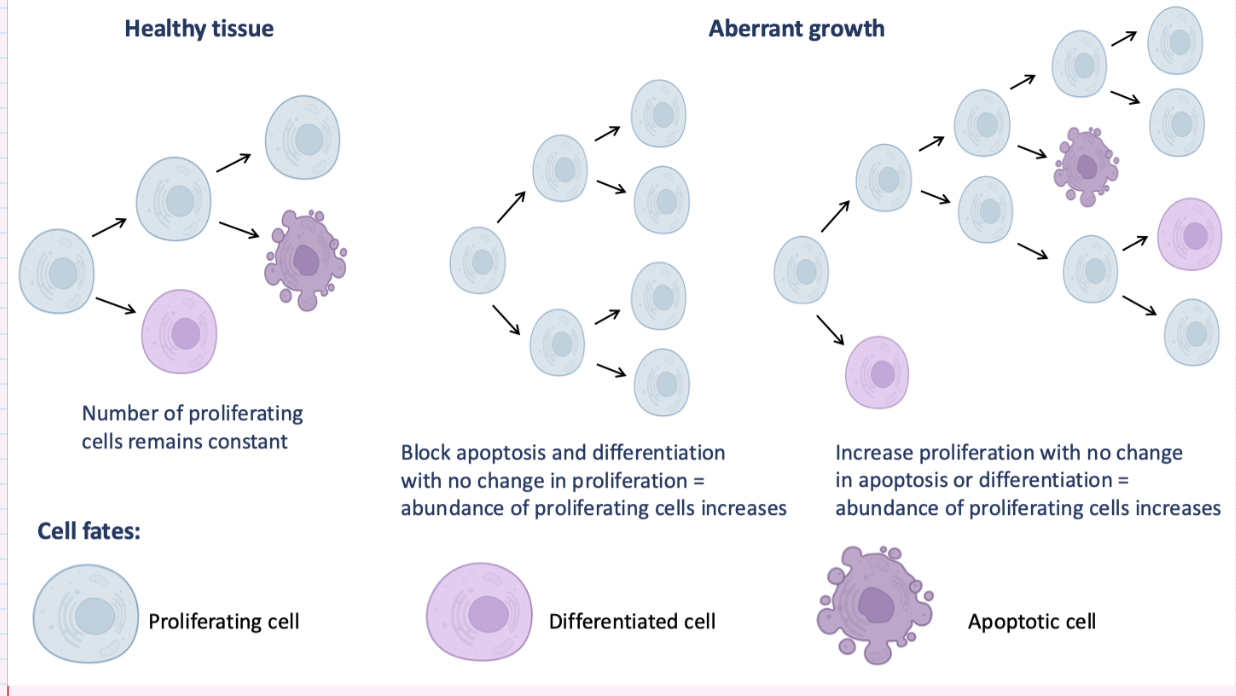
<ul><li><p><strong>Proliferation rate increases</strong></p></li><li><p><strong>Apoptosis remains unchanged</strong></p></li><li><p><strong>Differentiation remains unchanged</strong></p></li><li><p>More cells enter and remain in the cell cycle</p></li><li><p>Result: <strong>abundance of proliferating cells increases</strong>, causing aberrant growth</p></li></ul><p></p>
6
New cards

which tissue is a good representation of interplay between stem and progenitor cells

Colon- good example of interplay between stem cells progenitor cells and fully differentiated cells  

Undifferentiated cells in stem cell crypts- can differentiate and partially differentiate into progenitor cells (mostly useless) 

  • They move up and acquire more characteristics of colon cell- fully differentiated when they reach the villus- able to absorb food at this point 

This process is under tight control 
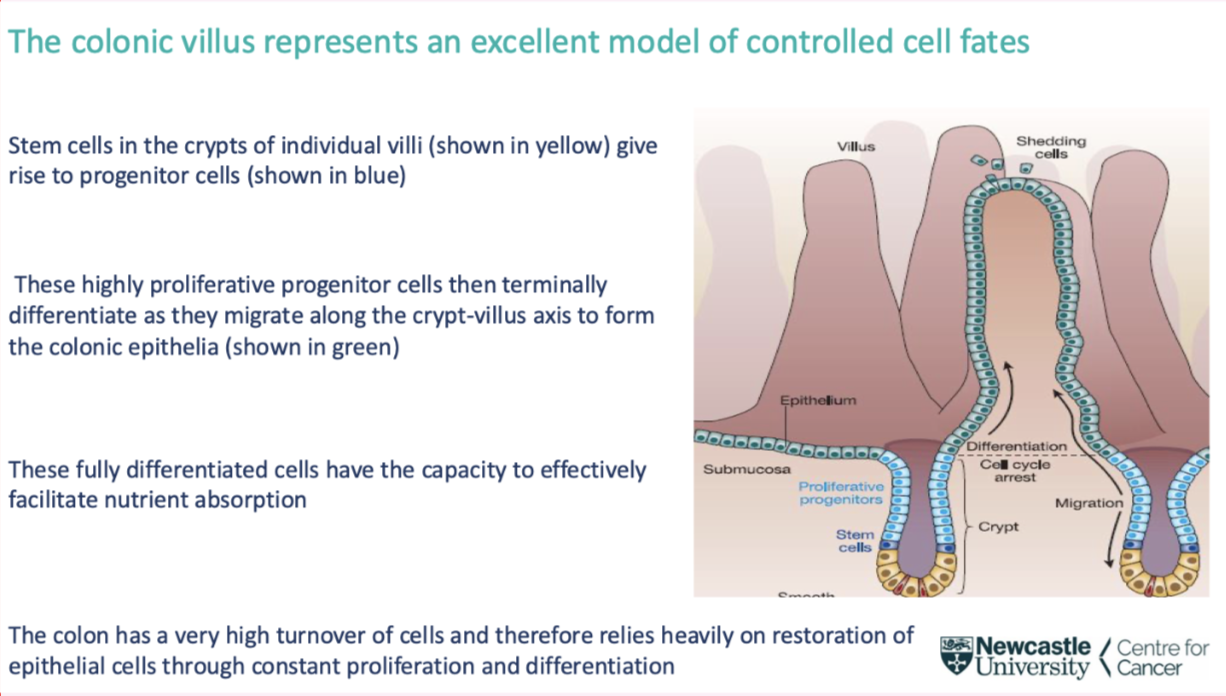
<p><span style="background-color: inherit; line-height: 22px; color: windowtext;"><span>Colon- good example of interplay between stem cells progenitor cells and fully differentiated cells&nbsp;</span></span><span style="line-height: 22px; color: windowtext;"><span>&nbsp;</span></span></p><p><span style="background-color: inherit; line-height: 22px; color: windowtext;"><span>Undifferentiated cells in stem cell crypts- can differentiate and partially differentiate into progenitor cells (mostly useless)</span></span><span style="line-height: 22px; color: windowtext;"><span>&nbsp;</span></span></p><ul><li><p class="Paragraph SCXO158002374 BCX0" style="text-align: left;"><span style="background-color: inherit; line-height: 22px; color: windowtext;"><span>They move up and acquire more characteristics of colon cell- fully differentiated when they reach the villus- able to absorb food at this point</span></span><span style="line-height: 22px; color: windowtext;"><span>&nbsp;</span></span></p></li></ul><p class="Paragraph SCXO158002374 BCX0" style="text-align: left;"><span style="background-color: inherit; line-height: 22px; color: windowtext;"><span>This process is under tight control</span></span><span style="line-height: 22px; color: windowtext;"><span>&nbsp;</span></span></p>
7
New cards

what does an imbalance between cell proliferation and differentiation lead to

cancer

In colon cancer- deregulated stem cell renewal capacity cell masses and loss of colon structure- predisposition to cancer

  • Outgrowth of poorly differentiated cells, crypts erupt into masses, lose functionality of colon 

  • Example of imbalance of homeostasis of stem and progenitor cell differentiation 
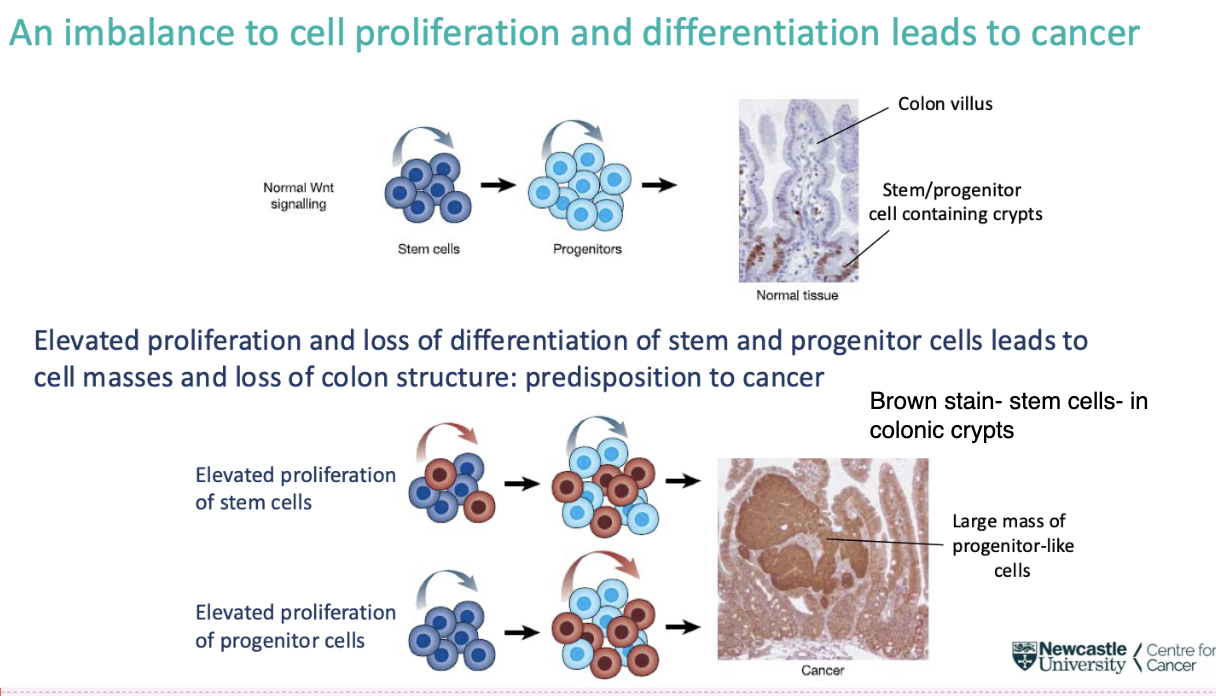
<p>cancer</p><p><span style="background-color: inherit; line-height: 22px; color: windowtext;"><span>In colon cancer- deregulated stem cell renewal capacity</span></span><span style="line-height: 22px; color: windowtext;"><span> cell masses and loss of colon structure- predisposition to cancer</span></span></p><ul><li><p class="Paragraph SCXO42306489 BCX0" style="text-align: left;"><span style="background-color: inherit; line-height: 22px; color: windowtext;"><span>Outgrowth of poorly differentiated cells, crypts erupt into masses, lose functionality of colon</span></span><span style="line-height: 22px; color: windowtext;"><span>&nbsp;</span></span></p></li><li><p class="Paragraph SCXO42306489 BCX0" style="text-align: left;"><span style="background-color: inherit; line-height: 22px; color: windowtext;"><span>Example of imbalance of homeostasis of stem and progenitor cell differentiation</span></span><span style="line-height: 22px; color: windowtext;"><span>&nbsp;</span></span></p></li></ul><p></p>
8
New cards

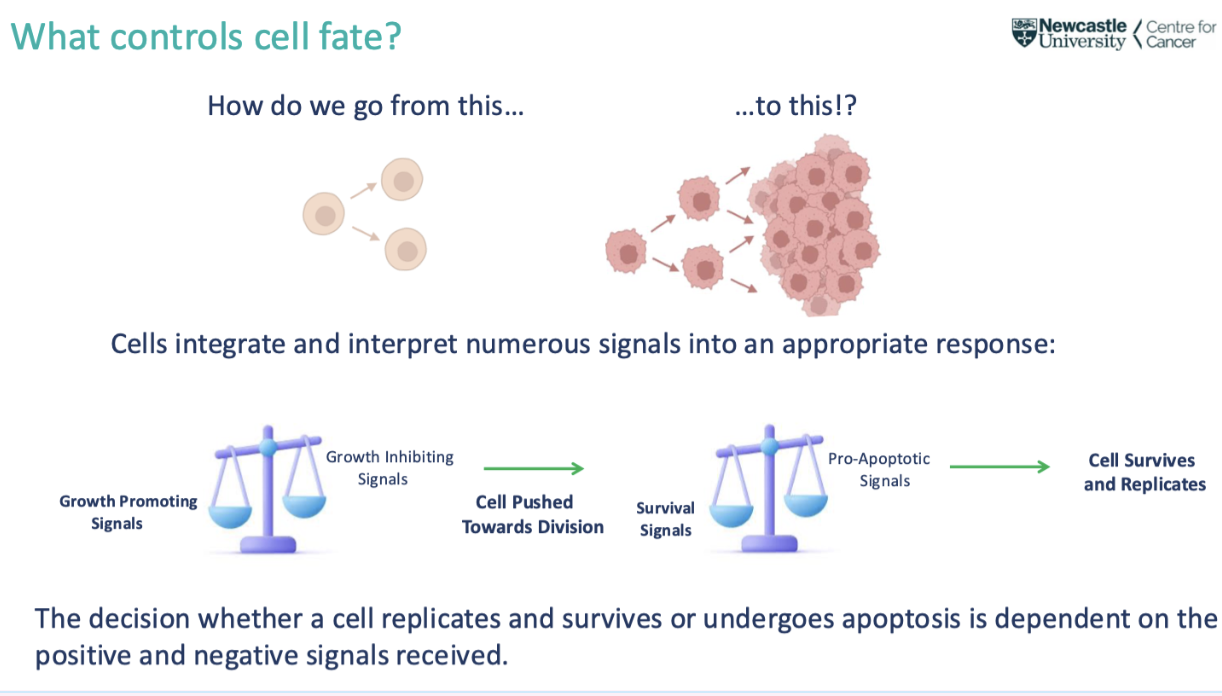
what controls cell fate

Controlled by signals (positive and negative)

Growth promoting and inhibitory 

Cell enters G1 if promoting outweighs inhibitory 

  • Very strict signals that regulate this  

  • Inhibitory- p53 

<p><span style="background-color: inherit; line-height: 22px; color: windowtext;"><span>Controlled by signals</span></span><span style="line-height: 22px; color: windowtext;"><span>&nbsp;(positive and negative)</span></span></p><p class="Paragraph SCXO172745087 BCX0" style="text-align: left;"><span style="background-color: inherit; line-height: 22px; color: windowtext;"><span>Growth promoting and inhibitory</span></span><span style="line-height: 22px; color: windowtext;"><span>&nbsp;</span></span></p><p class="Paragraph SCXO172745087 BCX0" style="text-align: left;"><span style="background-color: inherit; line-height: 22px; color: windowtext;"><span>Cell enters G1 if promoting outweighs inhibitory</span></span><span style="line-height: 22px; color: windowtext;"><span>&nbsp;</span></span></p><ul><li><p class="Paragraph SCXO172745087 BCX0" style="text-align: left;"><span style="background-color: inherit; line-height: 22px; color: windowtext;"><span>Very strict signals that regulate this&nbsp;</span></span><span style="line-height: 22px; color: windowtext;"><span>&nbsp;</span></span></p></li><li><p class="Paragraph SCXO172745087 BCX0" style="text-align: left;"><span style="background-color: inherit; line-height: 22px; color: windowtext;"><span>Inhibitory- p53</span></span><span style="line-height: 22px; color: windowtext;"><span>&nbsp;</span></span></p></li></ul><p></p>
9
New cards

what happens to cell signalling in cancer

In cancer- survival and growth signals outweigh the inhibitory- tumour masses 
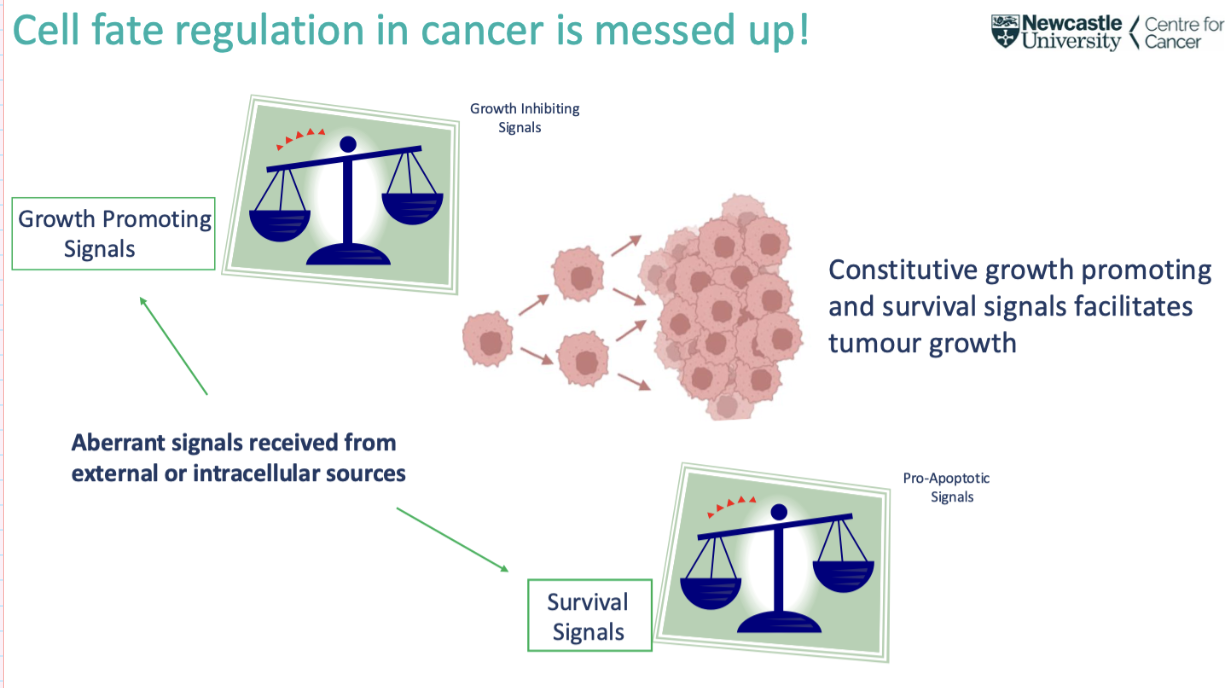
<p><span style="background-color: inherit; line-height: 22px; color: windowtext;"><span>In cancer- survival and growth signals outweigh the inhibitory- tumour masses</span></span><span style="line-height: 22px; color: windowtext;"><span>&nbsp;</span></span></p>
10
New cards

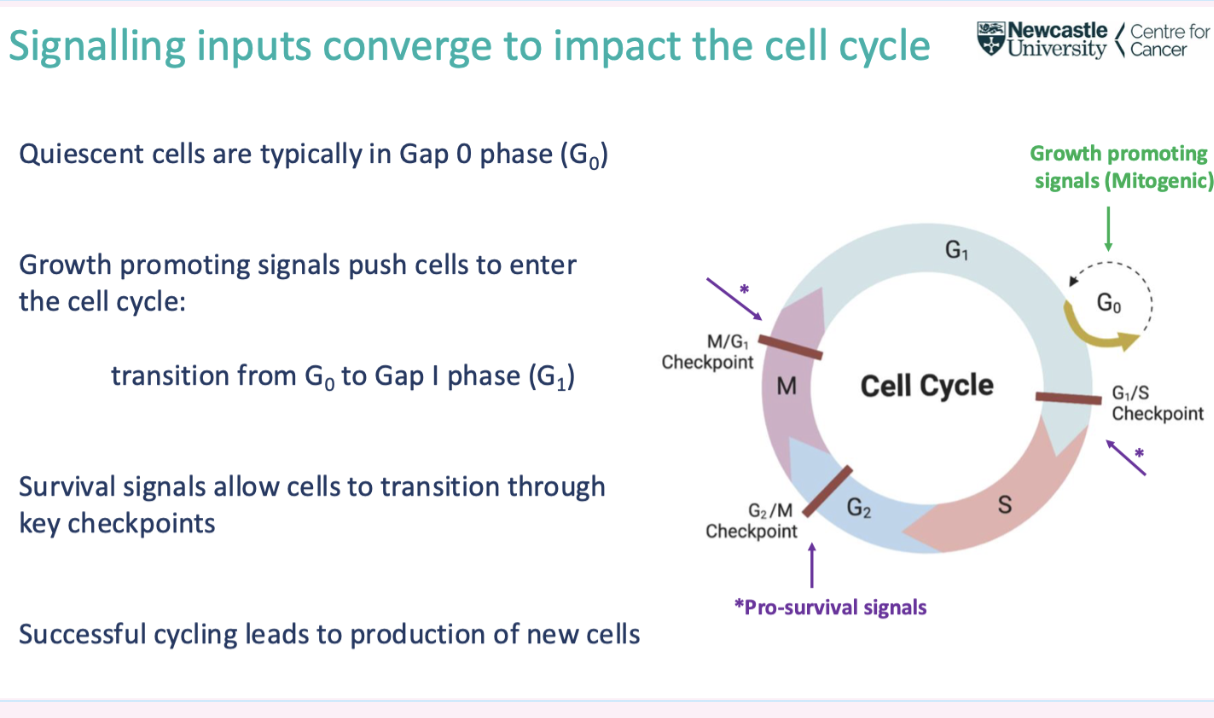
what are mitogenic signals

Mitogenic signal- drives cell through mitosis  

Lots of cells in G0 phase- need mitogenic signal to enter G1 

  • G1 prepare for division- generate organelles to prepare for S phase 

  • Checkpoints need to be reached to enter next phase  
<p><span style="background-color: inherit; line-height: 22px; color: windowtext;"><span>Mitogenic signal- drives cell through mitosis&nbsp;</span></span><span style="line-height: 22px; color: windowtext;"><span>&nbsp;</span></span></p><p class="Paragraph SCXO115238867 BCX0" style="text-align: left;"><span style="background-color: inherit; line-height: 22px; color: windowtext;"><span>Lots of cells in G0 phase- need mitogenic signal to enter G1</span></span><span style="line-height: 22px; color: windowtext;"><span>&nbsp;</span></span></p><ul><li><p class="Paragraph SCXO115238867 BCX0" style="text-align: left;"><span style="background-color: inherit; line-height: 22px; color: windowtext;"><span>G1 prepare for division- generate organelles to prepare for S phase</span></span><span style="line-height: 22px; color: windowtext;"><span>&nbsp;</span></span></p></li><li><p class="Paragraph SCXO115238867 BCX0" style="text-align: left;"><span style="background-color: inherit; line-height: 22px; color: windowtext;"><span>Checkpoints need to be reached to enter next phase&nbsp;</span></span><span style="line-height: 22px; color: windowtext;"><span>&nbsp;</span></span></p></li></ul><p></p>
11
New cards

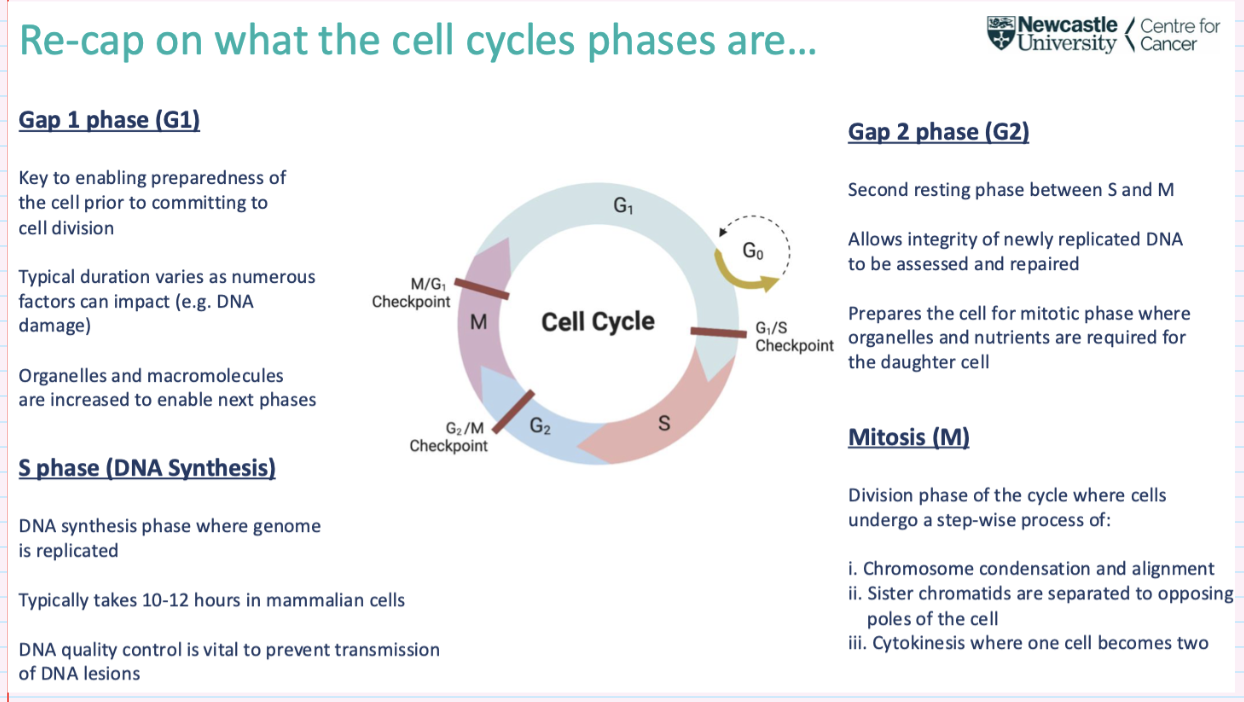
give an overview of the cell cycle phases

  1. gap 1 phase- G1

  2. S phase (DNA synthesis)

  3. gap 2 phase- G2

  4. mitosis- M

<ol><li><p>gap 1 phase- G1</p></li><li><p>S phase (DNA synthesis)</p></li><li><p>gap 2 phase- G2</p></li><li><p>mitosis- M</p></li></ol><p></p>
12
New cards

what are the main regulators of the cell cycle

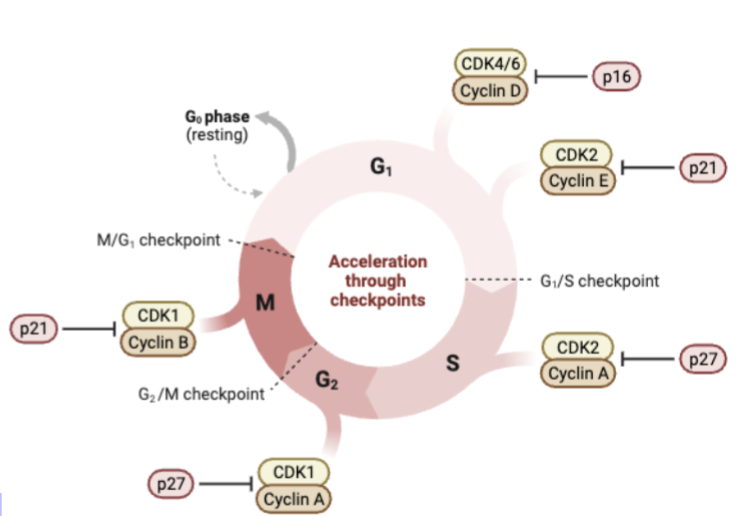
CDKs

cyclin dependent kinases- a family of serine/threonine kinases which phosphorylate key substrates to enable cell cycle progression
<p>CDKs</p><p>cyclin dependent kinases- a family of serine/threonine kinases which phosphorylate key substrates to enable cell cycle progression</p><p></p>
13
New cards

what structure do CDKs form

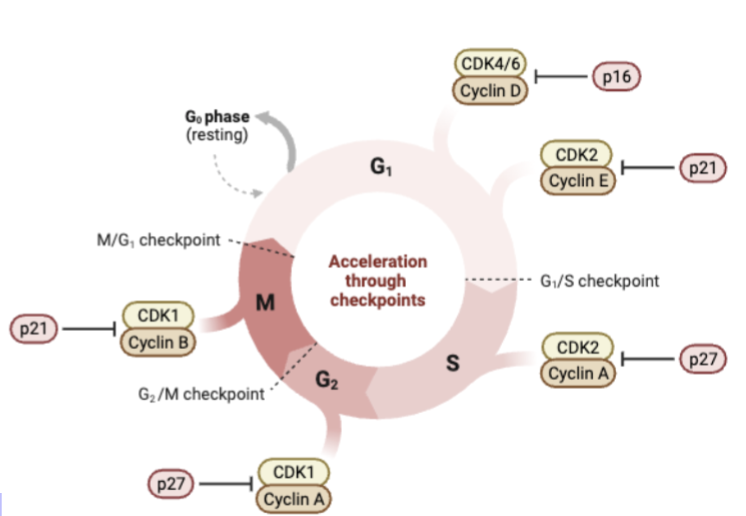
They form a holoenzyme complex with their respective cyclin protein which are required to enable activation of CDK catalytic activity
<p>They form a holoenzyme complex with their respective cyclin protein which are required to enable activation of CDK catalytic activity</p>
14
New cards

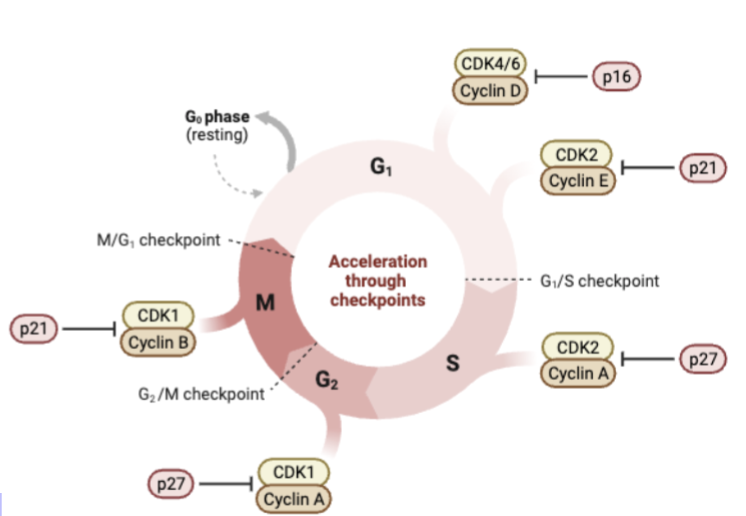
what are CDKs controlled by

Each cognate CDK-cyclin complex is itself controlled by specific inhibitors which help govern progression through the cell cycle: these are called CDK inhibitors (CKIs)

  • prevent hyperactivity

<p>Each cognate CDK-cyclin complex is itself controlled by specific inhibitors which help govern progression through the cell cycle: these are called CDK inhibitors (CKIs)</p><ul><li><p>prevent hyperactivity</p></li></ul><p></p>
15
New cards

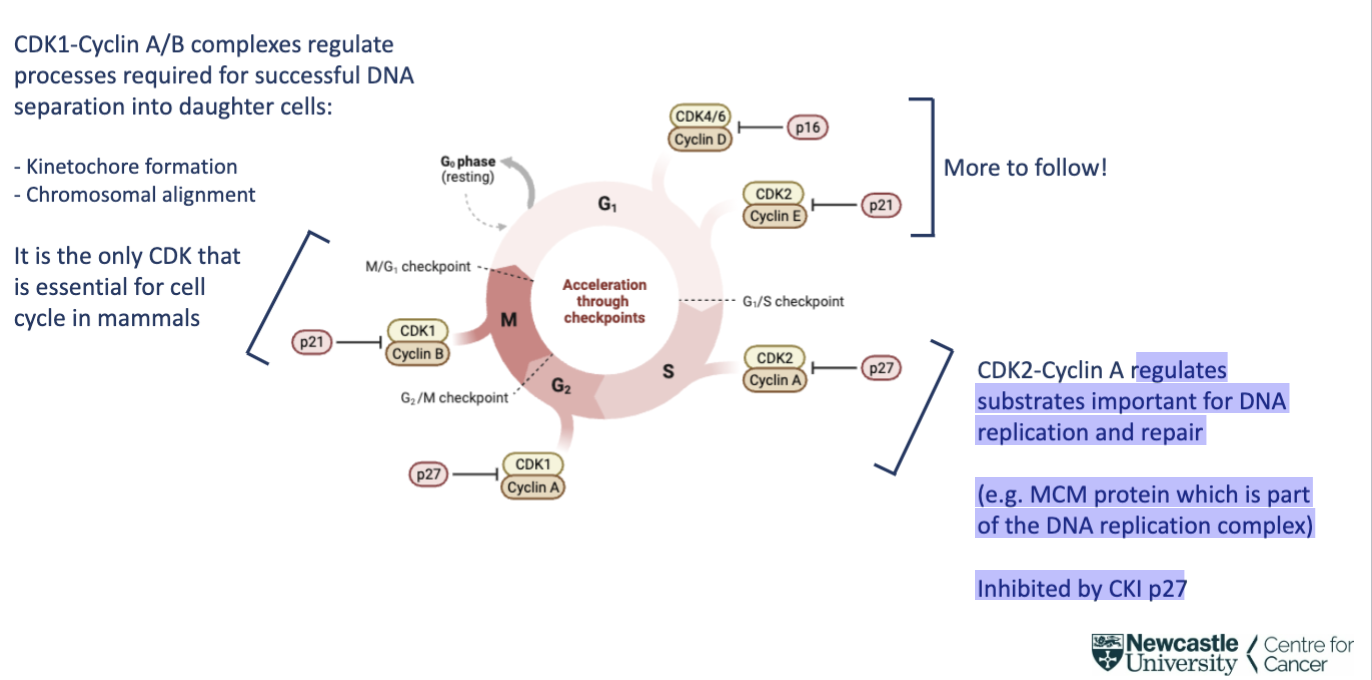
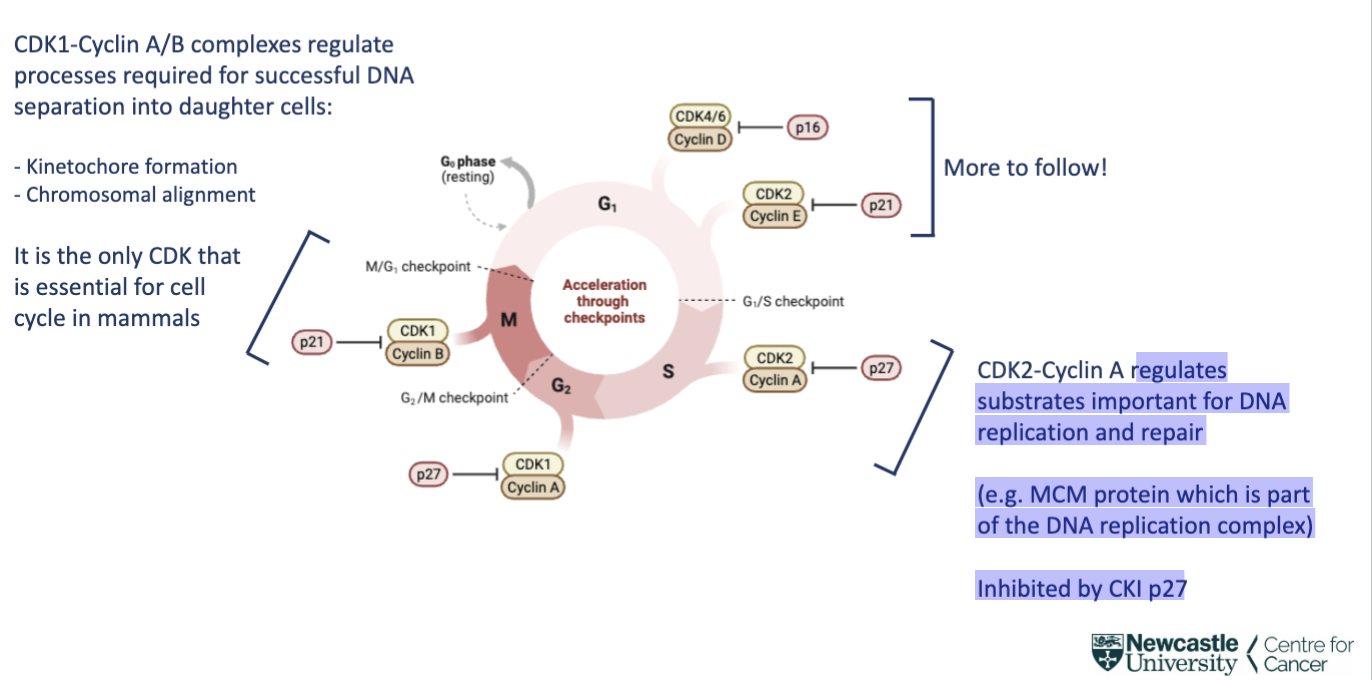
what process does CDK1-Cyclin A/B complex regulate

regulates processes required for successful DNA separation into daughter cells:

- Kinetochore formation

- Chromosomal alignment

It is the only CDK that is essential for cell cycle in mammals

  • inhibited by CKI p21

<p>regulates processes required for successful DNA separation into daughter cells:</p><p>- Kinetochore formation</p><p>- Chromosomal alignment</p><p>It is the only CDK that is essential for cell cycle in mammals</p><ul><li><p>inhibited by CKI p21</p></li></ul><p></p>
16
New cards

what process does CDK2-Cyclin A complex regulate

regulates substrates important for DNA replication and repair (e.g. MCM protein which is part of the DNA replication complex)

  • Inhibited by CKI p27

<p>regulates substrates important for DNA replication and repair (e.g. MCM protein which is part of the DNA replication complex)</p><ul><li><p>Inhibited by CKI p27</p></li></ul><p></p>
17
New cards

how were CDKs discovered

by pioneering studies in yeast and frog oocytes

18
New cards

how many CDKS are encoded in the human genome, what types are there

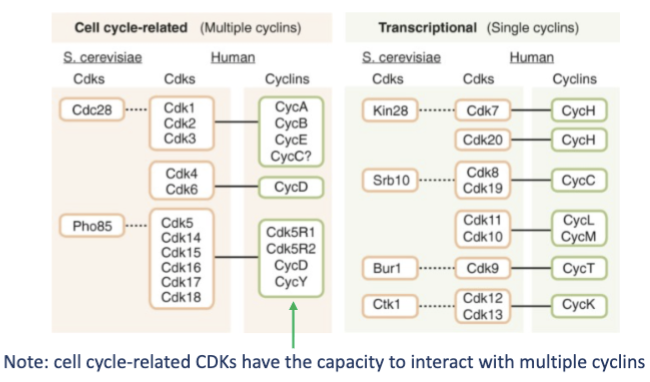
There are 20 CDKs encoded in the human genome and are classified into two separate groups:

1. Cell cycle-related

2. Transcriptional
<p>There are 20 CDKs encoded in the human genome and are classified into two separate groups:</p><p>1. Cell cycle-related</p><p>2. Transcriptional</p>
19
New cards

how do levels of CDKs and cyclins change throughout the cell cycle

Cellular CDK levels do not fluctuate throughout the cell cycle but cyclin levels do to control CDK activity at distinct phases
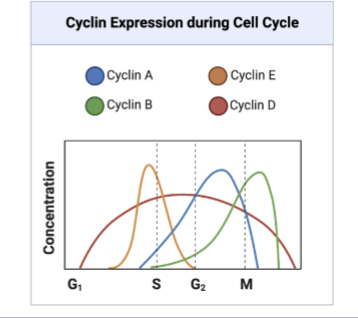
<p>Cellular CDK levels do not fluctuate throughout the cell cycle but cyclin levels do to control CDK activity at distinct phases</p>
20
New cards

describe the structure of CDKs

250-1500 amino acids

  • catalytic site called activation domain which phosphorylates substrates

  • In the cyclin unbound (apo) form, the activation domain is inaccessible

  • when bound to appropriate cyclin, there is an allosteric shift in structure which pulls apart the C-helix to expose the activation domain
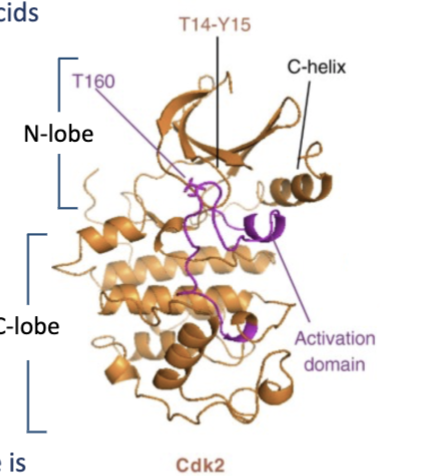
<p>250-1500 amino acids</p><ul><li><p>catalytic site called activation domain which phosphorylates substrates</p></li><li><p>In the cyclin unbound (apo) form, the activation domain is inaccessible</p></li><li><p>when bound to appropriate cyclin, there is an allosteric shift in structure which pulls apart the C-helix to expose the activation domain</p></li></ul><p></p>
21
New cards

where are substrates of the CDK-cyclin holoenzymes phosphorylates

Substrates of CDK-cyclin holoenzymes are typically phosphorylated on S/T-P-X-K/R sequences

22
New cards

describe the structure of cyclins

30-95 kDa- 29 human cyclins

defined by the cyclin box

A 100 amino acid sequence that assembles as a 5 ∂-helix stack

  • The cyclin box is important for making contacts with the partner CDK
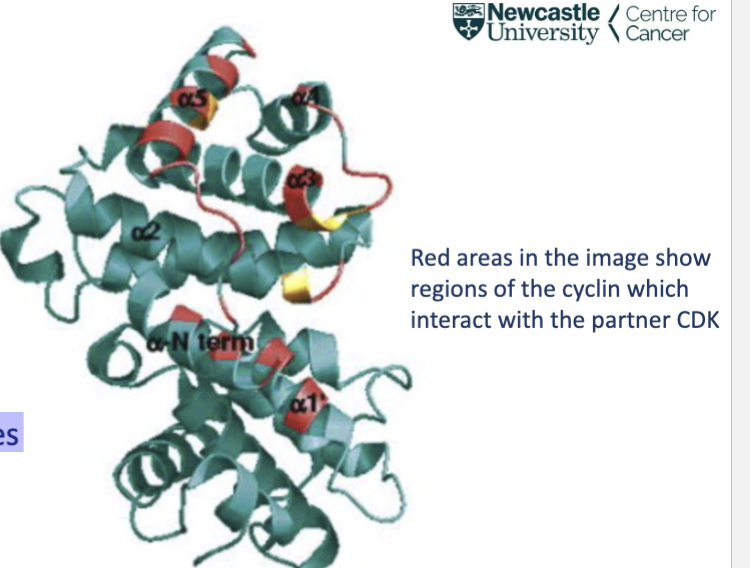
<p>30-95 kDa- 29 human cyclins </p><p>defined by the cyclin box</p><p>A 100 amino acid sequence that assembles as a 5 ∂-helix stack</p><ul><li><p>The cyclin box is important for making contacts with the partner CDK</p></li></ul><p></p>
23
New cards

what are the 2 key mechanisms of CDK-cyclin complex regulation

they are involved in preventing prolonged (and potentially cancer driving) activation of CDK complexes:

i. Phosphorylation-dependent regulation

ii. CDK inhibitors (CKIs)

24
New cards

how does CDK inhibitor (CKI) regulation occur (CDK-cyclin complex regulation)

  1. Threonine 14 and Tyrosine 15 reside within the G loop of CDKs

  2. They are phosphorylated by the kinase enzyme Wee1

  3. Phosphorylation of these residues reduces interaction with cyclins and kinase activity
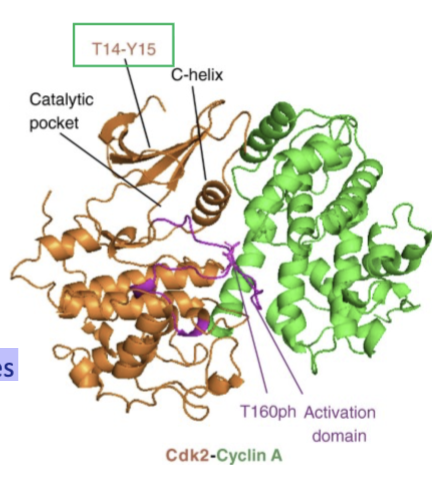
<ol><li><p>Threonine 14 and Tyrosine 15 reside within the G loop of CDKs</p></li><li><p>They are phosphorylated by the kinase enzyme Wee1</p></li><li><p>Phosphorylation of these residues reduces interaction with cyclins and kinase activity</p></li></ol><p></p>
25
New cards

how does phosphorylation dependent regulation occur (CDK-cyclin complex regulation)

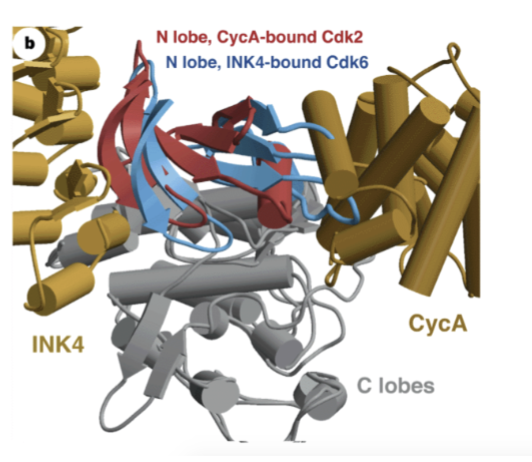
  1. p16 (INK4), p21 and p27 are well characterised CDKis

  2. They selectively interact with specific CDK-cyclin complexes and block binding of CDK enzymes to their cognate cyclin protein

  3. For p16 (INK4) interaction with CDK4/6-cyclin D complexes, p16 distorts the structure of the cyclin binding region of CDK4/6 and the ATP-binding site to prevent catalytic activity
<ol><li><p>p16 (INK4), p21 and p27 are well characterised CDKis</p></li><li><p>They selectively interact with specific CDK-cyclin complexes and block binding of CDK enzymes to their cognate cyclin protein</p></li><li><p>For p16 (INK4) interaction with CDK4/6-cyclin D complexes, p16 distorts the structure of the cyclin binding region of CDK4/6 and the ATP-binding site to prevent catalytic activity</p></li></ol><p></p>
26
New cards

what happens to CDK-cyclin complex regulation in cancer

they are commonly dysregulated

Genes encoding Cyclin D1 and CDK4/6 are commonly amplified in numerous cancer types:

  • More CDK4/6-cyclin D complexes uncouple the requirement for mitogenic signalling

  • The CKI p16 gene is commonly lost or mutated which allows cells to pass through G1 unhindered

More rapid cell cycling; higher risk of cancer

27
New cards

which molecules control G1 cycling

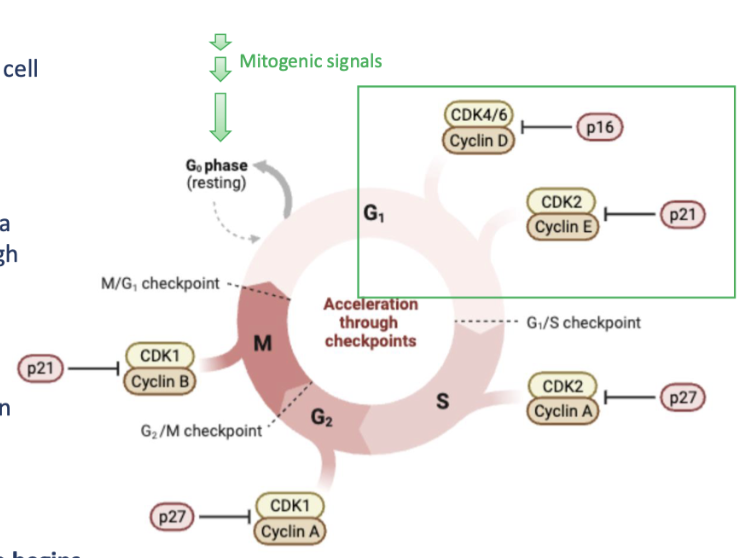
CDK4/6-cyclin D and CDK2-cyclin E complexes

  • For cells to come out of G0 and enter G1, the cell must receive mitogenic signals

  • These signals are typically received by plasma membrane receptors and transmitted through the cell via kinase cascades (e.g. MAPK)

  • activation of the MAPK pathway leads to an increase in cyclin D and CDK4 levels in the cell

Cyclin D interacts with CDK4/6 and the cycle begins
<p>CDK4/6-cyclin D and CDK2-cyclin E complexes</p><ul><li><p>For cells to come out of G0 and enter G1, the cell must receive mitogenic signals</p></li><li><p>These signals are typically received by plasma membrane receptors and transmitted through the cell via kinase cascades (e.g. MAPK)</p></li><li><p>activation of the MAPK pathway leads to an increase in cyclin D and CDK4 levels in the cell</p></li></ul><p>Cyclin D interacts with CDK4/6 and the cycle begins</p>
28
New cards

How does CDK4/6 and CDK2 activity enable cycling through G1 to S phase?

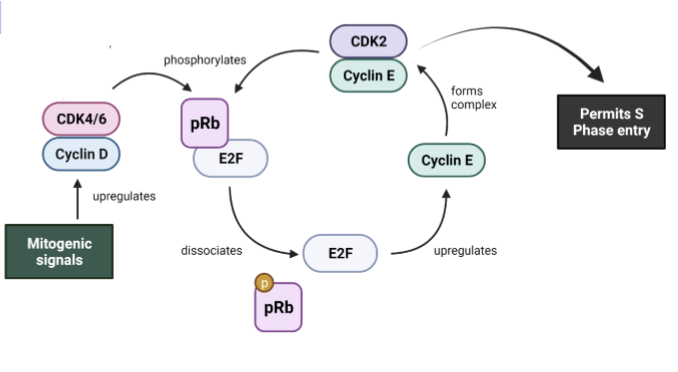
  1. Once CDK4/6-cyclin D complex is active, it phosphorylates pRb which is a tumour suppressor

  2. This phosphorylation blocks interaction between pRb and the transcription factor E2F.

  3. E2F is then able to activate transcription of genes important for transition to S-phase such as:

  • Cyclin E: This interacts with CDK2 which further phosphorylates pRB to block it’s activity and support elevated E2F transcriptional function

  • Numerous genes involved in DNA synthesis which prepare the cell to allow replication of DNA in S-phase
<ol><li><p>Once CDK4/6-cyclin D complex is active, it phosphorylates pRb which is a tumour suppressor</p></li><li><p>This phosphorylation blocks interaction between pRb and the transcription factor E2F. </p></li><li><p>E2F is then able to activate transcription of genes important for transition to S-phase such as:</p></li></ol><ul><li><p>Cyclin E: This interacts with CDK2 which further phosphorylates pRB to block it’s activity and support elevated E2F transcriptional function</p></li><li><p>Numerous genes involved in DNA synthesis which prepare the cell to allow replication of DNA in S-phase</p></li></ul><p></p>
29
New cards
30
New cards

what are the 6 steps of control of G1 entry and exit to S phase

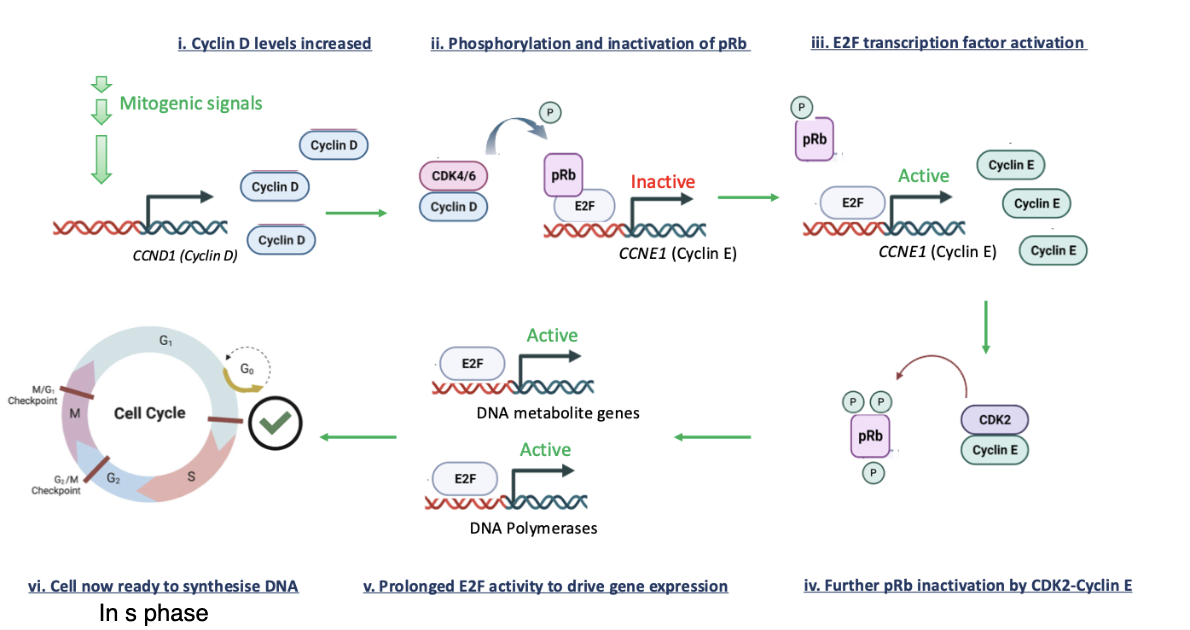
  1. Cyclin D levels increase

  2. phosphorylation and inactivation of pRB

  3. E2F transcription factor activation

  4. cell now ready to synthesise DNA in S phase

  5. prolonged E2F activity to drive gene expression

  6. further inactivation by CDK2-cyclin E

Mitogenic signal drives all this so can enter S phase 
<ol><li><p>Cyclin D levels increase</p></li><li><p>phosphorylation and inactivation of pRB</p></li><li><p>E2F transcription factor activation</p></li><li><p>cell now ready to synthesise DNA in S phase</p></li><li><p>prolonged E2F activity to drive gene expression</p></li><li><p>further inactivation by CDK2-cyclin E</p></li></ol><p><span style="background-color: inherit; line-height: 22px; color: windowtext;"><span>Mitogenic signal drives all this so can enter S phase</span></span><span style="line-height: 22px; color: windowtext;"><span>&nbsp;</span></span></p>
31
New cards

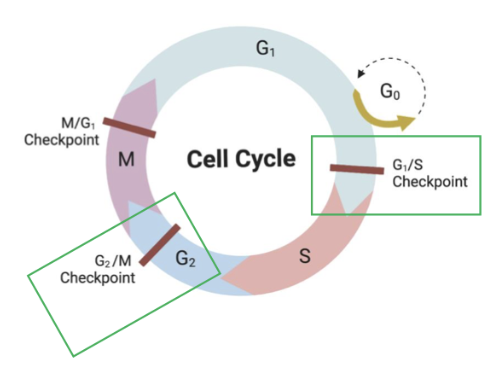
why is a G1/S checkpoint required

If damage is unrepaired prior to S-phase, this will lead to transmission of genetic lesions into cell progeny which could contribute to cancer development

  • Likewise, errors during DNA replication (e.g. replicative stress) need to be resolved before the cell can undergo mitosis: G2/M checkpoint

  • Need to also see how good the new copy of DNA is before its given to daughter cell 
<p>If damage is unrepaired prior to S-phase, this will lead to transmission of genetic lesions into cell progeny which could contribute to cancer development</p><ul><li><p>Likewise, errors during DNA replication (e.g. replicative stress) need to be resolved before the cell can undergo mitosis: G2/M checkpoint</p></li><li><p><span style="background-color: inherit; line-height: 22px; color: windowtext;"><span>Need to also see how good the new copy of DNA is before its given to daughter cell</span></span><span style="line-height: 22px; color: windowtext;"><span>&nbsp;</span></span></p></li></ul><p></p>
32
New cards

why is p53 deemed the guardian of the genome

as it controls key restriction points that permits transitions between G1/S and G2/M only if the DNA is error free and replicated without issue

33
New cards

how does p53 levels change when DNA is damaged

p53 levels are increased so that it can regulate an appropriate cell fate

  • Steady-state levels of p53 are low in cells to prevent unwanted interference to the cell cycle

34
New cards

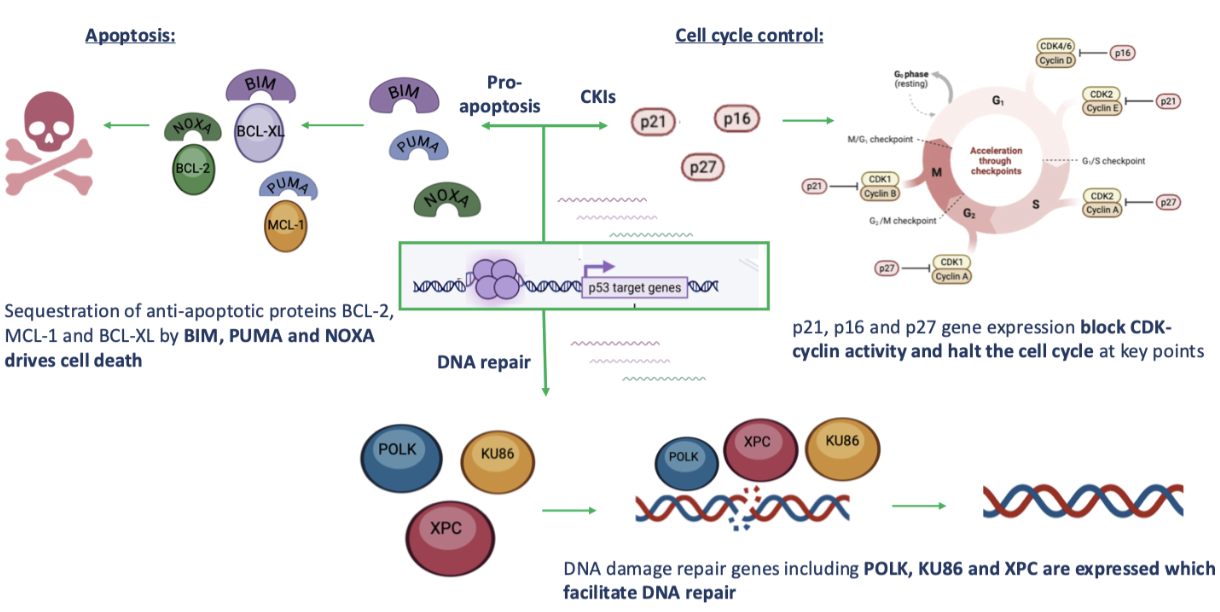
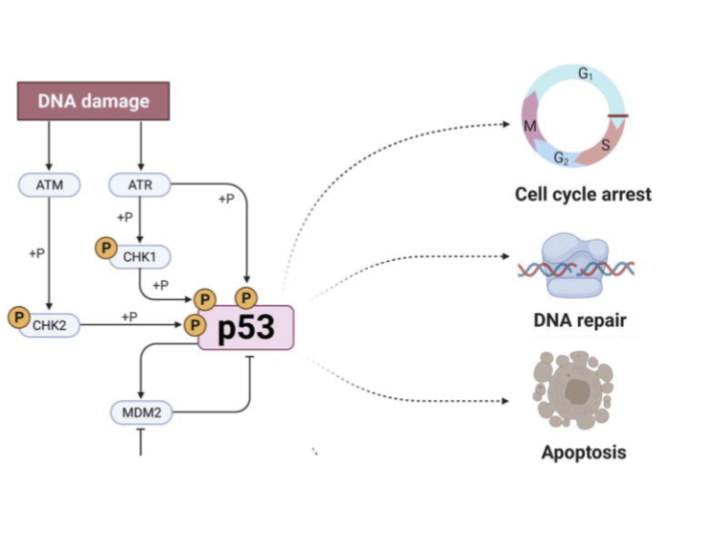
how does p53 control cell fates upon sensing DNA damage

DNA damage is ‘sensed’ by kinases ATM and ATR

  • These directly phosphorylate p53 to increase p53 cellular levels

  • P53 phosphorylation stops mdm2 from being able to degrade p53 

  • p53 can then act as a transcriptional regulator to control expression of genes involved in:

i. Cell cycle arrest

ii. DNA repair

iii. Apoptosis

Depending on the extent of DNA damage, p53 will decide whether repair is feasible or if the cell should die
<p>DNA damage is ‘sensed’ by kinases ATM and ATR</p><ul><li><p>These directly phosphorylate p53 to increase p53 cellular levels</p></li><li><p><span style="background-color: inherit; line-height: 22px; color: windowtext;"><span>P53 phosphorylation stops mdm2 from being able to degrade p53</span></span><span style="line-height: 22px; color: windowtext;"><span>&nbsp;</span></span></p></li><li><p>p53 can then act as a transcriptional regulator to control expression of genes involved in:</p></li></ul><p>i. Cell cycle arrest</p><p>ii. DNA repair</p><p>iii. Apoptosis</p><p>Depending on the extent of DNA damage, p53 will decide whether repair is feasible or if the cell should die</p><p></p>
35
New cards

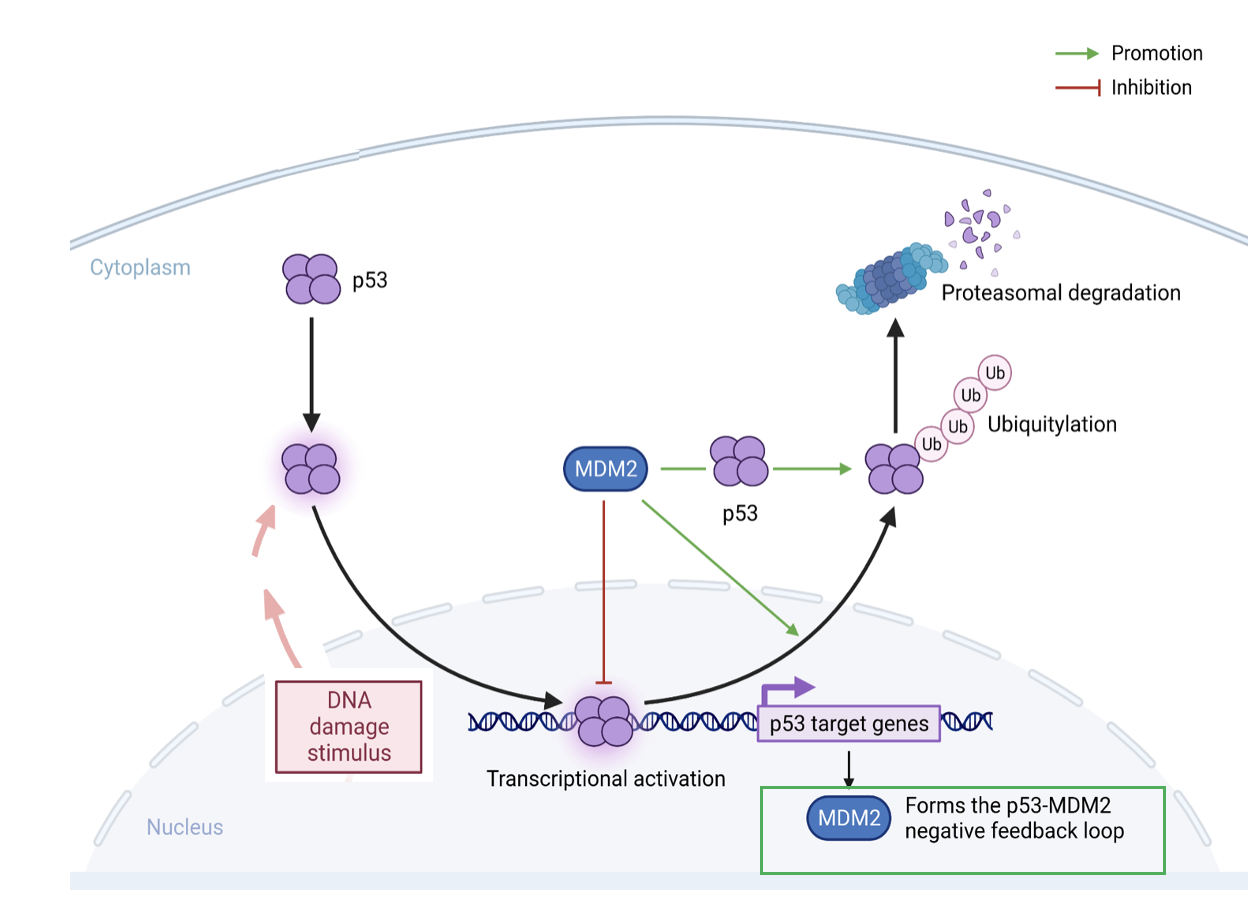
what happens to p53 in the absence of DNA damage

p53 levels are kept low by MDM2

  • MDM2 is an E3 ubiquitin ligase enzyme which poly ubiquitinates p53 to cause it destruction by the proteasome

  • Upon DNA damage, p53 phosphorylation by ATM/ATR blocks MDM2 interaction and allows p53 to tetramerise and move to the nucleus

  • p53 then binds and activates target genes to regulate cell fate
<p>p53 levels are kept low by MDM2</p><ul><li><p>MDM2 is an E3 ubiquitin ligase enzyme which poly ubiquitinates p53 to cause it destruction by the proteasome</p></li><li><p>Upon DNA damage, p53 phosphorylation by ATM/ATR blocks MDM2 interaction and allows p53 to tetramerise and move to the nucleus</p></li><li><p>p53 then binds and activates target genes to regulate cell fate</p></li></ul><p></p>
36
New cards

what genes does p53 control

Directly increases expression of Cdks 

  • Want to elongate G1 to give enough time for DNA to be repaired 

  • Before transitioning into S phase 

<p><span style="background-color: inherit; line-height: 22px; color: windowtext;"><span>Directly increases expression of Cdks</span></span><span style="line-height: 22px; color: windowtext;"><span>&nbsp;</span></span></p><ul><li><p class="Paragraph SCXO179557960 BCX0" style="text-align: left;"><span style="background-color: inherit; line-height: 22px; color: windowtext;"><span>Want to elongate G1 to give enough time for DNA to be repaired</span></span><span style="line-height: 22px; color: windowtext;"><span>&nbsp;</span></span></p></li><li><p class="Paragraph SCXO179557960 BCX0" style="text-align: left;"><span style="background-color: inherit; line-height: 22px; color: windowtext;"><span>Before transitioning into S phase</span></span><span style="line-height: 22px; color: windowtext;"><span>&nbsp;</span></span></p></li></ul><p></p>
37
New cards

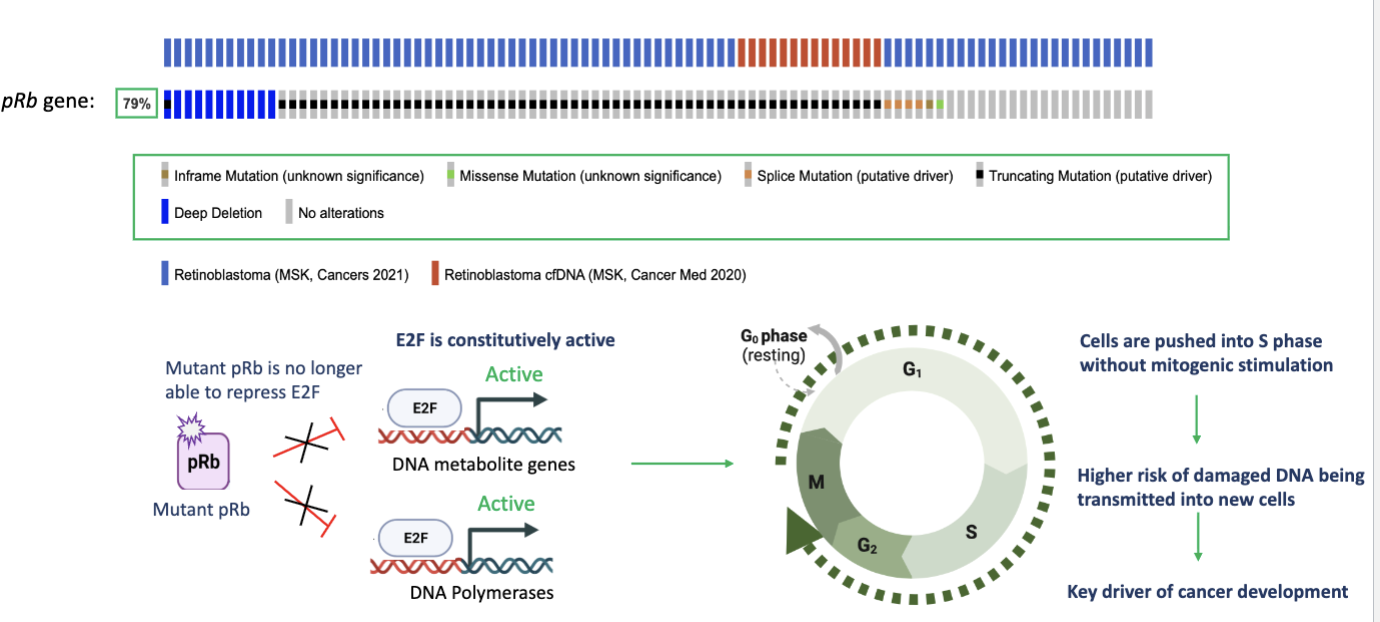
why is pRb and p53 relevent to cancer

pRb was the first tumour suppressor identified and as the name suggests is strongly associated with retinoblastoma:
<p>pRb was the first tumour suppressor identified and as the name suggests is strongly associated with retinoblastoma:</p>
38
New cards

where does pRb get its name from

name from retinoblastoma  

High number of patients with pRB mutations 

  • Cell pushed into proliferation constantly  

39
New cards

in what type of cancer is p53 the most commonly mutated gene

prostate cancer

  • These mutations are deleterious to p53 function; hence in cells that are p53 mutant:

i. They are unable to pause G1-S transition if DNA damage is present

ii. They have reduced capacity to repair DNA

iii. Their apoptotic potential is compromised

  • Interestingly, when p53 is wild-type, MDM2 gene amplification is often found in cancer which blocks p53 activity

  • ultimately, loss of p53 allows transmission of potentially cancerous genetic lesions to be transmitted to progeny

<p>prostate cancer </p><ul><li><p>These mutations are deleterious to p53 function; hence in cells that are p53 mutant:</p></li></ul><p>i. They are unable to pause G1-S transition if DNA damage is present</p><p>ii. They have reduced capacity to repair DNA</p><p>iii. Their apoptotic potential is compromised</p><ul><li><p>Interestingly, when p53 is wild-type, MDM2 gene amplification is often found in cancer which blocks p53 activity</p></li><li><p>ultimately, loss of p53 allows transmission of potentially cancerous genetic lesions to be transmitted to progeny</p></li></ul><p></p>
40
New cards

what are 2 key strategies for anti cancer treatments regarding cycle cycle regulators

1. Inhibition of CDKs using CDK4/6 as an example

2. Reactivation of wild-type p53 (in cells which have high MDM2 levels)

41
New cards

what is the rational for inhibiting CDK 4/6 in anti cancer treatments

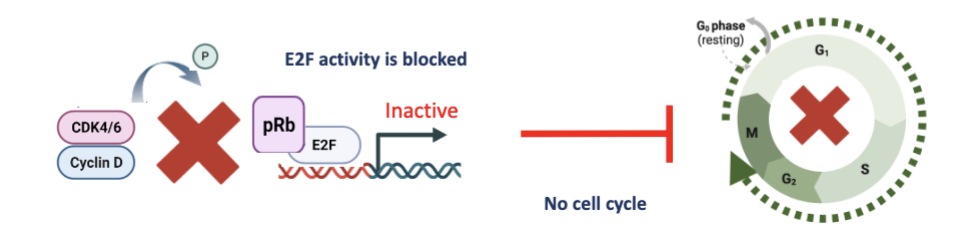
  • Aberrant CDK4/6 activity either though cyclin D or CDK4/6 gene amplification drives cell cycle without appropriate mitogenic signals

  • The kinase activity of CDK4/6 is therefore a tractable therapeutic target…this is helped by knowing its structure

  • By blocking the kinase activity of CDK4/6, pRb phosphorylation will be diminished and cells will not go through

High levels of Cdk protein in cells so might not need mitogenic signal to enter cell cycle  
<ul><li><p>Aberrant CDK4/6 activity either though cyclin D or CDK4/6 gene amplification drives cell cycle without appropriate mitogenic signals</p></li><li><p>The kinase activity of CDK4/6 is therefore a tractable therapeutic target…this is helped by knowing its structure</p></li><li><p>By blocking the kinase activity of CDK4/6, pRb phosphorylation will be diminished and cells will not go through</p></li></ul><p><span style="background-color: inherit; line-height: 22px; color: windowtext;"><span>High levels of Cdk protein in cells so might not need mitogenic signal to enter cell cycle&nbsp;</span></span><span style="line-height: 22px; color: windowtext;"><span>&nbsp;</span></span></p>
42
New cards

describe CDK 4/6 inhibition with Ribociclib

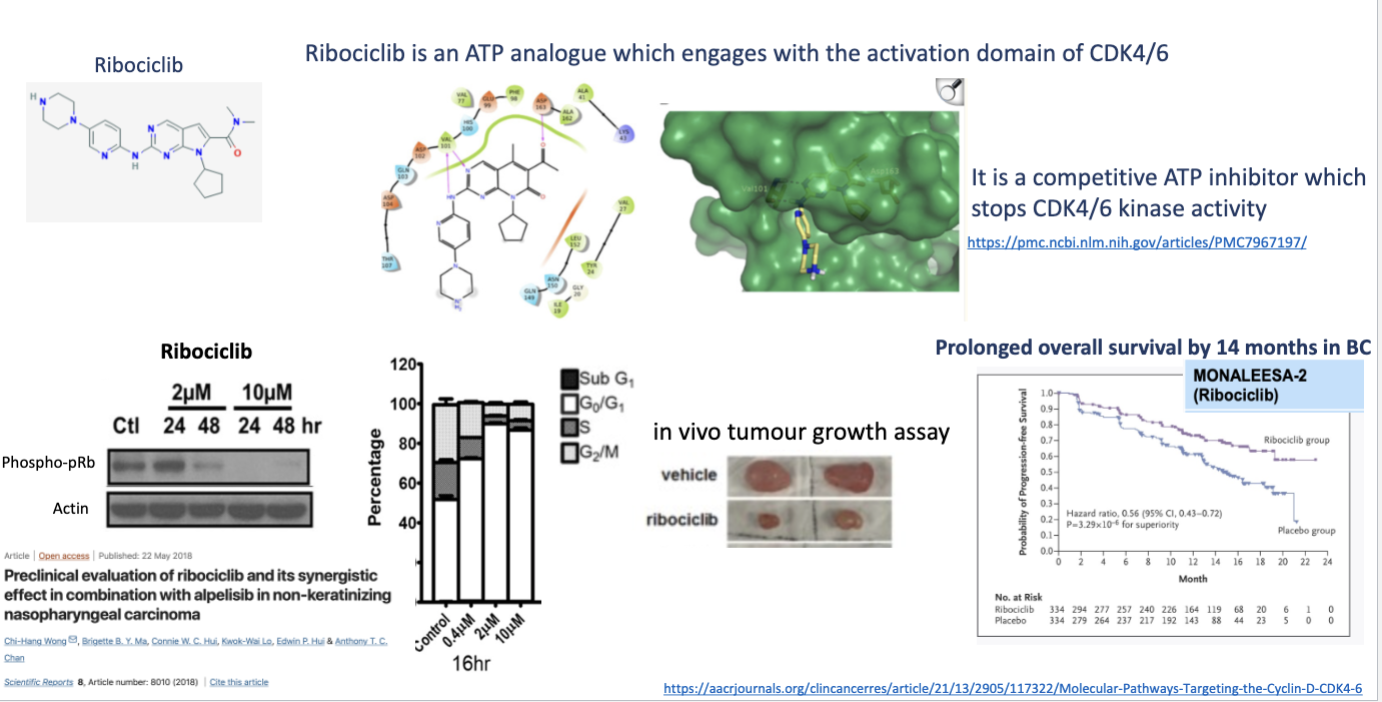
Ribociclib is an ATP analogue which engages with the activation domain of CDK 4/6

  • it is a competitive ATP inhibitor which stops CDK 4/6 kinase activity
<p>Ribociclib is an ATP analogue which engages with the activation domain of CDK 4/6</p><ul><li><p>it is a competitive ATP inhibitor which stops CDK 4/6 kinase activity </p></li></ul><p></p>
43
New cards

how doe most kinase inhibitors work

Make reduction in the phosphorylation in pRB so E2F can no longer bind and transcribe factors for G1- S transition 

44
New cards

describe the reactivation of wild type p53

In many tumours, p53 is not mutated but components of the negative regulatory pathway are amplified:

this stops p53 function

  • Block interaction between p53 and mdm2 no more ubiquitination of p53 so more active in cells and more control 

In these tumours there is an opportunity to reactivate wild-type p53 which would enable cell cycle blockade

Key to these strategies is the interaction between p53 and the negative regulator MDM2:

<p>In many tumours, p53 is not mutated but components of the negative regulatory pathway are amplified:</p><p>this stops p53 function</p><ul><li><p><span style="background-color: inherit; line-height: 22px; color: windowtext;"><span>Block interaction between p53 and mdm2 no more ubiquitination of p53 so more active in cells and more control</span></span><span style="line-height: 22px; color: windowtext;"><span>&nbsp;</span></span></p></li></ul><p>In these tumours there is an opportunity to reactivate wild-type p53 which would enable cell cycle blockade</p><p>Key to these strategies is the interaction between p53 and the negative regulator MDM2:</p>
45
New cards

how does Nutlin-3a/RG7112 stop MDM2 binding to p53

Stops mdm2 from ubiquitinating p53 so p53 levels increase 

  • Accumulation of p53 as no longer degraded 

  • As negative feedback loop- mdm2 transcription also goes up since -53 increases 

  • Mutant p53 cant do anything cand bind DNA  or drive anti proliferative effects 

    • Only efficacy In patients who are wild type p53 

    • So in clinical trial- do sample of only wild type patients as won’t make a difference In those with mutated 

Explore top flashcards

MKT 3401
Updated 491d ago
flashcards Flashcards (54)
Apush unit 3
Updated 1170d ago
flashcards Flashcards (63)
geschiedenis
Updated 1161d ago
flashcards Flashcards (49)
Human Phys Exam II
Updated 1077d ago
flashcards Flashcards (133)
MKT 3401
Updated 491d ago
flashcards Flashcards (54)
Apush unit 3
Updated 1170d ago
flashcards Flashcards (63)
geschiedenis
Updated 1161d ago
flashcards Flashcards (49)
Human Phys Exam II
Updated 1077d ago
flashcards Flashcards (133)