[ 2MID ] General Biology - Modification
 Call Kai
 Learn
Learn Practice Test
 Spaced Repetition
 Match
Match Flashcards
 Knowt Play
1/59

There's no tags or description
Looks like no tags are added yet.
Name | Mastery | Learn | Test | Matching | Spaced | Call with Kai | Chat |
|---|
No analytics yet
Send a link to your students to track their progress
60 Terms
Spines
In most xerophytes (plants that grow in regions with scarce water), the leaves are reduced to these but still take the responsibility of doing photosynthesis. These help reduce water loss and is also useful in absorbing droplets of water from the fog.
Succulent Leaves
These fleshy leaves that that serve as a storage part for water as well as reserve materials. The plants can survive for months without even a single drop of water and may turn brown.
Tendrils
found in climbers where leaf of plants are modified into elongated structures to help the plants climb efficiently.
Swollen Petiole
aquatic plants that have bulged petioles filled with air and help the plant float in water.
Reproductive Leaves
adventitious buds along their leaf margins. These buds develop roots while on the parent plant as they mature, they fall off the plant and start growing into a new plant when they land on nearby soil.
Sheathy Leaf Bases
found in plants that lack woody stems. The leaf base is expanded into a sheath that is rolled over one another in layers as new leaves grow. The sheathy leaf bases combine to form the pseudostem that’s supports the plant to stand erect.
Traps
plants that grow in nitrogen deficient places have modified their leaves to get this. The leaves may be modified into a pod which is used to attract insects and other tiny animals to fall inside and digest them. The inner walls secrete digestive enzymes that help digest the insects and extract the nitrogen needed for the plant.
Bulbs
leaves modified as storage organ.
Bud Scales
tough, overlapping, waterproof leaves that protect buds from frost, desiccation, and pathogens. These form before the onset of unfavorable growing seasons i.e. winter.
Bract
a modified leaf or scale, typically small, with a flower or flower cluster in its axil. These are sometimes larger and more brightly coloured than the true flower.
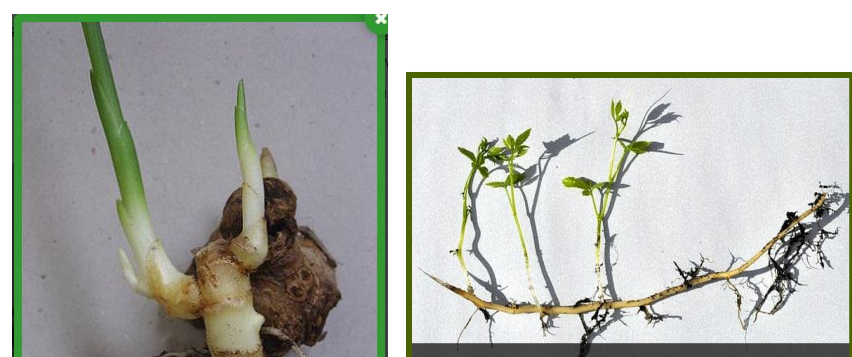
Rhizome
also called creeping rootstalk, horizontal underground plant stems capable of producing the shoot and root systems of a new plant
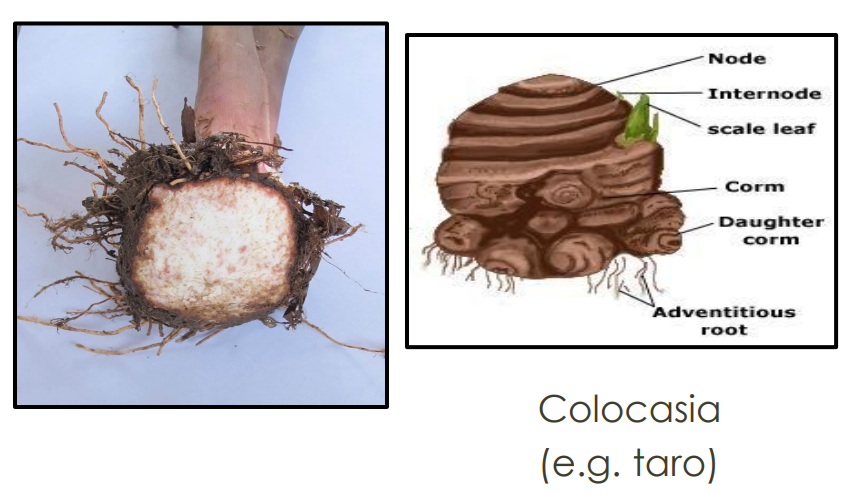
Corm
a condensed form of the stem that grows in the vertical direction. It is spherical in shape with a flattened base. It has distinct nodes and internodes. Adventitious roots are present either at the base or all over the body.
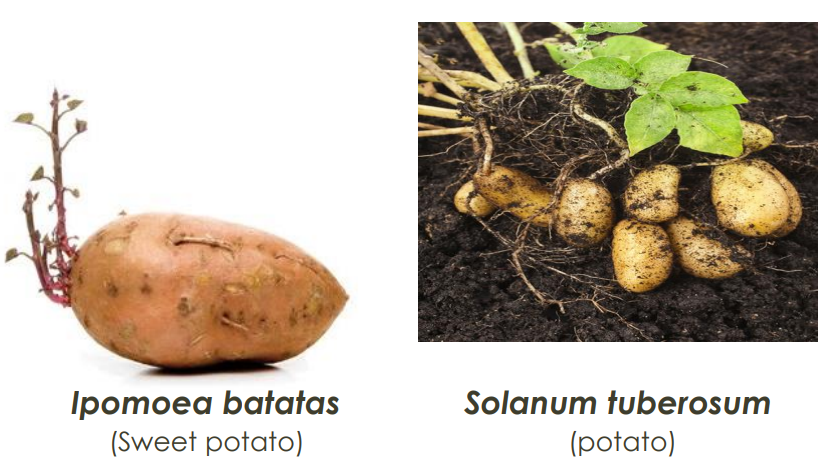
Tubers
enlarged structures in some plant species used as storage organs for nutrients
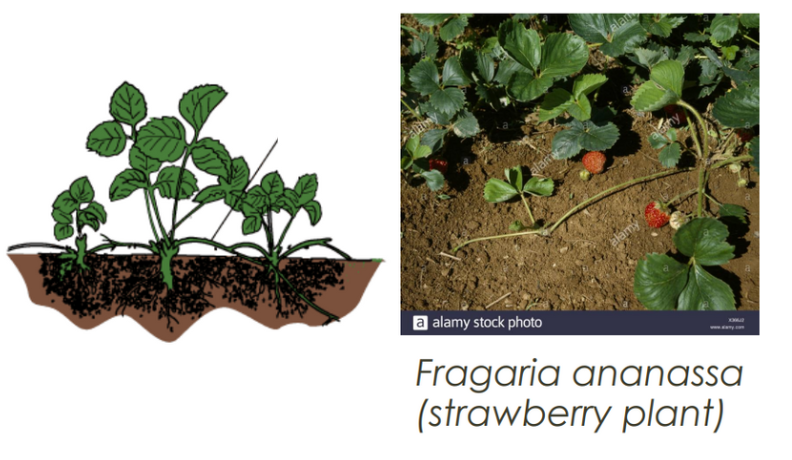
Runner/Stolon
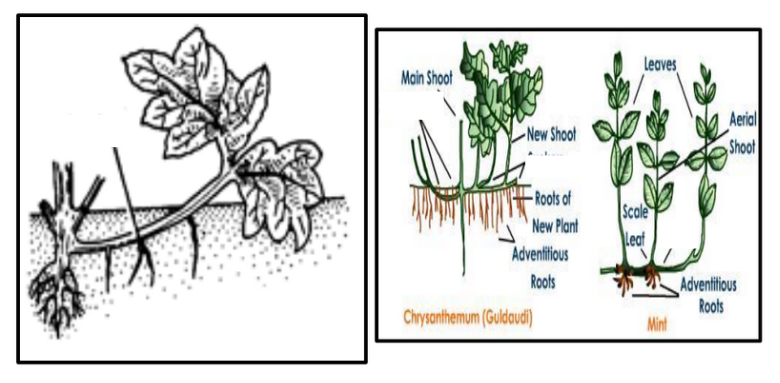
It is a creeper that runs horizontally on the surface of the soil. These break off and grow into an independent plant giving rise to vegetative propagation.
Sucker
This arises from the basal part of the main stem. Before separating from the original plant, it develops adventitious roots and leafy shoots. It moves horizontally under the soil for a distance and then grows obliquely upwards
Offset
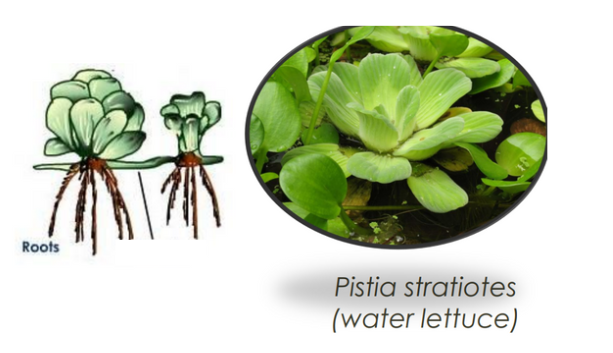
a modification of stem in which a lateral branch with short internode and each node bearing a rosette of leaves and a tuft of roots. This type of modification is found in aquatic plants.
Thorns
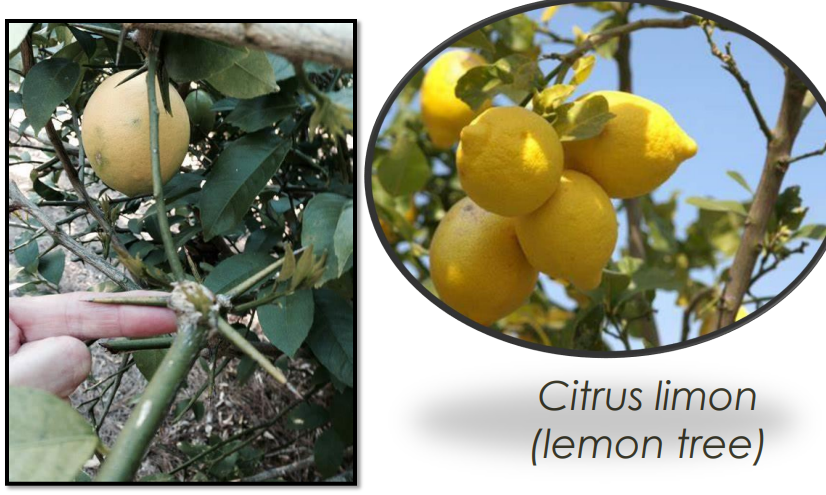
These are straight, pointed, hard or woody structures sometimes they bear leaves, flowers or even may be branched.
Roots
Anchor a vascular plant to the soil, absorb minerals and water, and often store carbohydrates
Root System
the subterranean or underground part of the plant body
Shoot
the aboveground part of the plant body
Geotropism
a coordinated process of differential growth by a plant in response to gravity pulling on it.
Buttress
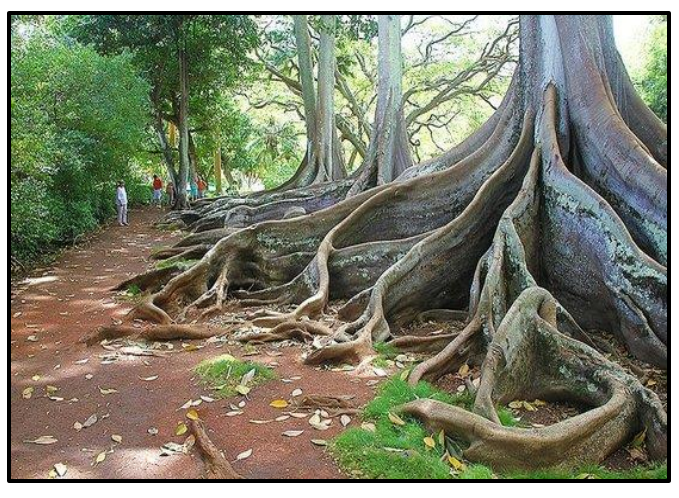
are aerial extensions of lateral surface roots and form only in certain species. These roots stabilize the tree, especially in shallow saturated soils, thereby resisting toppling.
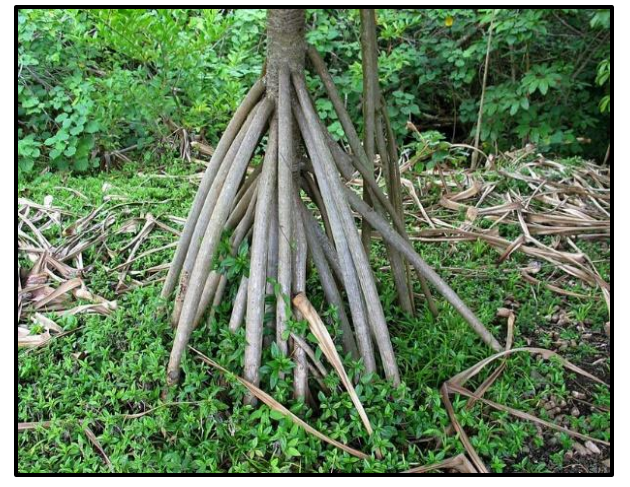
Prop Roots
Any of the modified roots that arise from the stem of certain plants and provide extra support.
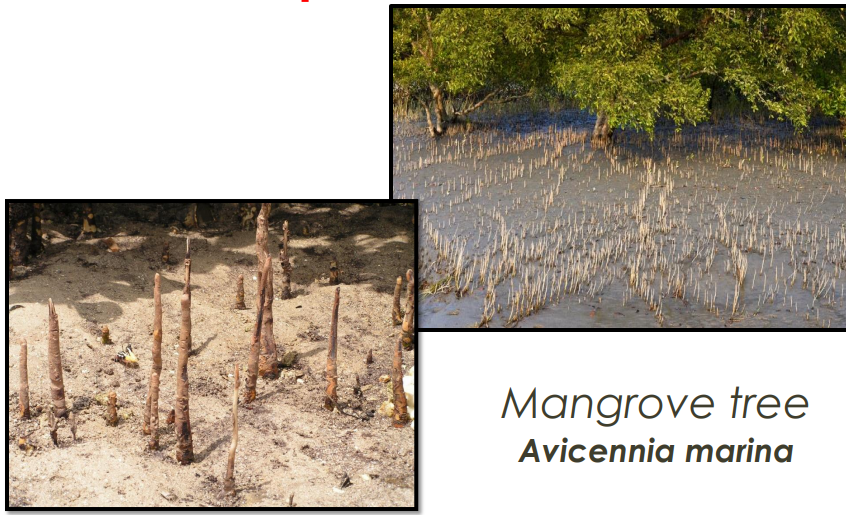
Pneumatophores
An aerial root specialized for gaseous exchange.
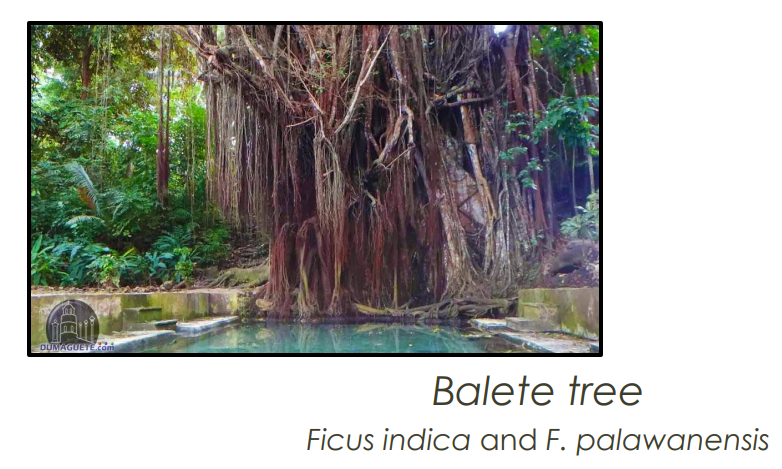
Aerial/Strangling Root
extend to the ground, supporting the growing plant, which eventually strangles the host tree.
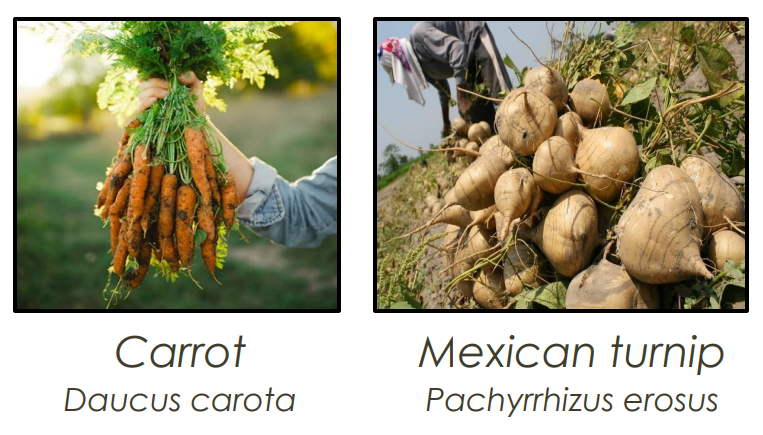
Storage Roots
the taproot becomes enlarged and swollen due to the storage of food.
Calyx
This is the outermost whorl of the flower which consists of sepals.
Sepals
This is usually green and they enclose and protect the developing bud
Corolla
The whorl next to calyx which consists of petals, which usually help to attract the pollinators.
Androecium
The whorl next to the corolla which consists of male organs called stamens.
Stamen
This consists of a slender stalk or filament attached to the flower at its base and carrying on its free, upper end, a structure called an anther, which contains the pollen.
Gynoecium
The innermost whorl of the flower which consists of the female organs called carpels.
Carpel
This consists of a basal ovary containing the ovules, a slender column-shaped structure, the style, and on the end of the style the stigma, the function of which is to receive the pollen grains.
Style
Part of a flower that is a slender column-shaped structure
Stigma
Part of the flower and the function of which is to receive the pollen grains.
Fruit
the fleshy or dry ripened ovary of a flowering plant, enclosing the seed or seeds.
Exocarp
refers to the outermost layer of the pericarp—which is variously called the skin, rind, peel, or husk of a fruit—that covers the mesocarp
Mesocarp
refers to the middle layer of a fruit, the usually fleshy plump part.
Endocarp
is the name for the inner region of the pericarp and can consist of layers of different textures or consistency that surround and protect the seed
Drupe
a type of fleshy fruit containing a large seed, for example, peaches, cherries, and apricots. Botanically, other types of drupe that could also be a classified under this category are some berries.
Berries
a fleshy fruit formed from the ovary of one flower with a seed or seeds embedded in the flesh.
Pomes
fruits in this category have a fleshy area surrounding a core containing seeds.
Hesperidia
fruits have a thick tangy rind and sectioned pulp inside
Pepo
fruits have multiple seeds throughout the flesh or grouped together in the center.
Rhizome
Corm
Tubers
Runner/Stolon
Sucker
Offset
Thorns
Buttress
Prop Roots
Pneumatophores
Aerial/Strangling Roots
Storage Roots
Dicotyledons
They show the following distinguishing characteristics:
We see taproots in the members of this group.
The leaves in members of these class exhibit reticulate (net-like) venation.
The flowers are tetramerous or pentamerous having four or five members in the various floral whorls, respectively.
The vascular bundles arranged in a ring, number 2–6, open and with cambium.
The seeds of dicotyledons are with two cotyledons as the name indicate.
Monocotyledons
They show following distinguishing characteristics:
We see adventitious roots in the members of this group.
The leaves are simple with parallel venation.
The flowers are trimerous. They have three members in each floral whorl.
The vascular bundles scattered in the ground tissue, many in number, closed and without cambium.
The seeds of monocotyledons are with one cotyledon as the name indicates. e.g., Cereals, bamboos, sugarcane, palms, banana, lilies and orchids.
Taproot System
consists of a primary root that grows deep into the soil, with smaller lateral roots branching off. It provides strong anchorage and is common in dicot plants like carrots and dandelions.
Fibrous Root System
consists of many thin, branching roots that spread out near the surface. It provides good soil grip and is common in monocot plants like grass and wheat.