Chapter 8: DNA/Genetics

0.0(0)
Studied by 4 people
call kaiCall Kai
learnLearn
examPractice Test
spaced repetitionSpaced Repetition
heart puzzleMatch
flashcardsFlashcards
GameKnowt Play
Card Sorting

1/45

encourage image

There's no tags or description

Looks like no tags are added yet.

Last updated 11:39 PM on 4/4/26
Name
Mastery
Learn
Test
Matching
Spaced
Call with Kai

No analytics yet

Send a link to your students to track their progress

46 Terms

1
New cards

How do we know that DNA is the hereditary molecule?

The process by which cells use hereditary information stored in DNA is very elegant.

  • DNA must be retained intact, yet copied to make new cells (DNA replication).

  • It must be turned into multiple “working copies” in the form of RNA to provide instructions to produce enzymes/structural proteins (transcription).

  • The RNA molecules must be read and decoded to form the enzymes/structural proteins of the cell (translation).

  • The systems must have the ability to deal with damage to the core DNA molecules of the cell (DNA repair).

2
New cards

What was the discovery of DNA and its role (The Griffith Experiment - 1920s)?

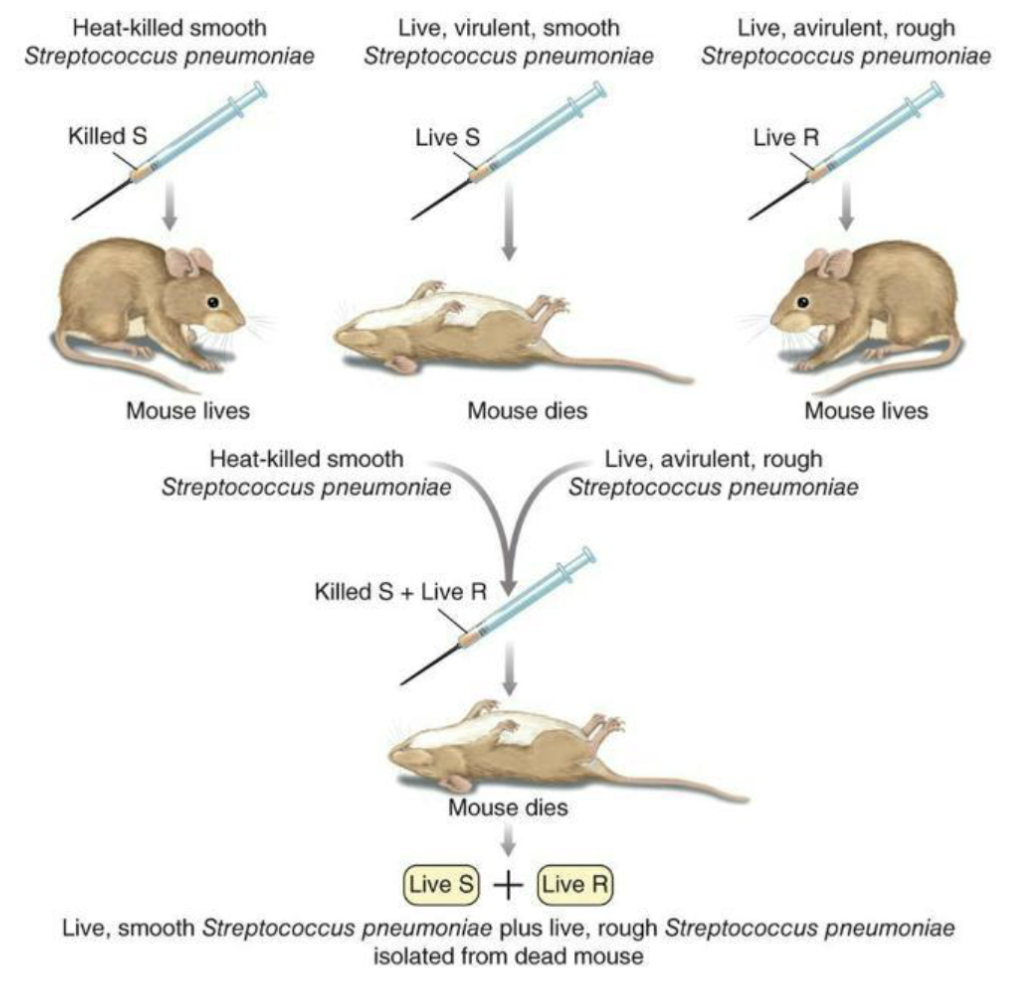
  • The Griffith Experiment (1920s): One of the earliest evidence that DNA may be the hereditary information in the cell

Image

Bacterial strains

  • S strain (smooth): Has polysaccharide capsule, Virulent (causes disease)

  • R strain (rough): No capsule, Avirulent (non-disease causing)

Experimental results

  1. Heat-killed S strain → Mouse lives

    • Bacteria are dead → no infection.

  2. Live S strain → Mouse dies

    • Capsule protects bacteria from immune system → infection.

  3. Live R strain → Mouse lives

    • No capsule → immune system destroys bacteria.

  4. Heat-killed S + Live R → Mouse dies

    • Unexpected result.

    • Live S bacteria recovered from mouse.

Key conclusion

  • DNA from dead S bacteria → taken up by R bacteria → R becomes virulent S.

Biological significance

  • Demonstrated bacterial transformation (genetic information transfer).

  • Suggested heritable traits can be transferred between cells.

  • Transformation: uptake of foreign DNA by a bacterial cell that changes its phenotype.
<ul><li><p>The Griffith Experiment (1920s): One of the earliest evidence that DNA may be the hereditary information in the cell</p></li></ul><p><u>Image</u></p><p><strong>Bacterial strains</strong></p><ul><li><p>S strain (smooth): Has polysaccharide capsule, Virulent (causes disease)</p></li><li><p>R strain (rough): No capsule, Avirulent (non-disease causing)</p></li></ul><p><strong>Experimental results</strong></p><ol><li><p>Heat-killed S strain → Mouse lives</p><ul><li><p>Bacteria are dead → no infection.</p></li></ul></li><li><p>Live S strain → Mouse dies</p><ul><li><p>Capsule protects bacteria from immune system → infection.</p></li></ul></li><li><p>Live R strain → Mouse lives</p><ul><li><p>No capsule → immune system destroys bacteria.</p></li></ul></li><li><p>Heat-killed S + Live R → Mouse dies</p><ul><li><p>Unexpected result.</p></li><li><p>Live S bacteria recovered from mouse.</p></li></ul></li></ol><p><strong>Key conclusion</strong></p><ul><li><p>DNA from dead S bacteria → taken up by R bacteria → R becomes virulent S.</p></li></ul><p><strong>Biological significance</strong></p><ul><li><p>Demonstrated bacterial transformation (genetic information transfer).</p></li><li><p>Suggested heritable traits can be transferred between cells.</p></li><li><p>Transformation: uptake of foreign DNA by a bacterial cell that changes its phenotype.</p></li></ul><p></p>
3
New cards

What was the discovery of DNA and its role (The Avery, MacLeod, and McCarty Experiment - 1940s)?

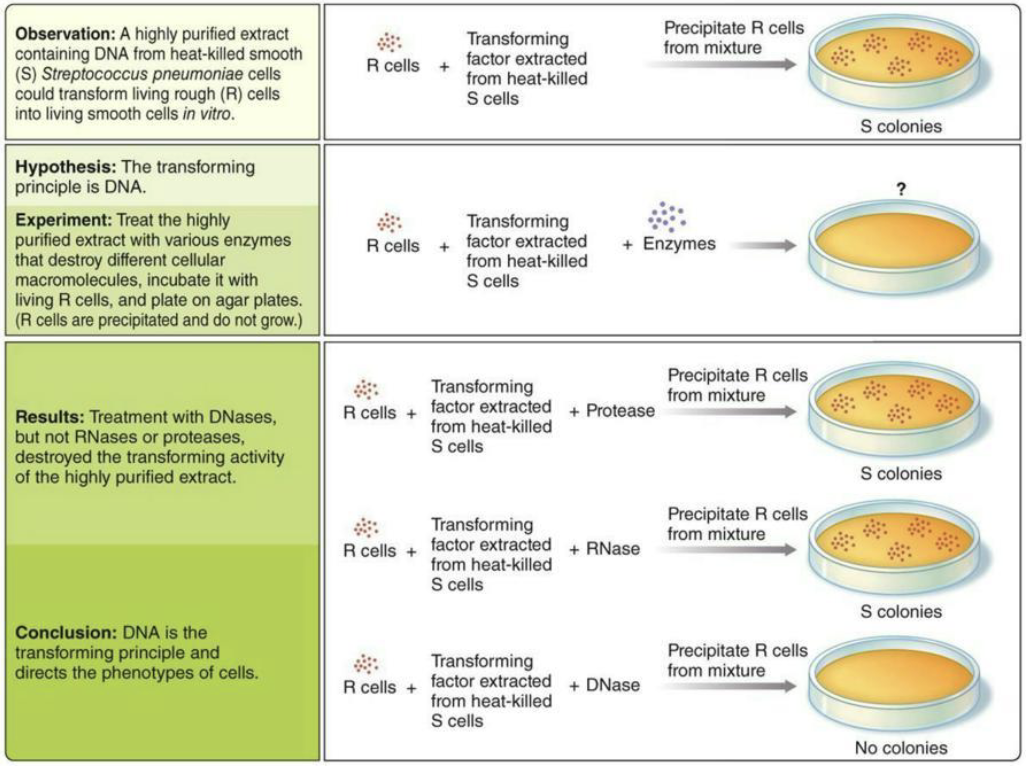
  • The Avery, MacLeod and McCarty Experiment (1940s): Is DNA, RNA or protein the causative agent of the “transformation” effect observed by Griffith

Image

  • Tested what molecule caused transformation in Streptococcus pneumoniae.

  • Extract from heat-killed S cells could transform R cells → S cells.

  • Added enzymes that destroy molecules: protease (protein), RNase (RNA), DNase (DNA).

  • Transformation still occurred with protease and RNase, but stopped with DNase.

  • Conclusion: DNA is the transforming principle (genetic material).
<ul><li><p>The Avery, MacLeod and McCarty Experiment (1940s): Is DNA, RNA or protein the causative agent of the “transformation” effect observed by Griffith</p></li></ul><p><u>Image</u></p><ul><li><p>Tested what molecule caused transformation in <span>Streptococcus pneumoniae</span>.</p></li><li><p>Extract from heat-killed S cells could transform R cells → S cells.</p></li><li><p>Added enzymes that destroy molecules: protease (protein), RNase (RNA), DNase (DNA).</p></li><li><p>Transformation still occurred with protease and RNase, but stopped with DNase.</p></li><li><p>Conclusion: DNA is the transforming principle (genetic material).</p></li></ul><p></p>
4
New cards

What was the discovery of DNA and its role (The Hershey-Chase experiment)?

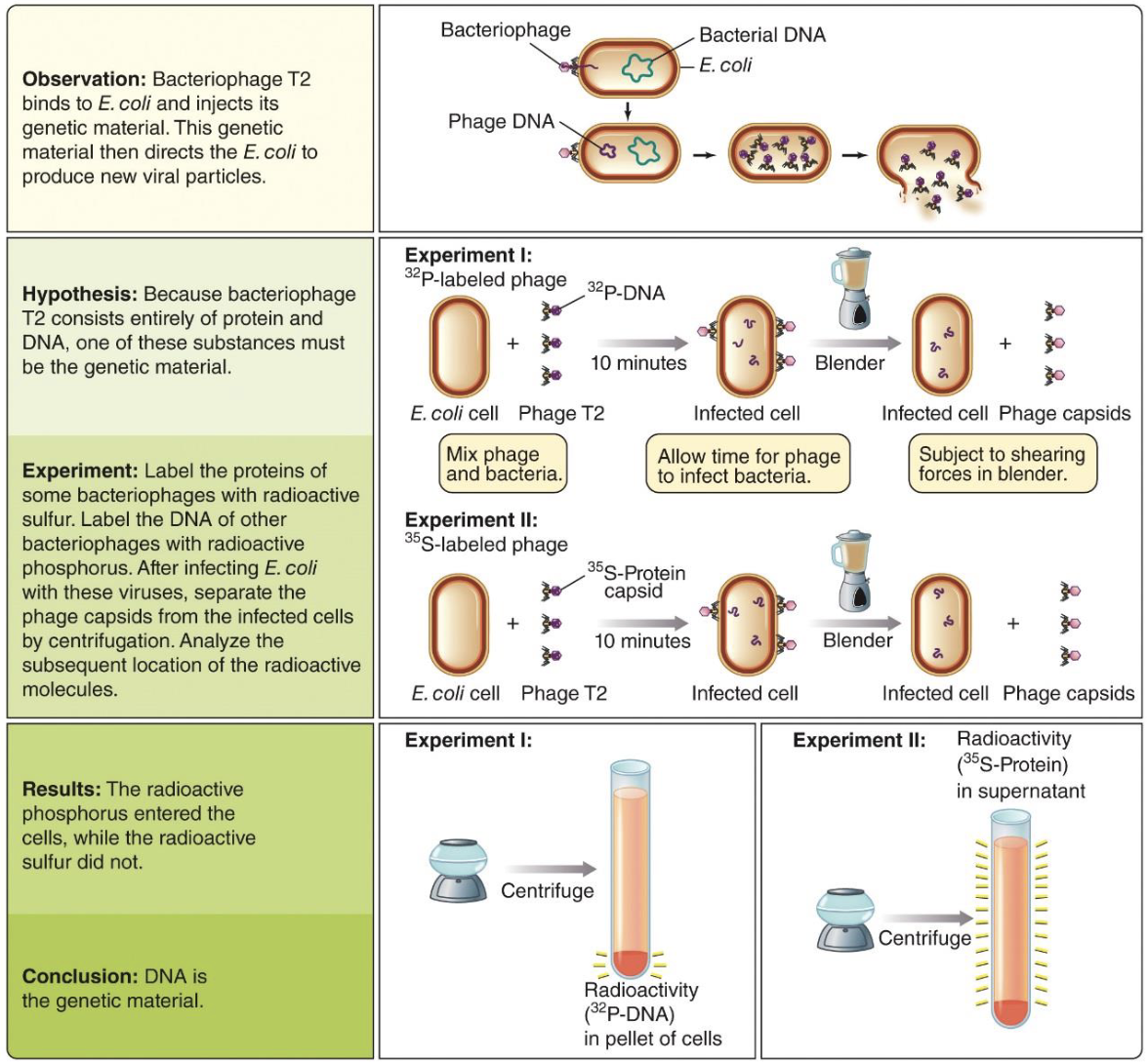
  • The Hershey‒Chase experiment: Radioactive labelling

Image

  • Tested whether DNA or protein is genetic material using Bacteriophage T2 infecting Escherichia coli.

  • Labeled DNA with radioactive phosphorus (³²P) and protein with radioactive sulfur (³⁵S).

  • After infection, used a blender and centrifuge to separate phage coats from bacteria.

  • ³²P (DNA) entered the cells, while ³⁵S (protein) stayed outside.

  • Conclusion: DNA is the genetic material.
<ul><li><p>The Hershey‒Chase experiment: Radioactive labelling</p></li></ul><p><u>Image</u></p><ul><li><p>Tested whether DNA or protein is genetic material using Bacteriophage T2 infecting Escherichia coli.</p></li><li><p>Labeled DNA with radioactive phosphorus (³²P) and protein with radioactive sulfur (³⁵S).</p></li><li><p>After infection, used a blender and centrifuge to separate phage coats from bacteria.</p></li><li><p>³²P (DNA) entered the cells, while ³⁵S (protein) stayed outside.</p></li><li><p>Conclusion: DNA is the genetic material.</p></li></ul><p></p>
5
New cards

Who discovered the structure of DNA?

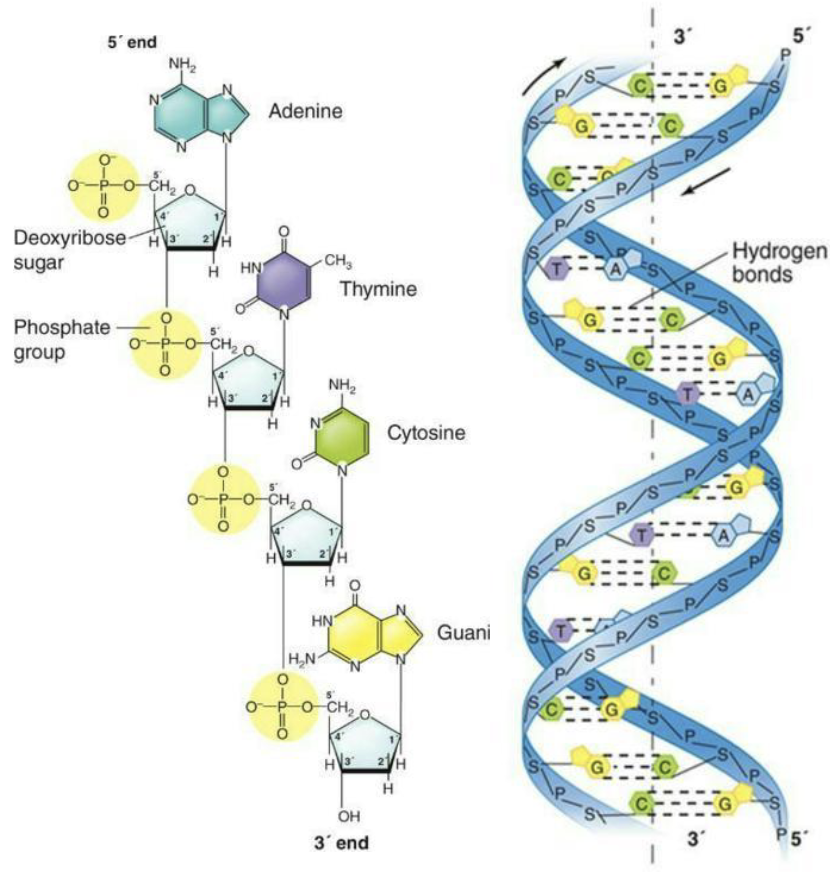
  • Double helix structure of DNA discovered in 1950s by James Watson, Francis Crick and Rosalind Franklin
<ul><li><p>Double helix structure of DNA discovered in 1950s by <strong>James Watson, Francis Crick and Rosalind Franklin</strong></p></li></ul><p></p>
6
New cards

What is the structure of DNA?

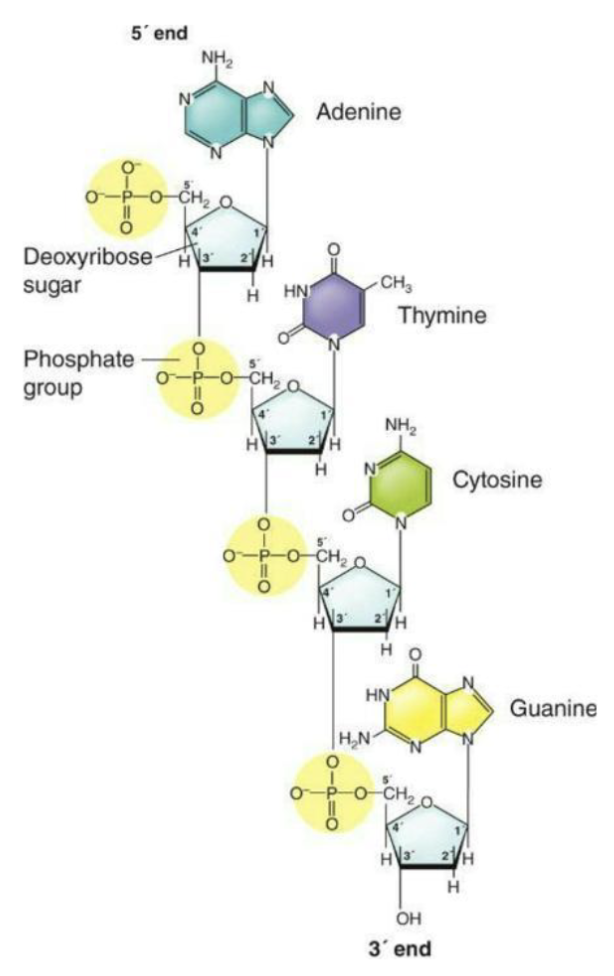
Each nucleotide building block of DNA consists of

  • A five-carbon sugar, 2-deoxyribose

  • A phosphate group attached to the 5' carbon of the sugar

  • A nitrogenous base attached to the 1' carbon of the sugar
<p>Each nucleotide building block of DNA consists of</p><ul><li><p>A five-carbon sugar, 2-deoxyribose</p></li><li><p>A phosphate group attached to the 5' carbon of the sugar</p></li><li><p>A nitrogenous base attached to the 1' carbon of the sugar</p></li></ul><p></p>
7
New cards

How are the two strands linked?

  • One strand of DNA is complementary to the other strand.

  • A pairs with T; G pairs with C by hydrogen bonding.

  • Phosphodiester covalent bonds form the sugar/phosphate backbone of each strand.
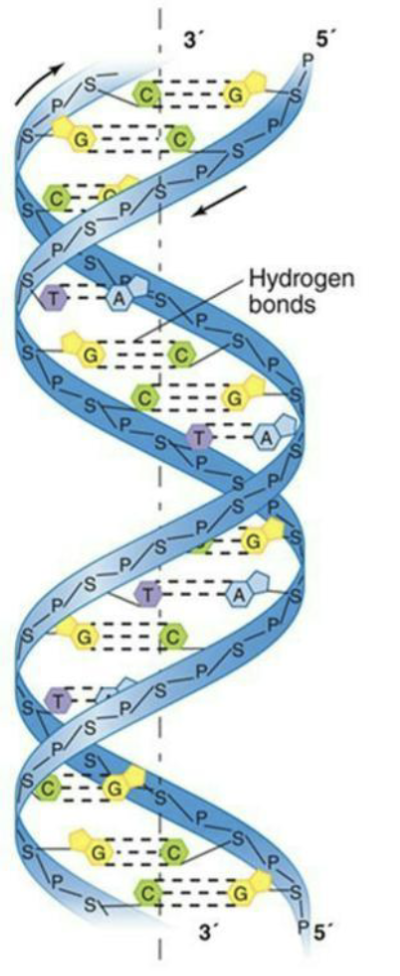
<ul><li><p>One strand of DNA is complementary to the other strand.</p></li><li><p>A pairs with T; G pairs with C by hydrogen bonding.</p></li><li><p>Phosphodiester covalent bonds form the sugar/phosphate backbone of each strand.</p></li></ul><p></p>
8
New cards

How is DNA packaged?

  • Structure of DNA is conserved across the three domains but the way its packaged is not.

    • Bacteria: Single circular chromosome, supercoiled

    • Archaea: Single circular chromosome packaged around histones

    • Eukarya: Multiple linear chromosomes packaged around histones. The wrapping of dsDNA around histones helps compact the very large chromosome structures of eukaryotic cells.
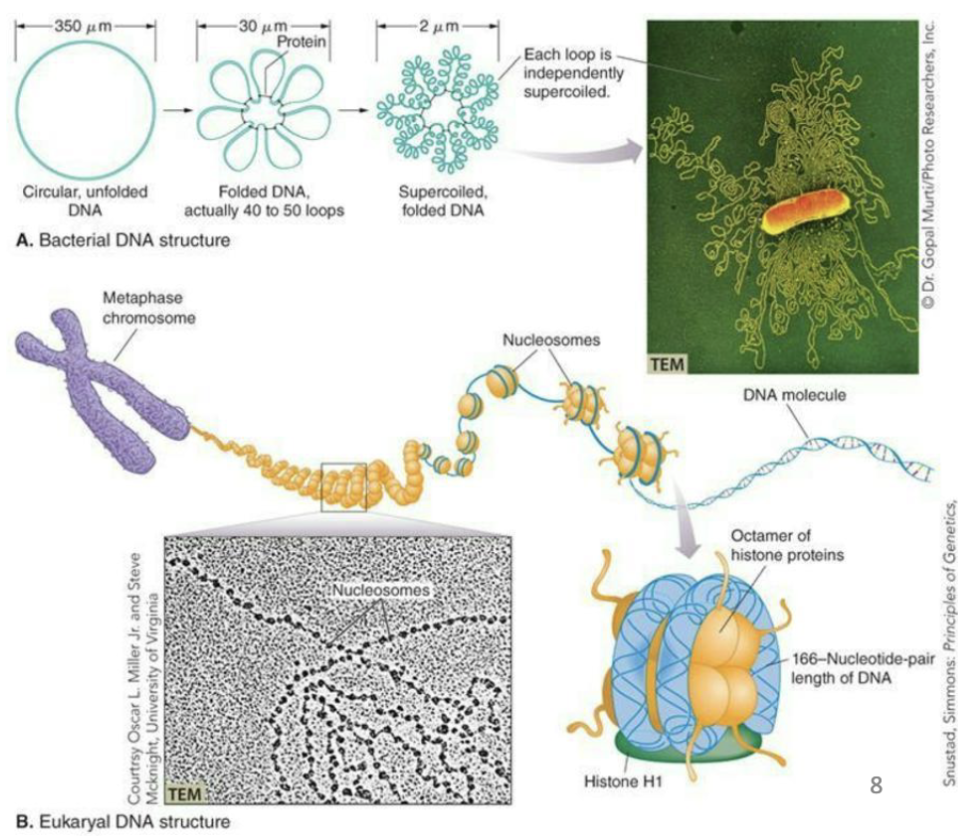
<ul><li><p>Structure of DNA is conserved across the three domains but the way its packaged is not.</p><ul><li><p><strong>Bacteria</strong>: Single circular chromosome, supercoiled</p></li><li><p><strong>Archaea</strong>: Single circular chromosome packaged around histones</p></li><li><p><strong>Eukarya</strong>: Multiple linear chromosomes packaged around histones. The wrapping of dsDNA around histones helps compact the very large chromosome structures of eukaryotic cells. </p></li></ul></li></ul><p></p>
9
New cards

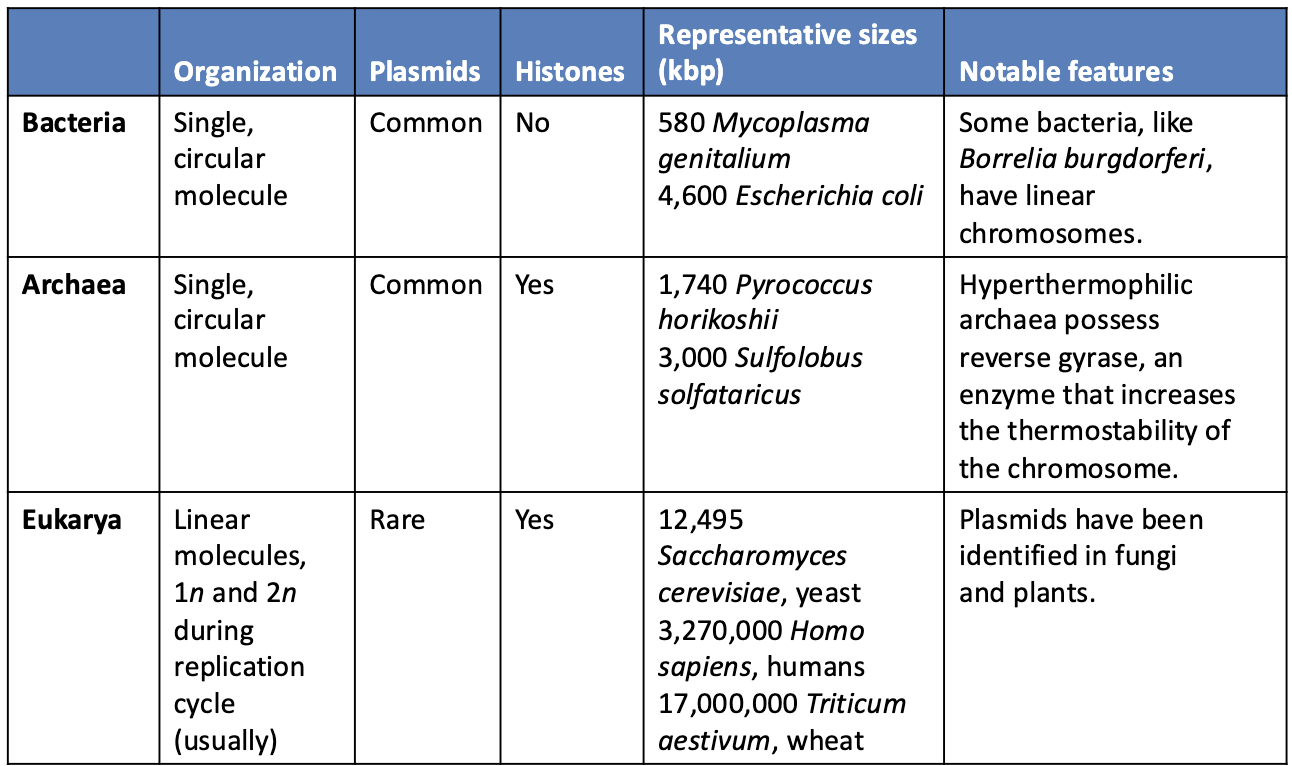
Compare DNA packaging in Bacteria, Archaea, and Eukarya?

Bacteria

  • Single circular chromosome

  • Plasmids common

  • No histones

  • Genome size ~ 580–4,600 kbp

  • Some species (e.g., Borrelia burgdorferi) have linear chromosomes

Archaea

  • Single circular chromosome

  • Plasmids common

  • Histones present

  • Genome size ~ 1,740–3,000 kbp

  • Some hyperthermophiles have reverse gyrase for DNA stability

Eukarya

  • Multiple linear chromosomes

  • Histones present

  • Plasmids rare

  • Usually diploid (2n), haploid (1n) at some stages

  • Genome sizes much larger

    • Saccharomyces cerevisiae ~12,495 kbp

    • Homo sapiens ~3,270,000 kbp

    • Triticum aestivum ~17,000,000 kbp

<p><strong><u>Bacteria</u></strong></p><ul><li><p>Single circular chromosome</p></li><li><p>Plasmids common</p></li><li><p>No histones</p></li><li><p>Genome size ~ 580–4,600 kbp</p></li><li><p>Some species (e.g., Borrelia burgdorferi) have linear chromosomes</p></li></ul><p><strong><u>Archaea</u></strong></p><ul><li><p>Single circular chromosome</p></li><li><p>Plasmids common</p></li><li><p>Histones present</p></li><li><p>Genome size ~ 1,740–3,000 kbp</p></li><li><p>Some hyperthermophiles have reverse gyrase for DNA stability</p></li></ul><p><strong><u>Eukarya</u></strong></p><ul><li><p>Multiple linear chromosomes</p></li><li><p>Histones present</p></li><li><p>Plasmids rare</p></li><li><p>Usually diploid (2n), haploid (1n) at some stages</p></li><li><p>Genome sizes much larger</p><ul><li><p>Saccharomyces cerevisiae ~12,495 kbp</p></li><li><p>Homo sapiens ~3,270,000 kbp</p></li><li><p>Triticum aestivum ~17,000,000 kbp</p></li></ul></li></ul><p></p>
10
New cards

What are exceptions to DNA packaging?

  • D. radiodurans may possess 4 to 10 copies of its genome.

  • The stacked genome copies may help give this bacterium its strong radiation-damage-resistance trait
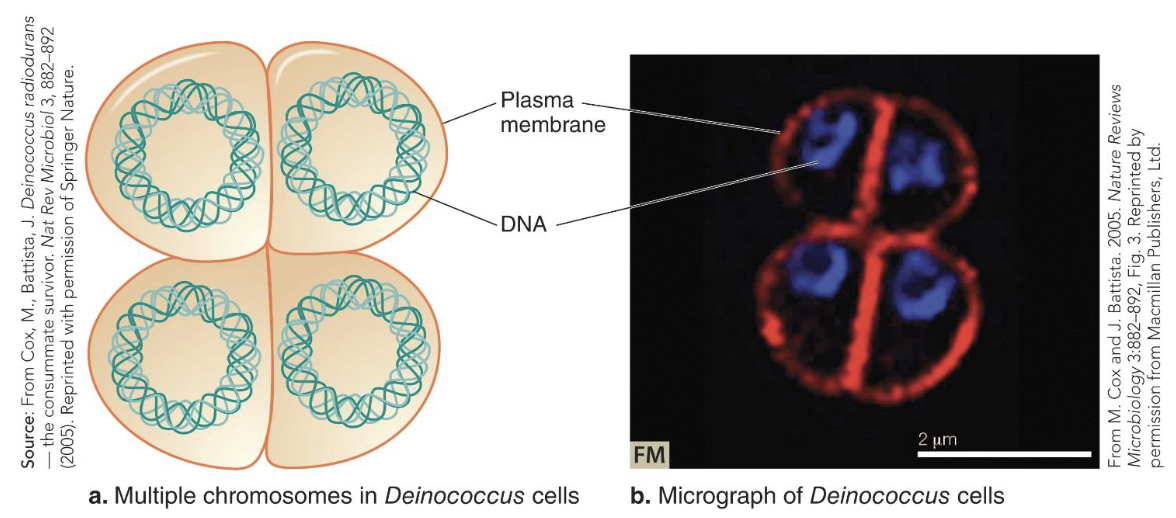
<ul><li><p><em>D. radiodurans</em> may possess 4 to 10 copies of its genome.</p></li><li><p>The stacked genome copies may help give this bacterium its strong radiation-damage-resistance trait</p></li></ul><p></p>
11
New cards

What does it mean by DNA replication is semi-conservative?

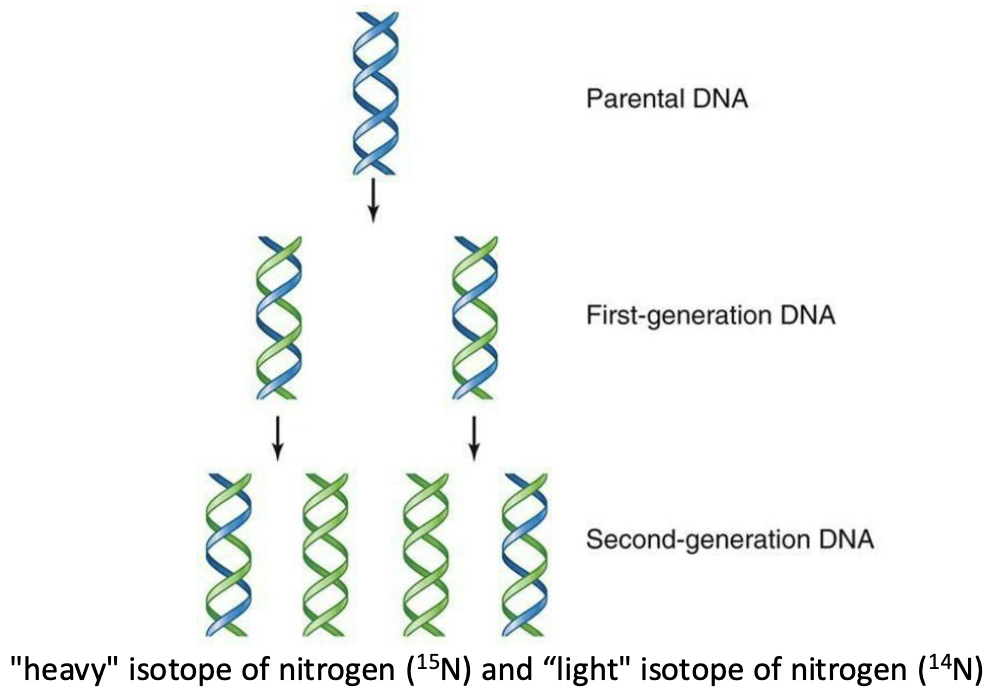
  • DNA replication is semi-conservative: each strand of a newly copied DNA molecule contains one strand form the original molecule and one newly synthesized

  • Meselson and Stahl Experiment: Showed that DNA replicates semi-conservatively by growing bacteria first in heavy nitrogen (¹⁵N) and then in light nitrogen (¹⁴N) and observing that new DNA molecules contain one old strand and one new strand
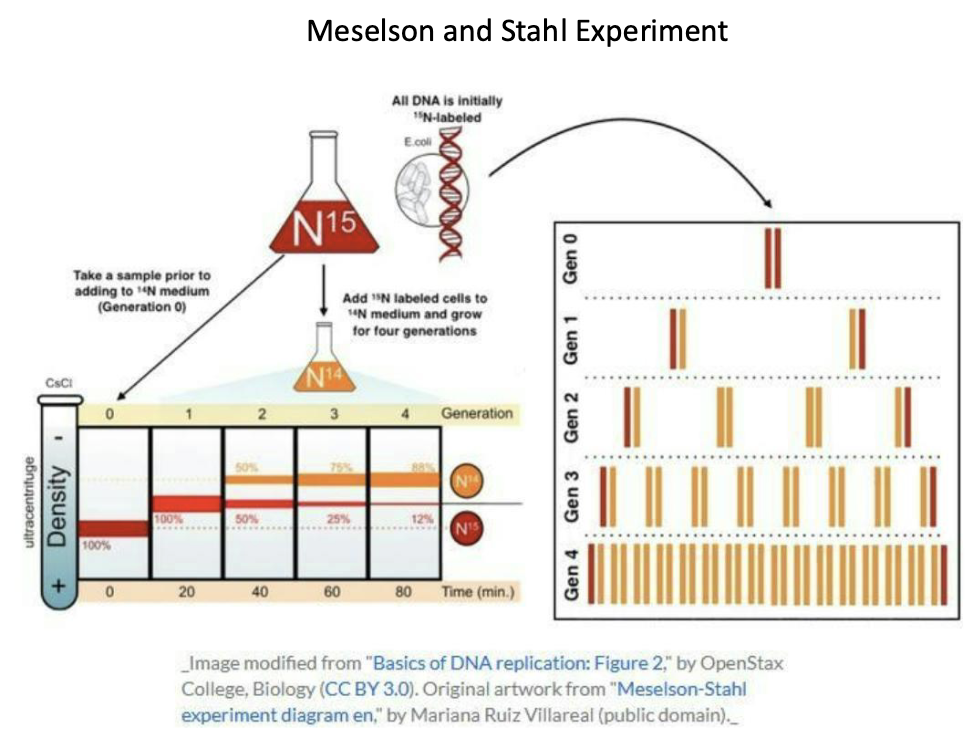
<ul><li><p>DNA replication is <strong><em>semi-conservative:</em></strong> each strand of a newly copied DNA molecule contains one strand form the original molecule and one newly synthesized</p></li><li><p>Meselson and Stahl Experiment: Showed that DNA replicates semi-conservatively by growing bacteria first in heavy nitrogen (¹⁵N) and then in light nitrogen (¹⁴N) and observing that new DNA molecules contain one old strand and one new strand</p></li></ul><img src="https://assets.knowt.com/user-attachments/797c4465-9df4-4fa7-b5e1-d726605f7684.png" data-width="75%" data-align="center"><p></p>
12
New cards

What is the initiation of DNA replication?

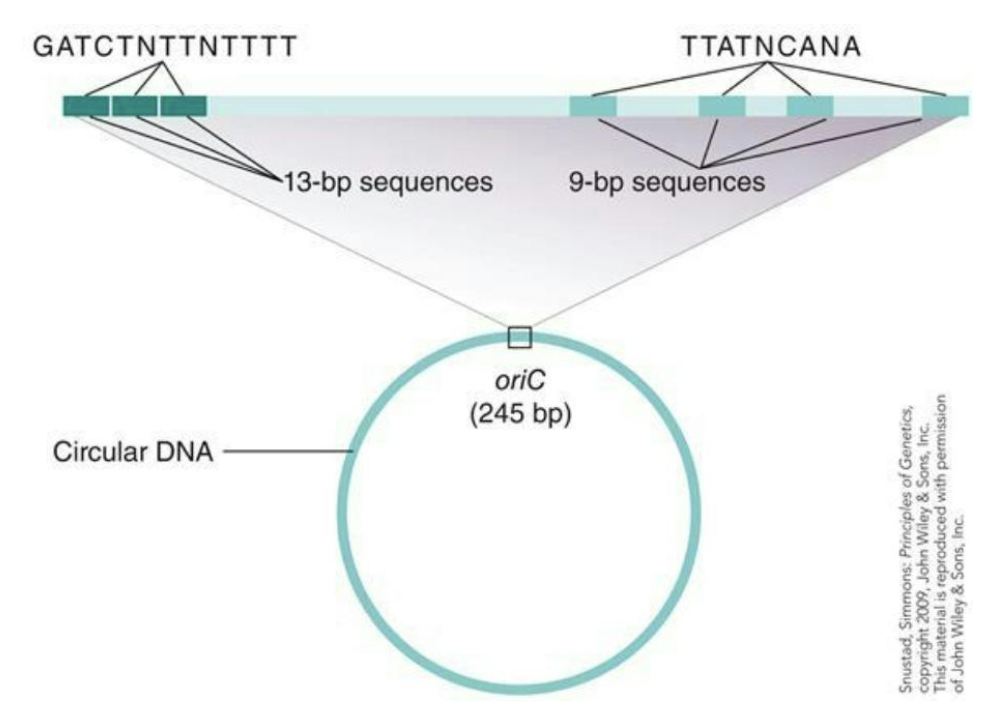
  • In bacteria DNA replication begins at a specific sequence in the molecule called the origin of replication (oriC)

  • Jacob Brenner and Cousin discovered how DNA was replicated in E.coli and oriC
<ul><li><p>In bacteria DNA replication begins at a specific sequence in the molecule called the<strong><em> origin of replication (oriC)</em></strong></p></li><li><p>Jacob Brenner and Cousin discovered how DNA was replicated in <em>E.coli </em>and oriC</p></li></ul><p></p>
13
New cards

What are the origins of replication?

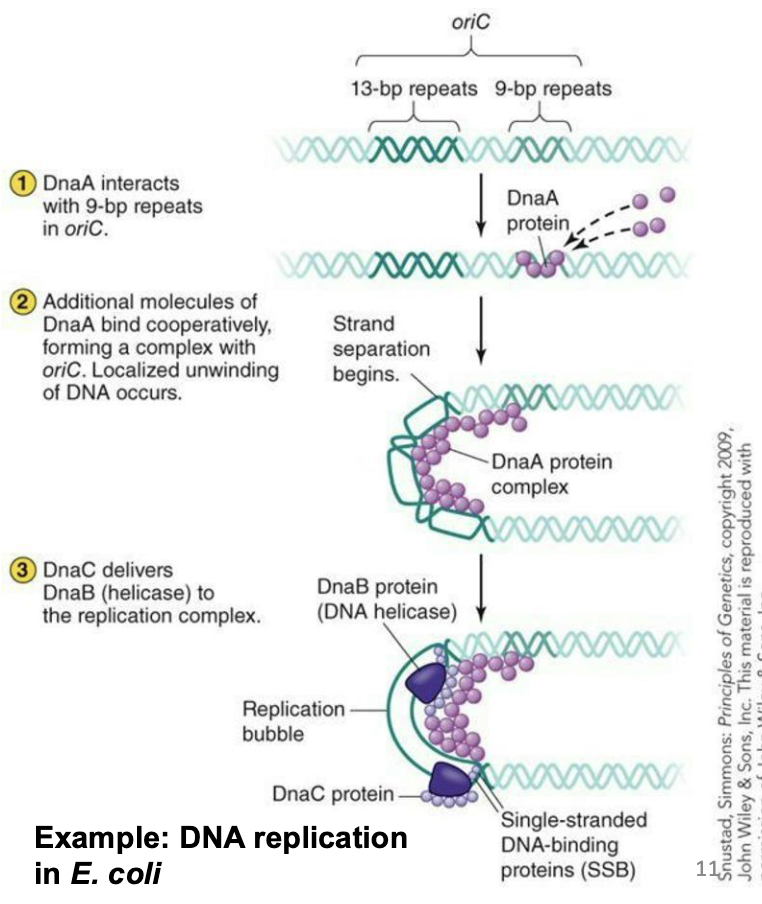
  • DnaA protein binds to oriC.

  • DnaB (a helicase) is recruited with DnaC (a helicase loader).

  • DnaG (a primase) is recruited to lay down initial RNA primers needed for DNA polymerases to work.

  • Single-stranded DNA binding proteins are recruited to help keep the DNA unwound.
<ul><li><p><strong><em>DnaA </em></strong>protein binds to oriC.</p></li><li><p><strong><em>DnaB</em></strong> (a helicase) is recruited with <strong><em>DnaC</em></strong> (a helicase loader).</p></li><li><p><strong><em>DnaG</em></strong> (a primase) is recruited to lay down initial RNA primers needed for DNA polymerases to work.</p></li><li><p>Single-stranded DNA binding proteins are recruited to help keep the DNA unwound.</p></li></ul><p></p>
14
New cards

What is an example of Eukaryotic replication initiation?

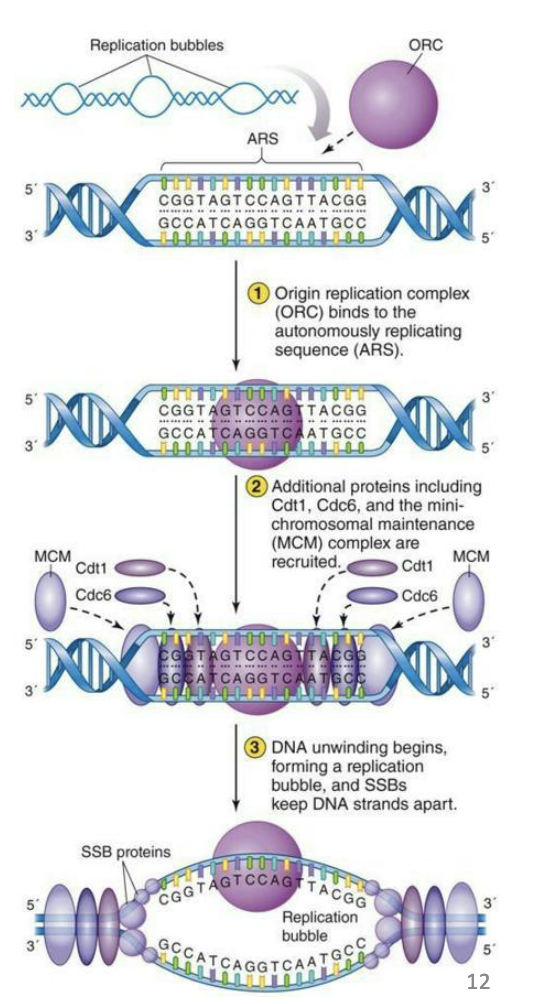
  • Multiple origins of replication on each chromosome.

  • ARS – 10 -100 kb apart

  • Chromosomes are much larger, so they need multiple starting points for replication.

  • Studied in yeast.

  • Very similar to process in bacteria, just using different proteins.
<ul><li><p>Multiple origins of replication on each chromosome.</p></li><li><p>ARS – 10 -100 kb apart</p></li><li><p>Chromosomes are much larger, so they need multiple starting points for replication.</p></li><li><p>Studied in yeast.</p></li><li><p>Very similar to process in bacteria, just using different proteins.</p></li></ul><p></p>
15
New cards

What is elongation in DNA replication?

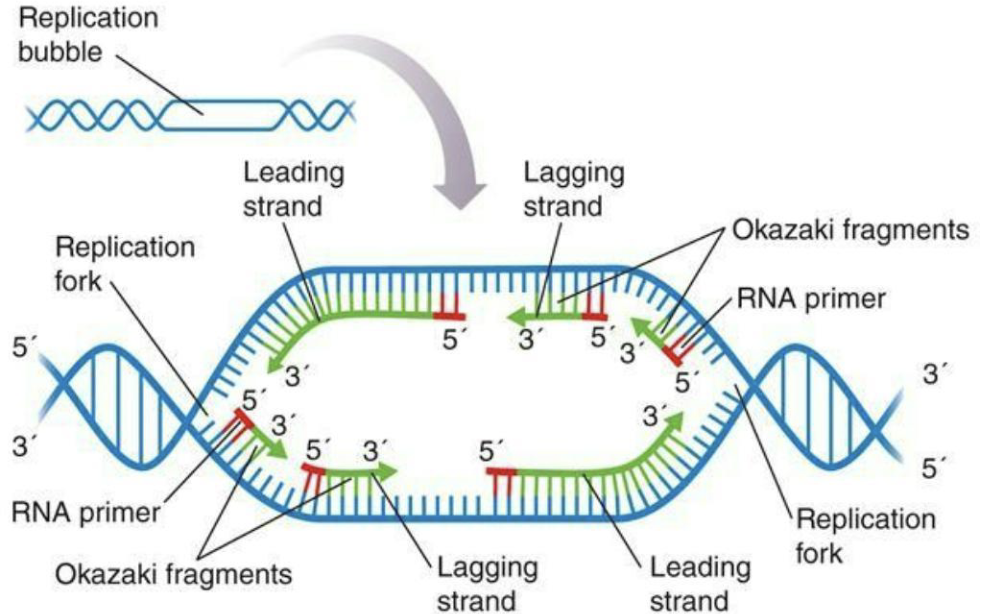
  • Initiation and elongation: DNA polymerase III adds nucleotides to RNA primers (synthesized by primase)

  • Continuous leading strand and discontinuous lagging strand (forming Okazaki fragments)
<ul><li><p>Initiation and elongation: DNA polymerase III adds nucleotides to RNA primers (synthesized by primase)</p></li><li><p><strong><em>Continuous</em></strong> leading strand and <strong><em>discontinuous</em></strong> lagging strand (forming Okazaki fragments)</p></li></ul><p></p>
16
New cards

What is at each replication fork?

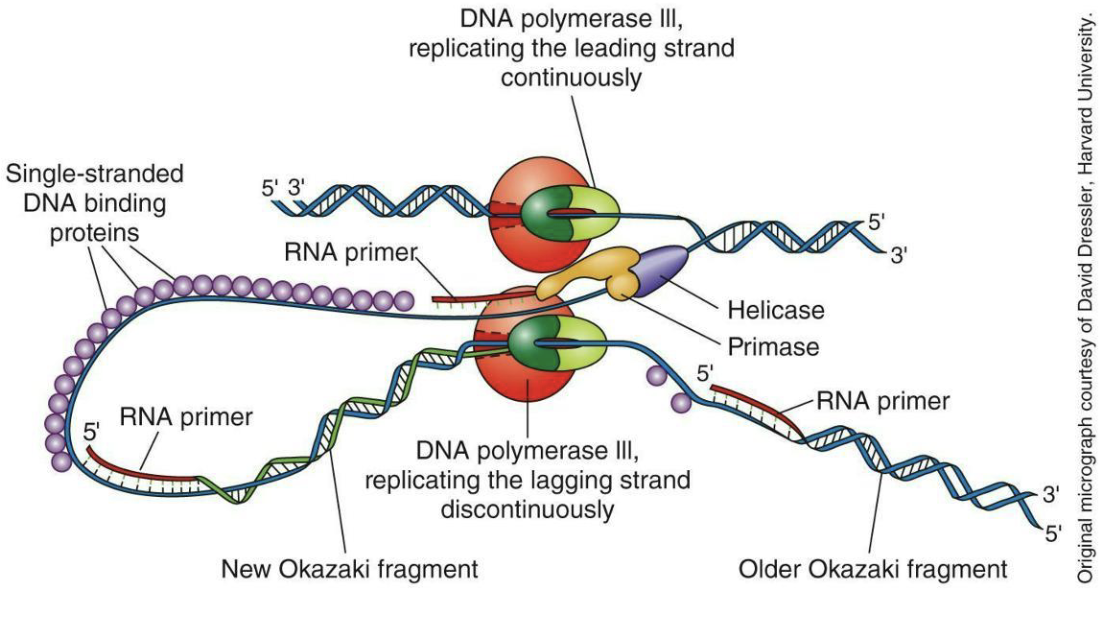
  • Initiation and elongation: DNA polymerase III adds nucleotides to RNA primers (synthesized by primase)

  • Continuous leading strand and discontinuous lagging strand at each replicating fork - a single fork is shown below
<ul><li><p>Initiation and elongation: DNA polymerase III adds nucleotides to RNA primers (synthesized by primase)</p></li><li><p><strong><em>Continuous</em></strong> leading strand and <strong><em>discontinuous</em></strong> lagging strand at each replicating fork - a single fork is shown below</p></li></ul><p></p>
17
New cards

What is the role of DNA ligase in elongation?

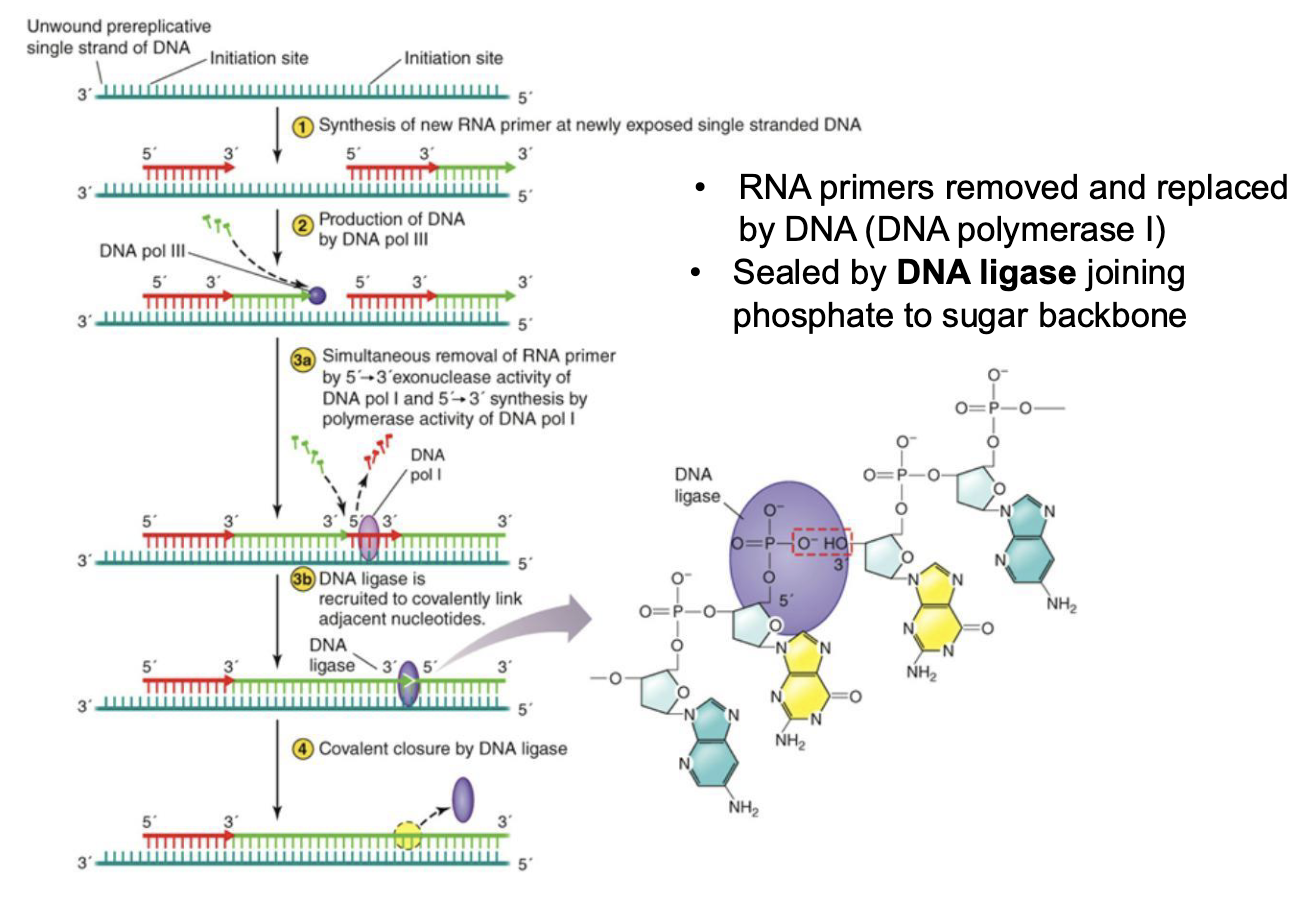
  • RNA primers removed and replaced by DNA (DNA polymerase I)

  • Sealed by DNA ligase joining phosphate to sugar backbone
<ul><li><p>RNA primers removed and replaced by DNA (DNA polymerase I)</p></li><li><p>Sealed by <strong><em>DNA ligase</em></strong> joining phosphate to sugar backbone</p></li></ul><p></p>
18
New cards

What are the interesting features regarding DNA replication?

  • Processivity ..... the ability of DNA polymerase to carry out continuous DNA synthesis on a template DNA without dissociation. A sliding DNA clamp protein or clamp processivity factor, is found in prokaryotes, eukaryotes and archaea. In E. coli β clamp –

  • E. coli DNA polymerase can synthesize as fast as ~ 1000 bp per second

  • Without proof reading – 1 error in 107 bp

  • With proofreading 1/109 nucleotides

19
New cards

What is termination in DNA replication?

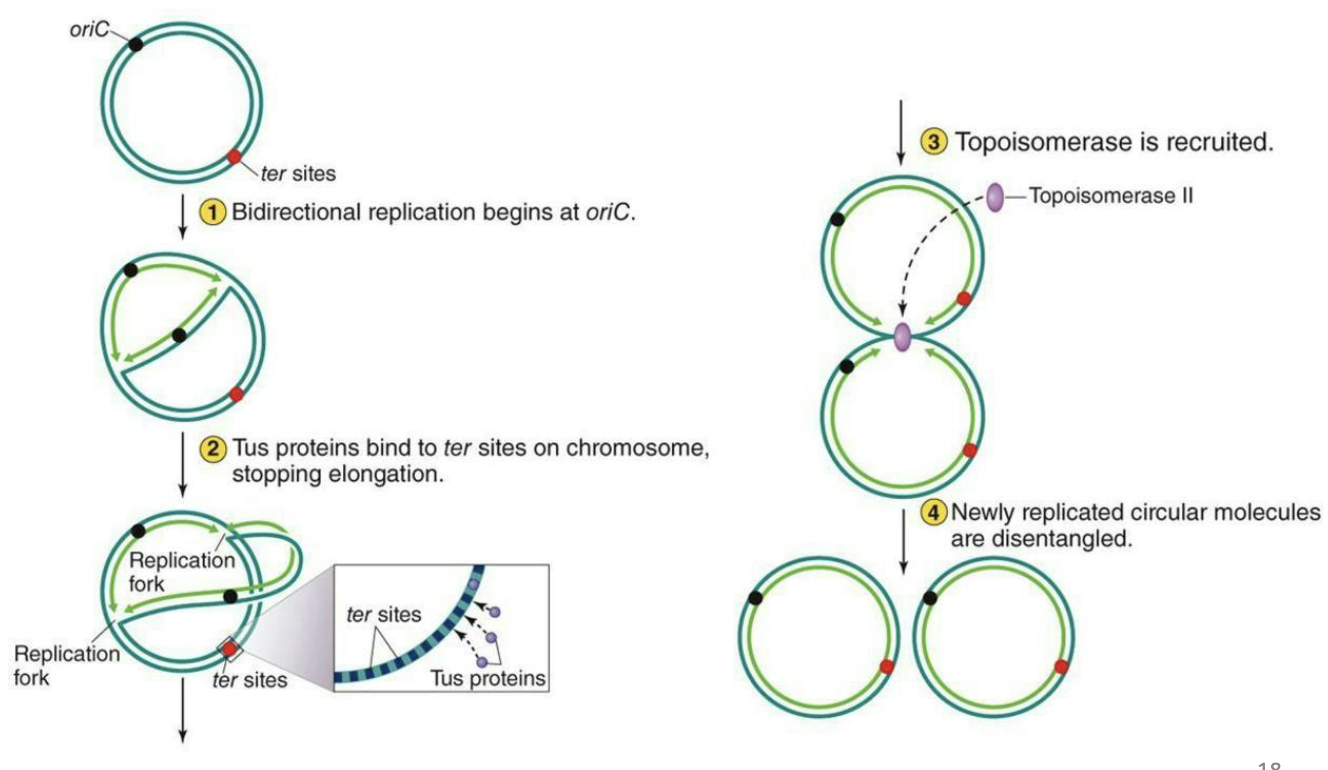
  • Termination of circular chromosome replication

    • 1) Bidirectional replication begins at oriC

    • 2) Tus proteins bind to ter sites on the chromosome, stopping elongation

    • 3) Topoisomerase is recruited

    • 4) Newly replicated circular molecules are disentangled
<ul><li><p>Termination of circular chromosome replication</p><ul><li><p>1) Bidirectional replication begins at <em>oriC</em></p></li><li><p>2) Tus proteins bind to <em>ter</em> sites on the chromosome, stopping elongation</p></li><li><p>3) Topoisomerase is recruited</p></li><li><p>4) Newly replicated circular molecules are disentangled </p></li></ul></li></ul><p></p>
20
New cards

What are the steps of linear termination?

  1. RNa primer removed

  2. RNA primer removal produces 5' end that cannot be extended by DNA polymerase.

  3. Telomerase binds.

  4. Telomerase extends 3' end (RNA-templated DNA synthesis).

  5. Translocation

  6. Repeat extension and translocation several times; release telomerase.

  7. Completion of the complementary strand by DNA polymerase (DNA-templated DNA synthesis)

  8. DNA ligase is recruited to link adjacent nucleotides.
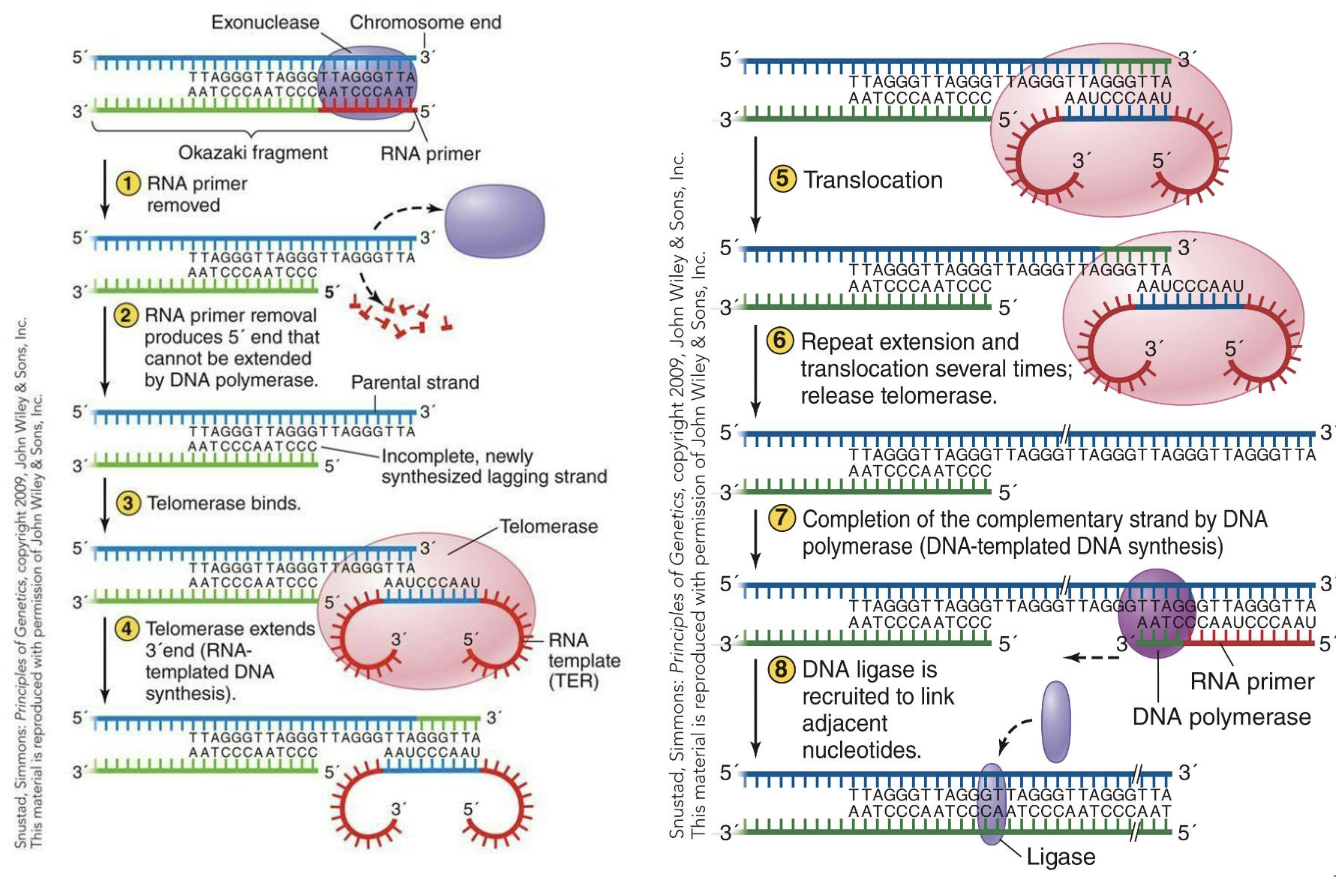
<ol><li><p>RNa primer removed</p></li><li><p>RNA primer removal produces 5' end that cannot be extended by DNA polymerase.</p></li><li><p>Telomerase binds.</p></li><li><p>Telomerase extends 3' end (RNA-templated DNA synthesis).</p></li><li><p>Translocation</p></li><li><p>Repeat extension and translocation several times; release telomerase.</p></li><li><p>Completion of the complementary strand by DNA polymerase (DNA-templated DNA synthesis)</p></li><li><p>DNA ligase is recruited to link adjacent nucleotides.</p></li></ol><p></p>
21
New cards

Summary

  • Experiments by Griffith (~1920) and Avery, McLeod and McCarty (~ 1940) showed DNA from one organism could alter (transform) the characteristics of another

  • DNA (A,T,C,G) is organized as antiparallel, complementary strands that form a double helix

  • DNA replication is semi-conserative

  • Begins at origin of replication, with proteins forming a replication bubble – one oriC in bacteria multiple in eukaryotic chromosomes

  • DNA polymerase extends an RNA primer by adding nucleotides to the 3’ end i.e. synthesis is 5’ → 3’

  • Extends continuously on leading strand and discontinuously on lagging strand

  • Ends by disentanglement of circular chromosomes by topoisomerase or extension of linear chromosomes in eukarya by telomerase.

22
New cards

What is Ribonucleic acid?

  • Transcription is the copying of a segment of DNA into single stranded RNA molecule

  • Can be transcribed to messenger, transfer, ribosomal or regulatory RNA molecules
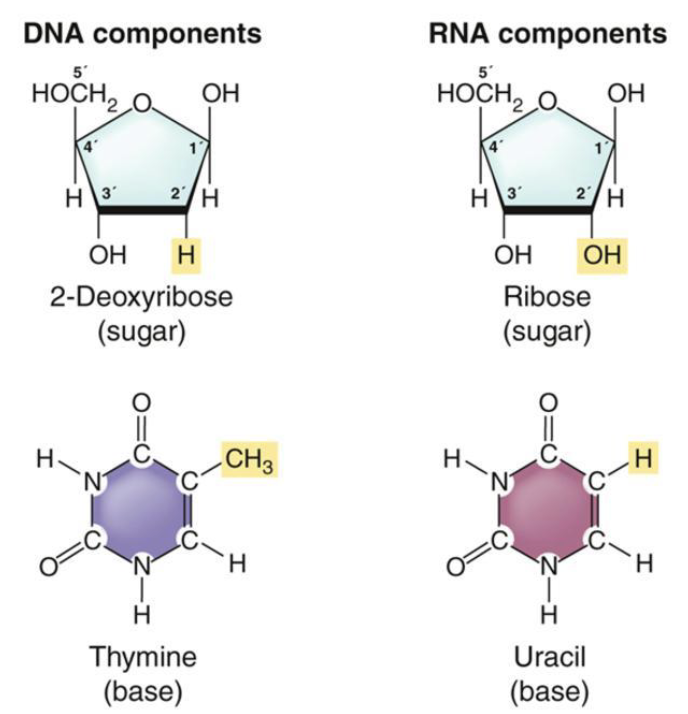
<ul><li><p><strong><em>Transcription</em></strong> is the copying of a segment of DNA into single stranded RNA molecule</p></li><li><p>Can be transcribed to <strong><em>messenger</em></strong>, <strong><em>transfer</em></strong>, <strong><em>ribosomal</em></strong> or <strong><em>regulatory</em></strong> RNA molecules</p></li></ul><p></p>
23
New cards

What is messenger RNA?

  • Messanger RNA (mRNA) are approx. 500-10,000 nucleotides

  • Contains information to translate into proteins (genes)

  • 5’ and 3’ untranslated regions carry features involved in initiating and terminating translation

    • Template strand: the DNA strand RNA polymerase reads to build mRNA.

    • Coding strand: the DNA strand with the same sequence as mRNA (except T → U), not used as the template.

  • Bacterial genes are about 1 Kb in size, but mRNA may be much longer because it is polycistronic (can encode several genes on same RNA)
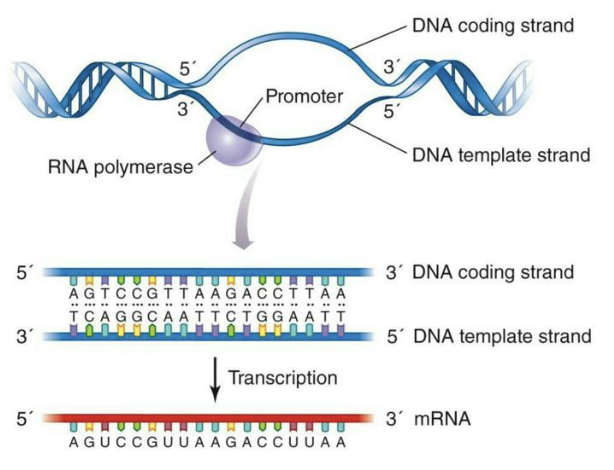
<ul><li><p>Messanger RNA (<strong><em>mRNA</em></strong>) are approx. 500-10,000 nucleotides</p></li><li><p>Contains information to translate into proteins (genes)</p></li><li><p>5’ and 3’ untranslated regions carry features involved in initiating and terminating translation</p><ul><li><p><strong>Template strand: </strong>the DNA strand RNA polymerase reads to build mRNA.</p></li><li><p><strong>Coding strand: </strong>the DNA strand with the same sequence as mRNA (except T → U), not used as the template.</p></li></ul></li><li><p>Bacterial genes are about 1 Kb in size, but mRNA may be much longer because it is <strong><em>polycistronic</em></strong> (can encode several genes on same RNA)</p></li></ul><p></p>
24
New cards

What does the diagram of prokaryotic polycistronic mRNA show?

  • Polycistronic mRNA → one mRNA codes for multiple proteins.

  • 5′ UTR at start; 3′ UTR at end.

  • Shine-Dalgarno sequence = ribosome binding site before each gene.

  • Each protein has its own start codon (AUG) and stop codon (UAG, UAA, UGA).

  • Ribosome can start translation multiple times on the same mRNA → produces Protein 1, 2, 3.
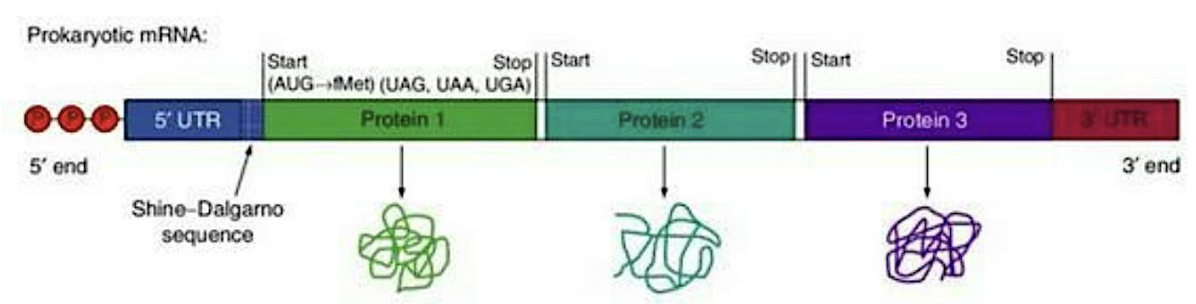
<ul><li><p>Polycistronic mRNA → one mRNA codes for multiple proteins.</p></li><li><p>5′ UTR at start; 3′ UTR at end.</p></li><li><p>Shine-Dalgarno sequence = ribosome binding site before each gene.</p></li><li><p>Each protein has its own start codon (AUG) and stop codon (UAG, UAA, UGA).</p></li><li><p>Ribosome can start translation multiple times on the same mRNA → produces Protein 1, 2, 3.</p></li></ul><p></p>
25
New cards

What is eukaryotic messenger RNA?

  • Eukaryotic genes often contain introns (non-coding regions) (and hence can be extremely large >10 Kb)

  • Introns must be processed and removed before mRNA can be translated
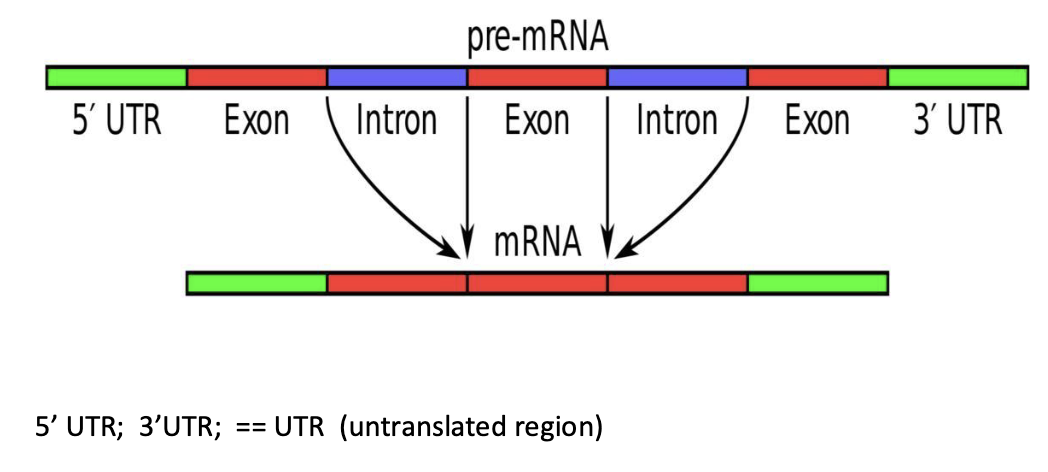
<ul><li><p>Eukaryotic genes often contain <strong><em>introns</em></strong> (non-coding regions) (and hence can be extremely large &gt;10 Kb)</p></li><li><p>Introns must be processed and removed before mRNA can be translated</p></li></ul><p></p>
26
New cards

What is transfer RNA?

  • The transfer RNA (tRNA) are 75 - 100 nucleotides in size

  • Form secondary structures that deliver amino acids to the Ribosomes

  • Note the 3’ to 5’ orientation!!

    • mRNA is read 5′ → 3′ by the ribosome

    • The anticodon on tRNA binds antiparallel, meaning it pairs 3′ → 5′ to the codon
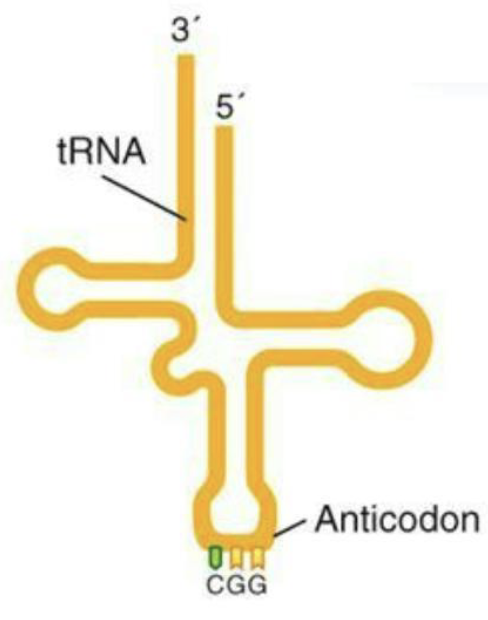
<ul><li><p>The transfer RNA (<strong><em>tRNA</em></strong>) are 75 - 100 nucleotides in size</p></li><li><p>Form secondary structures that deliver amino acids to the Ribosomes</p></li><li><p>Note the 3’ to 5’ orientation!!</p><ul><li><p>mRNA is read 5′ → 3′ by the ribosome</p></li><li><p>The anticodon on tRNA binds antiparallel, meaning it pairs 3′ → 5′ to the codon</p></li></ul></li></ul><p></p>
27
New cards

What is ribosomal RNA?

  • The ribosomal RNA (rRNA) are structural components of ribosomes (about 1500- 1900 nucleotides for small subunits and 2900-4700 nucleotides for large subunits

  • Vary between eukarya and bacteria, but overall similar organization

    • Eukarya 80S Ribosomes: Small 40S + Large 60S

    • Bacteria 70S Rubosomes: Small 30S + Large 50S
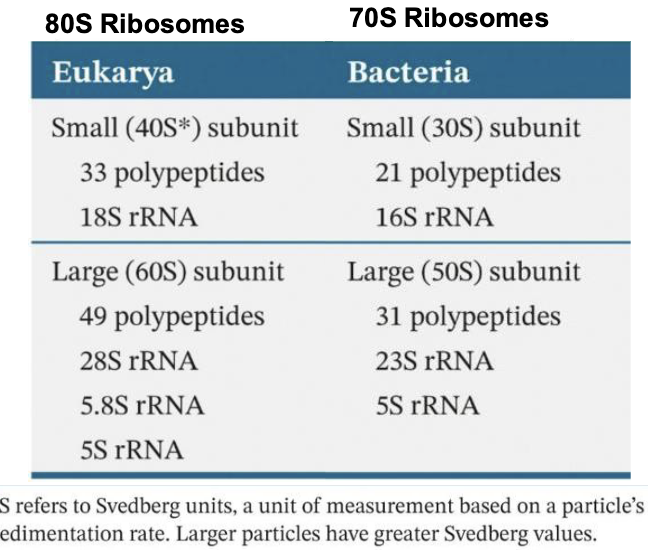
<ul><li><p>The ribosomal RNA (<strong><em>rRNA</em></strong>) are structural components of ribosomes (about 1500- 1900 nucleotides for small subunits and 2900-4700 nucleotides for large subunits</p></li><li><p>Vary between eukarya and bacteria, but overall similar organization</p><ul><li><p>Eukarya 80S Ribosomes: Small 40S + Large 60S</p></li><li><p>Bacteria 70S Rubosomes: Small 30S + Large 50S</p></li></ul></li></ul><p></p>
28
New cards

What is the promoter?

  • Promoters direct RNA polymerase to initiate transcription at specific positions on the DNA

  • Bacterial promoters have elements that are bound by sigma factors (-10/-35, for eg. for the main sigma factor RpoD in E. coli)

  • Alternative sigma factors can direct the RNA polymerase to the promoters of different sets of genes important under particular conditions (ex. Heat shock, starvation, nutrient depletion)

**Memorize image
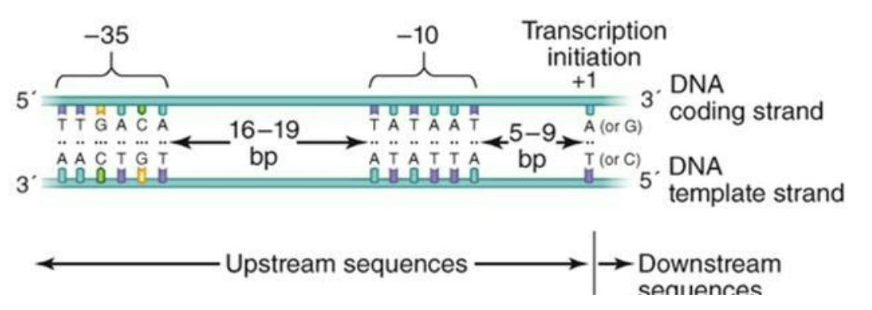
<ul><li><p><strong><em>Promoters</em></strong> direct RNA polymerase to initiate transcription at specific positions on the DNA</p></li><li><p>Bacterial promoters have elements that are bound <strong><em>by sigma factors </em></strong>(-10/-35, for eg. for the main sigma factor RpoD in <em>E. coli</em>)</p></li><li><p><strong><em>Alternative sigma factors</em></strong> can direct the RNA polymerase to the promoters of different sets of genes important under particular conditions (ex. Heat shock, starvation, nutrient depletion)</p></li></ul><p><em>**Memorize image</em></p>
29
New cards

What are eukaryal promoters?

  • Eukaryal promoters have several different elements that are bound be several different transcription factors (TATA binding protein for eg.) to direct transcription initiation.
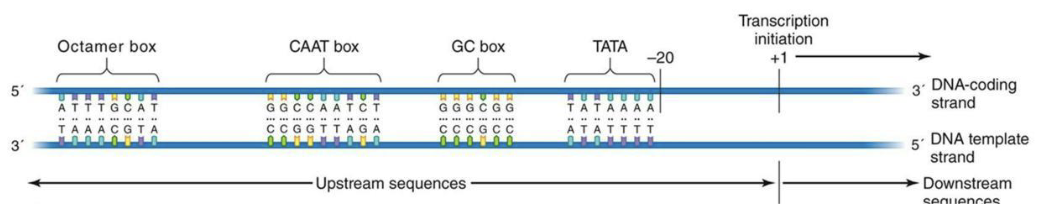
<ul><li><p><u>Eukaryal promoters</u> have several different elements that are bound be several different transcription factors (TATA binding protein for eg.) to direct transcription initiation.</p></li></ul><p></p>
30
New cards

What is initiation and elongation like for bacteria?

  • In bacteria sigma factors direct the core RNA polymerase to the promoter

  • Only one RNA pol in bacteria

  • Different sigma factors can direct RNA pol to a different set of genes that are co-regulated (heat stress genes for example)

**Memorize image and steps
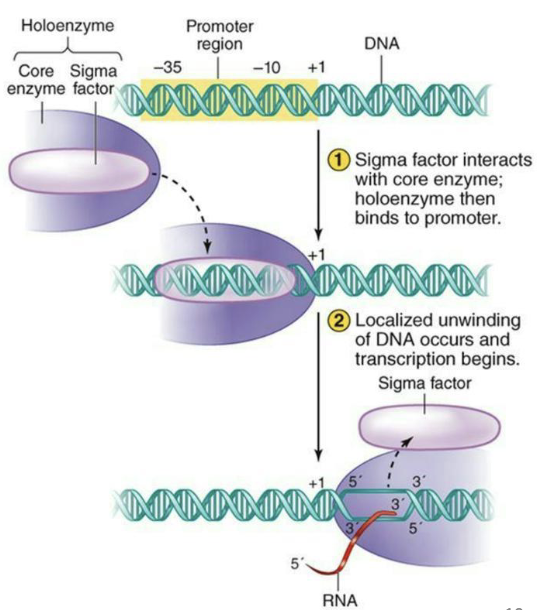
<ul><li><p>In bacteria <strong><em>sigma factors</em></strong> direct the core RNA polymerase to the promoter</p></li><li><p>Only one RNA pol in bacteria</p></li><li><p>Different sigma factors can direct RNA pol to a different set of genes that are co-regulated (heat stress genes for example)</p></li></ul><p><em>**Memorize image and steps</em></p>
31
New cards

What is initiation and elongation like for eukaryotes?

  • In eukaryotes, transcription factors bind the various upstream elements

  • One of three RNA polymerases is directed to the site of transcription initiation

    • RNA pol does not bind directly to DNA

    • Binding is facilitated by various transcription factors

  • This binding initiates the unwinding of the DNA and the start of the actual transcription process.
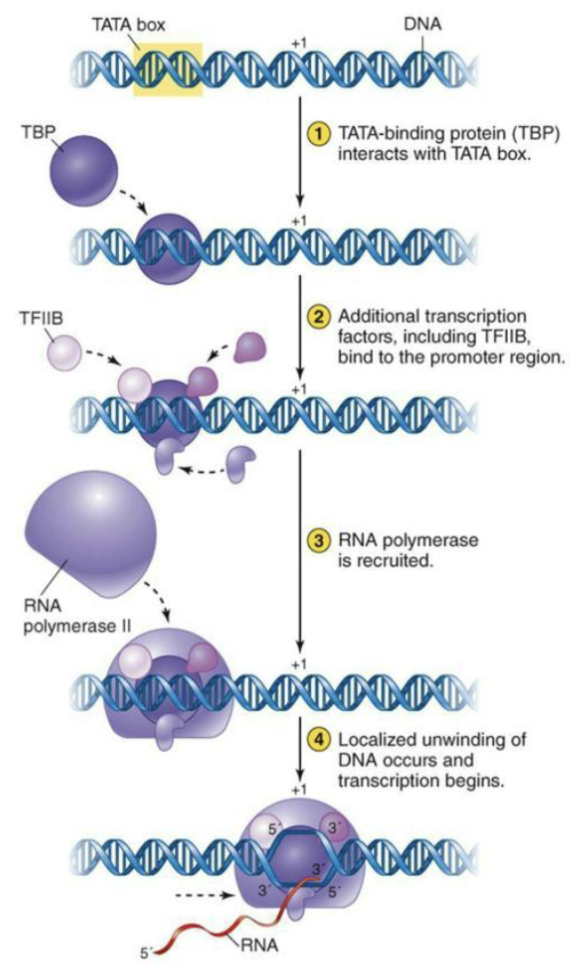
<ul><li><p>In eukaryotes, transcription factors bind the various upstream elements</p></li><li><p>One of three RNA polymerases is directed to the site of transcription initiation</p><ul><li><p>RNA pol does not bind directly to DNA</p></li><li><p>Binding is facilitated by various transcription factors</p></li></ul></li><li><p>This binding initiates the unwinding of the DNA and the start of the actual transcription process.</p></li></ul><p></p>
32
New cards

What is initiation and elongation like for archaea?

  • Single RNA polymerase like in bacteria, but looks more like eukaryal RNA pol II

  • Not well understood.

  • Resembles eukaryal transcription

  • Transcription factors direct RNA polymerase to promoter regions

  • TFB – transcription factor B – resemble eukaryal transcription factor TFIIB
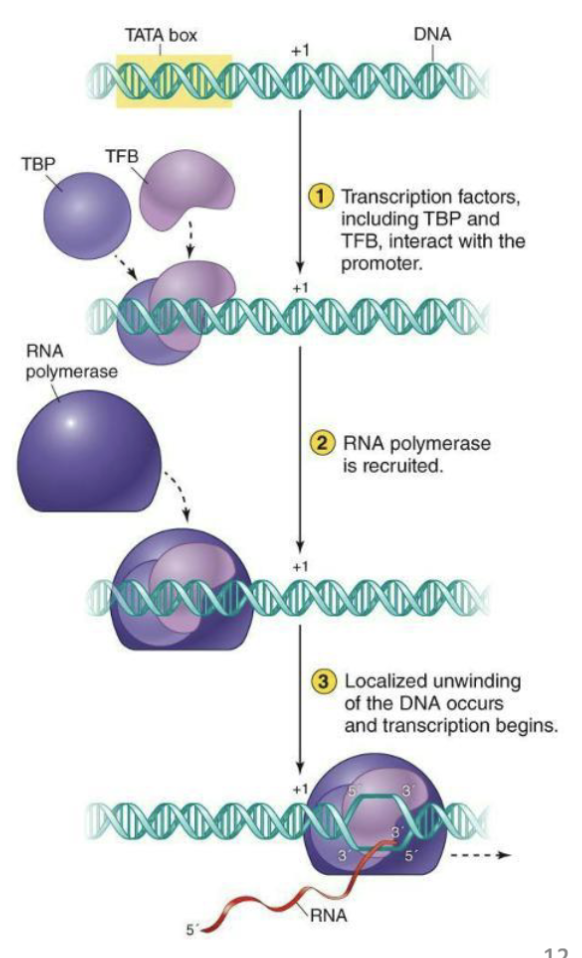
<ul><li><p><strong><u>Single</u></strong> RNA polymerase like in bacteria, but looks more like eukaryal RNA pol II</p></li><li><p>Not well understood.</p></li><li><p>Resembles eukaryal transcription</p></li><li><p>Transcription factors direct RNA polymerase to promoter regions</p></li><li><p>TFB – transcription factor B – resemble eukaryal transcription factor TFIIB</p></li></ul><p></p>
33
New cards

What is termination for bacteria?

  • In bacteria transcription can be terminated by a rho protein that causes RNA polymerase to pop off DNA at specific sequences

  • Alternatively, Rho- independent termination can be catalyzed by hairpin formed by complementary stretches of RNA, rich in guanine and cytosine followed by a segment rich in uracil
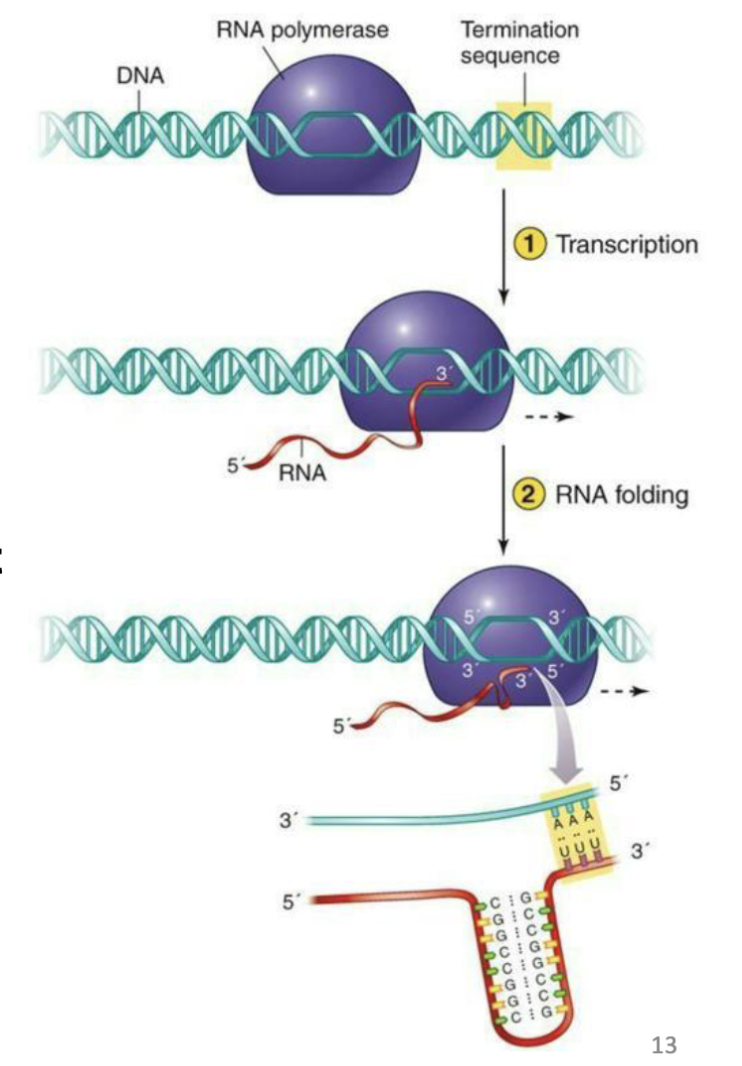
<ul><li><p>In <u>bacteria</u> transcription can be terminated by a r<strong><em>ho protein</em></strong> that causes RNA polymerase to pop off DNA at specific sequences</p></li><li><p>Alternatively, <strong><em>Rho- independent </em></strong>termination can be catalyzed by <strong><em>hairpin</em></strong> formed by complementary stretches of RNA, rich in guanine and cytosine followed by a segment rich in uracil</p></li></ul><p></p>
34
New cards

What is termination for eukarya?

  • In eukarya different mechanisms are used for termination by different RNA polymerases

  • RNA is modified after termination in eukarya

    • 5' cap added (7-methylguanosine)

    • Poly(A) tail added

    • Introns (non-protein coding region) spliced out; exons (coding regions) joined together
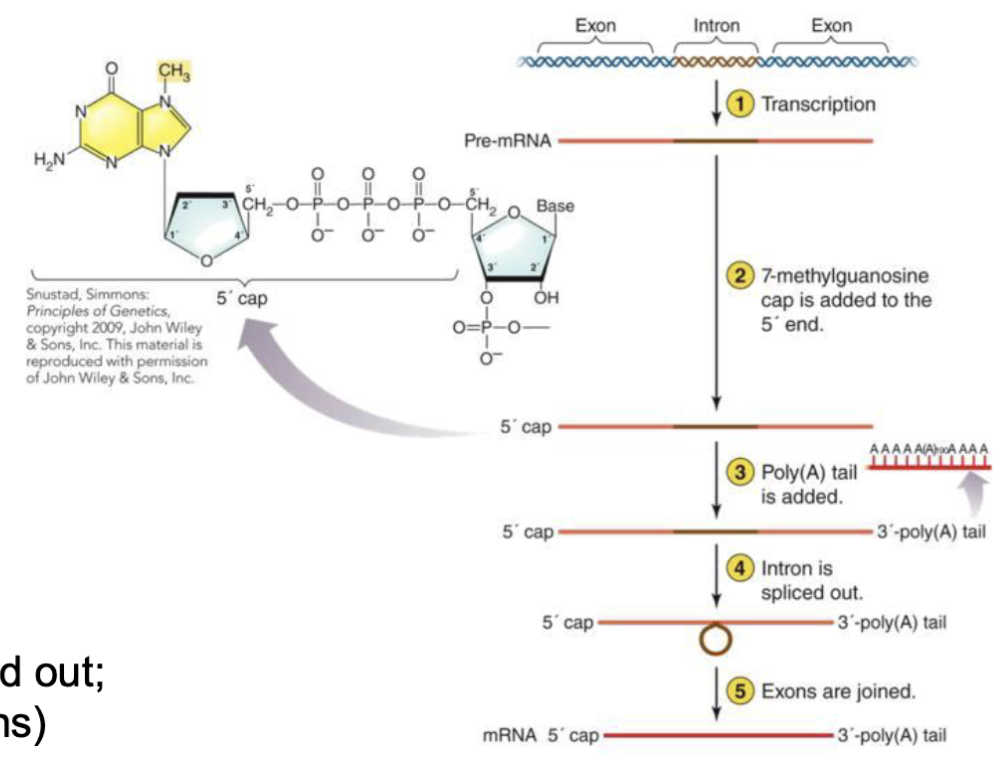
<ul><li><p>In eukarya different mechanisms are used for termination by different RNA polymerases</p></li><li><p>RNA is modified after termination in eukarya</p><ul><li><p><strong><em>5' cap added</em></strong> (7-methylguanosine)</p></li><li><p><strong><em>Poly(A) tail </em></strong>added</p></li><li><p><strong><em>Introns</em></strong> (non-protein coding region) spliced out; <strong><em>exons</em></strong> (coding regions) joined together</p></li></ul></li></ul><p></p>
35
New cards

How are transcription and translation linked in bacteria?

  • Transcription and translation coupled in bacteria thanks to lack of nuclear membrane (independent in eukarya)

  • The lack of introns and post transcriptional modification of mRNA also make coupling easier.

  • In bacteria, mRNA has a short half-life so cells can rapidly change protein production in response to environmental changes.
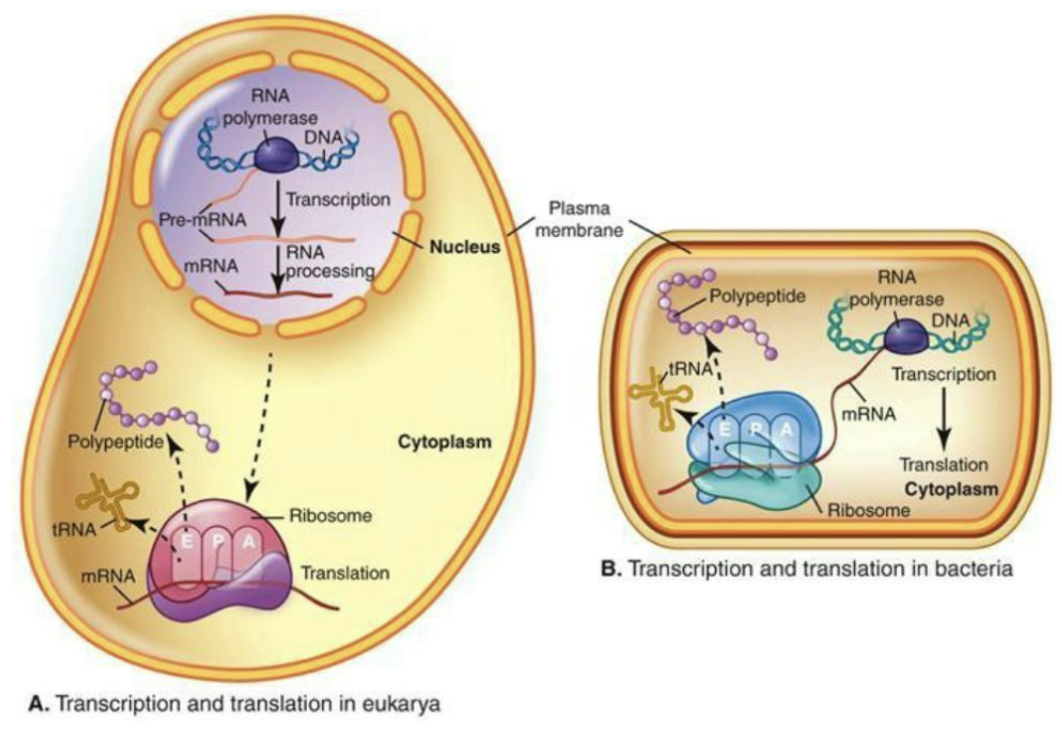
<ul><li><p><strong><em>Transcription and translation coupled in bacteria</em></strong> thanks to lack of nuclear membrane (independent in eukarya)</p></li><li><p>The lack of introns and post transcriptional modification of mRNA also make coupling easier.</p></li><li><p>In bacteria, mRNA has a short half-life so cells can rapidly change protein production in response to environmental changes.</p></li></ul><p></p>
36
New cards

What is the role of ribosomes in translation?

  • Ribosomes interact with mRNA and “charged” tRNA to assemble amino acids in a particular order

  • Anticodon of tRNA corresponds to codon in mRNA sequence

  • Amino acids delivered by tRNA are assembled with peptide bonds
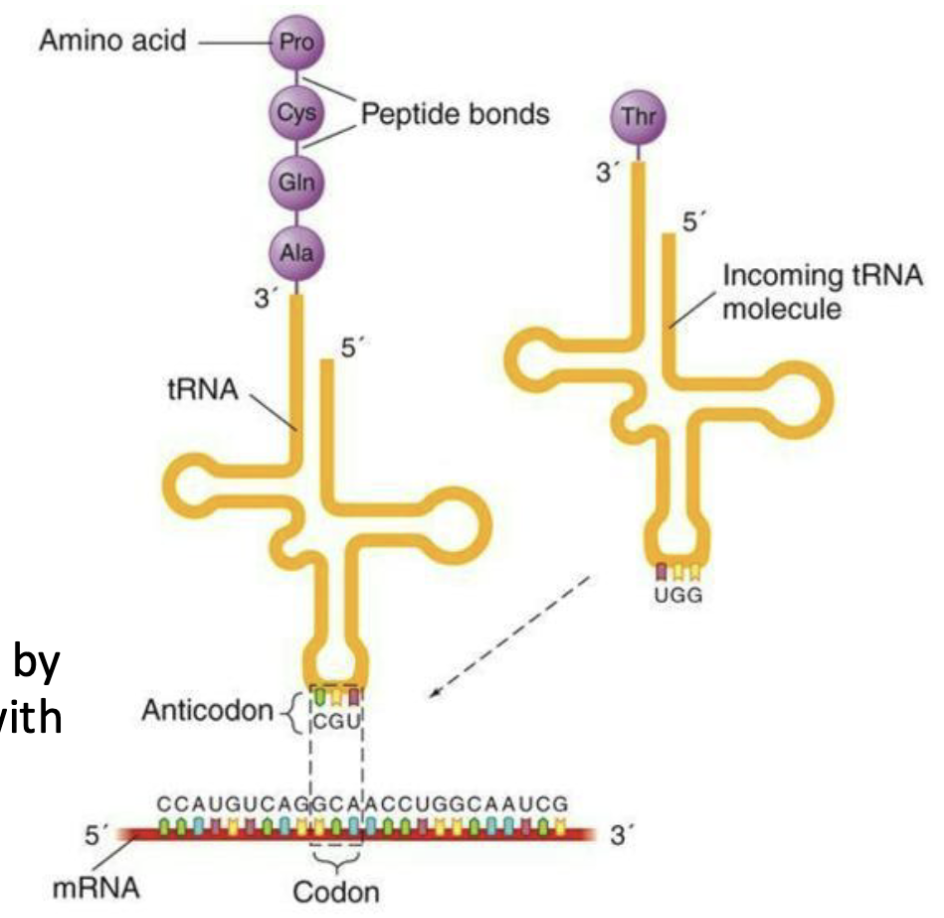
<ul><li><p>Ribosomes interact with mRNA and “charged” tRNA to assemble amino acids in a particular order</p></li><li><p>Anticodon of tRNA corresponds to codon in mRNA sequence</p></li><li><p>Amino acids delivered by tRNA are assembled with peptide bonds</p></li></ul><p></p>
37
New cards

What are the special features of the amino acid code?

  • 64 codons – 20 amino acids - code is degenerate

  • Several codons for each amino acid - third nucleotide in the codon is often variable = “wobble codon”

  • Specialized N-formyl methionine initiates translation at first AUG in bacteria

  • Unique initiator tRNA initiates in eukarya

  • Stop codons terminate translation of the protein
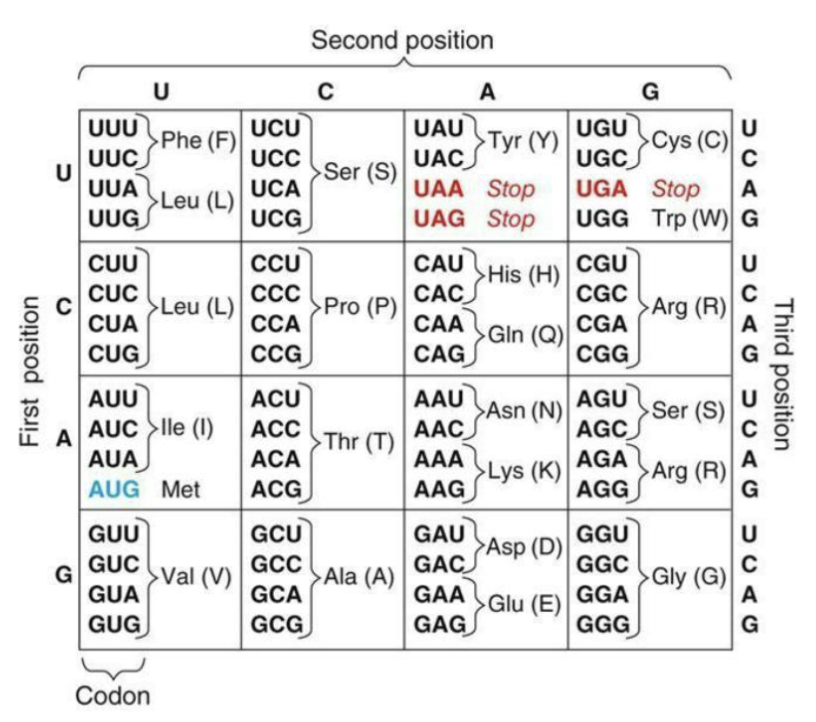
<ul><li><p>64 codons – 20 amino acids - code is <strong><em>degenerate</em></strong></p></li><li><p>Several codons for each amino acid - third nucleotide in the codon is often variable = “wobble codon”</p></li><li><p>Specialized <strong><em>N-formyl methionine</em></strong> initiates translation at first AUG in bacteria</p></li><li><p>Unique initiator tRNA initiates in eukarya</p></li><li><p>Stop codons terminate translation of the protein</p></li></ul><p></p>
38
New cards

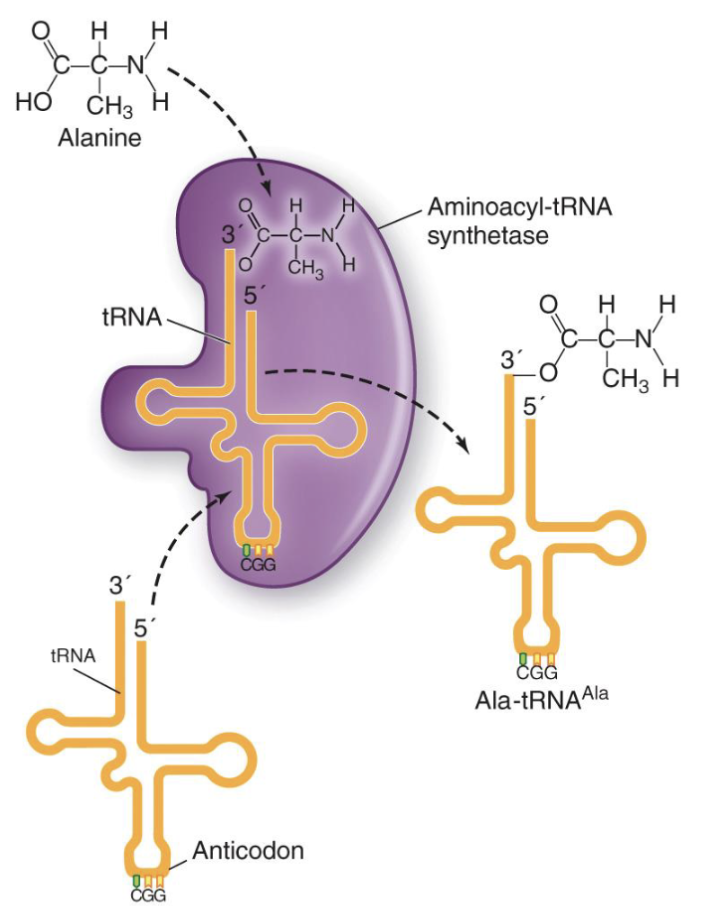
How is tRNA charged?

  • Prior to initiation of translation, each tRNA that will bring an amino acid to the ribosome needs to be “charged” with that amino acid

  • Highly specific aminoacyl-tRNA-synthetase enzymes achieve this charging

  • Create ester linkages

<ul><li><p>Prior to initiation of translation, <strong><em>each tRNA</em></strong> that will bring an amino acid to the ribosome <strong><em>needs to be “charged” with that amino acid</em></strong></p></li><li><p>Highly specific <strong><em>aminoacyl-tRNA-synthetase</em></strong> enzymes achieve this charging</p></li><li><p>Create <strong><u>ester</u></strong> linkages</p></li></ul><p></p>
39
New cards

What is the Shine-Delgarno sequence?

  • In bacteria, interaction between the Shine- Delgarno sequence (ribosome binding site) and specific site in 16S rRNA in the small subunit of the ribosome

  • In eukarya mRNA is bound by several polypeptides including one that binds the 5’ cap before being bound by the ribosome
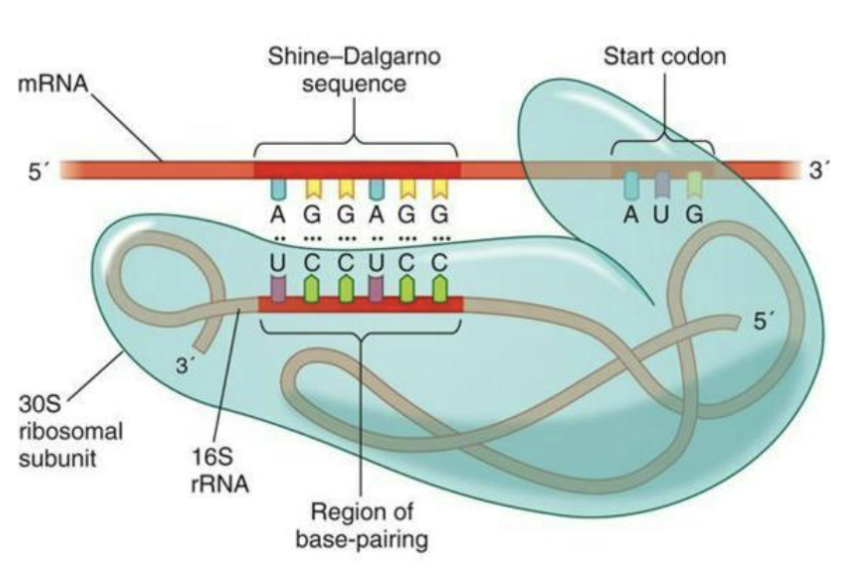
<ul><li><p>In <u>bacteria</u>, interaction between the <strong><em>Shine- Delgarno sequence</em></strong> (ribosome binding site) and specific site in 16S rRNA in the small subunit of the ribosome</p></li><li><p>In <u>eukarya</u> mRNA is bound by several polypeptides including one that binds the 5’ cap before being bound by the ribosome</p></li></ul><p></p>
40
New cards

What are the different types of mRNA?

  • Bacterial mRNA can be polycistronic using multiple Shine-Delgarno sequences on the same mRNA molecule to encode multiple proteins

  • Eukaryal mRNA is monocistronic and TL begins at first start codon
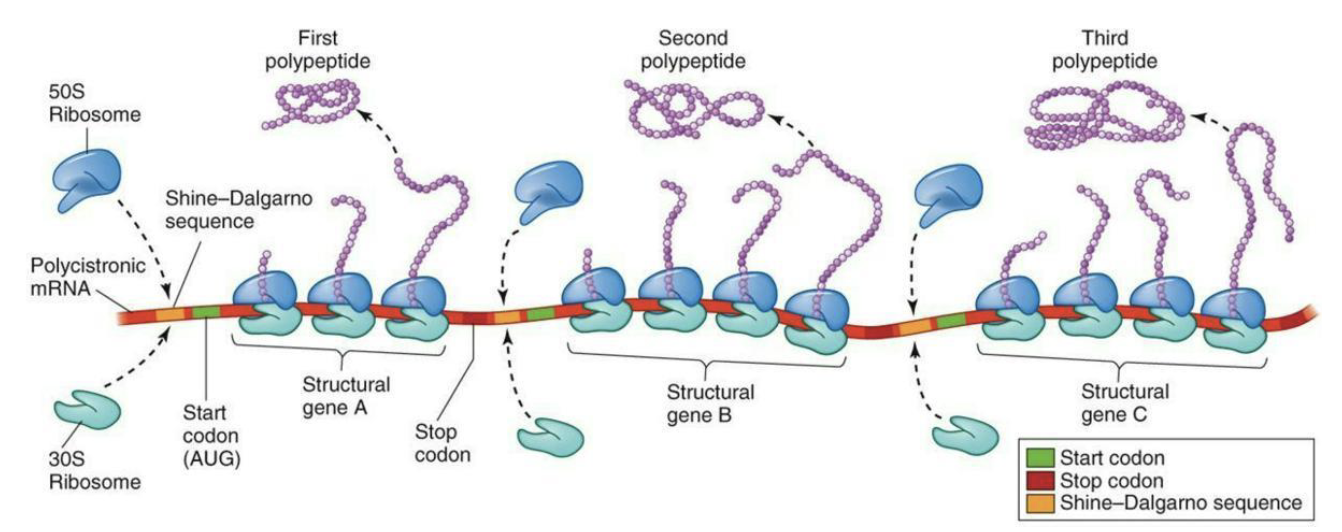
<ul><li><p>Bacterial mRNA can be <strong><em>polycistronic</em></strong> using multiple Shine-Delgarno sequences on the same mRNA molecule to encode multiple proteins</p></li><li><p>Eukaryal mRNA is <strong><em>monocistronic</em></strong> and TL begins at first start codon</p></li></ul><p></p>
41
New cards

How does the ribosome move along codons in mRNA for elongation?

  • Ribosome moves along codons in mRNA. Charged tRNA’s enter A site, peptide bond is formed, and uncharged tRNA exits the E site.
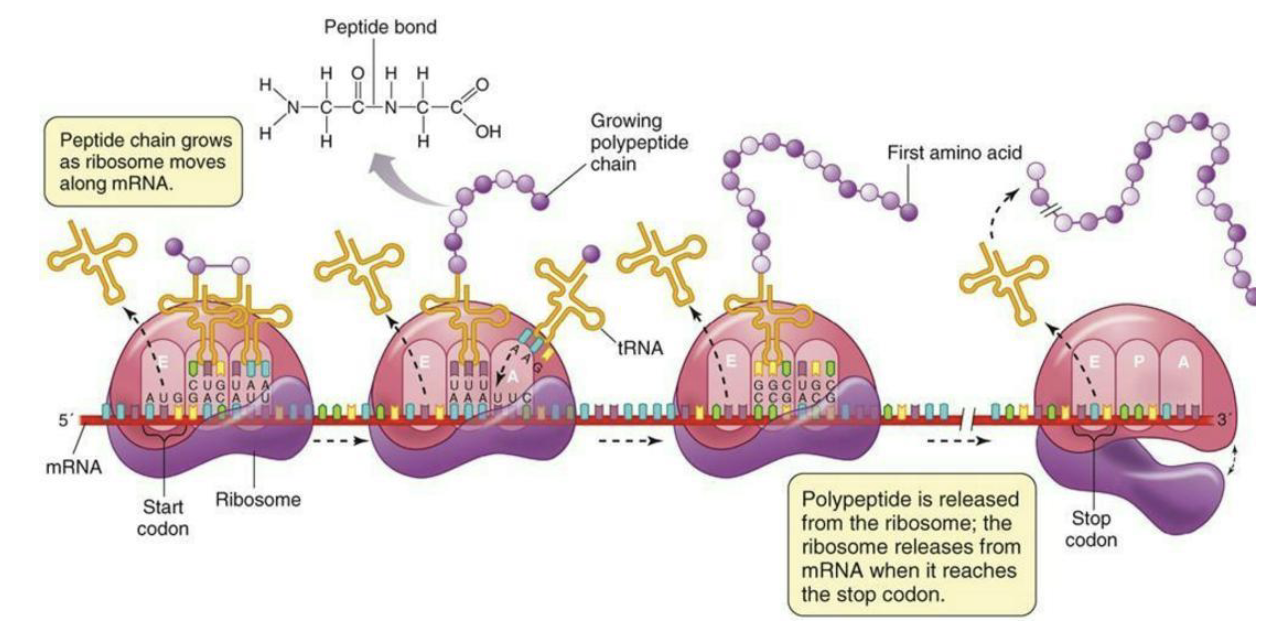
<ul><li><p>Ribosome moves along codons in mRNA. Charged tRNA’s enter A site, peptide bond is formed, and uncharged tRNA exits the E site.</p></li></ul><p></p>
42
New cards

What is the function of release factors in termintion?

  • Release factors in both eukarya and bacteria cause the complex to fall apart when a stop codon is reached
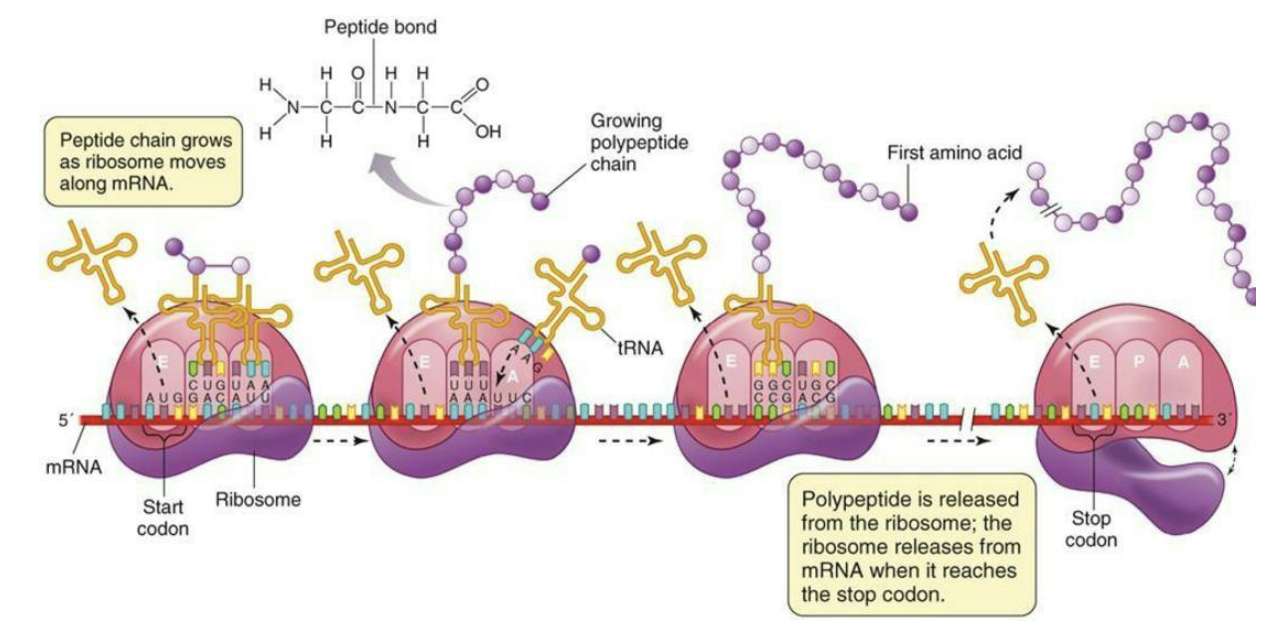
<ul><li><p>Release factors in both eukarya and bacteria cause the complex to fall apart when a stop codon is reached</p></li></ul><p></p>
43
New cards

How are proteins folded?

  • Proteins are folded upon leaving the ribosome, sometimes with the help of chaperones.

  • Chaperones (in all domains of life) assist in correct folding and refolding of polypeptide sequence

  • Eukaryal proteins are often modified by the addition of chemical groups
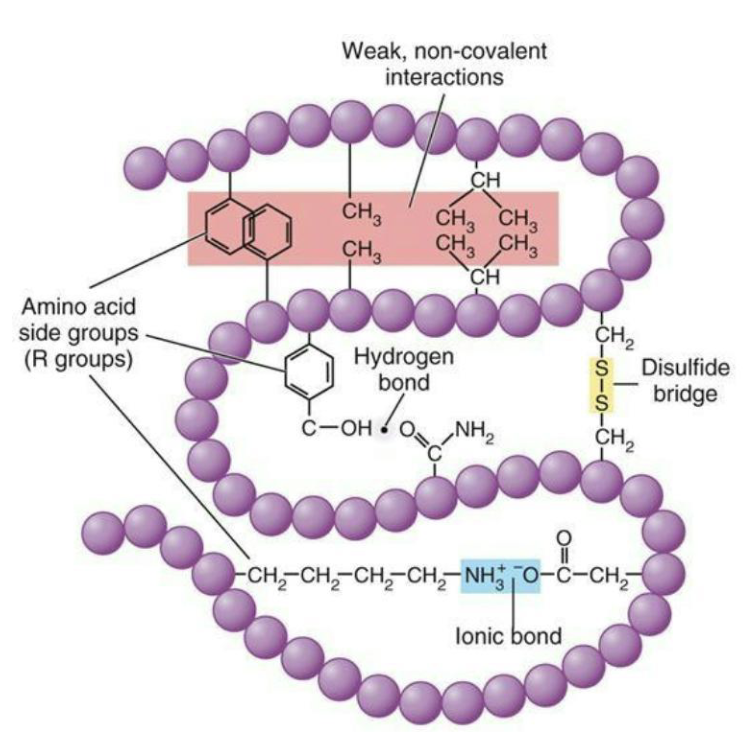
<ul><li><p>Proteins are folded upon leaving the ribosome, sometimes with the help of <strong><em>chaperones</em></strong>.</p></li><li><p>Chaperones (in all domains of life) assist in correct folding and refolding of polypeptide sequence</p></li><li><p>Eukaryal proteins are often modified by the addition of chemical groups</p></li></ul><p></p>
44
New cards

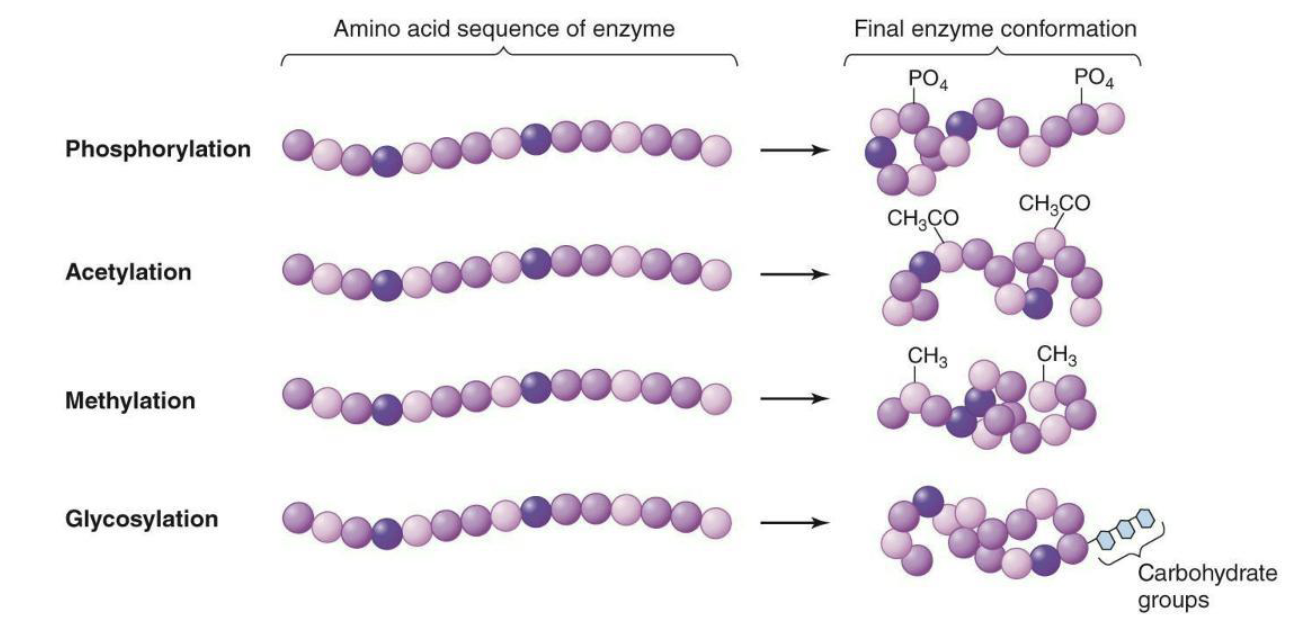
How are proteins modified?

  • Modification of proteins with different chemical groups or carbohydrates can affect their folding, and serve to activate or inhibit protein function

    • Phosphorylation

    • Acetylation

    • Methylation

    • Glycosylation

<ul><li><p>Modification of proteins with different chemical groups or carbohydrates can affect their folding, and serve to <strong><em>activate</em></strong> or <strong><em>inhibit</em></strong> protein function</p><ul><li><p>Phosphorylation</p></li><li><p>Acetylation</p></li><li><p>Methylation</p></li><li><p>Glycosylation</p></li></ul></li></ul><p></p>
45
New cards

How are proteins transported?

  • Signal peptides (short AA sequences at N-terminus) direct proteins to appropriate cellular location
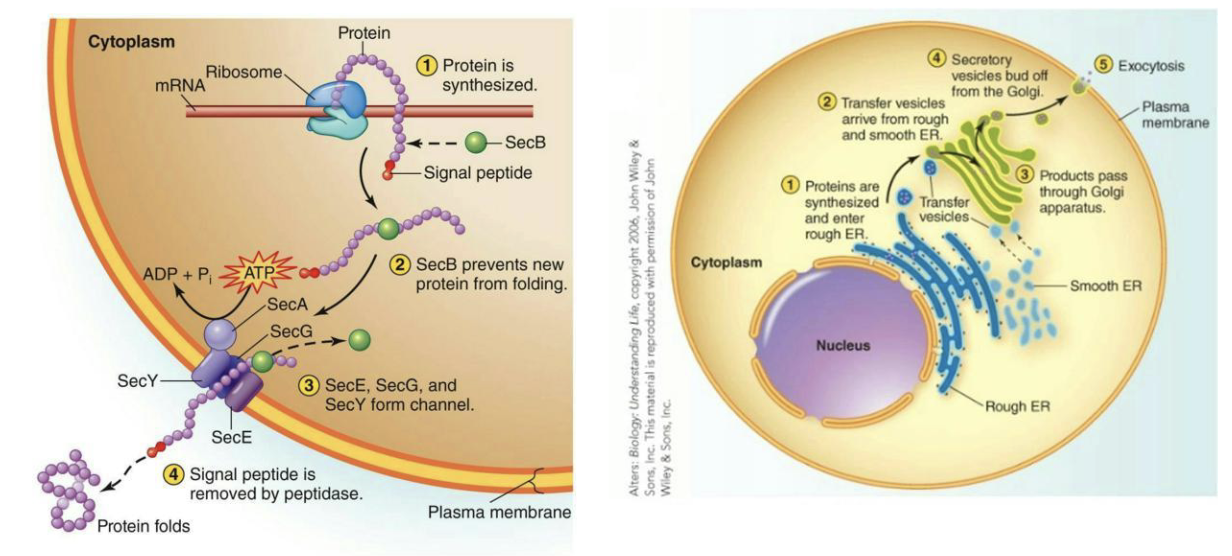
<ul><li><p>Signal peptides (short AA sequences at N-terminus) direct proteins to appropriate cellular location</p></li></ul><p></p>
46
New cards

Transcription and Translation Summary

  • RNA (A,U,C,G) made by transcription into mRNA, tRNA, rRNA and regulatory RNA

  • Sigma factors direct RNA polymerase to promoters in bacteria (other transcription factors used by eukaryotes)

  • Alternate sigma factors direct transcription of alternate subsets of genes

  • Eukaryotic mRNA modified by 5’ cap, 3’ polyA tail and introns spliced out

  • Transcription halted in bacteria by Rho-dependent or Rho-independent termination

  • Shine-Dalgarno sequence directs ribosomes to start of bacterial genes

  • Translation carried out by ribosomes that “read” mRNA codons

  • tRNA with “anticodons” add specific amino acids

  • Stop codons signal translation to end

Explore top notes

note
PRENATAL DEVELOPMENT
Updated 1221d ago
0.0(0)
note
CGO casus 1
Updated 444d ago
0.0(0)
note
Ancient Philosophers
Updated 1149d ago
0.0(0)
note
2.8 The Early Baroque Period
Updated 1220d ago
0.0(0)
note
Chapter 13: The Sectional Crisis
Updated 1286d ago
0.0(0)
note
Weathering, Soil, and Mass Wasting
Updated 1168d ago
0.0(0)
note
PRENATAL DEVELOPMENT
Updated 1221d ago
0.0(0)
note
CGO casus 1
Updated 444d ago
0.0(0)
note
Ancient Philosophers
Updated 1149d ago
0.0(0)
note
2.8 The Early Baroque Period
Updated 1220d ago
0.0(0)
note
Chapter 13: The Sectional Crisis
Updated 1286d ago
0.0(0)
note
Weathering, Soil, and Mass Wasting
Updated 1168d ago
0.0(0)

Explore top flashcards

flashcards
HFrEF Treatment
94
Updated 474d ago
0.0(0)
flashcards
Chapter 26
75
Updated 721d ago
0.0(0)
flashcards
Biopsychology -
62
Updated 583d ago
0.0(0)
flashcards
unit 3 ap hug
56
Updated 1211d ago
0.0(0)
flashcards
Psychology AOS Research Methods
51
Updated 303d ago
0.0(0)
flashcards
MI Quiz 1.4, 2.1, 2.2
58
Updated 1149d ago
0.0(0)
flashcards
HFrEF Treatment
94
Updated 474d ago
0.0(0)
flashcards
Chapter 26
75
Updated 721d ago
0.0(0)
flashcards
Biopsychology -
62
Updated 583d ago
0.0(0)
flashcards
unit 3 ap hug
56
Updated 1211d ago
0.0(0)
flashcards
Psychology AOS Research Methods
51
Updated 303d ago
0.0(0)
flashcards
MI Quiz 1.4, 2.1, 2.2
58
Updated 1149d ago
0.0(0)