The Genetic Code & tRNA

0.0(0)
Studied by 0 people
call kaiCall Kai
learnLearn
examPractice Test
spaced repetitionSpaced Repetition
heart puzzleMatch
flashcardsFlashcards
GameKnowt Play
Card Sorting

1/15

encourage image

There's no tags or description

Looks like no tags are added yet.

Last updated 11:53 PM on 4/4/26
Name
Mastery
Learn
Test
Matching
Spaced
Call with Kai

No analytics yet

Send a link to your students to track their progress

16 Terms

1
New cards

Translation Overview

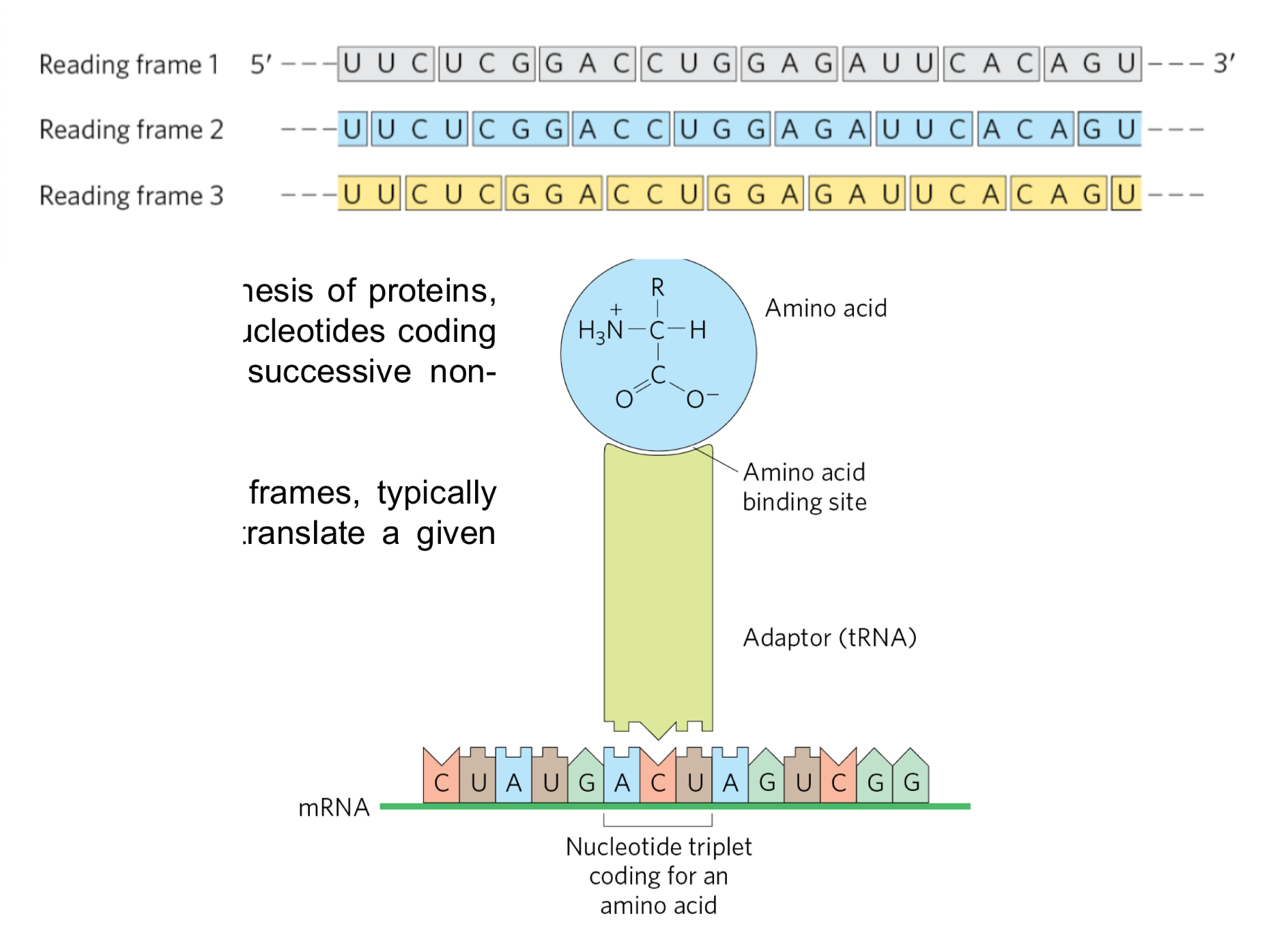
  • translation is the mRNA guided synthesis of proteins and performed by ribosomes

  • translation occurs after the codons (triplet of nucleotides coding for an amino acid) are read in a successive non-overlapping manner by a tRNA

  • among the 3 possible reading frames, typically only one will be used in order to translate a given mRNA to synthesize a polypeptide

    • there’s a signal that indicates where to stop and start translation
<ul><li><p>translation is the mRNA guided synthesis of proteins and performed by ribosomes</p></li><li><p>translation occurs after the codons (triplet of nucleotides coding for an amino acid) are read in a successive non-overlapping manner by a tRNA</p></li><li><p>among the 3 possible reading frames, typically only one will be used in order to translate a given mRNA to synthesize a polypeptide</p><ul><li><p>there’s a signal that indicates where to stop and start translation</p></li></ul></li></ul><p></p>
2
New cards

Codon

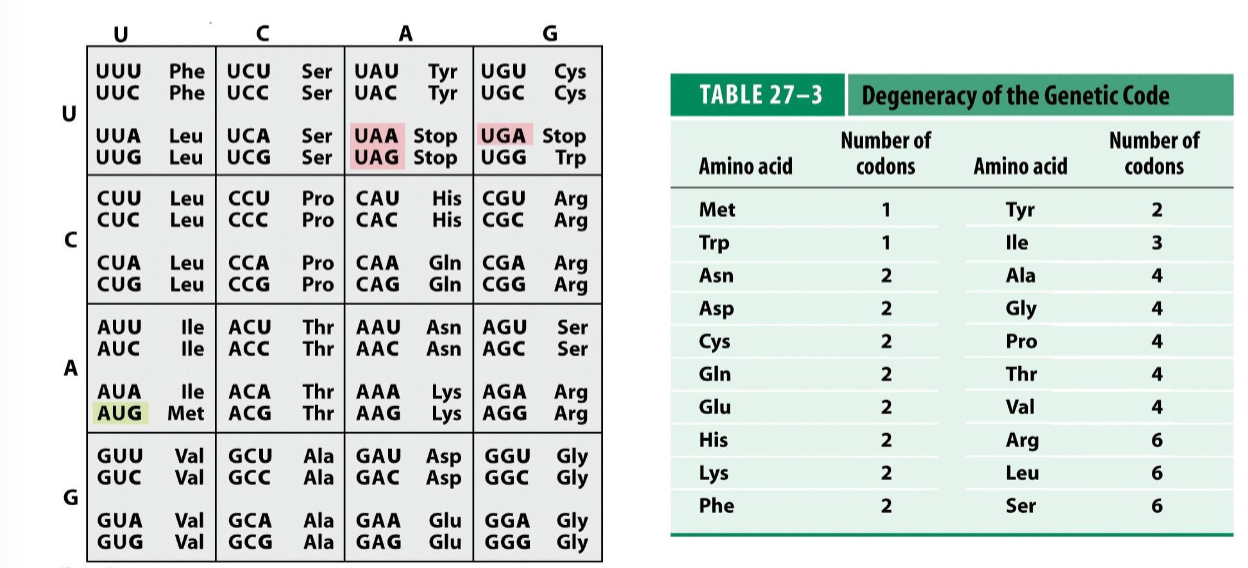
  • a triplet of nucleotides on the mRNA coding for an amino acid

  • there are 64 codons coding for 20 amino acids and 1 stop signal (proteins are typically composed of 20 a.a’s)

  • b/c there are more combinations (64) than coded elements (21), the genetic code is considered to be redundant (degenerate)

  • therefore, several amino acids are encoded by multiple codons

  • some tRNAs can recognize more than 1 codon
<ul><li><p>a triplet of nucleotides on the mRNA coding for an amino acid</p></li><li><p>there are 64 codons coding for 20 amino acids and 1 stop signal (proteins are typically composed of 20 a.a’s)</p></li><li><p>b/c there are more combinations (64) than coded elements (21), the genetic code is considered to be redundant (degenerate)</p></li><li><p>therefore, several amino acids are encoded by multiple codons</p></li><li><p>some tRNAs can recognize more than 1 codon</p></li></ul><p></p>
3
New cards

tRNA Structure: 2D

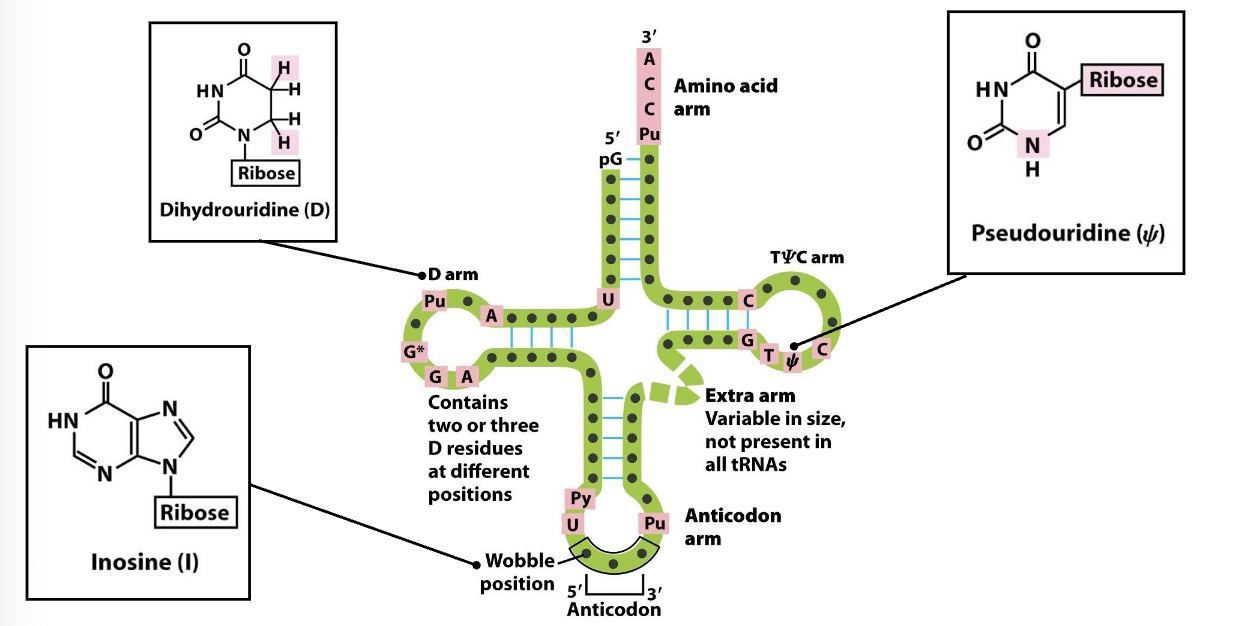
  • tRNA are small molecules (70-90 nts)

  • their secondary structure is represented by a cloverleaf

  • the anticodon arm (bottom) is located opposite to the amino acid arm (top)

  • there are several modified bases (e.g. inosine) often present in the Wobble position, dihydrouridine in the D arm and pseudouridine
<ul><li><p>tRNA are small molecules (70-90 nts)</p></li><li><p>their secondary structure is represented by a cloverleaf</p></li><li><p>the anticodon arm (bottom) is located opposite to the amino acid arm (top)</p></li><li><p>there are several modified bases (e.g. inosine) often present in the Wobble position, dihydrouridine in the D arm and pseudouridine</p></li></ul><p></p>
4
New cards

tRNA Structure: 3D

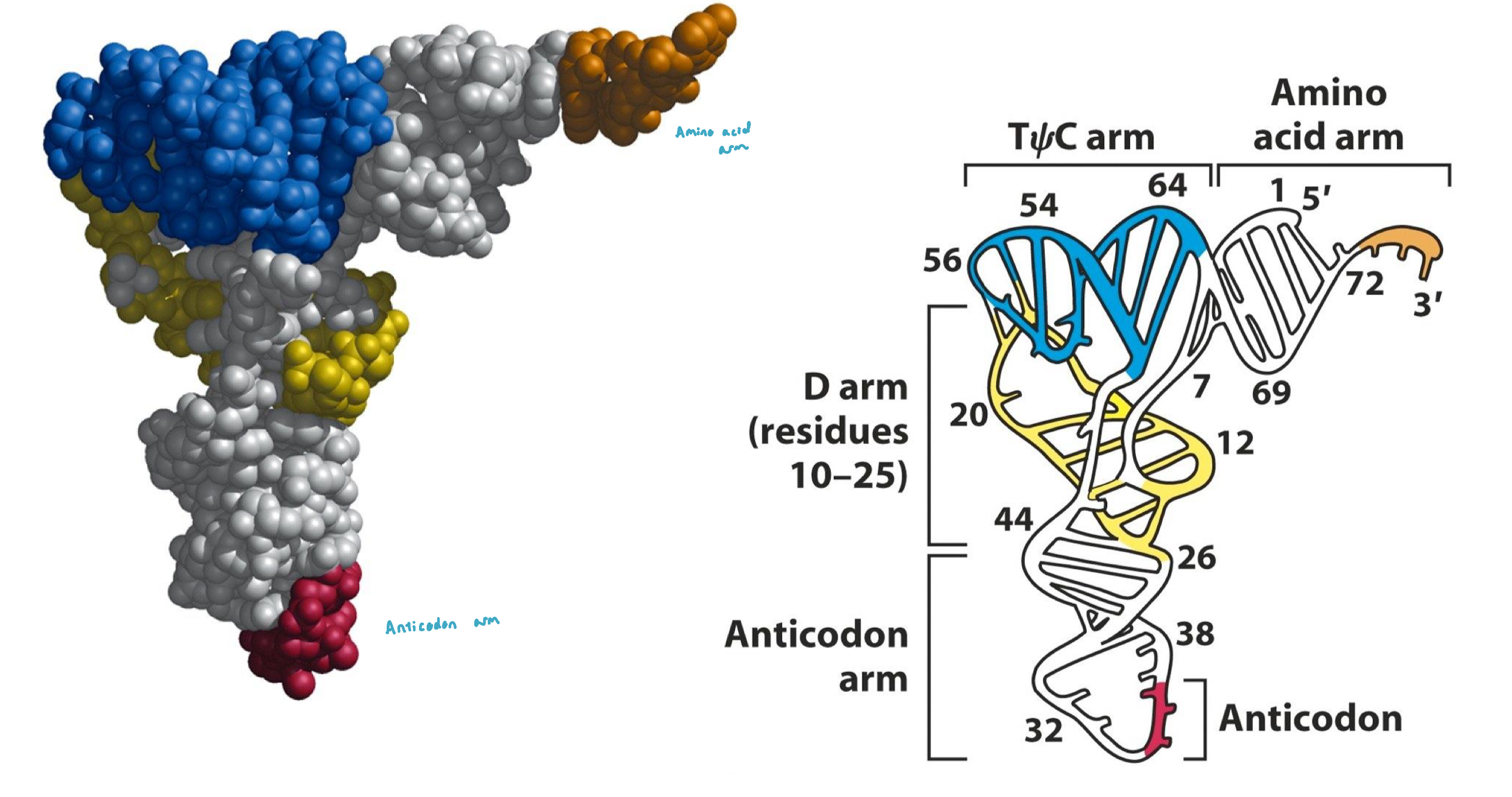
  • the 3D tertiary structure resembles a twisted L w/ the anti-codon and amino acid positions locate in both extremities
<ul><li><p>the 3D tertiary structure resembles a twisted L w/ the anti-codon and amino acid positions locate in both extremities </p></li></ul><p></p>
5
New cards

tRNA Structure & Processing

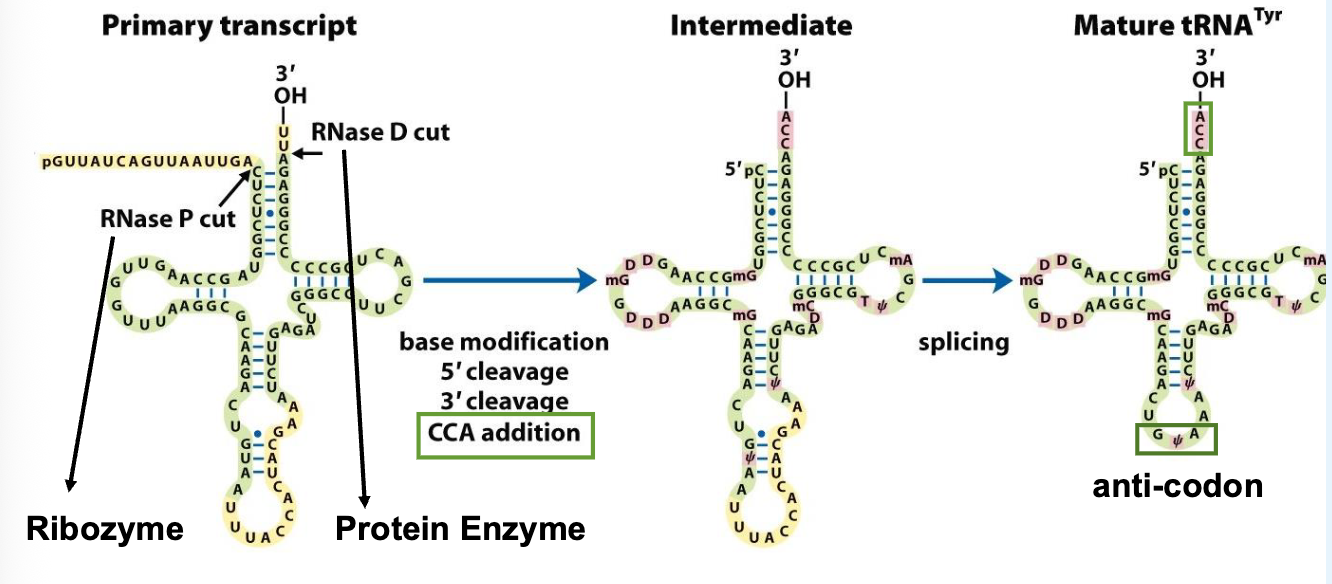
  • tRNA are transcribed by RNA pol III and are then processed (base modification, cleavage, splicing, 3’ end editing)

  • all tRNAs have the same CCA sequence at the 3’ end that is added post-transcriptionally
<ul><li><p>tRNA are transcribed by RNA pol III and are then processed (base modification, cleavage, splicing, 3’ end editing)</p></li><li><p>all tRNAs have the same CCA sequence at the 3’ end that is added post-transcriptionally</p></li></ul><p></p>
6
New cards

tRNA Processing: Adenosine Deaminase (ADAT2/3)

  • the tRNA adenosine deaminase (ADAT2/3) modifies adenosine bases on some tRNA anti-codon sequences to create inosine (I)

  • Inosine can form atypical base pairing with A, C, and U
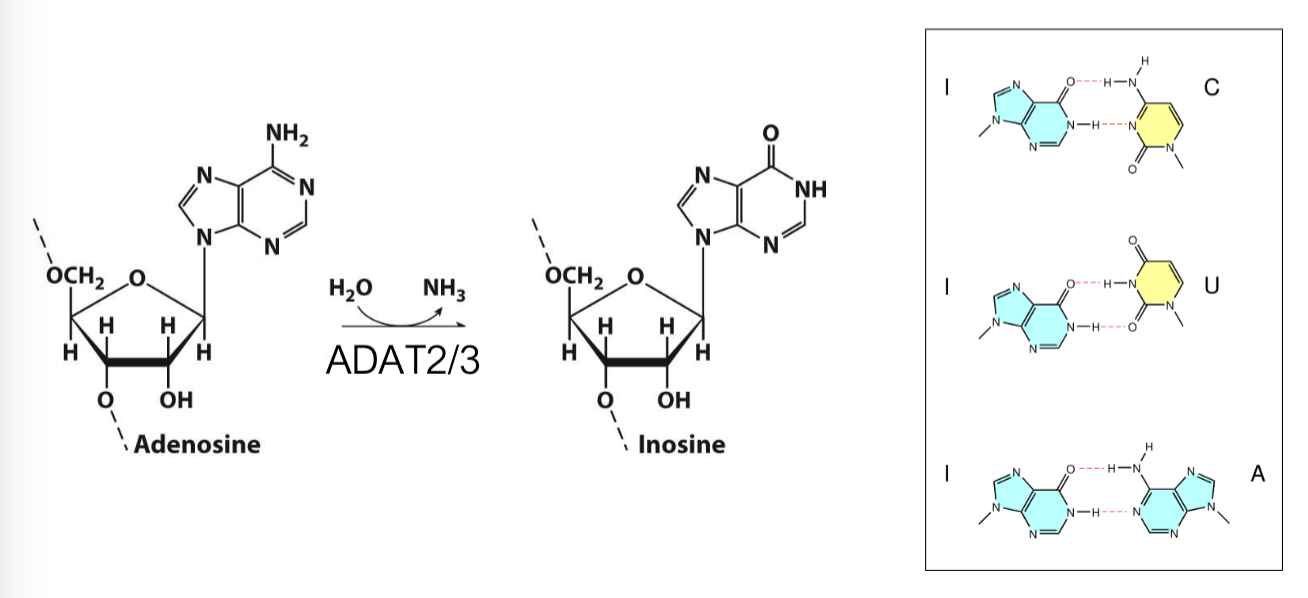
<ul><li><p>the tRNA adenosine deaminase (ADAT2/3) modifies adenosine bases on some tRNA anti-codon sequences to create inosine (I)</p></li><li><p>Inosine can form atypical base pairing with A, C, and U</p></li></ul><p></p>
7
New cards

Anti-codon

  • the anti-codon binds to the codon in an anti-parallel manner

    • the first nucleotide of the codon binds to the 3rd nucleotide of the anti-codon

  • the first 2 nucleotides of the codon will form strong W-C base pairing w/ the anti-codon
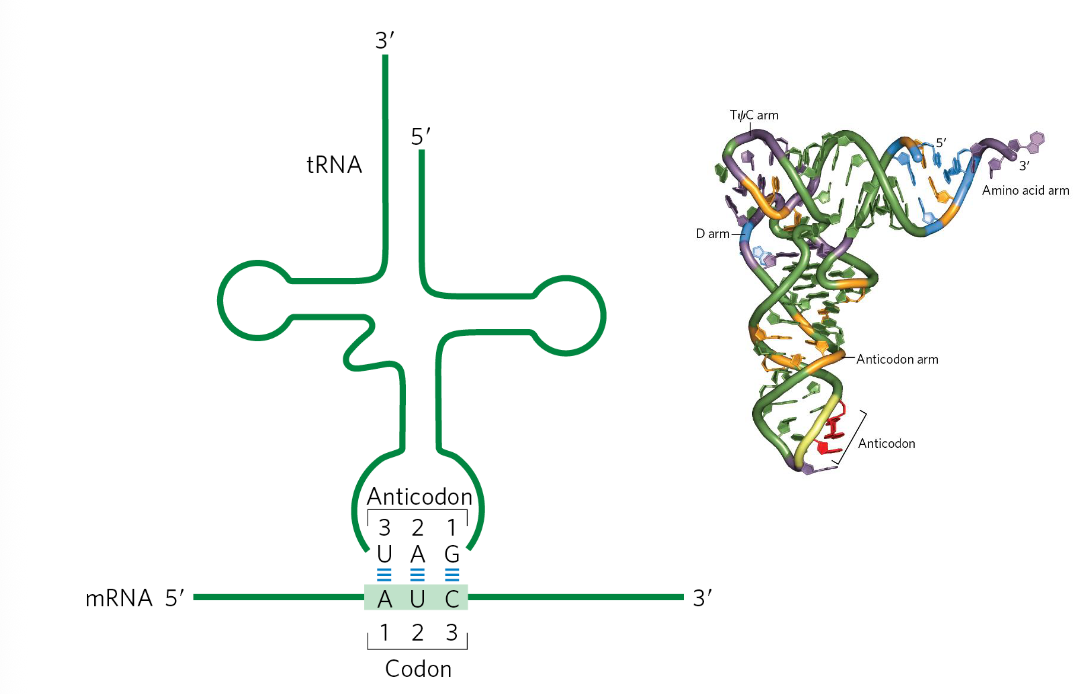
<ul><li><p>the anti-codon binds to the codon in an anti-parallel manner </p><ul><li><p>the first nucleotide of the codon binds to the 3rd nucleotide of the anti-codon</p></li></ul></li><li><p>the first 2 nucleotides of the codon will form strong W-C base pairing w/ the anti-codon</p></li></ul><p></p>
8
New cards

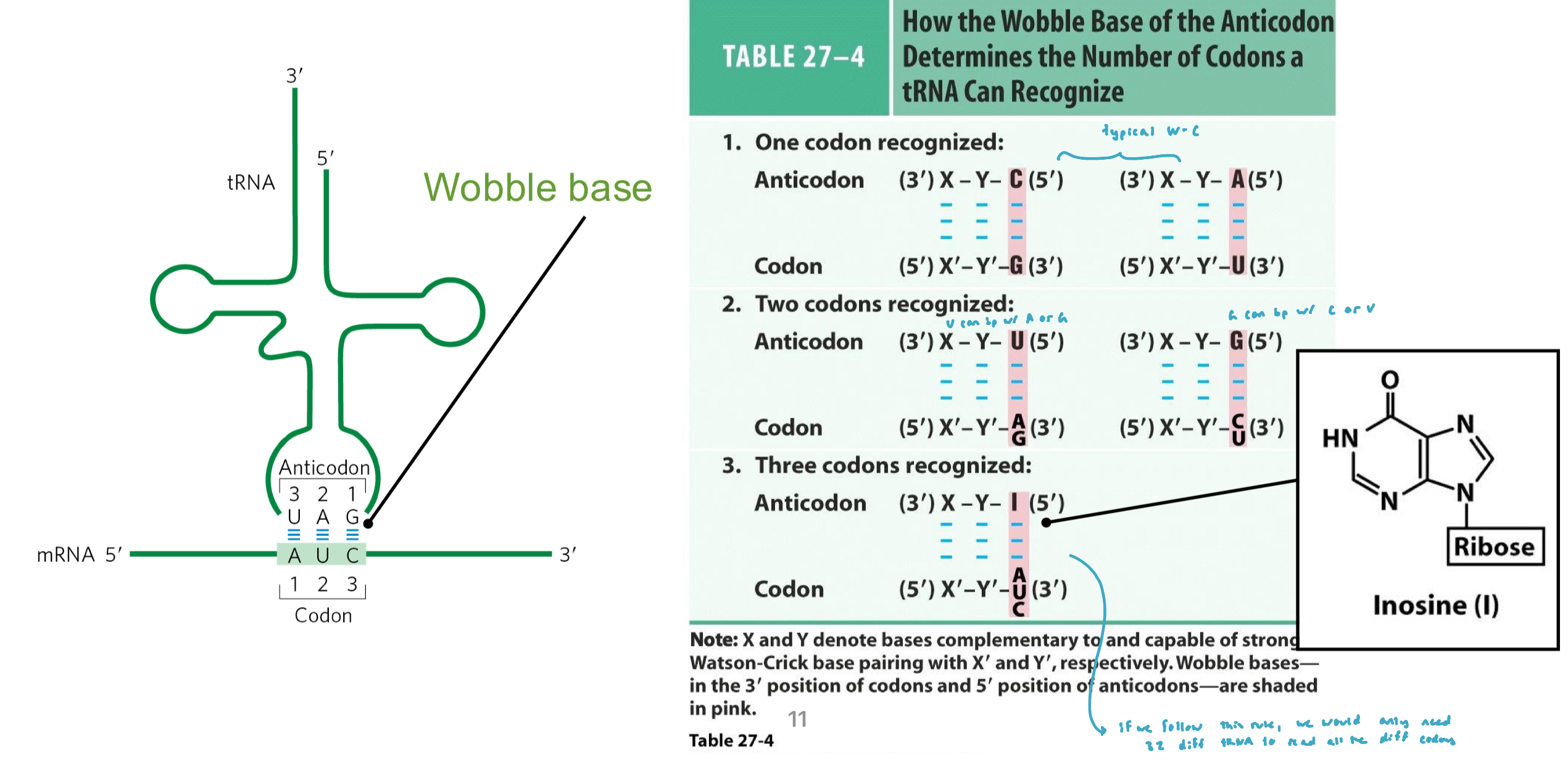
Wobble Base

  • the first nucleotide of the anti-codon forms a weaker interaction in the Wobble position w/ the third nucleotide of the codon

  • non-conventional base pairing can occur

    • e.g. the inosine minor base in the anti-codon can interact w/ A, U, C in the 3rd position of the codon sequence

    • e.g. U can interact w/ A and G

  • this allows a more rapid dissociation of tRNA from the mRNA (a higher affinity would significantly reduce the translation rate)

  • it also reduces the number of required tRNA

  • while a minimum of 32 tRNAs are required, cells typically express between 40-50 different tRNAs to recognize the 61 diff codons

9
New cards

Wobble Base Figure

knowt flashcard image
10
New cards

The Codon Flexibility: Genetic Code Variations

  • whereas the genetic code is considered “universal”, there are exceptions

  • the genetic code is slightly different in mitochondria

    • mitochondria contains its own genome that encodes a small number of proteins

    • e.g. the UGA stop codon encodes for a tryptophan (Trp) when translated from the mitochondria
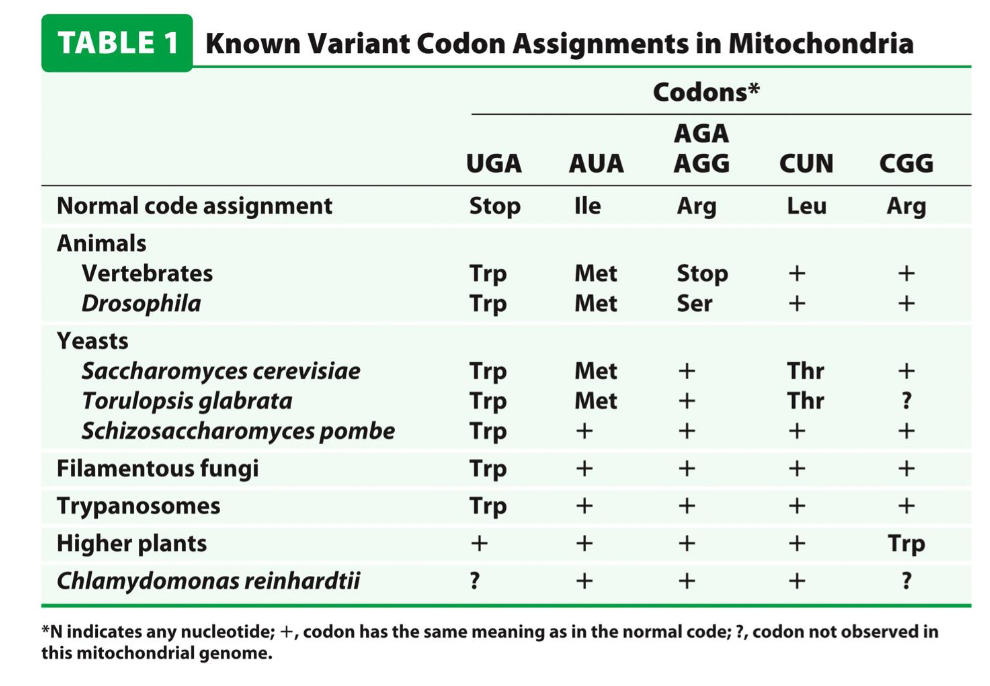
<ul><li><p>whereas the genetic code is considered “universal”, there are exceptions</p></li><li><p>the genetic code is slightly different in mitochondria</p><ul><li><p>mitochondria contains its own genome that encodes a small number of proteins</p></li><li><p>e.g. the UGA stop codon encodes for a tryptophan (Trp) when translated from the mitochondria</p></li></ul></li></ul><p></p>
11
New cards

Codon Flexibility: Translational Frameshifts

  • in most cases, only one reading frame encodes for a protein

  • there are exceptions where a second reading frame can be used (e.g. viruses)

    • in this case, the secondary structure of the mRNA can induce a slipping or skipping of the ribosome (ribosome shifts by 1 nucleotide while translating to read a completely diff set of codons → diff protein)

  • advantage: using one mRNA to encode multiple proteins

12
New cards

Codon Flexibility: Translational Frameshifts Example

  • in 95% of the cases, the Rous sarcoma Gag protein is normally stopped after the Leu residue

  • in 5% of cases, the ribosome will slip -1 nucleotide after the UUA codon to place the AUA codon in aminoacyl site and to translate the Gal-Pol fusion protein, that is later cleaved into two polypeptide

<ul><li><p>in 95% of the cases, the <em>Rous sarcoma </em>Gag protein is normally stopped after the Leu residue</p></li><li><p>in 5% of cases, the ribosome will slip -1 nucleotide after the UUA codon to place the AUA codon in aminoacyl site and to translate the Gal-Pol fusion protein, that is later cleaved into two polypeptide</p></li></ul><p></p>
13
New cards

Codon Flexibility: mRNA Editing

  • mRN editing can alter the protein sequence → more diversity in the # of proteins that can be generated by a limited number of genes

  • editing is mediated by adenosine deaminase that can generate Inosine and cytidine deaminase (C → U), such as APOBEC (apoB mRNA editing catalytic peptide)

  • APOBEC1 edits a specific codon at position 2153 to convert a Gln (CAA) to a stop codon (UAA)

    • generates a shorter isoform of the apoB protein
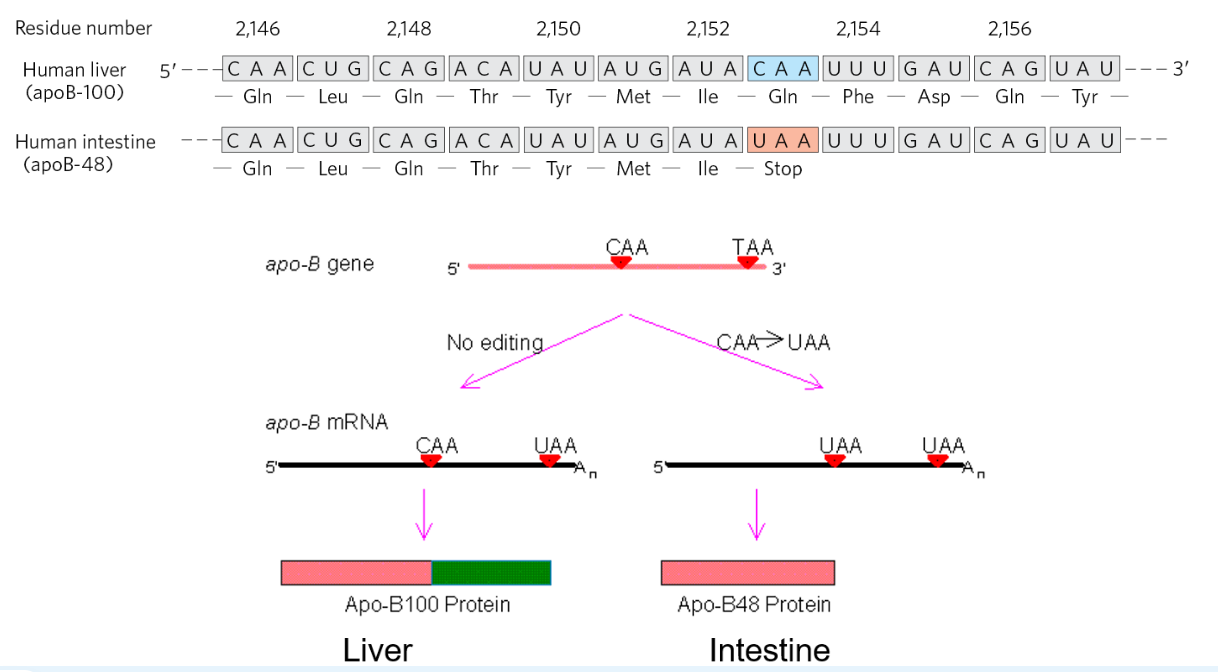
<ul><li><p>mRN editing can alter the protein sequence → more diversity in the # of proteins that can be generated by a limited number of genes</p></li><li><p>editing is mediated by adenosine deaminase that can generate Inosine and cytidine deaminase (C → U), such as APOBEC (apoB mRNA editing catalytic peptide)</p></li><li><p>APOBEC1 edits a specific codon at position 2153 to convert a Gln (CAA) to a stop codon (UAA)</p><ul><li><p>generates a shorter isoform of the apoB protein</p></li></ul></li></ul><p></p>
14
New cards

The Codon Usage Bias

  • while the same codons encode for the same a.a’s, the codon usage is different from species to spcecies

    • e.g. 22% of Arg codons are AGA in the human genome, while 1% of the Arg codons are AGA in E. coli. Accordingly, there are more tRNA w/ the GCG anti-codon compared to UCU in E. coli

  • in many fast-dividing organisms, there is a strong correlation b/w codon usage and protein abundance, as translation of an abundant protein will be favored by the higher concentrations of corresponding tRNAs in the cell

  • there’s a correlation between frequency of a given codon and tRNA abundance.

  • Genes for which numerous low frequency codons are expressed at lower levels
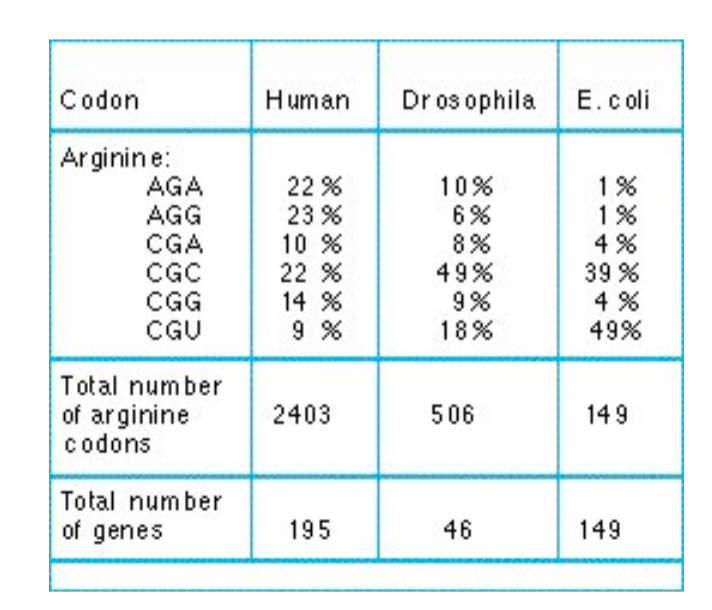
<ul><li><p>while the same codons encode for the same a.a’s, the codon usage is different from species to spcecies</p><ul><li><p>e.g. 22% of Arg codons are AGA in the human genome, while 1% of the Arg codons are AGA in <em>E. coli</em>. Accordingly, there are more tRNA w/ the GCG anti-codon compared to UCU in <em>E. coli</em></p></li></ul></li><li><p>in many fast-dividing organisms, there is a strong correlation b/w codon usage and protein abundance, as translation of an abundant protein will be favored by the higher concentrations of corresponding tRNAs in the cell </p></li><li><p>there’s a correlation between frequency of a given codon and tRNA abundance. </p></li><li><p>Genes for which numerous low frequency codons are expressed at lower levels</p></li></ul><p></p>
15
New cards

The Codon Adaptation Index (CAI)

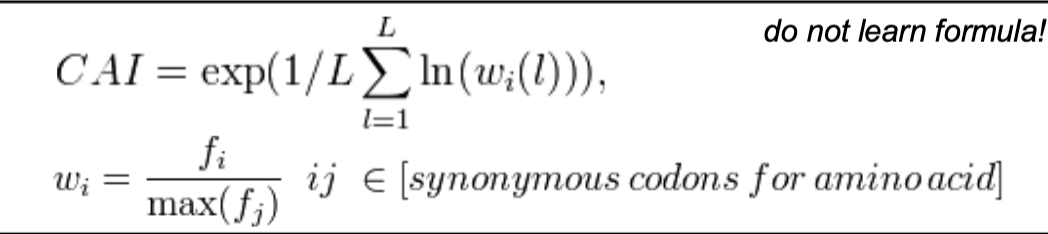
  • CAI is a method for analyzing codon usage bias

  • CAI measures the deviation of a given protein coding gene sequence w/ respect to the codon usage bias in the genome

  • CAI can be used to predict expression level of a protein based on its DNA sequence (especially in fast growing organism like the yeast S. cerivisaie)

  • the codons used in highly abundant proteins are more represented in the genome (~high CAI)

  • between 0 and 1

<ul><li><p>CAI is a method for analyzing codon usage bias</p></li><li><p>CAI measures the deviation of a given protein coding gene sequence w/ respect to the codon usage bias in the genome</p></li><li><p>CAI can be used to predict expression level of a protein based on its DNA sequence (especially in fast growing organism like the yeast <em>S. cerivisaie</em>)</p></li><li><p>the codons used in highly abundant proteins are more represented in the genome (~high CAI)</p></li><li><p>between 0 and 1</p></li></ul><p></p>
16
New cards

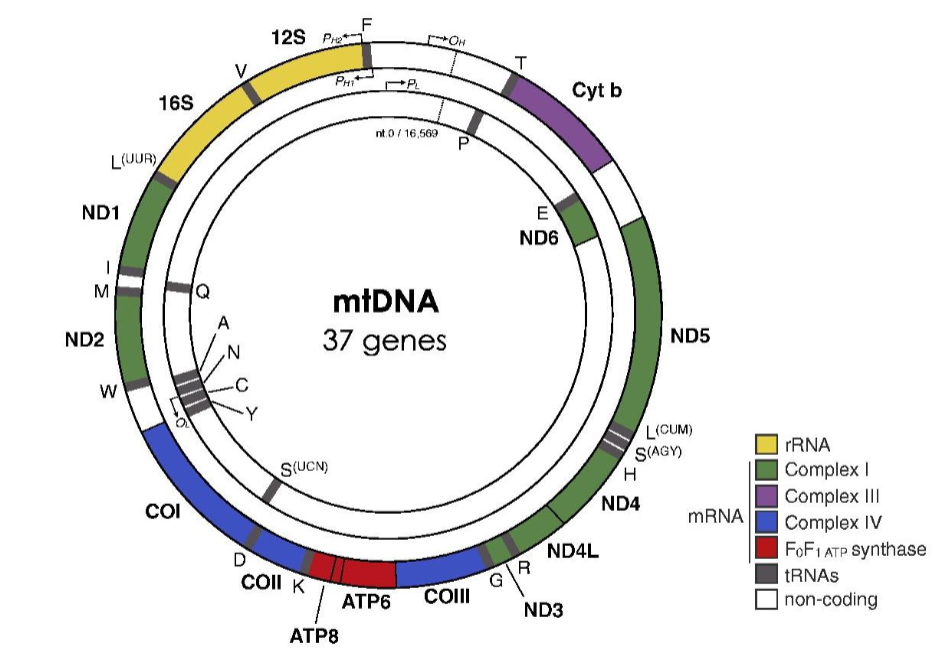
Mitochondria

  • mitochondrial genome has 22 tRNAs

<ul><li><p>mitochondrial genome has 22 tRNAs</p></li></ul><p></p>

Explore top notes

note
PRENATAL DEVELOPMENT
Updated 1221d ago
0.0(0)
note
CGO casus 1
Updated 444d ago
0.0(0)
note
Ancient Philosophers
Updated 1149d ago
0.0(0)
note
2.8 The Early Baroque Period
Updated 1220d ago
0.0(0)
note
Chapter 13: The Sectional Crisis
Updated 1286d ago
0.0(0)
note
Weathering, Soil, and Mass Wasting
Updated 1168d ago
0.0(0)
note
PRENATAL DEVELOPMENT
Updated 1221d ago
0.0(0)
note
CGO casus 1
Updated 444d ago
0.0(0)
note
Ancient Philosophers
Updated 1149d ago
0.0(0)
note
2.8 The Early Baroque Period
Updated 1220d ago
0.0(0)
note
Chapter 13: The Sectional Crisis
Updated 1286d ago
0.0(0)
note
Weathering, Soil, and Mass Wasting
Updated 1168d ago
0.0(0)

Explore top flashcards

flashcards
HFrEF Treatment
94
Updated 474d ago
0.0(0)
flashcards
Chapter 26
75
Updated 721d ago
0.0(0)
flashcards
Biopsychology -
62
Updated 583d ago
0.0(0)
flashcards
unit 3 ap hug
56
Updated 1211d ago
0.0(0)
flashcards
Psychology AOS Research Methods
51
Updated 303d ago
0.0(0)
flashcards
MI Quiz 1.4, 2.1, 2.2
58
Updated 1149d ago
0.0(0)
flashcards
HFrEF Treatment
94
Updated 474d ago
0.0(0)
flashcards
Chapter 26
75
Updated 721d ago
0.0(0)
flashcards
Biopsychology -
62
Updated 583d ago
0.0(0)
flashcards
unit 3 ap hug
56
Updated 1211d ago
0.0(0)
flashcards
Psychology AOS Research Methods
51
Updated 303d ago
0.0(0)
flashcards
MI Quiz 1.4, 2.1, 2.2
58
Updated 1149d ago
0.0(0)