EASC 2702 Lecture 18 Basins
 Studied by 0 people
 Call Kai
 Learn
Learn Practice Test
 Spaced Repetition
 Match
Match Flashcards
 Knowt Play
1/28

There's no tags or description
Looks like no tags are added yet.
Name | Mastery | Learn | Test | Matching | Spaced | Call with Kai |
|---|
No analytics yet
Send a link to your students to track their progress
29 Terms
basins formed in extensional settings
continental rift basins and proto-ocean troughs
passive continental margins
continental rift basins
forms where the crust and mantle lithosphere is being pulled apart
the asthenosphere rises below thinned lithosphere
on the surface forms grabens and half-grabens, filled with prograding sediment and coeval volcanics
common during periods of supercontinent breakup - now buried beneath deposits of the passive continental margins
evolution of rifts into oceans
continental rifts → proto oceanic troughs → pavssive continental margins and oceanic basins
passive continental margins
formed when a continent rifted apart and new oceanic crust developed
but there is now no tectonic interaction occurring
proto-ocean troughs
elongated depressions that form during the earliest stage of continental rifting.
margins connected to rivers…
will form deltas, estuaries, clastic shelf deposits, and submarine channels and fans
margins not connected to rivers…
are starved and may form thick carbonate platforms
basins formed in compressional settings
formed along major collisional plate tectonic boundaries
arc related basins
orogenic basins
arc related basins
trench, forearc, back-arc basins
Volcanic arcs form above subduction zones because …
the release of water from subducting slabs reduce the soludus of the mantle, producing melts.
the steeper and faster the rate of subduction…
the more extension there is in the plate above the subducting oceanic crust
trench
A deep, narrow depression on the ocean floor that forms at a subduction zone where old, cold, dense oceanic crust bends and sinks beneath another plate.
forms at the front of the accretionary prism
accretionary prism
A wedge-shaped mass of sedimentary material that forms when light, deep-marine sediments on the subducting oceanic plate are scraped off and piled onto the overriding plate.
fore-arc basins
form above subduction zones, between the accretionary wedge and the arc
main source of sedimentation is the arc (which produce volcaniclastic detritus continuously)
sediment is mostly mineralogically immature and dominated by volcaniclastic sed rocks
can also be sediment starved and form carbonate platforms
Fore-Arc Basin Deposits
Steep slopes, deep water, and abundant volcanism cause volcaniclastic turbidites and deep-marine fan facies to dominate, with abundant ash fall beds and subaqueous volcanic flows.
There is a direct relationship between volcanic eruptions and sedimentation events.
back-arc basins
extensional basins behind the volcanic arc
may start as rifts and proto-oceanic troughs and can evolve into oceanic crust with their own spreading ridges
deposits are similar to rift deposits, but with a lot more fresh volcaniclastic material
foreland basins
form adjacent to mountain ranges (mountains are where the crust piles up creating a orogenic load)
the load pushes down on the underlying lithosphere, causing it to sink, forming a basin on the edge of mountain belts
peripheral and retroarc
peripheral foreland basins
occur at continent-continent collision zones (e.g., Himalayas) where the overriding plate, the subducted plate, and sediment accumulation all add to the load
retroarc foreland basins
form on the craton-ward side of continental subduction zones, where compression and terrane accretion lead to loading (e.g., the Western Canadian sedimentary basin)
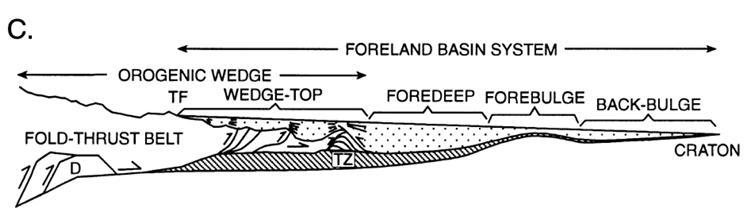
foreland basin sub-basins: the wedge top (piggyback) basin
the part of the basin that forms above the thrust front of the orogen. It is characterized by syn-deformational sedimentation, including growth sequences and unconformities above blind thrusts.
foreland basin sub-basins: the foredeep
the deepest part of the foreland basin, where most sediment accumulates. The presence of a mountain range adjacent to these basins means that sediment supply is abundant
foreland basin sub-basins: the forebulge
the zone of uplift from the crest of the attenuated flexural wave. It may be covered or form a basement high where additional sediment may be sourced.
foreland basin sub-basins: the back bulge
a shallow basin that may (or may not) form craton-ward of the forebulge
foreland basin sub-basins
basins formed in strike-slip settings
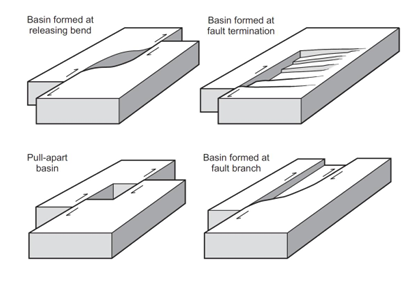
form only local pull-apart basins where there are bends, lateral displacement, terminations, and bifurcations
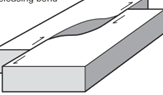
releasing bends
pull-apart basins
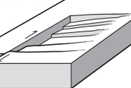
strike-slip terminations
releasing bends
result in transtension, and the opening of narrow, sigmoidal basins.
basin formed in strike-slip settings
pull-apart basins
occur where there is a lateral displacement of a strike-slip fault.

strike-slip terminations
leave behind remnant stress that is taken up by transtension.
basin formed in strike-slip settings
intracratonic basins
broad basins formed on stable continental crust, and over 100s of millions of years episodically experienced subsidence, including widespread flooding during the Paleozoic eustatic rise
origin is not understood
 Note
Note  Flashcards (96)