W1 Vergence and Refraction
 Studied by 0 people
 Call with Kai
 Learn
Learn Practice Test
 Spaced Repetition
 Match
Match Flashcards
 Knowt Play
1/16

There's no tags or description
Looks like no tags are added yet.
Name | Mastery | Learn | Test | Matching | Spaced | Call with Kai |
|---|
No study sessions yet.
17 Terms
What happens to wavefronts at infinity?
Wavefronts are flat
What is the direction of light?
Left to right
What is vergence?
Describes the path/curvature of the pencil of light rays- whether they’re converging or diverging
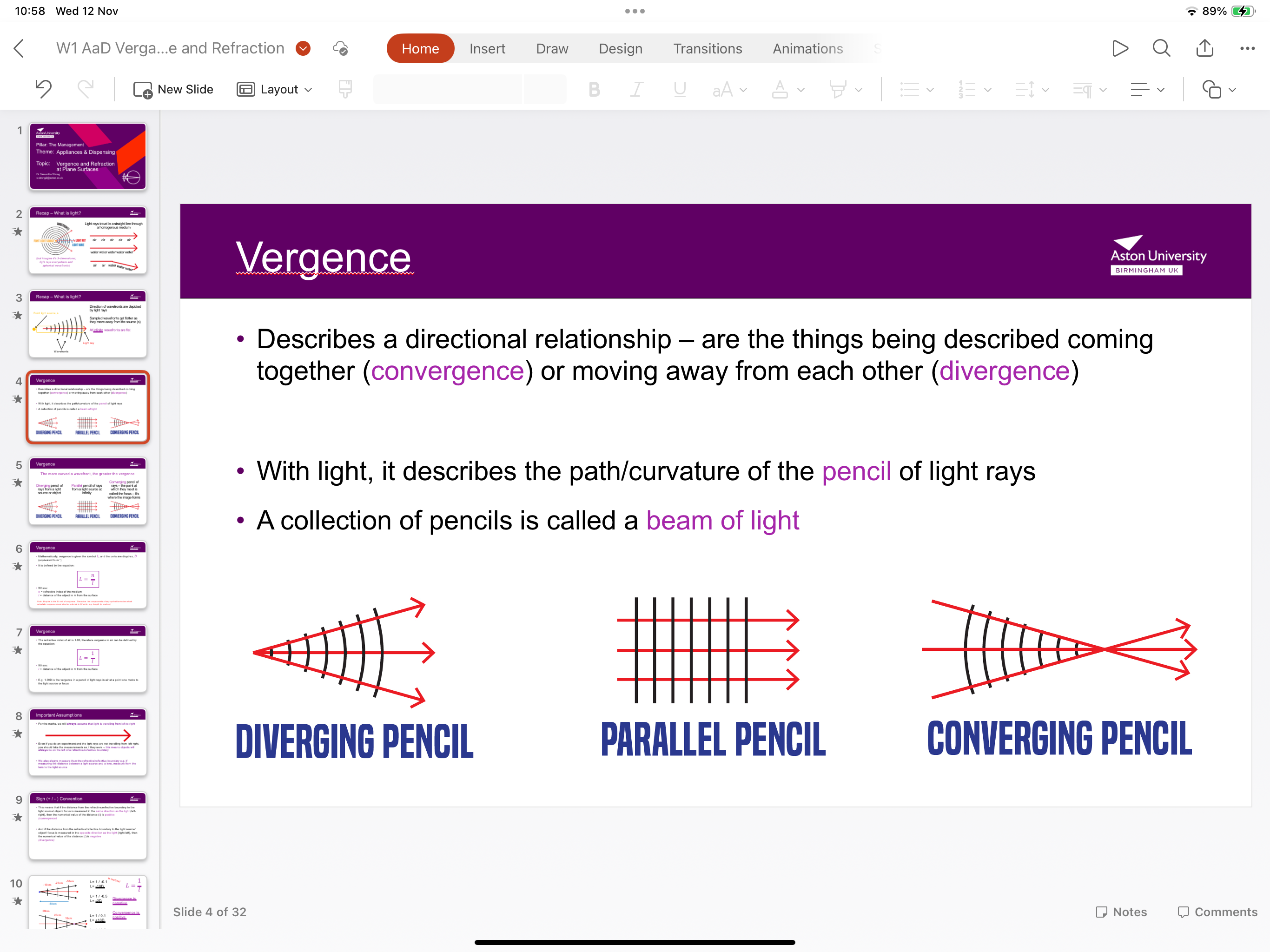
What is the relationship between wavefronts and vergence?
The more curved the wavefront greater the vergence
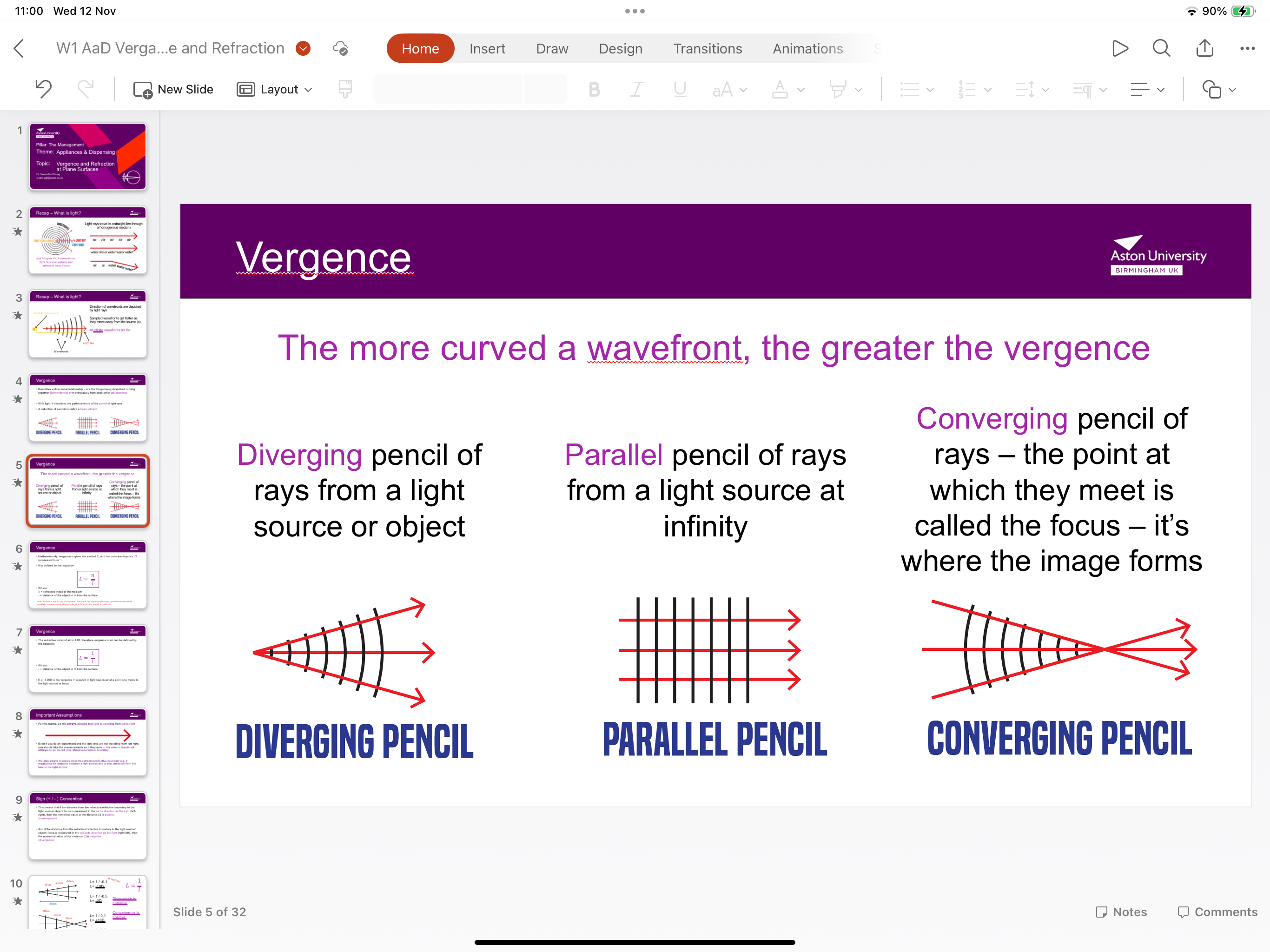
What is the focus in a converging pencil?
The point at which the rays of light meet and the image forms
What is the refractive index of air?
1.00
What do we assume about the direction of light?
That it’s travelling from left to right
What other assumptions do we make?
Objects will always be on the left of a reflective/refractive boundary and we always measure FROM the reflective/refractive boundary
How do we obtain a positive numerical value of distance (l)?
If the distance from the boundary to the light source/object is measured in the same direction of light then the value is positive (convergence)
How do we obtain a negative numerical value of distance (l)?
If the distance from the boundary to the light source/object is measured in the opposite direction of light (right to left) then the numerical value of distance is negative (divergence)
What is image vergence?
The vergence of the light rays after experiencing the refractive boundary
What factors impact refractive index?
The wavelength of light- high refractive index materials are typically more dense
What is the normal?
The angle perpendicular to the surface- refraction cannot occur when light rays fall on the normal
How does velocity change?
Depending on the change in refractive indexes between optical mediums
What is Snell’s law?
The ratio of the sine of the angle of incidence to the sign to the angle of refraction is constant
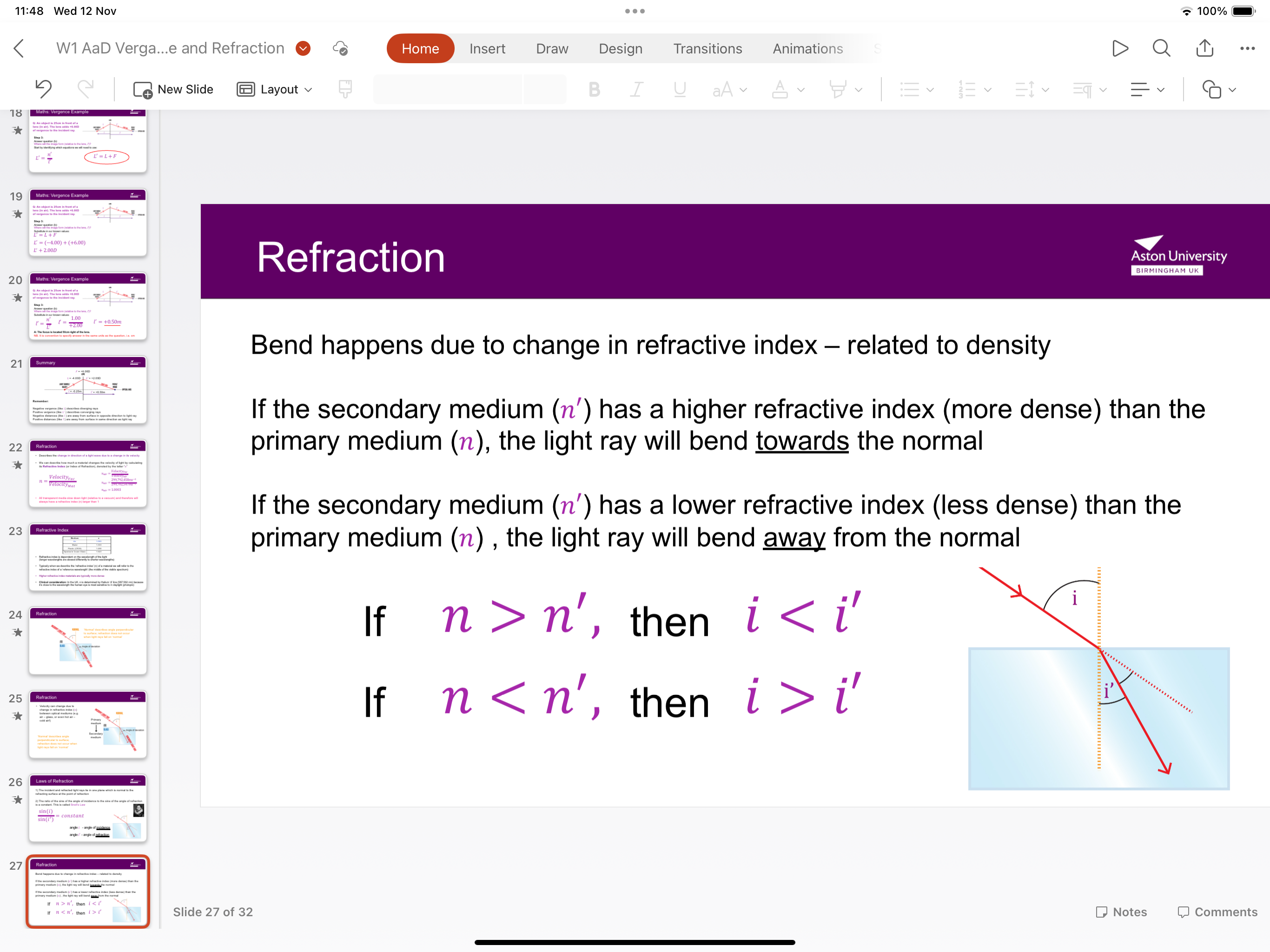
What is the difference between angle (i) and angle (I’)?
Angle (I) is angle of incidence angle (I’) is angle of refraction
What happens if the secondary medium (n’) has a higher refractive index than the primary medium (n)?
Secondary medium is more dense so light ray moves towards the normal and vice versa
 Note
Note  Flashcards (22)