3.2 Impressions and Coupling
 Call Kai
 Learn
Learn Practice Test
 Spaced Repetition
 Match
Match Flashcards
 Knowt Play
1/119

There's no tags or description
Looks like no tags are added yet.
Name | Mastery | Learn | Test | Matching | Spaced | Call with Kai |
|---|
No analytics yet
Send a link to your students to track their progress
120 Terms
what are the steps of ear impression procedures?
otoscopy, oto-block placement, mixing, syringing material into ear, remove impression and inspect the impression.
what is the first step of ear impression making?
otoscopy.
Gauge the size and bend of the ear canal.
Identify any contraindications such as:
- Ear wax
- Discharge
- Mastoid cavity
- Exostosis
how to do otoblock placement?
Place the oto-block into the ear canal using ear light.
Depth of insertion: past the second bend of ear canal.
what’s the point of otoblock placement?
makes sure that the impression fluid doesn’t leak past the canal.
what are the two types of otoblocks?
foam block
or cotton dam
what are other names for otoblocks?
foam block, canal block, ear dam, cotton wool
what material do we use when mixing?
1:1 silicon impression materials of different viscosity.
what do we use when mixing?
spatula.
Make sure material is fully mixed before putting into the syringe.
what the benefits of a low viscosity impression fluid?
Leads to a more accurate impression.
when to use low viscosity impression fluid?
Lower viscosity should be used for floppy ear to make sure that the ear canal is not widening which is an issue for more elderly patients
what to avoid when syringing?
Do not pull back on pinna whilst syringing because that will distort the shape of the earmould end product.
how to syringe correctly?
• Begin syringing into ear canal until material flows out around the tip.
• Fill the concha bowl, move up into the antihelix, then follow the contour of the ear, up to the helix lock.
when do you remove the impression?
after material has set.
how to remove impression?
Pull the pinna up and back to break the seal.
Remove the impression from the anti helix area and gently rotate forward and out.
what should you do after removing an impression?
Perform otoscopy.
Inspect ear impression.
and then clean up.
what are some common problems with impression making?
Ear wax making indentation and air bubbles (not make the proper impression).
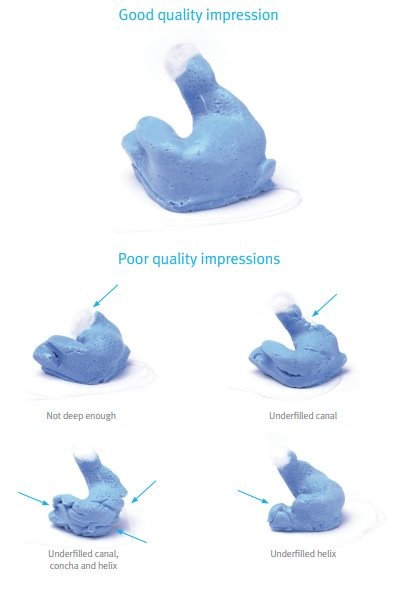
inspecting the impression, key criteria:
Are there any air bubble gaps?
Any marks from insufficient curing time (time for material to harden)?
Helix lock missing?
Is the canal and concha area fully sealed?
Is the canal length too short? Is it past the second bend?
impressions for CIC are usually around:
5 mm past the second bend
impressions for IIC are usually around:
8-12 mm beyond second bend.
which type of otoblock should be used for extra deep impressions?
cotton dam rather than foam for contraindications: exostosis, active infection, small canals, perforations..
goes very close to TM.
modified ear impression technique patients:
some patients may experience ear canal shape changes with jaw movements particularly when they are smiling, chewing and talking.
modified ear movement impact on impression technique making?
Significant impact on the retention of custom hearing aids (loss of retention due to ear canal movements) and can lead to feedback due to break of acoustic seal.
Discomfort due to movement of ear canal and pinna.
sound leakage.
what is open jaw impression technique?
- Ear impression is taken with client’s mouth open e.g. using bite block.
- This creates the largest canal volume in the EAM
Front teeth (sideways or vertically for more open).
what are the three main steps of ear mould and ear shell construction:
computer aided manufacturing or CAM.
Laser scanning of ear impression to generate a 3D image.
Ear impression is photographed by several digital cameras.
computer modelling.
Determine how hearing and components are placed.
Add casing or shell.
Compare to finished product.
laser printing of shell.
Laser beam sweeps across the photo-sensitive acrylic material in a vat of a print machine.
The shell undergoes a final cure under UV light.
what is an advanced new gen method of ear mould and ear shell making?
Otoscan.
3D Ear Scanning.
Laser used to scan shape of EAC.
advantages of Otoscan
No impression and no mess.
More accurate than ear mould impression.
Removes issues around oto-block placements.
disadvantages of otoscan
Middle ear pathology or wax may distort 3D image made.
what do you need to specify when placing a BTE order?
tubing (standard or slim tube)
earpiece (ear mould or domes)
for ear moulds we need to specify:
- Ear-mould style
- Material
- Vent options
the more occluding an ear mould is:
the more low frequencies stay inside the person’s ear. Impacts how loud their own voice is.
how to solve a bigger hearing loss, what venting size should you use?
smaller or no vent, keeps sounds inside hearing aid more likely to be amplified
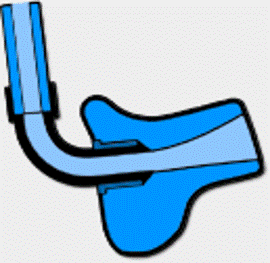
what does standard tubing attach to?
the ear hook on the BTE
what impact does a wider tube have on sound propragation?
the wider the tubing the more sounds will come into the ear, so less amplification is needed from the hearing aid.
how thick are standard tubing vs thinner tube i.e. their inner diameters?
~2mm for wider and ~0.8mm for thinner.
which provides greater amplification standard or thin tubing?
standard
what areas are standard tubing better than thin tubing?
provides greater amplification.
more robust.
easier to clean and maintain.
what is standard tubing also equated to?
#13
thin tubing is also called what?
slim tube
advantages of thin tubing:
more discreet so more cosmetically appealing.
what is a disadvantage of standard tubing?
less cosmetically appealing and more visible than slim tube
what are some disadvantages of thin tubing?
more sound leakage in higher frequencies.
prone to wax blockage.
more difficult to clean and maintain.
some need an adaptor to attach to a BTE whilst others have an integrated adaptor.
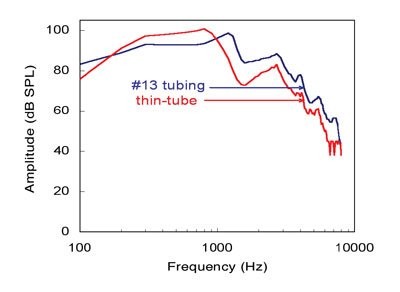
what kind of tubing should you use for someone with a more significant hearing loss?
thicker or standard tubing.
since slim tube has less amplification of high frequency sound.
standard tubing vary in:
type and thickness
what are the 3 types of standard tubing?
standard or #13 (thicker wall), moisture resistant tubing (reduces the likelihood of moisture forming inside the tubing) and wide bore tubing (Libby horn).
also got thick tubing (separate from standard)
for high gain hearing aids what factor affects leakage of sound?
tube thickness
Wide bore tubing such as libby horn boost what frequency range?
>3kHz
what are the sizes of a libby horn?
3mm, 4mm and greater than or equal to 1cm
how much of a boost does a 3mm libby horn give in dB?
5-10 dB boost
how much of a boost does a 4mm libby horn give in dB?
10-15 dB boost
what is needed for 1 cm or more than 1 cm libby horn?
need acoustic horn tubing
what does the earhook contain inside it and what’s the function of that component?
acoustic damper to smooth out resonant peaks
what is the acoustic damper made out of?
a mesh material
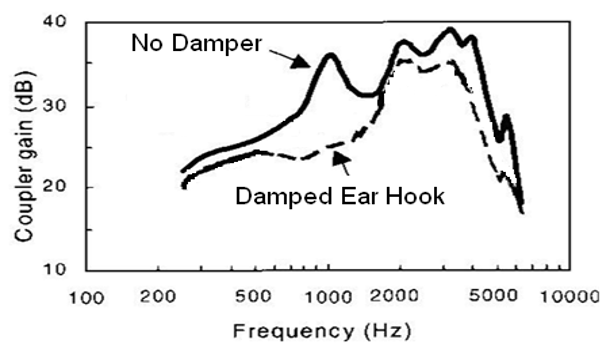
what are the acoustic effects of a damper?
reduces the peakiness or jaggedness of hearing aid responses by providing attenuation.
may allow increased overall hearing aid gain.
what frequencies do hearing aids affect?
750Hz and 3kHz
what is the level of attenuation provided by a damper dependent on?
impedance of damper the material itself.
placement of damper. if placed closer to receiver impact is much bigger (more impact at 2kHz).
closer to earmoulds or further down earhook (more affecting 1kHz) has less impact on gain.
what tubing should you use for boosting high frequencies?
standard or thick tubing
what should you do if you want a boost beyond 3kHz?
libby horn
if you want a boost for < 3kHz what could you do?
remove a damper
always consider what two things to reduce sound leakage via feedback when selecting domes?
degree of hearing loss and acoustic seal
why is it important to select the right earmould?
can alter acoustical properties like:
shape of gain frequency response.
quality of client’s own voice.
likelihood of feedback.
what 3 factors are the acoustical properties of earmoulds dependent on?
style
material
venting
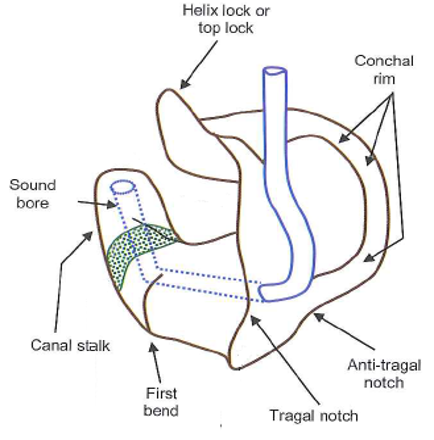
name the structures of a hearing aid
helix lock or top lock.
conchal rim.
anti tragal notch.
tragal notch.
first bend.
canal stalk.
and sound bore.
what are the 3 types of earmould styles for bte?
Shell earmould.
skeleton style mould.
canal style mould.
what kind of hearing losses is good for shell earmould?
appropriate for severe to profound hearing losses.
what other benefits of shell earmould are there?
easier management.
minimise risk of feedback.
can be carved to reduce bulk (concha bowl region is thinned out).
what kind of hearing loss is skeleton style mould appropiate for?
mild to severe
what are some other benefits of choosing a skeleton style mould?
offers good retention.
can be easily modified to a canal lock by removing helix lock and middle portion.
what kind of hearing loss is canal style mould appropriate for?
mild to moderate
downsides of choosing a canal style mould
poorer retention unless a canal lock is added and canal stalk is made longer.
more risk of feedback.
benefits of choosing a canal style mould
small size offers comfort and cosmetic appeal
range most to least occluding earmould style for BTE
full shell, half shell, skeleton, canal lock and canal tip
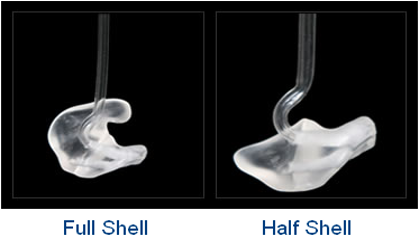
what does a full shell and half shell look like?
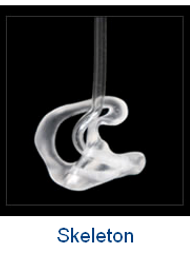
what does a skeleton shell look like?
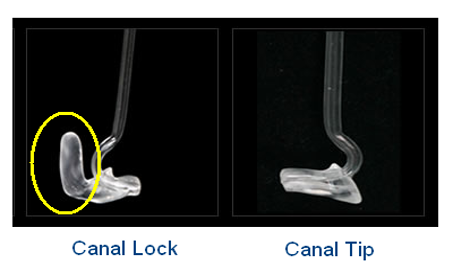
what does a canal lock and tip look like?
difference and similarities between thin tube BTE and RIC?
RIC has receiver integrated earmould for severe losses (made with shell material).
different powered receivers in that earmould.
both have hollow canal tip and canal tip.
what the two kinds of materials used for earmoulds?
hard or soft material
what are the advantages of using hard earmould material?
- Durable and easy to grind and modify
- Comfortable and easier to keep clean
- Offer good retention and comfortable
- Easy to insert and remove than soft material earmoulds
- Material doesn’t deteriorate over time
what are the disadvantages of using hard earmould material?
- Cannot compress the mould to fit past narrow openings
- Not a perfect seal so more feedback prone
- Can shatter if stepped on
examples of hard material include:
hard acrylic (most common), vinyl, titanium.
what are some advantages of using soft earmould material?
- Most flexible material; adjusts to minor movements of ear canal
- Yields better acoustic seal for high gain hearing aids i.e. severe losses
- Hypoallergenic
what are some disadvantages of using soft earmould material?
- Not easily modified
- Deteriorates more easily than say acrylic
- Difficult to insert and more occluding (sticks to ear canal)
examples of soft earmould materials
silicone (most common), vinyl, soft acrylic
vent size is limited by:
- Client ear canal anatomy
- Components of the hearing aid in custom styles
what is a vent used for?
A vent is any opening through the earmould/shell to allow ventilation of the canal.
what 2 factors affect hearing aid acoustics?
length and diameter
what are the 3 vent types?
parallel vent, IROS vent and select a vent or SAV
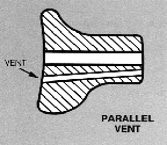
parallel vents features:
- Constant diameter
- Runs relatively parallel to the sound bore
- Most common type of vent
IROS vent features
Vent path opened into a shorter wider vent path by removing some of the shell
Increases venting effect whereas a larger diameter vent cannot fit, good for tapered canal shape
SAV features
Varying vent diameters (6 inserts) on SAV tree
disadvantages of an SAV
may expire or fall out
advantages of using SAV
Modify sounds more easily, getting enough amplification and modify according to person’s voice and how they perceive their own voice and quality.
what is occlusion effect in layman’s terms, what does it feel like?
client’s own voice sounding boomy or like talking in a barrel.
how to solve occlusion effect?
Increase vent size or shorten vent.
Allows low frequency sound to escape the ear canal.
how does occlusion effect occur?
When a person speaks the movement of the mandible and vocal tracts causes the cartilaginous portion of the canal to vibrate and this generates low frequency sounds that escape out of the canal generally but because of hearing aids in or ear plug diverts the low frequencies back into the middle ear and back into the cochlea.
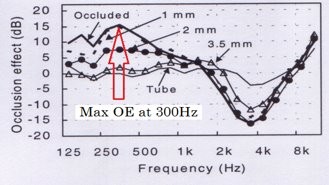
what frequency does occlusion effect impact the most?
Max OE at 300Hz
1 mm diameter has most occlusion effect with higher y axis value like 15 dB occlusion effect vs 2 mm where occlusion effect is much lower.
a vent is a column of air with ___ and ___:
mass and inertia.
relationship between length and diameter of a vent and acoustic mass
Wider, shorter vents = LOWER acoustic mass (e.g. IROS vent through shortening of vent)
Longer, narrower vents = HIGHER acoustic mass
high acoustic mass is related to
high occlusion ratings
vent size can affect
occlusion effect and acoustic feedback
a larger vent size can alleviate occlusion but cause what
can increase likelihood of amplified sound escaping and causing feedback.

