Cell Membranes AQA A Level Biology
 Studied by 0 people
 Call Kai
 Learn
Learn Practice Test
 Spaced Repetition
 Match
Match Flashcards
 Knowt Play
1/44

There's no tags or description
Looks like no tags are added yet.
Name | Mastery | Learn | Test | Matching | Spaced |
|---|
No study sessions yet.
45 Terms
what are the functions of membranes?
controls what enters and leaves the cell
act as barriers between organelles and cytoplasm, allowing there to be different conditions within and without
helps to maintain homeostasis by regulating internal contents of cell
what is the model of the structure of the cell membrane?
fluid mosaic model
why is the term ‘fluid-mosaic model’ appropriate to describe the cell membrane?
fluid - phospholipids in bilayer can move laterally
mosaic - membrane composed of many parts including proteins which are distributed through, making it a mosaic
model - we don’t know exactly what it looks like, only a theory
what are the constituent parts of the cell membrane?
phospholipid bilayer
glycolipids
glycoproteins
channel proteins
carrier proteins
cholesterol
draw/describe the structure of the cell membrane
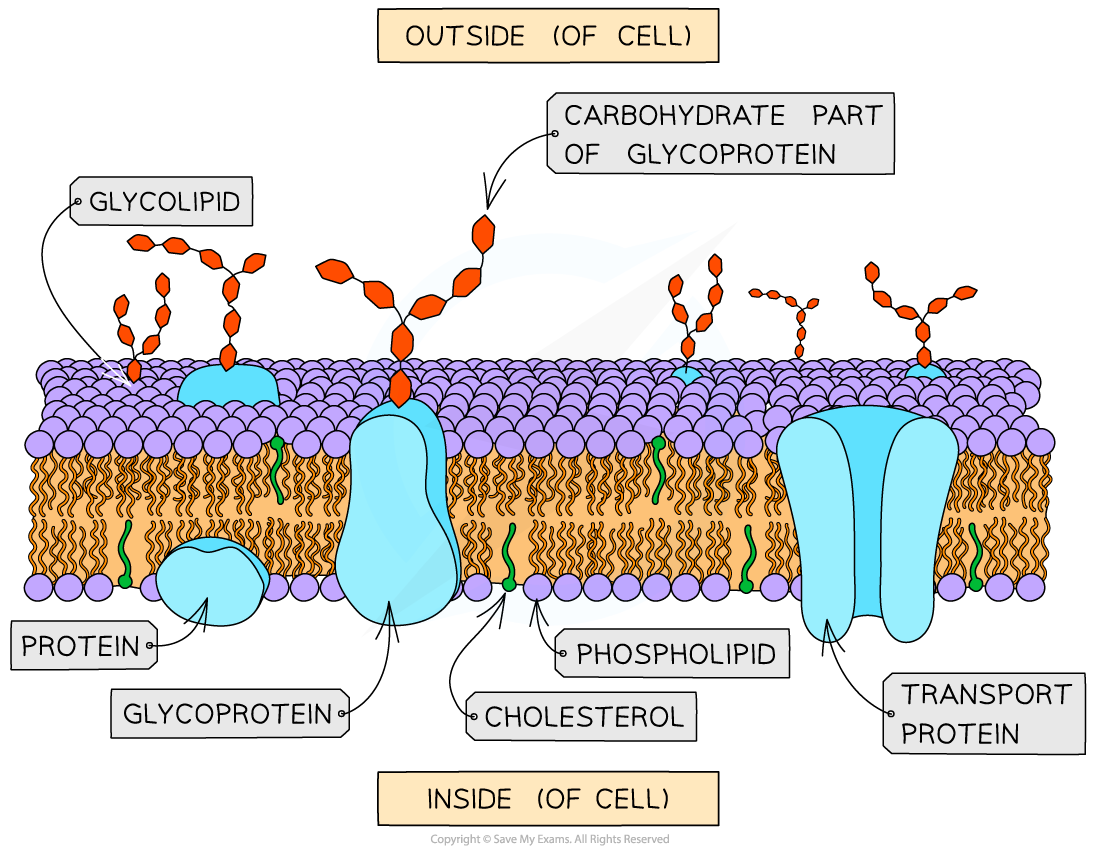
what is the function of cholesterol in the membrane?
gives membrane stability
binds to hydrophobic tails of phospholipids, causing them to pack more closely together, restricts movement, makes membrane less fluid
prevents polar substances moving through membrane
what is a glycoprotein and what is it’s function?
protein with short carbohydrate chain attached
helps with cell recognition and acts as a receptor
helps with immune response
stabilises structure
what is a glycolipid and what is its function?
lipid with short carbohydrate chain attached
helps with cell recognition and acts as a receptor
helps with immune response
stabilises structure
what is the function of a protein receptor site?
allows other proteins to attach such as enzymes/antigens/hormones
what is the function of a channel protein?
provides hydrophilic pathway for water and small polar ions to enter/leave cell
key for facilitated diffusion
what is the function of a carrier protein?
transport substances from one side of the membrane to the other
can change shape to move molecules that are too large for facilitated diffusion
specific to substances they transport
how do temperatures below freezing affect the cell membrane?
phospholipids don’t have much energy
packed closely together, membrane rigid
channel and carrier proteins denature, increasing membrane permeability
ice crystals may form and pierce membrane making it permeable when it thaws
how do temperatures between 0 and 45 C affect the membrane?
phospholipids can move around and aren’t packed as tightly together
membrane is partially permeable
as the temperature increases, the phospholipids move more because they have more energy
increases permeability of membrane
how do temperatures above 45C affect the membrane?
phospholipid bilayer starts to melt/break down
membrane becomes more permeable
water inside the cell expands, putting pressure on the membrane
channel and carrier proteins denature
membrane permeability increases
how does surrounding cells in an increasing concentration of solvent affect membrane permeability?-
increases membrane permeability
solvent dissolves the lipids, causing it to lose its structure
define diffusion
movement of particles from an area of high concentration to an area of low concentration
what factors affect the rate of diffusion?
concentration gradient - steeper gradient = faster rate of diffusion; as diffusion takes place, the difference decreases until it reaches equilibrium
thickness of surface - shorter diffusion distance = faster rate
surface area - larger surface area = faster diffusion rate
which molecules can diffuse directly through a cell membrane?
lipid soluble molecules
very small molecules such as oxygen and carbon dioxide
which molecules cannot diffuse directly through a cell membrane?
polar molecules
larger molecules
how do polar and large molecules diffuse through the cell membrane?
facilitated diffusion
describe the process of facilitated diffusion
same as normal diffusion, but substances diffuse through the membrane using transport proteins (channel and carrier)
describe how channel proteins function
small pores/channels in the cell membrane
hydrophilic
when charged particles collide with them, and are the right kind of charged particle for the channel protein, they pass through it to the other side of the membrane
describe how carrier proteins function
move larger molecules across the membrane
large molecules attach to a specific carrier protein in the membrane
protein changes shape
releases molecule on the opposite side of the membrane
what does water pass through in the cell membrane?
aquaporins
which factors affect the rate of facilitated diffusion?
concentration gradient
number of channel/carrier proteins - once all the proteins in a membrane are in used, facilitated diffusion cannot happen any faster - causes rate of diffusion graphs to plateau
define active transport
movement of molecules or ions from a region of lower concentration to a region of higher concentration using energy and carrier molecules
what produces energy for active transport?
hydrolysis of ATP to form ADP and Pi
define osmosis
net movement of water molecules from a region of high water potential to one of low water potential across a partially permeable membrane
what is the water potential of water?
0
what sort of concentration does a solution with high water potential have?
dilute concentration
what sort of concentration does a solution with low water potential have?
strong concentration
what is an isotonic solution?
a solution with the same osmotic concentration as the cytoplasm of the cell
what is a hypertonic solution?
a solution with a higher osmotic concentration than the cytoplasm of the cell (low water potential)
what is a hypotonic solution?
a solution with a lower osmotic concentration than the cytoplasm of the cell (high water potential)
what happens to cells placed in an isotonic solution?
no net movement of water
plant: incipient (slight) plasmolysis
animal: nothing
what happens to cells in a hypertonic solution?
water moves out of the cell
plant: full plasmolysis
animal: shrivels
what happens to cells in a hypotonic solution?
water moves into the cell
plant: cells become turgid, structured
animal: cells swell and burst
how would you use a graph of % change in mass of potatoes against sucrose concentration to find the water potential of the sucrose solution?
find the point where the curve intersects the x acis
find the concentration of sucrose solution at this point
look this up to find the water potential of the solution
what does a more negative water potential show about the solution?
that it is more concentrated (low water potential)
what does a less negative water potential show about the solution?
that it is more dilute (high water potential)
what is the symbol for water potential?
Psi; trident shape
what is co-transport?
when two substances are transported together using the same protein
normally when one molecule is moving down its concentration gradient passively, and the other molecule can be brought with it
what type of proteins does active transport use?
carrier
give an example of where co transport takes place
small intestine
describe how co transport takes place in the small intestine
glucose and amino acids need to move from the lumen of the small intestine, through the epithelial cells and out the other side into the blood stream
sodium ions are actively transported out of the cell by the sodium-potassium pump in the membrane - a carrier protein
lower conc of sodium ions inside cell compared to intestine lumen
sodium ions diffuse into the epithelial cell down it’s concentration gradient through a different type of carrier protein
the sodium ions bring the glucose with them
 Note
Note  Flashcards (274)