Functional Anatomy of the Lower Extremity (ANKLE and FOOT))
 Studied by 0 people
 Call Kai
 Learn
Learn Practice Test
 Spaced Repetition
 Match
Match Flashcards
 Knowt Play
1/39

There's no tags or description
Looks like no tags are added yet.
Name | Mastery | Learn | Test | Matching | Spaced | Call with Kai |
|---|
No analytics yet
Send a link to your students to track their progress
40 Terms
Ankle (talocrural) and foot form a ________ unit
complex
mobile and stable
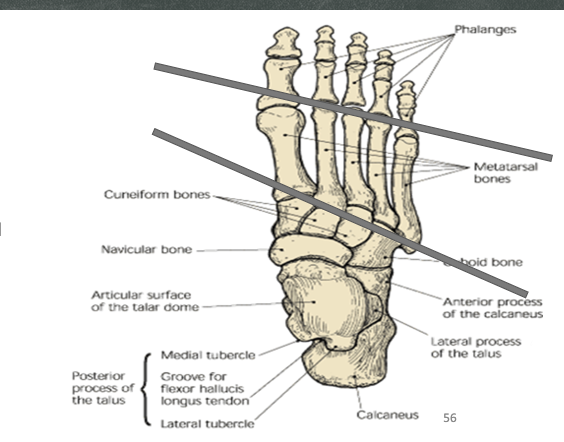
Bones in the ankle and foot
26 bones:
7 tarsals: Calcaneus, Talus, Navicular, Cuboid, and Medial, intermediate, and lateral cuneiforms
5 metatarsals
14 phalanges
Arches in the foot
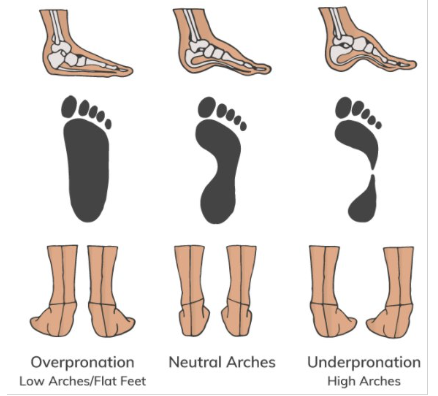
Medial longitudinal arch is 15 to 18mm: Level of navicular, which is the keystone of arch
Lower lateral longitudinal arch: 3 to 5mm from ground at level of cuboid
Normal transverse arch: Angle formed between metatarsals and ground

Functions of the foot and ankle
Support of body weight with least expenditure of anatomical material
Protection for nerves and vascular supply
High arch or low arch can result in a variety of
dysfunctions
Forces from foot are transferred to more proximal joints
The foot is passively interlocked by action of
Plantar aponeurosis (plantar fascia)
Long plantar ligament
Short plantar ligament
Plantar calcaneonavicular (spring) ligament
The articular surfaces are particularly applicable to evaluation of the components of joint motion such as
glide, roll, spin, and interventions involving joint mobilizations
Ligamentous fibers direction is the key to
determining which motions are guided and limited
The ankle joint (talocrural) consists of
Proximally and medially (internally): talus and the tibia
Laterally (externally): talus and the fibula
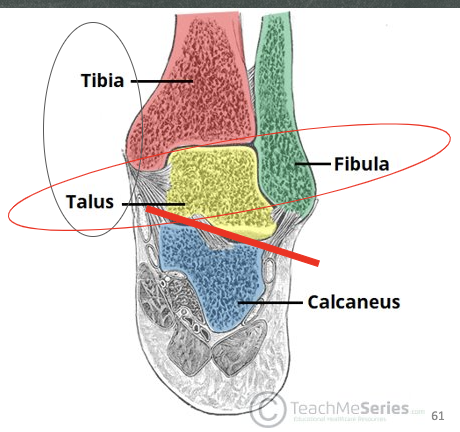
Strong ligaments like anterior/posterior tibiofibular and interosseous tightly bind
the distal tibiofibular joint
no synovial membrane
The bony attachments of ligaments in the foot and ankle
Indicates the name of the ligament
Reveals the motions limited when the ligament is tight
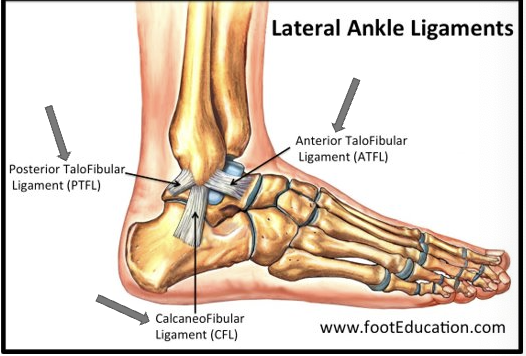
The Lateral Collateral ligament in the ankle is composed of what 3 bands ?
Anterior talofibular ligament, Calcaneofibular ligament, and Posterior talofibular ligament
What are the medial ankle ligaments ?
Deltoid ligament or medial collateral ligament of ankle: Tibiocalcaneal ligament, Tibionavicular ligament, Posterior tibiotalar ligament, and the Anterior tibiotalar ligament
Anterior and Posterior muscle compartments are separated by the
tibia, fibula, and interosseous membrane between
Lateral Muscle Compartments are separated from
the other two compartments by: Strong fascial sheaths (intermuscular septa) → extend from fibula to superficial extent of muscle
The Subtalar Joint consists of
Anterior → biconcave calcaneal facet articulating with a biconvex talar facet on neck of talus
Middle → sustentacular facet of talus with middle facet at sustentaculum tali of calcaneus
Posterior → biconvex calcaneal facet articulating with a biconcave posterior talar facet on body of talus
Transverse Tarsal Joint consist of what 2 joints
Talonavicular joint
Calcaneocuboid joint
Muscles that cross the transverse tarsal joints act around
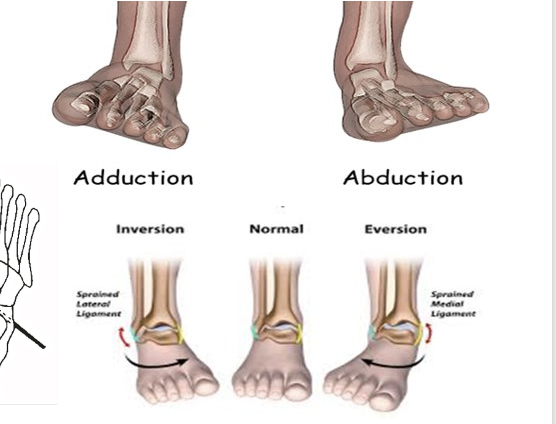
a longitudinal and oblique axis producing the motions of: Plantar flexion-dorsiflexion, Inversion-eversion, Abduction-adduction
The intertarsal Joints include
Three slightly convex navicular facets with the cuboid with the fifth ray
Metatarsophalangeal Joints consists of
Biconvex metatarsal heads and biconcave proximal phalangeal bases
What are the motions of the Metatarsophalangeal Joints
Plantar flexion / dorsiflexion, Abduction / adduction, and Circumduction
Hallux has how many phalanges ?
2 : (IP Joint)
Toes 2-5 have how many phalanges?
3 : (PIP and DIP Joint)
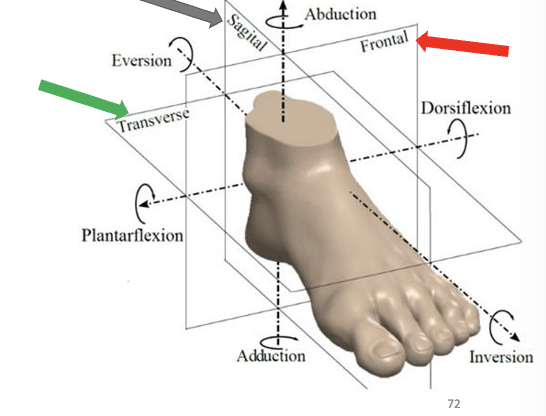
What are the 3 cardinal planes of motion ?
Sagittal plane: Flexion / extension
Frontal (coronal) plane: Abduction / adduction
Transverse plane: Internal & external rotation
Rotation occurs about an axis _____________ to that plane
perpendicular
The true mechanical axes of the joints of the foot complex _______ perpendicular to these cardinal planes
are not
These motions occur in planes that pass through all three cardinal planes which is called
tri-planar motions

tri-planar motions combine
Dorsiflexion, abduction, and eversion
Plantarflexion, adduction, and inversion
Pure rotation about an oblique axis results in the
same end position as three separate rotations in the cardinal planes
Axis of motion at the ankle passes
just distal to medial and lateral malleoli
Axis of motion is ________ to all of the cardinal planes of motion
oblique
Subtalar Joint Axis and Motion
Gliding joint in supination
Hinge or uniaxial joint
Axis runs downward, posteriorly and laterally: Motion of the STJ is tri-planar, providing pronation and supination
Transverse Tarsal Joint functional articulation between
Hindfoot (talus and calcaneus)
Midfoot (navicular and cuboid)
Transverse Tarsal Joint Axis & Motion
Plane or gliding joints
In supination: Navicular glides medially and inferiorly on the head of the talus, and Cuboid follows the navicular, moving medially and inferiorly on the calcaneus
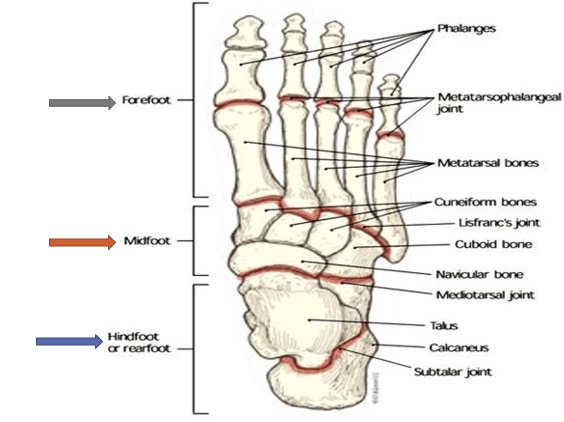
Foot regions include
Forefoot: Metatarsals and Phalanges
Midfoot: Cuneiforms, Cuboid, and Navicular
Hindfoot: Calcaneus and Talus
Transverse Tarsal Joint Axis & Motion
Two axes of motion:
Longitudinal axis is similar to the longitudinal component of the STJ axis: Provide eversion and abduction or inversion and adduction
Oblique axis is similar to the axis of the ankle: Contributes more to dorsiflexion and plantar flexion than to motions in the frontal and transverse planes
Tarsometatarsal Joint Axes & Motions is divided into 1st through 4th rays, more specifically?
1st ray: functional unit between the first metatarsal and medial cuneiform bones (Axis of motion: anterior, lateral & downward)
2nd ray: between 2nd metatarsal & middle cuneiform
3rd ray: between 3rd metatarsal & lateral cuneiform
4th ray: 4th metatarsal & cuboid
5th ray: 5th metatarsal & cuboid (Allows pronation & supination)
Joints of the foot are _____ and ______joints allowing motion in the sagittal and transverse planes
condyloid or biaxial
Tarsometatarsal Joint Axes & Motions
Axes pass through the head of each metatarsal : Dorsiflexion / plantar flexion and Abduction / adduction
Interphalangeal Joint Axis & Motion are
hinge joints
allow pure flexion and extension in the sagittal plane
 Note
Note  Flashcards (345)