PSY 392 brain waves and human cog exam 1
 Call Kai
 Learn
Learn Practice Test
 Spaced Repetition
 Match
Match Flashcards
 Knowt Play
1/105

There's no tags or description
Looks like no tags are added yet.
Name | Mastery | Learn | Test | Matching | Spaced | Call with Kai |
|---|
No analytics yet
Send a link to your students to track their progress
106 Terms
Cognitive Neuroscience
an interdisciplinary field studying the biological basis of mental processes (cognition) in the brain and investigating how neural circuits support cognitive functions using neuroscience and behavioral methods
cognitive psychology
the scientific study of internal mental processes, exploring how people cquire, process, store, and use information, covering areas like perception, memory, attention, language, problem-solving, and decision-making
neuroscientific methods
fMRI, EEG, electrocorticography (ECoG, or iEEG), TMS, etc.
What is an electrode
a conductor (like metal or graphite) that allows electricity to enter or leave a nonmetallic part of a circuit, serving as a gateway for currentflow in devices like batteries, medical sensors, and electronic components.
ERP components
voltage deflections in the ERP waveform
Naming of ERP components
NAming of ERP components
Ordinal position vs. latency of the peak
p1, p2, N1, N2, P3 vs. P300, N400
paradigm-based, e.g., no-go N2
Function based name, e.g., ERN(error-related negativity), FRN (feedback-related negativity), RewP (Reward Positivity)
Which way is up?
Historically, negative is up, so pay attention to the Y axis
more recent papers switch this
what leads to PSPs
constant brain activity leads to constant variations in the pattern of PSPs across the billions of neurons in your brain, this lead to a constantly varying EEG on the scalp
many different brain waves are what at the individual scalp electrodes
combined, creating a complicated mixture
one portion of the mixture of brain signals during an EEG that are brief, transient responses to internal and external events
ERPs
What activity of EEG is not driven by discrete events
much of the event driven activity is oscillatory in nature, reflecting feedback loops in the brain
EEG oscillations are mainly classified according what?
frequency bands
alpha band (8-13 Hzz)
Delta band (<4Hz)
Theta band (4-8 Hz)
beta band (13-30 Hz)
gamma band (>30Hz)
It is not generally true however that a specific frequency band reflects a specific process
What is EEG
Electorencephalogram
a non-invasive measure of changes in electrical potentials at the scalp produced by neural activity. It is a continuous and direct measure of brain activity in real time
EEG indexes broad mental states and large signals
mentalarousal level
epileptic seizures
large muscle movements
some patterns topographically recognized
ways EEG is used in the medical field
sleep disorders
epilepsy and seizure disorder
brain tumor
brain damage from head injury
stroke
drug intoxication
monitor anesthesia
confirm brain death
other brain disorders
EEGs can be used for brain-computer interfaces (BCIs) using motor imagery
large muscle movements
EEG during imagined movements allows direct control of devices without using limbs
What is EEG good for
EEG indexes broad mental states and large signals
EEG is used extensively in the medical field
EEGs can be used for brain-computer interfaces (BCI’s) using motor imagery
EEGs can be used to ask questions about the mind (mind-behavior link) and factors that influence mental states
How to go beyound slide 12’s early “ERPology”
What are ERPs good for
Assessing the time course of processing
Identifying potential neurocognitive processes
is a process absent or present
Covert measurement of processing
A link to the brain? (Maybe, but more about the mibd and the relationship between the mind and behavior, not so much about the brain circuitry)
Biomarker? (maybe…)
What are ERPs bad for
Waveforms recorded on the scalp represent the sum of many underlying components and it is difficult to decompose this mixture into the individual underlying neural porcesses
ERPs are small signals, sensitive to head, mouth, eye movements
signal to noise ratio - not great
“ERP” require the use of measurable events
can’t measure cognitive function that extends beyond a few seconds (e.g., long-term memory consolidation)
fNIRS
fNIRS (functional Near-Infrared Spectroscopy) is a non invasive brain imaging technique that uses near infrared light to measure chnage in blood oxygenation in the brain
fMRI
(functional Magnetic Resonance imaging)
non invasive brain imaging technique that maps brain activity by detecting changes in blood flow, revealing which areas are working hardest during specifiic tasks like thinking, speaking, or moving, by measureing blood oxygen levels
PET
Positron emission tomography
is a nuclear medicine imaging technique that creates #D pictures of metabolic activity inside the body, revealing how tissues and organs are functioning at a cellular level, often beforestructural changes appear on other scans like CT or MRI
MEG
Magnetoencephalography
non-invasive brain imaging technique that measures the tiny megnetic fields produced by electrical currents from brain activity, offering high temporal and spatial resolution to map brain functions like langauge and movement, and pinpoint seizure origins for epilepsy surgery
which design best allows a researcher to make causal claims
experimental manipulation
in within subject design each participant
serve as their own control
which of the following is a key disadvantage of a within subject design
order effects
counterbalancing is used to
control for order effects
which statement best describes reliability
the consistency of a measurement
a confounding variable is
a variable that varies with the independent variable and affects the dependent variable
in psych research a result is considered significant when
the probability of observing the data if the null hypothesis is true
random assignment is used to
equate groups on all extraneous variable
Current
actual flow of lectricity (charged particles) through a conductor. It is a measure of the number of charge units (electrons, or protons) that flow past a given point in a specific amount of time.
unit: amperes (A)
Voltage
(or electrical potential) the pressure that pushes the electrical current through the conductor.
unit: volt V
Microvolt (UV)
Resistance
the ability ofa substance to keep charged particles from passing. the inverse of “conduction”. the length, diameter, composition of the substance determines the resistance
unit: ohms (
Electricity and magnetism
the flow of current through aconductor is always accompanied by a magnetic field that flows around the conductor
this is what MEG measures
Action potentials
discrete voltage spikes that travel from the beginning of the axon at the cell body to the axon terminals, where neurotransmitters are released
Postsynaptic potentials (PSP)
the voltages that arise when the neurotransmitters bind to receptors on the membran of the postsynaptic cell, causing ion channels to open or close and leading to a graded change in the voltage accross the cell membrane
drives action potentials
ERPs almost alway reflect postsynaptic potentials (PSP) rather tha cation potentials. why?
action potentials last about 1- ms, whereas PSP lasts 10- 100+ ms, allowing PSP from many neurons to summate and record at a great distance
scalp ERPs are thought to arise from cortical pyramidal cells (main input-output cells of the cerebral cortex
Cortical pyramidal cells are all oriented perpendicular to the cortical surface with the apical dendrite heading in the direction of the cortical surface and the cell body and basal dendrites located closer to the white matter
Dipole
a pair of positive and negative electrical charges seperated by a small distance (e.g., a pyramidal cell)
Equivalent current dipole
summed dipoles from individual neurons within a folded sheet of cortex
Arrowhead indicates positive voltage
Volume conduction
when a dipole is present in a conductive medium (e.g. the brain) current is conducted through that medium until it reaches the surface
note that we’re measuring coltage, not current. thus we’re measuring a PSP in a set of neurons that produce an instantaneous voltage field throught the entirety of the head, with no delay
however the skill (high resistance) causes the voltage to be even widely distributed. Thus the scalp distribution of an “ERP component” is usually very broad
The position and orientation of the equivalent current dipole determines the
distribution of positive and negative voltages recorded at the surface of the head
Electrodes that are perpendicular to the equivalent current dipole will of a voltage of
0
Magneticencephalogram (MEG) measures
the magnetic field of the quivalent current dipoles
magnetic fields are perpendicular to the current
Dipoles that are tengential (parallel) to the skull can be recorded with MEG, but not those that are ______ to the skull
radial (perpendicular)
this is opposite for EEG
Why is EEG better for measuring post-synaptic potentials than action potantials?
APs are rapid changes in electrical potential whereas PSPs are slower and graded
the slower more sustained PSP allows the signals to summate creating a stronger measurablesignal
Why isn’t EEG sensitive to all activity within the brain?
the signal is may be weak if neurons are not synchronously active (timing of neurons)
the signal is very weak or non-existent if synchronsly active neurons are in opposite alignment or randomly aligned (orientations of neurons)
The signal is strongest when synchronously active neurons are spatially aligned
Forward problem: from dipoles to scalp ERPs
C= underlying component or source waveform generated by a dipole
E = electrodes on the scalp
cannot directly dipole activty from electrical activity
combo of different sources and different weights
Voltage measured at a given electrode sight is a weighted sum of all the underlying components
the weights will be negative on one side of the head and positive on the other, with a “narrow” band where the weights are zero transitioning between positive and negative sides of the dipoles
a given electrode will pick up at least some voltage from almost every component in the brain. How many components in an experiment?
Picton et al.,: at least 10 different sources was found in a brief period from 50-200 ms after the onset of an auditory stimulus in a simple target detection task!!
Superposition probelm
we’re interested in the “underlying components” not the mixture recorded at a given scalp electrode
superposition problem - hwo to ‘recover’ the underlying components from this (scalp) mixture?
Dipole localization method, principle component analysis independent component analysis, fourier analysis, time-frequency analysis etc
but the reality is that there no way to solve the superposition problem
all of the analysis methods above are based on assumptions that are either known to be false or are not known to be true…
Challenges of ERP localization
A given voltage distribution can be produced by an infinite number of different dipole orientations and locations
Localizing ERP
when the data are noisy, the problem becomes even worse
one way to help ERP localization is to add external constraints (e.g., structural MRI to constrain the dipoles to be in the gray matter) to improve the non-uniqueness of the solutions
another way is to do hypothesis testing and deductive reasoning
e.g., P3 was hypothesized to be generated in the hippocampus, but P3 was found to be intact in patients with medial temporal lobe lesions
Is an equivalent current dipole the same thing as an ERP component?
no
a single ERP component can be explianed by multiple dipoles or distributed sources
a single dipole can contribute to multiple apparent ERP components across time or conditions
An equivalent current dipole is a modeling abstraction of neural source activity, whereas an ERP component is a deceptive feature of the scalp-recorded waveform; the two should not be equated
Waveforme ERP peaks vs. underlying components
because of the superimposition problem, it is oftern very misleading to look at ERP waveforms and interpret them as undeerlying components, why?
6 rules of ERP interpretation
Waveform ERP peaks vs. underlying components cont..
peaks dont equal components
observed ERP peaks do not usually have any particular physiological or psychological meaning
observed ERP peaks are usually unrelated to the time course of any individual underlying component
peak 1 in A does not equal c1’s peak in B
theories of cognition or brain processes do not usually say much about when a process peaks
It is impossible to estimate the time course or peak latency of an underlying component by looking at the local part of the observed ERP waveform
e.g. C2’ vs. C2 are both possible underlying components producing the peak 2 in the observed ERP waveform
An experimental effect (e.g. condition X vs baseline) during the time period of a particular peak may not rflect a modulation of the underlying component that is usally associated with the peak
looked at peaks → falsely thinking that at least 2 underlying components are modulated by condition x
or, falsely drawing inference that increased amplitude in peak 3 reflects an incres in the amplitudes of long-latency positive component
or it could be reflecting a 50% decrease of C2’ (i.e., an inytermediate-latency negative component)
Difference as waves as a solution
However, differences in peak amplitude do not necessarily correspond with differences in component size and differences in peak latency do not necessarily correspond with changes in component timing
averaged ERP waveforms fo not always represent the individual waveforms that were averaged together
i.e., averaged ERP waveform (B) does not equal the single trial ERP wavefomr in A
An ERP effect observed in one experiment may not reflect the same underlying brain activity as an effect of the same polarity and timing in previous experiments
e.g., if you conducted an experiment comparing two conditions (e.g., bilinguals reading nouns in two different languages) that supposedly elicit a larger effect around 400 ms, one cannot be sure of the underlying source
specificially, it would be unclear whether the eefct reflects an increased N400 or a decreased p3
the 6 rules of ERP interpretation
peaks and components are not the same thing
you can’t infer the time course or a peak latency of an underlying ERP component from an observed ERP waveform
An effect during the time period of a particular peak may not reflect a modulation the underlying component that is usually associated with that peak
you can’t infer differences in peak amplitudes as differences in component size, and you can’t infer differences in peak latency as changes in component timing
onset and offset times in the average waveform represent the earliest onsets and latest offsets from the individual trials or individual subjects that contribute to the average
An ERP effect observed in one experiment may not reflect the same underlying brain activity as an effect of the same polarity and timing in previous experiments
Difference waves
tool for isolating components
help revealing the time course of an underlying component
a well-constructed difference waves always contain fewer components than the parent waveforms, thus less opportunity for confusion due to the mixing of components
logic of differences waves: see “forward” problem solving
Importance of measuring scalp distributions from difference waves
gives an idea where things are coming from
Difference waves can help avoid vuisual illusion when lookign at ARP effects on raw waveforms
Difference waves are great but…
effects observed in difference waves cannot be uniquely attributed yto asingle somponent, as they may arise from multiple underlying component modulations
Always noisier than the parent waveforms
however, a t-test against zero on a difference wave statistically equivilent to a one-way ANOVA on the parent waveforms
What is an “ERP component”?
Historically, it was defined by its polarity, latency and general scalp distribution, but these are superficial features
but they are still helpful in determinging what an experimental effect reflects
Conceptual definition: an ERP component is a scalp-recorded neural signal that is generated in a specific neuroanatomical module when a specific operation is performed (useless definition because too many unknowns)
operational def: an ERP component is a set of potential changes that can be shown to be functionally relatedto an (well-controlled) experimental variableor a combination of them
ignoring that ERP components are generated by specific neuroanatomical modules
ignoring the presence of spontaneous or correlational variability beyound the well-controlled experimental variables
Luck (ch2, ERP techniques
an ERP component can be operationalluy defined as a set of voltage chnages that are consistent with a single neural generator site and that systematicall vary in amplitude across conditions, time, individuals and so forth
an ERP component is a source of systematic and reliable variability in an ERP data set
Given we have a conceptual and an operational definition for ERP components, how can we determine which underlying components are responsible for observed differences?
its difficult to compare between experiments (both waveformsand scalp distributions)
a slight change in the experimental paradigm can change ERP components and/or scalp distributions
fancy techniques such as source localization, ICA, etc can help
but its easier to find evidence against the hypothesis that two effects reflect the same component than in favor of a hypothesis
start with well-designed experiments, clearly articulated hypotheses, and the accumulation of converging evidence
are source waveforms the same thing as observed scalp ERP waveforms?
no
source waveforms are generated by modeled dipoles, whereas ERP waveforms reflect the observed mixture of multiple source waveforms at the scalp
Amplifier
amplifies (adds voltage from power source) and filters voltage data
scalp electrodes
measure participants neural responses
EEG data acquisition computer
periodically samples and records voltage from the amplifier
Data monitor
displays EEG waves (channels) as software connects sampled time points
what do you need if you want to record neural responses to a specific event presented in an experiment (ERP data)
Stimulus monitor
presents experiment to participant
response device
collects participants behavioral response
stimulus computer
controls experiment and presentation of stimuli
stimulus monitor 2
mirrors experiment to experimenter
cables
send event codes from stimuli and responses to EEG data file
Electrical potential (voltage)
The potential for current to flow due to the difference in charge between two points is measured in volts or microvolts
measuring voltage in EEG is similar to how we measure voltage in a battery
electrical potential is a relative measure reflecting a difference in charge between two locations
it takes two electrodes to measure voltage
active electrode (data) relative to the
reference electrode (baseline)
strength and polarity of voltage measurment
the voltage strength is indexed by the absolute value of the difference in chrage between the two electrodes
active - reference
the polarity (+ or -) depends on the relative positions of the two electrodes
what happens if we switch the positions of the active and reference electrodes?
the strength remains the same, but the polarity becomes negative
you need ____ electrodes to measure scalp voltage
2
active electrode
the signal of interest
ground electrode
primary reference electrode
active - ground = brain signal + system noise
Adding asecond reference cancels what?
system noise
active electrode
the signal of interest
reference electrode
secondary reference (baseline)
ground electrode
primary reference electrode
(active - ground) - (reference - ground) = active - reference
most studies use
multiple active scalp electrodes
electrode capes and configurations
caps are used to save time and maintain standard scalp locations
standard 10-10 configuration
all distance is 10% from NZ
Standard 10-20 configuration
EEG electrode positions
refere to locations on the scalp NOT to locations in the brain
Electro-oculogram (EOG) electrodes
Electro-oculogram (EOG) electrodes index eye movements that create large voltage fluctuations in the EEG
horizontal electro-oculogram (HEOG) electrodes
electrodes are placed to the right and left to capture horizontal eye movements
vertical electro-oculogram (VEOG)
electrodes are placed below one eye to capture vertical eye movements and blinks
averaging ERPs to reduce
noise
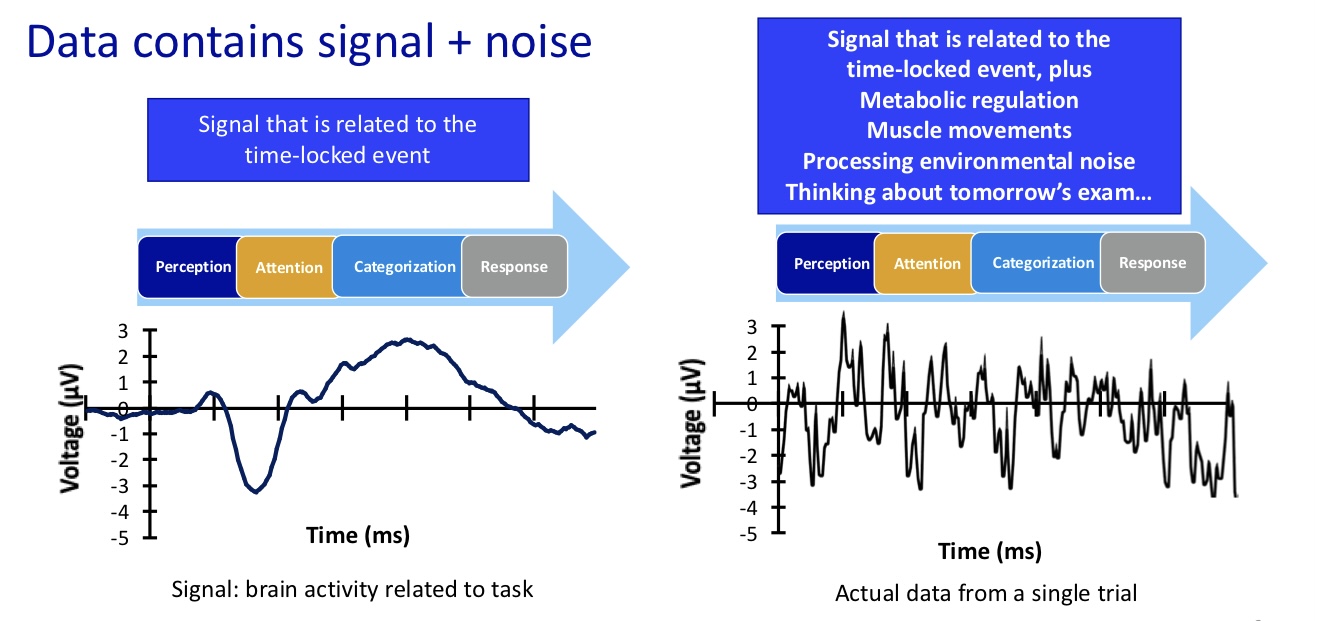
Data contains signal +
signal + noise
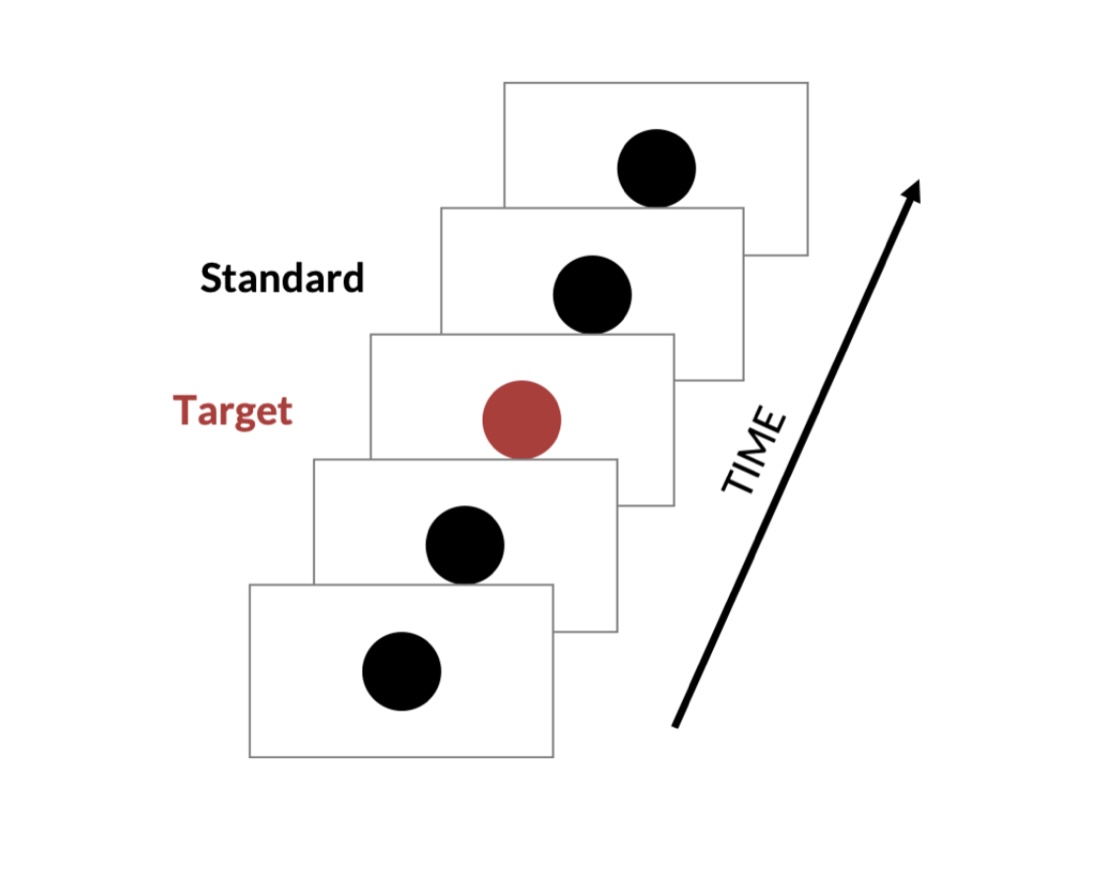
Intro to simulation: the odball paradigm
presents rare targets (red circles) among common standards (black circles)
participants press one button for targets, and another for standards
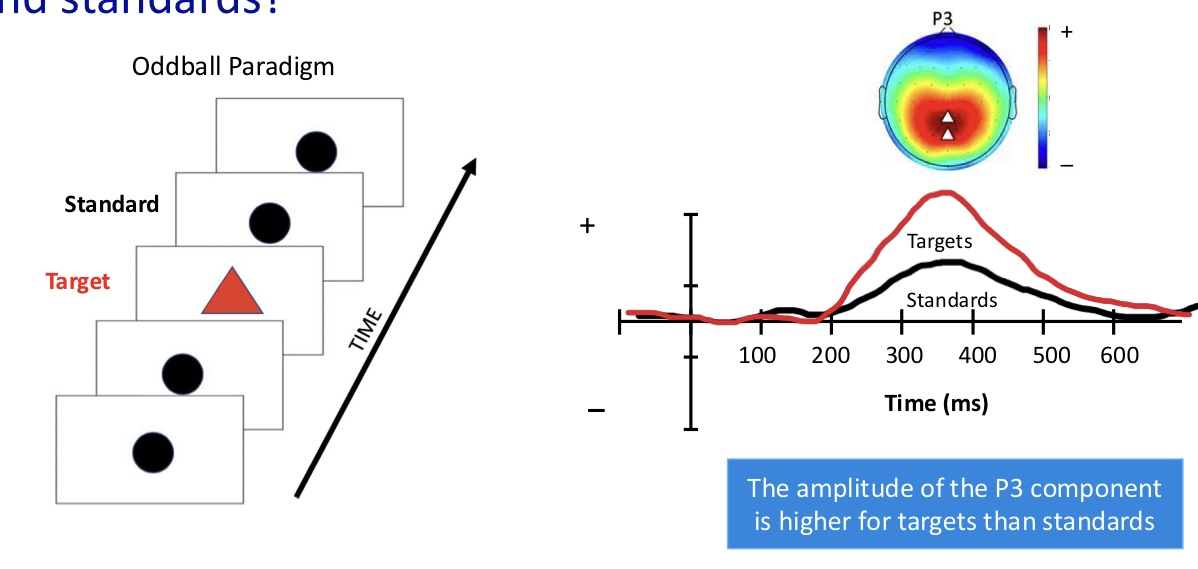
Intro to simulation: noise can mask the effect
P3 component: compared to standards, targets produce a greater positive deflection in the stimulus-locked waveform around 300 ms after stimulus presentation
the difference between targets and standards in masked by single trial noise
Average multiple trials in each condition boosts
the signal to noise retio by decreasing the noise
Why does averaging reduce the noisebut maintain the signal?
on each trial the event-related signal is always aligned to time 0, the onset of the stimulus, so averaging these data will provide a consistent measure of the event-related signal
The noise is not time-locked to the stimulus, and so averaging over many trials reduces the noise
what are ERP components
ERP components are deflections (peaks and troughs) in the ERP waveform that reflect the summation of neural activity in response to an event
LAbeling ERP components
ERP components are typically labeled by their:
polarity (negative or positive)
order or peak latency
Example: the P3 component
third positive deflection
sometime called P300 because it peaks around 300 ms after the stimulus
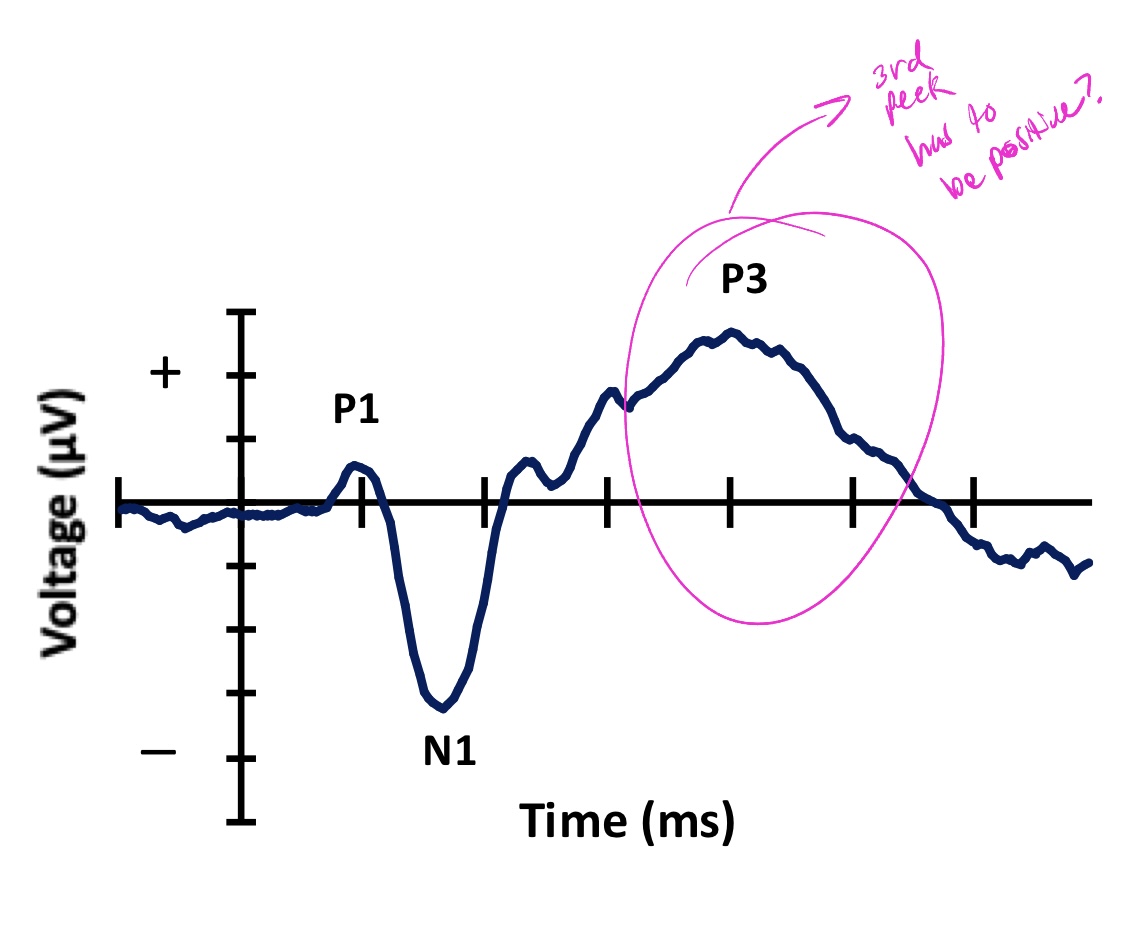
Waveform plot
shows how electric potentials change over time at a particular scalp location (e.g., a single electrode or set of averaged electrodes)
positive polarity can be plotted up or down
Topographical map
shows how distribution of electric potential change over scalp locations at a particular time
these are scalp locations, not brain locations
We can described the physical properties of ERP components
amplitude: how large is the deflection (uV)?
latency: when does the deflection begin or peak (ms)?
Scalp distributions
the scalp distribution for each component represents a different time-frome during which the component amplitude is maximal
scalp distributions show which alectrodes have the largest amplitude for a particular component
Amplitude and latency measurements for a components are reported from electrodes which typically have the highest amplitudes for that component
How would you describe the difference between targets and standards
the amplitude of the p3 component is higher for targets than standards
raw data contains information about
the event (signal) plus information from other sources
3 main categories
exogenous sensory components: triggered by the presence of a stimulus (butmay be modulated to some degree by top-down processes (e.g., goals, expectations, attentions, etc)
endogenous components: reflecting neural processes that are task-dependent
motor components: accompanying the preparation and execution of a motor response
naming conventions: P = positive going; N = negative going; P”300”: peaks at 300ms when it was first discovered; P”2”: 2nd major positive peak; functional names, e.g., “error-related negativity (ERN)”
Common ERP components
CNV (contingent negative variation)
C1, P1, N1
N2 family (N2a, N2b = anterior N2, N2c = posterior N2
N2a, e.g., the Mismatch Negativity (MMN): rather automatic/pre-attentive (deviant vs. standard)
anterior N2 e.g., response inhibition, conflicts between response alternatives
posterior N2 (almost like the P3) e.g., N2pc, PD, CDA
P3 family
Frontal P3a
parietal P3b (P3, P300)
N400, ERN (error-related negativity), LRP (lateralized readiness potential)
Steady-state ERPs
ERP components evoked by visual tasks
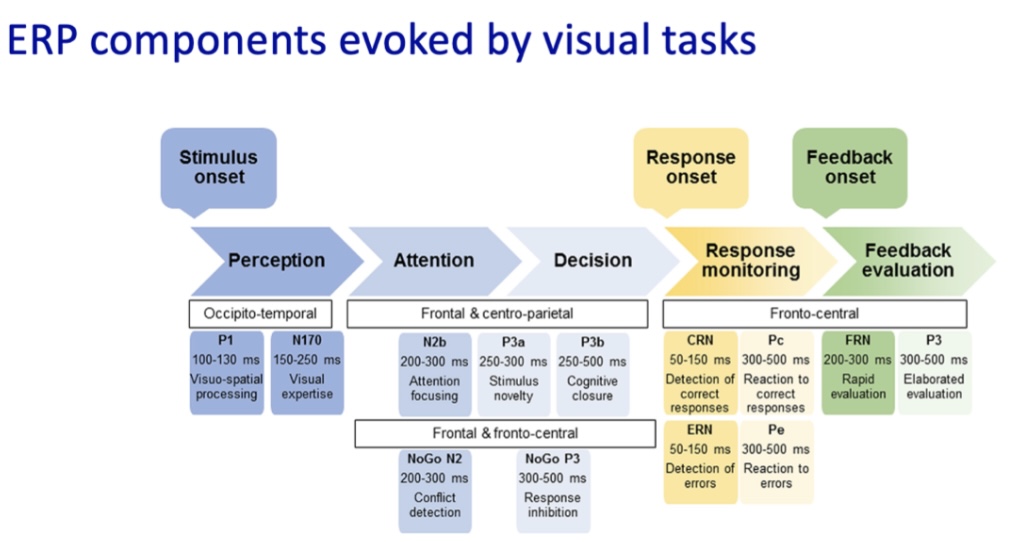
Link ERPs with neural and cognitive processes
its not possible to get an one-to-one mapping between one specific ERP component and a specific functional process
list of antecedent vs. a functional theory of what an ERP component reflect (e.g. the computational process served by the circuit that generate that ERP component
e.g., P3 is a manifestation of a process invoked in the service of the uupdating process, not necessarily the updating per se
“reverse inference” error e.g. if P entails X, X does not necessarily entail P
forward inference problem
getting around the inference problem
accepting claims or less precise conclusion (1) if compontnt Y occurs, process P is probably active (2) settle for conclusions that do not involve the specification of highly precise cognitive functions
conducting a very involved program of resaerch designed to asses the relationship (boot strapping approach)
Reverse inference error
If P entails X, X does not necessarily entail P
Forward inference problem
testing the hypothesis that comonent Y occurs if and only if process P is active. But… if we don’t know when process P is active, we cannot test that hypothesis in the first place
getting around the forward inference problem
accepting claims or less precise conclusion (1) if compontnt Y occurs, process P is probably active (2) settle for conclusions that do not involve the specification of highly precise cognitive functions
conducting a very involved program of resaerch designed to asses the relationship (boot strapping approach)
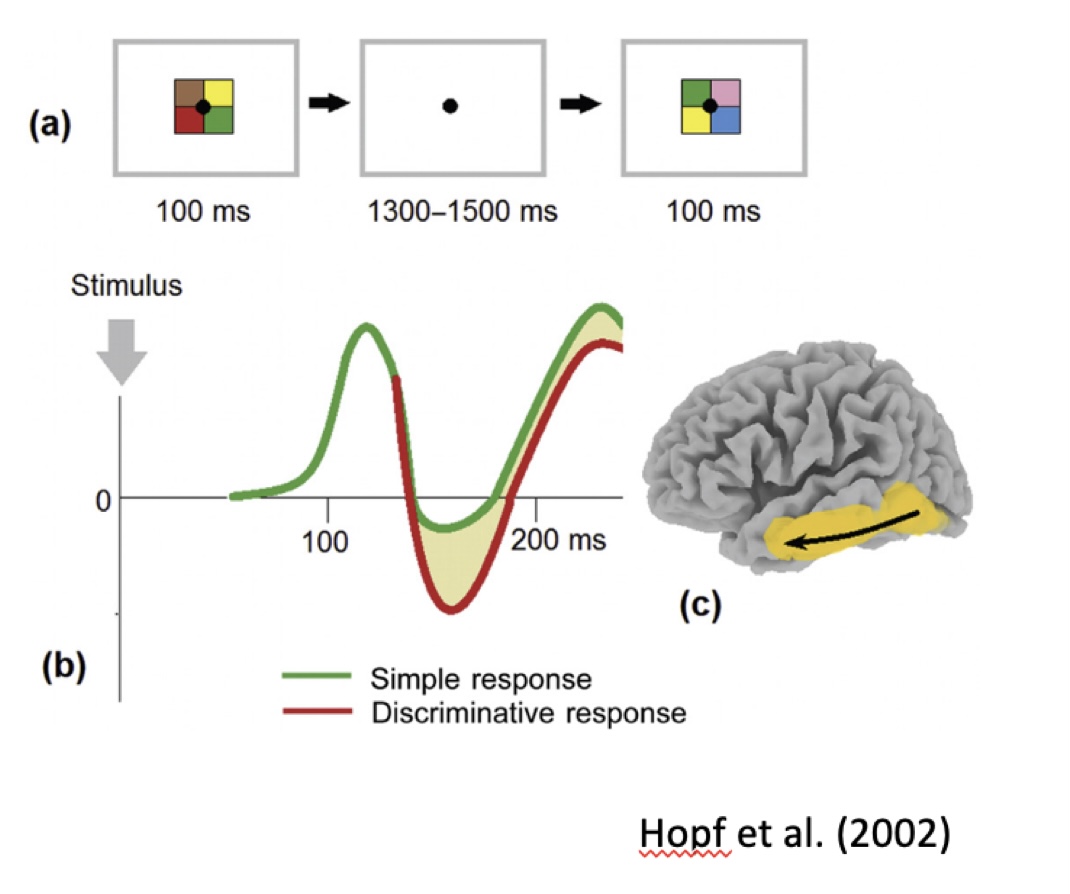
Example cognitive association: N1 and visual discrimination
how do we know?
simple response
press button for any colorful stimulus
discrimination response
press on button if red is present another button when red is absent
The N1 component has a larger amplitude when visual discrimination is required
N170
Jeffreys (1989): comparing faces vs. non-face stimuli, observed a difference from 150 to 200-ms at Cz → VPP (vertex positive potential)
Bentin et al: N170 at lateral occipital sites
N170 and VPP are likely the opposite sides of thesame dipole
one of subcomponent of the N1 wave
Does the N170 effect (face vs. non-face difference waves) truly reflect face-specificprocessing?
hypothesis:the N170 effect reflects face specific processing
Bentin et al
Q will simple stimuli (two dots) be perceived as part of faces elicit N170 when subjects are primed to perceive faces?
ERP components might be affected by
multiple cognitive processes

