Earth and Earth's Subsystems
 Studied by 0 people
 Call Kai
 Learn
Learn Practice Test
 Spaced Repetition
 Match
Match Flashcards
 Knowt Play
1/21

There's no tags or description
Looks like no tags are added yet.
Name | Mastery | Learn | Test | Matching | Spaced |
|---|
No study sessions yet.
22 Terms
Habitability Requirements
— Star needs to be 3 billion years old. (Our sun is 4.6 billion yrs old).
— Needs to be in the “Goldilocks zone”, where the temperature is just right.
— Sun needs high metallicity. Which allows rocky planets (Earth) to form.
— Has low-stellar variation. (Means brightness doesn’t fluctuate)
— Planet’s mass needs to be large enough to keep an atmosphere and have a molten core for heat that drives geological processes (ex. volcanoes)
— Orbital eccentricity.
— Axial tilt needs to be just right as it affects the seasons.
— Rotational speed as it affects the wind velocities.
★HYDROSPHERE
Sum of all the water on earth. (lakes, rivers, seas, oceans, water vapor.)
Mainly composed of saltwater, with an average salinity of 35 parts per thousand.
★ATMOSPHERE
Layer above the Earth’s surface composed of different gases, mainly nitrogen and oxygen.
— Absorbs UV rays from the sun.
— Retains heat and warms the surface causing the greenhouse effect and reduces temperature extremes between day and night.
— Keeps a balanced composition for life and pressure.
Troposphere
Lowest layer of the atmosphere.
75-80% of the total mass of the atmosphere.
— Where weather happens.
— Airplanes and birds fly here.
— Tropopause separates it from the stratosphere.
— Temperature decreases with altitude due to decreasing air density and pressure.
Stratosphere
Secondary layer of the atmosphere.
— Contains the ozone layer.
— Temperature increases with altitude due to the absorption of UV radiation by the ozone.
— Ozone is made up of three oxygen atoms to shield us from UV.
— Bounded by the Stratopause.
Mesosphere
Third layer of the atmosphere.
— Coldest layer, -90c.
— Protects the Earth from planetary debris, as they burn here due to friction with atmospheric particles.
— Bounded by the mesopause, temperature stops decreasing here.
Thermosphere.
Fourth layer, 80-700km above the Earth’s surface.
— Temperature increases with altitude due to the absorption of high-energy solar radiation.
— Temperature would feel cold due to low particle density.
— Ionosphere, 90-500km, contains ionized gases that play a role in radio communication and auroras.
Exosphere
Outermost layer of the atmosphere. 700-100,000km and gradually transitions into outer space.
— Composed of lightweight elements such as hydrogen and helium.
— Low density and incredibly thin.
— Considered part of the atmosphere due to presence of trace particles.
★GEOSPHERE
Solid part of the Earth that houses the crust, mantle, and core.
Core
Composed of a solid inner core and a liquid outer core.
— Inner is composed of iron-nickel alloy and contributes to Earth’s magnetic fields.
— Outer is composed of molten iron and nickel, 4000-5000c.
— Lehmann Discontinuity separates the inner and outer core.
Mantle
Largest layer of the Earth by volume. Has an upper and lower mantle.
— Composed of silicate minerals that are rich in iron and magnesium.
— lower mantle is rigid due to high pressure, upper is semi-molten and plastic-like, it flows slowly.
— Upper mantle is combined with the crust forms of the lithosphere.
— Boundary between the lower mantle and the outer core is the Gutenberg Discontinuity
— Movement of the mantle drives the tectonic plates and volcanic activity.
Crust
Outermost layer of the Earth. Divided into oceanic and continental crusts.
— Continental Crust is thicker and less dense, composed of granite.
— Oceanic Crust is thinner and denser, made up of basaltic rocks.
Lithosphere
The most rigid and the outermost shell of the geosphere, made up of the crust and the upper mantle.
— Solid, brittle, and broken into 50 major and minor tectonic plates.
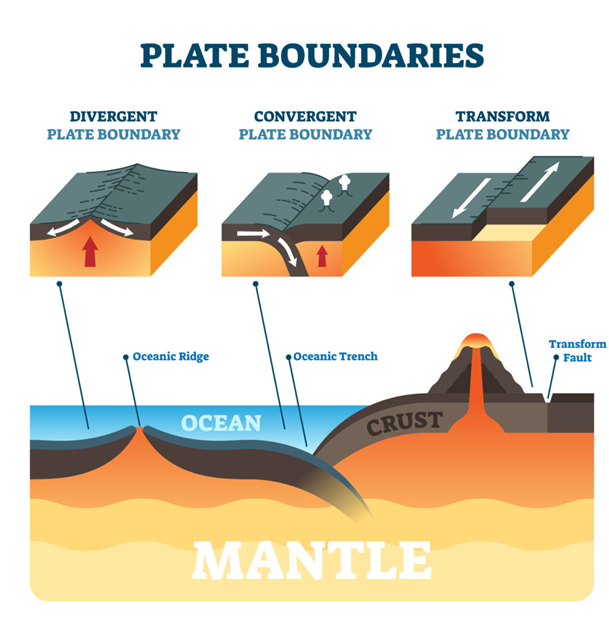
— Plate boundaries are area with geological movement that fall under: Convergent, Divergent, Transform.
★BIOSPHERE
All living organisms and every ecosystem on Earth. It regulates the Earth’s climate, nutrient cycles, and atmospheric composition.
Biomes
Large distinct regions that are classified by climate, vegetation, and adaptations of organisms.
— Aquatic
— Grasslands (Houses most animals)
— Desert
— Tundra (Coldest biome)
Biochemical Cycle
Movement of chemicals from living creatures and nonliving components through different spheres.
— Water cycle
— Carbon cycle
— Nitrogen cycle
— Phosphorus Cycle
— Sulfur Cycle
★NITROGEN CYCLE
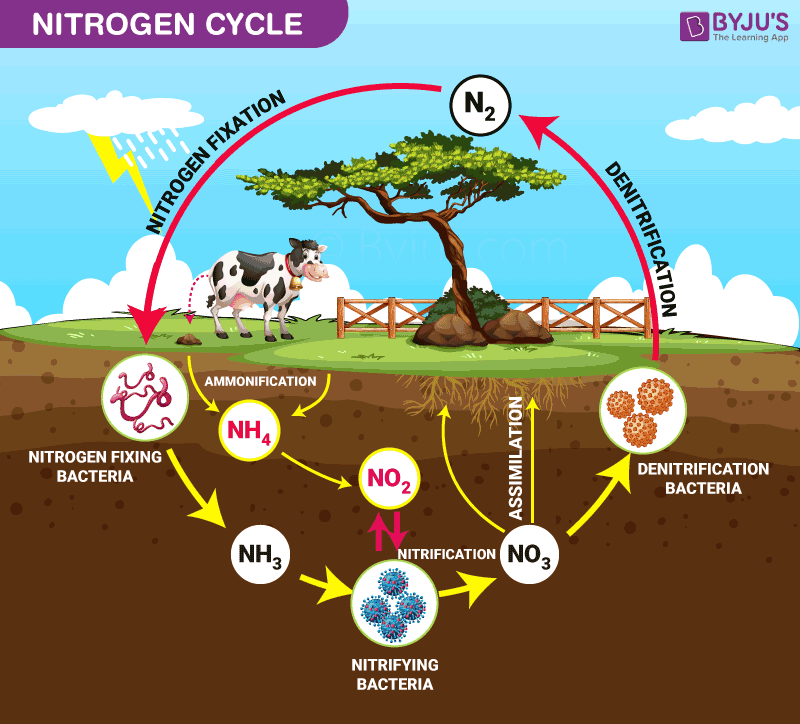
Cycle of nitrogen being passed from the atmosphere or decomposing matter into the soil and into plants.
— Nitrogen Fixation is the process of bacteria taking Nitrogen, removing its bonds and replacing it with Hydrogen. This turns the Nitrogen into Ammonia(NH3) or Ammonium(NH4).
— Atmosphere is made up of 78% of Nitrogen.
Assimilation
Some plants and living organisms already use ammonia to create things like DNA, RNA, etc.
Nitrification
Left over Ammonia is absorbed by Nitrifying Bacteria that oxidizes it, turning it into Nitrite then into Nitrate for plants and other organisms to use.
Food Web
Nitrate is absorbed by plants which is a food source for animals, which then produce Nitrogen through breathing and by dying for cycles to repeat.
Ammonification
Nitrogen from the decomposing body of the animal is then absorbed into the soil and bacteria turns it into ammonia and ammonium.
Denitrification
Denitrifying bacteria takes Nitrates and turns it back into gas. Usually happens in soil that lacks oxygen.
 Note
Note  Flashcards (39)