Experiment 4
 Call Kai
 Learn
Learn Practice Test
 Spaced Repetition
 Match
Match Flashcards
 Knowt Play
1/24

There's no tags or description
Looks like no tags are added yet.
Name | Mastery | Learn | Test | Matching | Spaced | Call with Kai |
|---|
No analytics yet
Send a link to your students to track their progress
25 Terms
Mechanical Properties
These help to measure how materials behave under a given load (force) or how it is affected by it.
Mechanical Properties
During manufacture of various products, a wide array of testing is done to ensure that the materials are within the specifications or fit their specific purpose.
Tensile Testing
Usually done on with sample strips or machined samples with either circular or rectangular cross section.
Tensile Testing
Test specimen are inserted or screwed into a testing machine and stretched by moving grips apart at a constant speed.
Tensile Testing
The data of load and deformation is then plotted which can be converted into a stress-strain curve.
Stress
is defined as the ratio of force applied to a certain area and is given by the equation:

Strain
is known as the deformation of a metal due to stress with the formula:

Hooke’s Law
states that the stress is proportional to the load while strain is proportional to deformation.
Hooke’s Law
This then introduces the Young’s modulus, E, or otherwise known as the Modulus of Elasticity.
Modulus of Elasticity or Young’s Modulus, E
can be used in determining the degree of elongation or compression of an object upon application to a force.

Stress-Strain Curve: Proportionality limit
The maximum stress that a material can take WITHOUT deviation from straight line between stress and strain.
Stress-Strain Curve: Elastic Limit
Beyond this point, the object can no longer recover its original shape.
Stress-Strain Curve: Elastic Limit
Maximum stress that can be applied to the substance before it becomes permanently deformed.
Stress-Strain Curve: Elastic Limit
Beyond this point, the material behaves plastically.
Stress-Strain Curve: Yield Point and Yield Stress
there is a notable increase in strain with little or even no increase in stress
Stress-Strain Curve: Ultimate Stress or Tensile Strength
Known as the maximum stress in the stress-strain curve that a material can take.
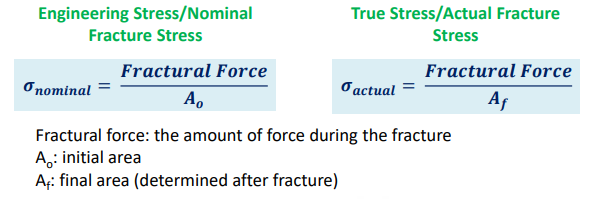
Stress-Strain Curve: Fracture or Breaking Point Stress
Value of stress at the point of final fracture on the stress-strain curve.
Ductility
characteristic of a material where the material can undergo large plastic deformations before fracture.
Ductility
indication of how much plastic strain a material can withstand before it breaks.
Ductility
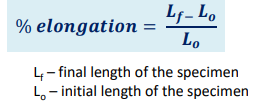
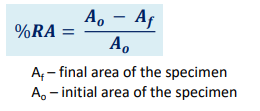
Expressed quantitatively as either percent elongation or percent reduction in area.
Percent Elongation
Percent Reduction of Area
Stress-Strain Curve: Strain Hardening or Work Hardening
Material becomes less ductile, harder and stronger with plastic deformation.
Stress-Strain Curve: Necking
a small constriction or neck begins to form after the ultimate stress, and all subsequent deformation is confined at this neck.
Stress-Strain Curve: Engineering Stress and True Stress