CH 41: Pituitary Disorders
 Call Kai
 Learn
Learn Practice Test
 Spaced Repetition
 Match
Match Flashcards
 Knowt Play
1/27

There's no tags or description
Looks like no tags are added yet.
Name | Mastery | Learn | Test | Matching | Spaced | Call with Kai |
|---|
No analytics yet
Send a link to your students to track their progress
28 Terms
*A patient is diagnosed with hypopituitarism. Which additional body structure will most like be examined to determine the root cause of this disorder?
1) Thyroid
2) Cerebrum
3) Hypothalamus
4) Parathyroid glands
ANS: 3
the pituityary gland controls all hormones. that is why it is called HYPOPITUITARISM (all hormones low). however, the hypothalamus is what is examined becuase i† contrrols the pituitary gland
A patient is demonstrating signs of low pituitary gland function. Which diagnostic test should the nurse expect to be prescribed for this patient?
1) MRI
2) Lumbar puncture
3) Cerebral angiogram
4) Carotid Doppler studies
ANS: 1
as head MRi is a diagnostic if it is connected to pituitary glands because it gives a clear image of the ac†ivity of this brian portion
The nurse is reviewing orders written for a patient with hypopituitarism. What should the nurse expect to be prescribed for this patient?
1) Diuretics
2) Antibiotics
3) Antihypertensives
4) Electrolyte supplements
ANS: 4
electrolyute support is needed for hypopituitarism because everything is low. one of the most affected elec†rolytes is calcium
The bone density report for a patient with hypopituitarism shows areas of thinning and demineralization. What teaching should the nurse prepare for this patient?
1) Importance of avoiding extremes in temperature
2) Need to reduce exposure to people with infections
3) Food sources containing high amounts of calcium
4) Strategies to increase rest periods throughout the day
ANS: 3
calcium intake is a good teaching advice since hypopituitarism has a secondary struggle of osteoporosis (risk)
hypopituyitariusm = regulates growth and hormones.
→ BONE GROWTH is affected. (highly influenced by calcium)
A patient with hypopituitarism is experiencing muscle weakness. Which referral should the nurse make to help this patient?
1) Home care
2) Physical therapy
3) Recreational therapy
4) Occupational therapy
ANS: 2
since HYPOPITUITARISM leads to MUSCLE WEAKNESS, physical therapy is good to enhance and maximize mobility
A patient is being evaluated for possible hyperpituitarism. Which manifestation most likely caused this patient to seek medical treatment?
1) Hair loss
2) Headaches
3) Sore throat
4) Muscle cramps
ANS: 2
Headache for hyperpituitarism (high hormone, tumor growth), headaches is a sign of tumor pressure, due to a pituitary gland tumor growth
A patient is concerned because facial features are changing and the hands are becoming larger and painful. Which hormone should the nurse suspect is causing this patient’s manifestations?
1) Testosterone
2) Growth hormone
3) Thyroid-stimulating hormone
4) Adrenocorticotropic hormone (ACTH)
ANS: 2
increased levels of GROWTH HORMONE leads to enlarged hands/feet, and facial changes.
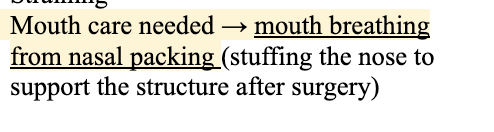
A patient is recovering from surgery to remove a pituitary tumor. Why should the nurse schedule frequent mouth care for this patient?
1) Medications dry mucous membranes
2) Maintenance of nothing by mouth status
3) Mouth breathing because of nasal packing
4) Stomatitis caused by the hormone imbalance
ANS: 3
The patient is preparing discharge teaching for a patient recovering from surgery to treat hyperpituitarism. Which interdisciplinary team member should be consulted to ensure medication teaching is appropriate?
1) Surgeon
2) Pharmacist
3) Charge nurse
4) Endocrinologist
ANS: 2
post-surgery MEDICATION TEACHING. this is accurate for a pharmacist because there are specific extreme side effects and changes that the family might need to look out for hyperpituitarism medication
(may decrease secretion of other anterior pituitary hormones)
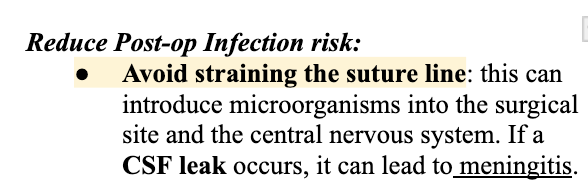
A patient is being discharged after surgery for hyperpituitarism. What should the nurse emphasize to reduce the risk of postoperative infection?
1) Restrict fluids
2) Avoid straining the suture line
3) Maintain bedrest for several days
4) Expect clear nasal drainage to occur
ANS: 2
A patient is suspected of having a disorder of the posterior pituitary gland. For which additional health problem should the nurse anticipate planning care for this patient
1) Acromegaly
2) Osteoporosis
3) Diabetes insipidus
4) Type 1 diabetes mellitus
ANS: 3
Diabetes insipidus is the decreased seceretion of the ADH hormone. this is secreted by the posterior pituitary gland.
A patient is being treated for diabetes insipidus (DI). Which medication should the nurse prepare to administer?
1) Calcium
2) Synthroid
3) Vitamin D
4) Desmopressin (DDAVP)
ANS: 4
Desmopressin becomes the SUBSTITUTE ADH to help with the decreased ADH hormones in DIABETES INSIPIDUS.
The nurse notes that patient with diabetes insipidus (DI) has a loss of free water. Which nursing diagnosis should the nurse use to guide care for this patient?
1) Fluid Volume Deficit
2) Alteration in Comfort
3) Body Image Disturbance
4) Sensory Perceptual Alteration
ANS: 1

A patient with diabetes insipidus (DI) is experiencing extreme dehydration. What should be used to guide intravenous fluid replacement therapy for this patient?
1) Skin turgor
2) Urine output total
3) Hemoglobin level
4) Serum sodium level
ANS: 4

The nurse is reviewing discharge instructions with a patient being treated for diabetes insipidus (DI). What should the nurse direct the patient to do regarding changes in body weight?
1) Restrict fluids for a day
2) Notify the health-care provider
3) Increase the intake of salty foods
4) Take an extra dose of medication
ANS: 2

A patient with osteoarthritis develops the syndrome of inappropriate antidiuretic hormone (SIADH). What information in the patient’s history should the nurse identify as being the best reason for the development of this disorder?
1) Male gender
2) Age 70 years
3) Use of NSAIDs
4) African American
ANS: 3
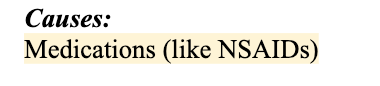
SIADH is too much ADH, resulting to water overload.
MEDICATION inhibits PROSTAGLANDIN, which controls over secretion of ADH. without this, SIADH occurs.
A patient with syndrome of inappropriate antidiuretic hormone (SIADH) is experiencing a headache and confusion. Which laboratory test would best explain the reason for this patient’s symptoms?
1) Sodium
2) Calcium
3) Potassium
4) Hematocrit
ANS: 1
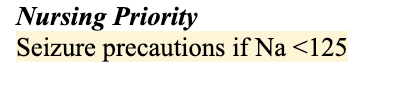
SODIUM. is a teller for volume overload and deficit. if the patient has confusion and headache, that means thaT the patient has low sodium.
The nurse is reviewing laboratory values for a female patient who has had minimal urine output over the last shift. Which finding suggests that this patient may be experiencing syndrome of inappropriate antidiuretic hormone (SIADH)?
1) Hematocrit 40%
2) Serum sodium 136 mEq/L
3) Urine specific gravity 1.035
4) Serum potassium 3.9 mEq/L
ANS: 3
The nurse is reviewing orders written for a patient with syndrome of inappropriate antidiuretic hormone (SIADH). Which order should the nurse clarify?
1) No added salt diet
2) Fluid restriction 1L/day
3) IV fluids 0.9% normal saline 125 mL/hr
4) Furosemide (Lasix) 20 mg by mouth every day
ANS: 1

A patient has a serum sodium level of 126 mEq/L. What action should the nurse take to ensure for this patient’s safety?
1) Apply wrist restraints
2) Implement seizure precautions
3) Prepare for nasogastric tube insertion
4) Plan for intermittent urinary catheterization
ANS: 2
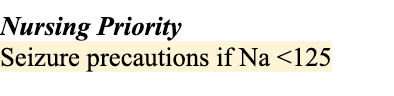
an NA of 126 mWq/L is close enough to a seizure risk value. so in this serum level, seizure precautions needed to be started, since this is totally aligned with the SIADH diagnosis
The nurse is preparing medications for a patient with syndrome of inappropriate antidiuretic hormone (SIADH). Which medication would most likely be prescribed for this patient?
1) Ampicillin
2) Tetracycline
3) Vancomycin
4) Demeclocycline
ANS: 4
democlocycline encourages the excretion of water. this helps RAISE SODIUM LEVELS, since SIADH has less sodium due to the volume overload
A patient with a history of syndrome of inappropriate antidiuretic hormone (SIADH) reports a low urine output for several days. What should the nurse respond to this patient?
1) “Drink more fluids.”
2) “Avoid eating salty foods.”
3) “Go to the emergency room now.”
4) “Take an over-the-counter NSAID.”
ANS: 3
if a SIADH patient has low urine output for several days, it is a MEDICAL EMERGENCY because it causes cerebral edema. (this causes seizures, coma, and even death)
A patient’s thyroid-stimulating hormone (TSH) is below normal. What should the nurse expect to assess in this patient? Select all that apply.
1) Weight gain
2) Thinning hair
3) Decreased bone density
4) Decreased muscle strength
5) Complaints of decreased libido
ANS: 1,2,5
although all of these are signs and symptoms of HYPOPITUITARISM (this is why TSH is low), 3 and 4 (decreased bone density and decreased muscle strength) cannot be physically assessed in a patient.
the questions is what the nurse can assess the patient for in relation to low TSH. bone density and muscle strength is DONE BY SOMEONE ELSE (an actual diagnosis is done by physicians)
The nurse is planning care for a patient with hypopituitarism. What interventions would be a priority for this patient? Select all that apply.
1) Fertility
2) Skin care
3) Vital signs
4) Bone density
5) Fluid balance
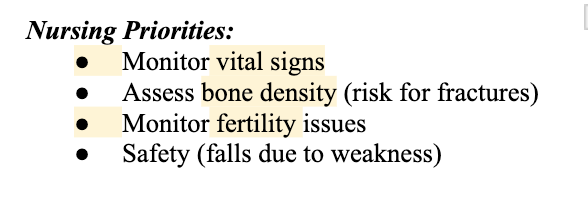
ANS: 1,3,4
A patient is being evaluated for hyperpituitarism. Which laboratory studies should the nurse expect to be prescribed for this patient? Select all that apply.
1) Calcium level
2) Growth hormone
3) Cortrosyn stimulation test
4) Follicle-stimulating hormone level (FSH)
5) Thyroid-stimulating hormone level (TSH)
ANS; 2,3,4,5
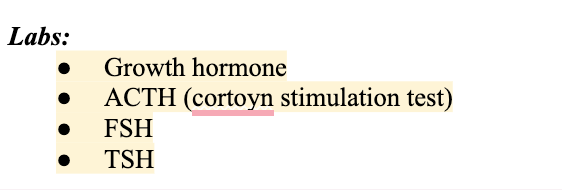
(1) calcium level is for hypopituitarism
The nurse is preparing discharge teaching for a patient recovering from a transsphenoidal hypophysectomy for a pituitary tumor. What should the nurse emphasize in this teaching? Select all that apply.
1) No lifting
2) Avoid coughing
3) Do not bend over
4) Sneeze with an open mouth
5) Avoid driving for several weeks
ANS: 2,3
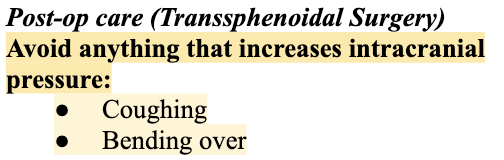
(1) no lifting: is not important to be TAUGHT because it does not cause a DIRECT HARM TO INCREASING BRAIN PRESSURE
(4) sneeze with open mouth: ALL TYPES of sneezing should be stopped
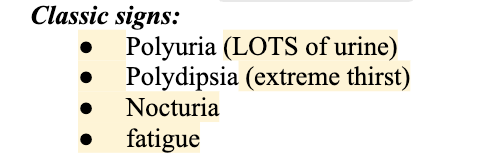
The nurse is preparing to assess a patient with diabetes insipidus (DI). Which manifestations should the nurse expect? Select all that apply.
1) Fatigue
2) Extreme thirst
3) Extreme hunger
4) Large amounts of urine output
5) Waking up to urinate during the night
ANS: 1,2,4,5
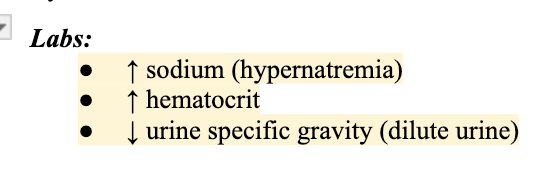
Laboratory results have been posted for a male patient experiencing manifestations of diabetes insipidus (DI). Which results would confirm the diagnosis? Select all that apply.
1) Hematocrit 52%
2) White blood cells 8000
3) Serum sodium 150 mEq/L
4) Urine specific gravity 1.002
5) Serum potassium 5.5 mEq/L
ANS: 1,3,4