Ch 1 - Systems, Roles, and Development Methodologies
 View linked note
 Call Kai
 Learn
Learn Practice Test
 Spaced Repetition
 Match
Match Flashcards
 Knowt Play
1/47

There's no tags or description
Looks like no tags are added yet.
Name | Mastery | Learn | Test | Matching | Spaced | Call with Kai |
|---|
No analytics yet
Send a link to your students to track their progress
48 Terms
Why is information crucial for businesses?
Information fuels business and can determine the success or failure of a business.
What is the purpose of systems analysis and design?
To understand user needs and systematically analyze, process, store, and output data within an organization's context.
Why is the emphasis on users important in systems analysis?
It involves analyzing users' business objectives and ensuring effective communication of planned systems.
What are the qualities of a systems analyst?
Problem solver
communicator
self-disciplined
strong personal and professional ethics
What is the Systems Development Life Cycle (SDLC)
Definition:
Distinctive phases to initiate the software production for client requirements in the highest quality, low-cost and shortest possible time.
Advantages:
Structured, Time-Intensive, Ensures thorough solutions.
Disadvantages:
Takes time, rigorous, resource intensive, gives solutions that are no longer needed
Stages:
1) Identifying problems, opportunities and objectives
2) determining information requirements
Human Computer Interaction
3) analyzing system needs
Step 4: Designing the Recommended System
5) developing and documenting software
6) testing and maintaining the system
7) and implementation
What is the impact of maintenance?
Maintenance consumes 48% to 60% of the total system development time and is an ongoing process. It involves:
Correcting Software Errors
Enhancing Capabilities:
Users requesting new features
Adapting to changes
Keeping up with rapid advancements
What is Computer-Aided Software Engineering (CASE)?
CASE tools automate routine tasks to improve productivity, enhance communication with users, and streamline system development from start to finish.
Examples (The Repository Concept): Tools like Visible Analyst, Microsoft Visio, and OmniGraffle support creating and modifying diagrams easily.
Facilitates brainstorming and collaboration.
Manages data flow and requests for corrections.
Enables changes and models project requirements.
Defines project boundaries.
Visualizes how projects integrate with organizational systems.
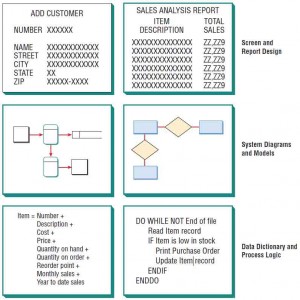
Info reported in CASE Repository
What is The Agile Approach?
Definition:
A software development method based on values, principles, and core practices
Communication
Simplicity
Feedback
courage
Advantages:
Short release time
Onsite customer
Pair programming
Incremental and iterative
Customer oriented, user feedback
Disadvantages:
What levels may an SA be involved in?
Operational level
Day-to-day operations
Knowledge Level
Analyzes data to improve business process
Middle Level
Designs and implement MIS that help with performance tracking and reporting
tactical descision-making
strategic level
Top management, long term planning
What is the operational level?
Support the day-to-day operations of the company
frontline workers, customer service reps, data entry staff
Transaction Processing System (TPS:) Uses IT to handle repetive tasks
Examples: Payroll Processing, Inventory Management
what is knowledge level?
Employees use their expertise, experience, and analytical skills to process information, solve problems, and support decision-making.
Office Automation System (OAS)
Supports data workers who share information, but do not usually create new knowledge
Examples: Word processing, Spreadsheets, Desktop publishing, Electronic scheduling,
Communication through voice mail, Email, Video conferencing
Knowledge Work System (KWS)
Supports professional workers such as scientists, engineers, and doctors
• Examples: computer-aided design systems, virtual reality systems, investment
workstations
What is middle level management?
Designs and implements MIS that helps with performance tracking and reporting.
Management Information System (MIS)
Support a broad spectrum of organizational tasks including decision analysis and decision making
Examples: profit margin by sales region, expenses vs. budgets
Decision Support System (DSS)
Aids decision makers in the making of decisions
Examples: financial planning with what-if analysis, budgeting with modeling
Expert System (ES)
Captures and uses the knowledge of an expert for solving a particular problem which leads to a conclusion or
recommendationExamples: MYCIN, XCON
What is Strategic Level?
Make long-term decisions that shape the org’s direction, goals, and competitive position
CEOS, CFOs, COO, Senior executives
Executive Support System (ESS)
Helps executives to make unstructured strategic decisions in an informed way
Examples: drill-down analysis, status access
Group Decision Support System (GDSS)
Permit group members to interact with electronic support
Examples: email, Lotus Notes
Computer-Supported Collaborative Work System (CSCWS)
CDCWS is a more general term of GDSS
May include software support called “groupware” for team collaboration via network
computersExample: video conferencing, Web survey system
Integrating New Technologies into Traditional
Systems
Ecommerce and Web Systems
Enterprise Resource Planning Systems
Wireless Systems
Open Source Software
Need for Systems Analysis and Design
CASE Tools Classification
Upper CASE tools perform
analysis and designCreate and modify the system design
Help modeling organizational requirements and defining system boundries
Ex:
DFD
ER models
Lower CASE tools generate
programs from CASE designFocus on code generation, debugging, and testing
Integrated CASE tools perform
both upper and lower CASE
functionsMicrosoft Visio, IBM Rational Rose
Scrum
Sprint cycle lasts between two and four weeks
Development team is expected to produce a potentially releasable product
Applications or websites are constantly changing
Each iteration boasts a new set of features produced during the spring cycle
Stage 1 - Agile Approach
Exploration
Explore environment, assert conviction, assemble team, asses member skills
Duration: a few weeks to a few months
Tasks
Examine tech to build new system
Estimate time needed for a variety of tasks
Goal:
Get customer to refine a story enough to estimate time to build solution into the system you are planning
Stage 2 - Agile Approach
Planning
Establish plan to deliver solution (two months to half a year)
Duration: Short
Planning Game (kent beck)
team of dev and stakeholders discuss and prioritize user stories for the next development iteration, estimating effort, and deciding which stories to focus based on their value to the project
Time, expense, and uncertainty
Goal: Limit uncertainty
Simple solution, feedback, and adapt design
Story cards: task, notes, and provide an area for task tracking
Stage 3 - Agile Approach
Iterations and First Release
Cycles of testing, feedback and change
Duration: three weeks in duration
Goal
Run customer written function tests at the end of each iteration
Question whether the schedule needs to be altered or whether you are tackling too many stories
Celebrate progress
Stage 4 - Agile Approach
Productionizing
Software revision turn around in one week
Duration: One week
Goal
Daily briefings
Product released, but may be improved
Celebrate occasion
Stage 5 - Agile Approach
Maintenance
Kept running smoothly
Goal
Add features, consider customer suggestions, and team members rotated on or off the team
Object-Oriented Systems Analysis and Design
Split work into models to reduce the amount of work. Split into individual projects and not care about the customer. Allows for separation of work activities.
Cycle repeats with design and implementation of next part and this repeats until the project is complete
Dev of systems that must change rapidly in response to dynamic business environ
Difference from SDLC:
Examines objects that are part of the system
customers, items, oprders, and so on
SDLC and O-O more slower than agile
Advantages:
Code reusability, scalability, maintainability, flexibility, collaboration
Disadvantages:
increased complexity, higher resource consumption, over-engineering, learning curve
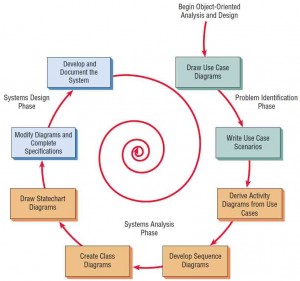
Unified Modeling Language
Used to break down a system into a use case model
Use Case Model
Identifies actors and major events initiated by the actors
Draw diagrams called Use Case Diagram to show flow of events
Write up case scenario in words the steps that are normally performed
Use Case Model - Stage 1
During the Systems Analysis Phase, Begin Drawing UML Diagrams
Draws activity diagrams of all major activities
Creates one or more sequence diagrams for each use case that show the sequence of activities and their timing
Use Case Model Stage 2
Continuing in the Analysis Phase, Develop Class Diagrams
Nouns in use cases are objects that potentially can be grouped into classe
Example:
Every automobile is an object that shares characteristics with other automobiles (class)
Use Case Model - Stage 3
Still in the Analysis Phase, Draw Statechart
Class diagrams used to draw state-chart diagrams
Statechart diagrams helpful in modifying class diagrams, so iterative process of UML modeling continues
Use Case Model - Stage 3
Begin Systems Design by Modifying the UML Diagrams, then Complete the Specifications
Modify existing system (diagrams)
Derive classes, their attributes, and methods
Class specifications for each class
Develop method specifications that detail the input and output requirements for each method, along with a detailed description of the internal processing of the method
Use Case Model - Stage 4
Develop and Document the System
More complete documentation and UML diagrams, faster development
Spiral Model (Often focus on small, quick iterations of development)
Small part of the system, high-priority item or item that has greatest risk
Design and implementation
Repeated w/ analysis of the next part, design, and some implementation
Repeated until project is complete
Cloud Computing
Virtual servers
Cloud computing offers many services
Web browsers used to access applicatons
Scalable to suit growing (or changing) demand by users.
Software as a Service (SaaS)
Not necessary to have IT infrastructure, enables small companies with smaller and less predictable budgets to make advances in processing more quickly
disaster revoery, lower cost, and increased flexibility
Google apps, AWS, Akami, CRM software
Cloud Computing Trade-Offs
Security and privacy
(improved staff training, making security of cloud computing a strategic priority, and so on)
SA must evaluate and compare cloud providers can be valuable to your client
Public cloud
external cloud
less critical data
Private cloud
Internal one
data control
ERP Systems and the Cloud
Enterprise Resource Planning Systems
Integrated management of main business proceses often in real time and mediated by software and technology
No need to purchase new IT , new versions and upgrades of ERP software are maintained and installed by the ERP cloud vendor and switching to other modules may be less cumbersome
Workday
Addresses costs, soolution to IT business problems and variable level of service
NetSuite
account software, real-time invetory management, CRM software, ecommerce, and real time global business management to small and medium enterprise
Implementing CDLC
mplementing CDLC
Five essential Characteristics
One demand self service
Broad network access
Resource pooling
Rapid elasticity
Measured service
Three service models include:
Software as a Service (Saas)
Platform as a Service (Paas)
Infrastructure as a Service (laas)
Four Deployment Models
Private Cloud
Community cloud
Public Cloud
Hybrid Cloud
CDLC
Predicative life cycle
Phases
1. Data gathering
Devleopment
Launch
Continuing operations
Optimization
Improvement
Inexpensive testing (pentesting)
Collaboartion with the development ecosystem permits the developers access to data and a lower amount of time invested for other tasks such as a diverse range of sytem tests
Faster approach than traditional SDLC
Integration with cloud services (AWS) give businesses the potential to scale up acrosst he organization rapidly
SDLC
Does not offer penetration testing only after installation
5 Strategic Considerations in Implementing Cloud-Based Systems
Save money on premises data centers, maintenance and support personal = use cloud based systems
Start small and build your cloud endeavors gradually so that they can be expanded later
Choose multiple cloud providers in order to avoid getting stuck with one vendor
Monitor changes closely. Visibility of applications and data from multiple systems
Develop an integration strategy
Choosing Which Systems Development Method to Use
Understand org first
Budget time and resources and develop a project proposal
Interview org members and gather detailed data using questionnares and sample data from existing reports
Observe how business is currently trasnsacted
Similarities
SDLC and OOAs both require extensive planning and diagramming
Agile approach and OOA both allow subsystems to be built one at t ime untilt he entire system is complete
Agile, SDLC, CLDC all concerned with the way data logicall moves through the system
THE SDLC APPROACH
A structured process for software development, from planning to maintenance.
it is important to document each step of the way
upper-level management feels more comfortable or safe using SDLC
there are adequate resources and time to complete the full SDLC
Focus:
Entire software lifecycle
Approach
Sequential (Waterfall) or iterative (e.g, agile)
Waterfall = rigid, agile = flexible
AGILE METHOD
A flexible, iterative approach to software dev. emphasizing collaboration and adaptability
speed and adaptability
application need to be developed quickly in response to a dynamic and changing environment
the customer is satisfied with incremental improvements
executives and analysts agree with the principles of agile methods
Focus
Rapid iteratitons and user feedback
Approach
Iterative and incremental
Flexibility
Highly flexibile
Adv
Flexibility, customer satisfaction, faster, risk, higher quality
Disadv
Lack of predictability, scope creep, customer avaiability required, high learning curve, team collaboration, not ideal for large scale projects
OBJECT ORIENTED METHOD
Definition:
A method of analyzing system requirements using object-oriented concepts.
Focus:
System design through objects, classes, and interactions
Approach:
Conceptual modeling (UML diagrams, use cases).
Flexibility
More rigid in analysis but flexible in design.
systems can be added gradually, one subsystem at atime
reuse of previously written software is a possibility
it is acceptable to tackle the difficult problem first
THE CDLC APPROACH
Definition:
A specialized SDLC tailored for cloud environments, integrating cloud-specific processes.
Focus
Development, deployment, and management in cloud-based infrastructure.
Phases
Cloud-native architecture, deployment, monitoring, scaling, and security.
Collaboratioin
Cross-functional collaboration between cloud engineers, developers, and security teams.
Users and coders can study, share, and modify the code or computer instructions
The Open Source Movement
any capable user is able to participate online in development, making the number of possible contributors indefinite.
Benefits of Corporate participation in Open Source Software Development
Rational
Save money
Emotional
Accepting responsibility
Licensing and Compliance
Product of community consensus, so diff communities use diff licenses
The Role of the Analyst in Open Source Software
Shotage of open source developers and huge demand
Responsive design
adaptive lifecycle
flexible method of managing projects in unpredictably changing situations.
Rapid Application Development
Primarily targeted in resolving limits of system development life cycle using object oriented strategies
Hybrid of Orbeject Oriented and Agile
Focused on process
Roles of an Analyst: Consultant
Roles of an Analyst: Consultant
Acting as a systems consultant means you understand the organiztion culture or subcultures
Outside consultant means using systematic methods and IS users to understand culture
Roles of an Analyst: Supporting Expert
Draws on professional expertise concerning computer hardware and software and their uses in the business
Doesn’t manage projects, serves as a resource
Roles of an Analyst: Agent of Change
Must interact with users and management (if they are not one and the same) from the very beginning of your project
Understand what they need to support their work so change can take place
