HBS Units 9 + 10
 Call Kai
 Learn
Learn Practice Test
 Spaced Repetition
 Match
Match Flashcards
 Knowt Play
1/92

There's no tags or description
Looks like no tags are added yet.
Name | Mastery | Learn | Test | Matching | Spaced | Call with Kai |
|---|
No analytics yet
Send a link to your students to track their progress
93 Terms
Lymphatic System
Is the body of organs and tissues that contribute to the immune system and cardiovascular system
Interstitial fluid
surrounds tissues and blood vessels, excess fluid can return to blood via lymphatic system
Lymph
Filtered plasma that leaked from circulatory system into interstitial spaces and is picked up by the adjacent lymph vessels
contains water, white blood cells, proteins, salts, glucose, fats – no red blood cells
Lymphatic capillaries
permit excess tissue fluid to leave the tissue space
What direction is lymph flow, and what path does it take
ONE WAY: lymphatic capillaries → lymphatic veins → lymphatic ducts → blood
Lymph flowing through capillaries empty into either
Right lymphatic duct
Thoracic duct
Where does lymph in ducts go
returns to the blood through subclavian vein and internal jugular vein in neck (one way passage – back to blood just before it enters the heart)
Lymphatic capillaries are designed to
maximize capture of pathogens and debris as well as larger proteins that haven't been taken up by cells
Lymph nodes
clusters of lymphatic vessels
function to contain infection (WBCs)
filter in the lymphatic vessels, removes bacteria, foreign particles, cancer cells
where antigen processing and recognition largely occurs
Lymphadenitis
infection of lymph node with swelling and tenderness
Leukocytes
WBCs
Lymphocytes
main WBC found in the lymph system
Lymphedena
blockage of lymph flow due to surgery, tumors, or infection results in accumulation of lymph in the tissues with swelling
Elephantiasis
lymphedema caused by Filaria worm
Lymphoid tissue
where lymphocytes (types of WBCs) are made and mature or are activated
Thymus
Lobulated gland located deep to the sternum in the thorax
Produces hormones (thymopoietins and thymosins) which makes it also part of the endocrine system
Thymopoietins and thymosins
are necessary for the white blood cell (WBC) production (T lymphocytes)
Thymus’s relation with T lymphocytes
Site of T lymphocytes maturation (T cells form in red bone marrow and then migrate to the thymus to mature), which then migrate to the spleen, tonsils, lymph nodes and other lymphatic tissues
thymus reaches maturation at ____.
Disappears by age ____.
Puberty, 80
Tonsils
First line of defense in the mouth
A protective set of lymphoid tissues under the mucous membrane in the back of the throat
types of tonsils and where
Palatine tonsils
Pharyngeal tonsils or adenoids (adenoiditis)
Lingual tonsils
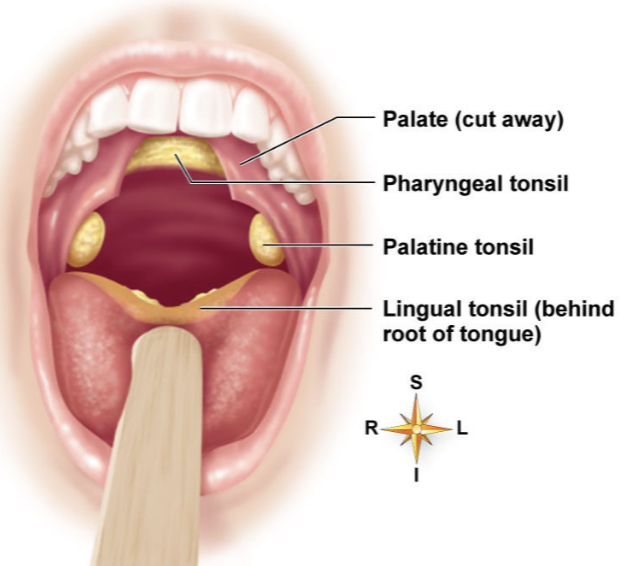
Tonsilitis
infection of tonsils
Spleen
Largest lymphoid organ in the body
The red pulp filters out aged RBCs and salvages iron from their hemoglobin
The white pulp contains both B and T lymphocytes
A blood reservoir (red pulp) may contain more than 1 pint of blood
immune system
Interactive network of organs and cells that allow us to fight off threats
Innate immunity
Non-specific immunity
Uses defenses we are born with
Rapid response (first responders)
Adaptive immunity
specific immunity
Allows us to adapt to new threats
Long-term protection (memory)
Natural: occurs over the course of living
Artificial: immunizations
physiological innate barriers
Skin
Mucous membranes
Cilia
Body temperature
pH
Cytokines
inflammation mediators that attract WBCS to site of injury
Phagocytes
(innate) ingest and digest foreign cells/particles, include neutrophils, monocytes, dendritic cells
Neutrophils
Abundant but short lived phagocytic cells
Found in blood
Monocytes (macrophages)
engulf bacteria
found in blood, convert into macrophages in tissues
Dendritic cells
Made in bone marrow
Released into blood stream
Migrate to tissues in contact with external environment
Antigen presenting cells
include monocytes and dendritic cells, display part of digested material (antigen) to trigger adaptive immune response
Natural killer cells
Directly kill many types of tumor cells and cells infected by viruses
Recognizes abnormal cells using different recognition receptors
Main pathway for killing = apoptosis (programmed cell death)
Adaptive immune response stimulated by
innate immune response
Immunologic synapse
naive T cells receive antigen presentation from macrophage
Types of Lymphocytes
T cells and B cells
T cells
Part of adaptive immune system
Function to destroy invading molecules
Develop in the thymus
Found in large numbers within lymphoid tissues (bone marrow, spleen, tonsils, and lymph nodes)
Activated when it comes in contact with an antigen (antigen presentation)
Activated T cells
Memory T cells: stored in lymph nodes for future use
Cytotoxic T cells: kill foreign cell directly, release substances to lyse cells
Helper T cells: kill foreign cells indirectly (by attracting macrophages) trigger activation of B cells
Regulatory T cells: help shut down immune reaction after antigens have been destroyed
B cells
Part of the adaptive immune system
Make antibodies
Originate in the bone marrow
Transform into immature B cells in liver and bone marrow (pre-birth) or in bone marrow (adults)
Mature (inactive) B cells stored in lymph nodes and spleen
Mature (active) B cells form when B cell antibody comes in contact with an antigen (also requires help from T cells)
Activated B cells
Memory cells: stored in lymph nodes until comes in contact with antigen a second time, rapid second response
Plasma cells: secrete antibodies into blood
Antibodies
Proteins (immunoglobulins) that can recognize a specific antigen to assist in clearing the foreign particle
produce humoral or antibody-mediated immunity by binding to the antigen
Antigens
may be foreign proteins, carbohydrates or lipids, most often molecules in the surface membranes of invading microorganisms or diseased cells such as cancer cells. (Antigen = antibody generator)
function of respiratory system
• Movement of air
• Exchange oxygen for carbon dioxide
• Traps pollutants/irritants
• Helps regulate acid-base balance
Bronchi end in
alveoli which are tiny terminal air sacs where oxygen and carbon dioxide diffuse across the alveolar membrane
upper respiratory tract
comprised of the nose, pharynx, and larynx
lower respiratory tract
consists of the trachea, all segments of the bronchial tree, and the lungs.
respiratory mucosa
lines nasal cavity, superior portion of pharynx, lower respiratory tract
Air flow
External nares (nostrils) to nasal cavities (L+R; separated by the nasal septum
4 paranasal sinuses
drain into nasal cavities
Lined with mucous membrane that helps to make mucus for respiratory tract
Nasolacrimal ducts
drain tears from lacrimal sacs into the nose
Conchae
protrude into the nasal cavity – increases surface over which air flows; warms & humidifies.
pharynx
passageway between nose and the larynx
nasopharynx: connected to nasal cavities
oropharynx: behind mouth
laryngopharynx: above the larynx
auditory/eustochian tubes
opens into nasopharynx
Pharyngeal tonsils/adenoids in the
nasopharynx
palantin tonsils in the
oropharynx
larynx
voice box that contains the vocal cords (muscles control tensions)
epiglottis
covers opening of larynx, prevents food from entering
Swallowing causes epiglottis to close trachea and uvula to close off nasopharynx
thyroid cartilage
Adam’s apple (connective tissue; grows during puberty)
Trachea
windpipe
lined by mucosa
Provides continuation of the air passageway from the larynx to the lungs
consists of non-collapsible C-shaped cartilage rings
Primary Bronchi
main tubes leading to the lung; off of the trachea, also lined with C-rings of cartilage
Right primary bronchi
right primary bronchi is more in line with the trachea; objects that enter
the trachea tend to lodge in the right bronchi more than the left
bronchioles
tiny tubes containing only smooth muscle
alveoli
single layer of simple squamous epithelial cells; allow for effective exchange of O2 and CO2), surrounded by capillaries
Alveoli need
large surface area; helps with gas exchange, gas only travels through capillary wall and respiratory membrane
Right lung has ___ lobes, left lung has __
3, 2
pleurae
think membrane lining the lung
Pulmonary ventilation
breathing
respiration
gas exchange between and organism and environment
external respiration
exchange of gases between air in lungs and blood
Internal respiration
exchange of gases between blood and cells of body
cellular respiration
ability to use oxygen and nutrients to make energy
Moving air in and out of the lungs requires
a change in intrathoracic pressure (air goes from high-pressure to low pressure), created by diaphragm
When lungs expand (breath in), pressure goes ___, when lungs contract (breathe out), pressure goes ___
down, up
Inspiration
Inhalation; chest cavity enlarges as the diaphragm contracts; pressure in lungs goes down and air can enter
expiration
exhalation; diaphragm muscles relax, pressure in lungs can go up and air can exit
phrenic nerves
stimulated diaphragm to contract
gas exchange enabled by___, occurs in ___
diffusion, alveoli
External respiration gas exchange
higher concentration of oxygen in alveoli moves oxygen to capillary vent
higher concentration of CO2 in capillary vents moves CO2 to alveoli
Internal respiration gas exchange
higher concentration of oxygen in oxygenated blood from capillary vents moves oxygen to cells
higher concentration of CO2 in cells moves CO2 to capillary vents —> deoxygenated blood
harder to breath at high altitude because
air pressure at high altitudes is lower, so harder for oxygen to move from high pressure to lower pressure since difference in outside pressure and lung pressure is smaller
oxygen binds to ____ via ___ in the ___
hemoglobin, iron, RBC
what happens to RBC at high altitudes
you make more red blood cells to adapt to high altitudes in order to have more hemoglobin to hold onto oxygen for longer
carbon dioxide can be ___ at high concentrations
toxic
3 ways CO2 can be transported through blood
1) dissolved in blood (10%)
2) Carboaminohemoglobin (attaches to hemoglobin (20%)
3) Bicarbonate ions (70%)
respiratory control center
Brain stem phrenic nerves found in pons and medulla
why we need oxygen
for energy, generate ATP
cellular respiration inputs and outputs
glucose + oxygen —> CO2 and water, ATP
cellular respiration occurs in
what are its parts?
cytoplasm and mitochondria
1) glycolysis
2) pyruvate oxidation
3) Krebs cycle
4) electron transport chain
glycolysis
occurs in cytoplasm
anaerobic (doesn’t need oxygen)
breaks down glucose into pyruvates, makes 2 ATP
pyruvate oxidation
occurs in intermembrane space of mitochondria
converts pyruvate to Acetyl-CoA
Krebs/Citric acid cycle
Occurs in mitochondrial matrix
Acetyl Co-A converted to carbon molecules
donated electrons (FADH2 and NADH) to electron transport chain
makes ATP, CO2 and H+ byproducts
Electron transport change
occurs in inner mitochrondrial membrane
requires oxygen (aerobic)
uses electrons and H+ from Krebs cycle and special proteins to make ATP and H2O

