History of Oceanography and The Water Planet
 Studied by 0 people
 Call Kai
 Learn
Learn Practice Test
 Spaced Repetition
 Match
Match Flashcards
 Knowt Play
1/17

Earn XP
Description and Tags
MSCI 230
Name | Mastery | Learn | Test | Matching | Spaced | Call with Kai |
|---|
No analytics yet
Send a link to your students to track their progress
18 Terms
Primary Uses of the Ocean in the Early Times
Food, Trade, and Transportation
Shell Middens
ancient refuse heaps consisting primarily of discarded mollusc shells, bones, and cultural artifacts deposited by early coastal civilizations
Primary Uses of the Ocean in the Middle Times
Exploration, Trade, and Colonization
Primary Uses of the Ocean in the Modern Day (19th century onwards)
Scientific Study, Engineering
The Challenger Expedition
A pioneering 4-year British scientific voyage that circumnavigated the globe to study the deep sea, effectively launching modern oceanography. Discovered 4,700+ new species. Did deep-sea soundings to find depth of oceans - challenger deep.
Challenger Deep
the deepest known point in Earth's oceans, located at the southern end of the Mariana Trench in the western Pacific, southwest of Guam
Catalyst for Modern Oceanography
World War II acted as a major catalyst for modern oceanography by transitioning it from a small, academic pursuit into a massive, well-funded, and technologically advanced, interdisciplinary field. The urgent military necessity for submarine warfare, underwater communication, and amphibious landings forced rapid, large-scale investigation into the ocean's physical, chemical, and geological properties.
Big Bang
14 billion years ago. Describes the universe expanding from an initial hot, dense state.
Age of the Earth
4.5-4.6 billion years ago
Hypothesis of Water On Earth
1 - Volcanic Activity; 2 - Formed as a Wet Planet; 3 - Brought by Comets and Asteroids
Reservoir
a key storage component in the global water cycle, holding water for varying durations
Fluxes
represent the continuous, dynamic movement of water between storage reservoirs
Water Distribution
Ocean - 97%; Glaciers - 2.1%; Ground and Surface - 0.9%
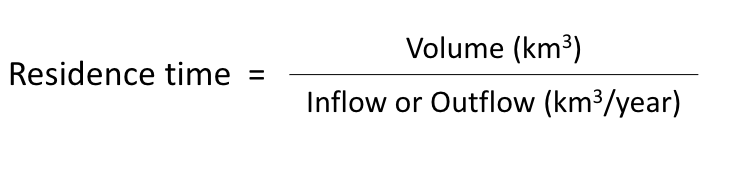
Residence Time
The average length of time that a water molecule spends in any one reservoir. Large reservoirs tend to have a large residence time and small with small.
Distribution of Water and Continents
More ocean than land in both hemispheres. More land in northern hemisphere than in southern.
Hypsographic Curve
a graph plotting the distribution of Earth's surface area (x-axis) at various elevations or depths (y-axis), using sea level as the datum
Average Depth of Ocean
4,000m
Ocean Size (L→S)
Pacific, Atlantic, Indian, Southern, Arctic
 Note
Note  Flashcards (133)