Bacteriology Lab Exam - Fungi

0.0(0)
studied byStudied by 0 people
0.0(0)
full-widthCall Kai
learnLearn
examPractice Test
spaced repetitionSpaced Repetition
heart puzzleMatch
flashcardsFlashcards
GameKnowt Play
Card Sorting

1/9

flashcard set

Earn XP

Description and Tags

Year 2 Semester 1

Study Analytics
Name
Mastery
Learn
Test
Matching
Spaced

No study sessions yet.

10 Terms

1
New cards

HX: opportunistic, white plaques (thrush), curd-like vaginal discharge, mastitis

Morphology: budding yeasts

What is it?
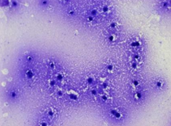
candida albicans

2
New cards

HX: chronic, antibiotic unresponsive bovine mastitis

What is it?
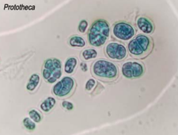
NOT BACTERIA; NOT FUNGI - Prototheca zopfii (ALGAE)
3
New cards
<p><span style="font-family: &quot;Times New Roman&quot;, serif; line-height: 107%;"><span>Classical association: bovine abortion (“mucormycosis”)</span></span></p><p class="MsoListParagraphCxSpMiddle"><span style="font-family: &quot;Times New Roman&quot;; line-height: normal; font-size: 7pt;"><span> </span></span><span style="font-family: &quot;Times New Roman&quot;, serif; line-height: 107%;"><span>Histology: aseptate broad hyphae, irregular width, wide angle branching</span></span></p><p class="MsoListParagraphCxSpMiddle"><span style="font-family: &quot;Times New Roman&quot;, serif; line-height: 107%;"><span>Culture: fluffy mould on Sam</span></span></p><p class="MsoListParagraphCxSpLast"><span style="font-family: &quot;Times New Roman&quot;, serif; line-height: 107%;"><span>Microscopy: sporangium filled with sporangiospores</span></span></p><p class="MsoListParagraphCxSpLast"><span style="font-family: &quot;Times New Roman&quot;, serif; line-height: 107%;"><span>What is it?</span></span></p>

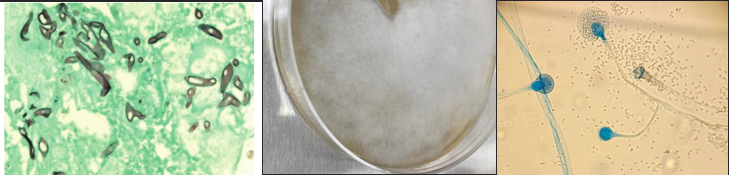
Classical association: bovine abortion (“mucormycosis”)

Histology: aseptate broad hyphae, irregular width, wide angle branching

Culture: fluffy mould on Sam

Microscopy: sporangium filled with sporangiospores

What is it?

Mucor species

class: zygomycetes aseptate fungi
4
New cards
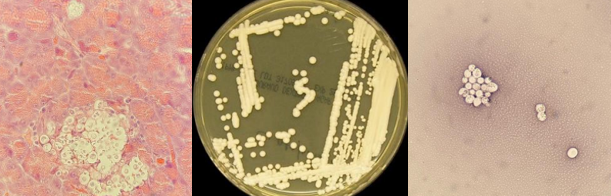
<p><span style="font-family: &quot;Times New Roman&quot;, serif; line-height: 107%;"><span>Classical association: bovine abortion; nasal aspergillosis in dogs</span></span></p><p class="MsoListParagraphCxSpMiddle"><span style="font-family: &quot;Times New Roman&quot;, serif; line-height: 107%;"><span>Histology: septate, parallel walls, 45° dichotomous branching</span></span></p><p class="MsoListParagraphCxSpMiddle"><span style="font-family: &quot;Times New Roman&quot;, serif; line-height: 107%;"><span>Culture: powdery/velvety mould</span></span></p><p class="MsoListParagraphCxSpLast"><span style="font-family: &quot;Times New Roman&quot;, serif; line-height: 107%;"><span>Microscopy: conidiospores</span></span></p><p class="MsoListParagraphCxSpLast"><span style="font-family: &quot;Times New Roman&quot;, serif; line-height: 107%;"><span>What is it?</span></span></p>

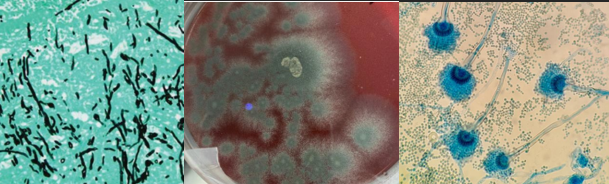
Classical association: bovine abortion; nasal aspergillosis in dogs

Histology: septate, parallel walls, 45° dichotomous branching

Culture: powdery/velvety mould

Microscopy: conidiospores

What is it?

aspergillus fumigatus 
5
New cards
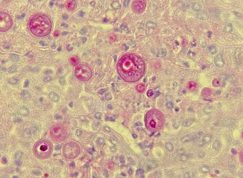
<p><span style="font-family: &quot;Times New Roman&quot;, serif; line-height: 107%;"><span>Clinical association: cats (pneumonia, CNS, nasal masses); most common systemic fungal pathogen in cats</span></span></p><p class="MsoListParagraphCxSpMiddle"><span style="font-family: &quot;Times New Roman&quot;, serif; line-height: 107%;"><span>Histology: soap bubble appearance due to the capsule</span></span></p><p class="MsoListParagraphCxSpMiddle"><span style="font-family: &quot;Times New Roman&quot;, serif; line-height: 107%;"><span>India ink: shows thick capsule</span></span></p><p class="MsoListParagraphCxSpLast"><span style="font-family: &quot;Times New Roman&quot;, serif; line-height: 107%;"><span>Culture: small, mucoid colonies</span></span></p><p class="MsoListParagraphCxSpLast"><span style="font-family: &quot;Times New Roman&quot;, serif; line-height: 107%;"><span>What is it?</span></span></p>

Clinical association: cats (pneumonia, CNS, nasal masses); most common systemic fungal pathogen in cats

Histology: soap bubble appearance due to the capsule

India ink: shows thick capsule

Culture: small, mucoid colonies

What is it?

Cryptococcus neoformas
6
New cards
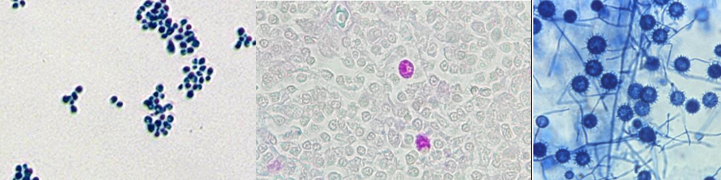
<p><span style="font-family: &quot;Times New Roman&quot;, serif; line-height: 107%;"><span>Clinical association: NA dogs with coccidiodomycosis will have a history of travel to western USA or Mexico where this species is endemic</span></span></p><p class="MsoListParagraphCxSpMiddle"><span style="font-family: &quot;Times New Roman&quot;, serif; line-height: 107%;"><span>This stain is from a lung preparation from a dog</span></span></p><p class="MsoListParagraphCxSpMiddle"><span style="font-family: &quot;Times New Roman&quot;, serif; line-height: 107%;"><span>Has two forms – mould or yeast (aka thermally dimorphic fungi)</span></span></p><p class="MsoListParagraphCxSpMiddle"><span style="font-family: &quot;Times New Roman&quot;, serif; line-height: 107%;"><span>Mould form (25C): septate hyphae</span></span></p><p class="MsoListParagraphCxSpMiddle"><span style="font-family: &quot;Times New Roman&quot;, serif; line-height: 107%;"><span>Yeast/Spherule form (37C): huge spherules with endospores</span></span></p><p class="MsoListParagraphCxSpMiddle"><span style="font-family: &quot;Times New Roman&quot;, serif; line-height: 107%;"><span>What is it?</span></span></p>

Clinical association: NA dogs with coccidiodomycosis will have a history of travel to western USA or Mexico where this species is endemic

This stain is from a lung preparation from a dog

Has two forms – mould or yeast (aka thermally dimorphic fungi)

Mould form (25C): septate hyphae

Yeast/Spherule form (37C): huge spherules with endospores

What is it?

Coccidioides immitis 
7
New cards
<p><span style="font-family: &quot;Times New Roman&quot;, serif; line-height: 107%;"><span>Clinical association: systemic infection found in macrophages</span></span></p><p class="MsoListParagraphCxSpMiddle"><span style="font-family: &quot;Times New Roman&quot;, serif; line-height: 107%;"><span>Has two forms – mould or yeast (aka thermally dimorphic fungi)</span></span></p><p class="MsoListParagraphCxSpMiddle"><span style="font-family: &quot;Times New Roman&quot;, serif; line-height: 107%;"><span>Mould form (25C): septate hyphae, tuberculate chlamydospores</span></span></p><p class="MsoListParagraphCxSpMiddle"><span style="font-family: &quot;Times New Roman&quot;, serif; line-height: 107%;"><span>Yeast/spherule form (37C): small intracellular yeasts</span></span></p><p class="MsoListParagraphCxSpLast"><span style="font-family: &quot;Times New Roman&quot;, serif; line-height: 107%;"><span>Considered a Risk Group 3 fungal agent</span></span></p><p class="MsoListParagraphCxSpLast"><span style="font-family: &quot;Times New Roman&quot;, serif; line-height: 107%;"><span>What is it?</span></span></p>

Clinical association: systemic infection found in macrophages

Has two forms – mould or yeast (aka thermally dimorphic fungi)

Mould form (25C): septate hyphae, tuberculate chlamydospores

Yeast/spherule form (37C): small intracellular yeasts

Considered a Risk Group 3 fungal agent

What is it?

Histoplasma capsultatum

8
New cards

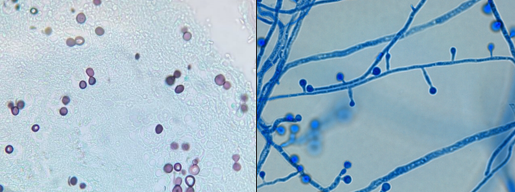
Commonly isolated from cases of otitis externa and dermatitis in dogs. It is thought to be an opportunist pathogen, since it may be found in low numbers, in the ears and on the skin of normal healthy dogs

gram stain smear of a case of chronic otitis externa in dog

 peanut/boot print/bowling ball shaped

What is it?
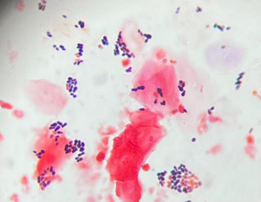
Malassezia pachydermatis
9
New cards
<p><span style="font-family: &quot;Times New Roman&quot;, serif; line-height: 107%;"><span>Clinical application: histology of canine with pneumonia, but can be in lungs (transtracheal aspirates), skin (exudates/aspirates), and brain (CSF)</span></span></p><p class="MsoListParagraphCxSpMiddle"><span style="font-family: &quot;Times New Roman&quot;, serif; line-height: 107%;"><span>Has two forms – mould or yeast (aka thermally dimorphic fungi)</span></span></p><p class="MsoListParagraphCxSpMiddle"><span style="font-family: &quot;Times New Roman&quot;, serif; line-height: 107%;"><span>Mould form (25C): septate hyphae</span></span></p><p class="MsoListParagraphCxSpLast"><span style="font-family: &quot;Times New Roman&quot;, serif; line-height: 107%;"><span>Yeast/spherule form (37C): large yeasts, thick wall, broad-based budding</span></span></p>

Clinical application: histology of canine with pneumonia, but can be in lungs (transtracheal aspirates), skin (exudates/aspirates), and brain (CSF)

Has two forms – mould or yeast (aka thermally dimorphic fungi)

Mould form (25C): septate hyphae

Yeast/spherule form (37C): large yeasts, thick wall, broad-based budding

Blastomyces dermatitidis 

10
New cards
<p><span style="font-family: &quot;Times New Roman&quot;, serif; line-height: 107%;"><span>Clinical associations: ringworm (dogs, cats = M. canis; cattle = T. verrucosum)</span></span></p><p class="MsoListParagraphCxSpMiddle"><span style="font-family: &quot;Times New Roman&quot;, serif; line-height: 107%;"><span>Histology (PAS): arthroconidia on/outside hair (ectothrix)(bring pink/red staining arthrospores called arthroconidia outside hair shaft)</span></span></p><p class="MsoListParagraphCxSpMiddle"><span style="font-family: &quot;Times New Roman&quot;, serif; line-height: 107%;"><span>KOH prep: clear keratin </span></span><span style="line-height: 107%;"><span>à</span></span><span style="font-family: &quot;Times New Roman&quot;, serif; line-height: 107%;"><span> reveals fungal arthrospores</span></span></p><p class="MsoListParagraphCxSpMiddle"><span style="font-family: &quot;Times New Roman&quot;, serif; line-height: 107%;"><span>Culture (SAB-CC): selective fro dermatophytes</span></span></p><p class="MsoListParagraphCxSpLast"><span style="font-family: &quot;Times New Roman&quot;, serif; line-height: 107%;"><span>Microscopy: M. canis = spindle macroconidia with terminal knob</span></span></p><p class="MsoListParagraphCxSpLast"><span style="font-family: &quot;Times New Roman&quot;, serif; line-height: 107%;"><span>What is it?</span></span></p>

Clinical associations: ringworm (dogs, cats = M. canis; cattle = T. verrucosum)

Histology (PAS): arthroconidia on/outside hair (ectothrix)(bring pink/red staining arthrospores called arthroconidia outside hair shaft)

KOH prep: clear keratin à reveals fungal arthrospores

Culture (SAB-CC): selective fro dermatophytes

Microscopy: M. canis = spindle macroconidia with terminal knob

What is it?

Microsporum canis (aka dermatophytes - ringworm)