Week 3: fri: Genetics and extinction I: inbreeding depression
 Call Kai
 Learn
Learn Practice Test
 Spaced Repetition
 Match
Match Flashcards
 Knowt Play
1/52

There's no tags or description
Looks like no tags are added yet.
Name | Mastery | Learn | Test | Matching | Spaced | Call with Kai |
|---|
No analytics yet
Send a link to your students to track their progress
53 Terms
Inbreeding depression
A decrease in fitness (e.g. survival
Genetic mechanism of inbreeding depression
Inbreeding reduces heterozygosity leading to more homozygous deleterious alleles being expressed and lowering fitness
Role of heterozygotes (Aa)
They mask harmful recessive alleles and therefore maintain higher fitness
Why inbreeding decreases mean performance
It converts heterozygotes into homozygotes and increases harmful aa individuals which lowers average fitness
Identifying dominance from graphs
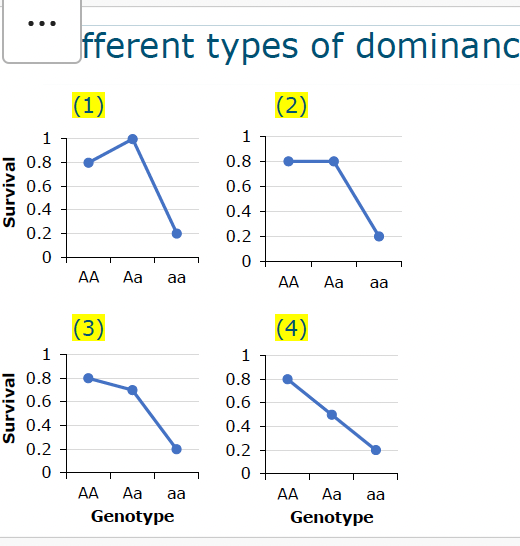
Look at where Aa lies relative to AA and aa
Overdominance
Aa has the highest fitness compared to both AA and aa
Complete dominance
Aa has the same fitness as AA so the recessive allele is fully masked
Partial dominance
Aa has intermediate fitness but closer to AA than aa
Additive (no dominance)
Aa is exactly halfway between AA and aa
Why dominance matters for inbreeding depression
Inbreeding removes beneficial heterozygotes so fitness decreases if Aa is advantageous
Partial dominance hypothesis
Inbreeding depression is caused by recessive deleterious alleles becoming homozygous
Overdominance hypothesis
Inbreeding depression is caused by loss of high-fitness heterozygotes
Main mechanism of inbreeding depression
Partial dominance involving many small-effect recessive deleterious alleles
Direction of dominance effects
Whether the heterozygote performs better or worse than expected
When inbreeding depression is strongest (direction)
When dominance is favourable and heterozygotes have high fitness
Size of dominance effects
The magnitude of the difference between Aa and aa
When inbreeding depression is strongest (size)
When aa is much worse than Aa
Single locus effect of inbreeding
Inbreeding increases homozygous deleterious genotypes and reduces mean survival
Additive combination of loci
Effects of different loci sum together for traits like size or production (Phenotype = locus1 + locus2 + …)
Multiplicative combination of loci
Effects of loci multiply together for fitness traits like survival (Fitness = locus1 × locus2 × …)
Linear decrease in additive traits
Phenotype declines linearly with F because each locus contributes independently
Linear regression formula
P = a + bF
Regression coefficient b
The slope describing change in a trait per unit increase in inbreeding
Exponential decline in survival
Survival decreases exponentially with inbreeding because effects multiply across loci
Exponential model of survival
S = e^(-A - BF)
Log transformation of survival
ln(S) = -A - BF
Why take ln(S)
To linearize the exponential relationship and estimate parameters
Lethal equivalents (B)
A measure of the strength of inbreeding depression on survival
Interpretation of B
A higher B indicates stronger reduction in survival due to inbreeding
Relative survival with inbreeding
SF / S0 = e^(-BF)
Meaning of relative survival
Survival at inbreeding level F relative to outbred individuals
Delta (δ)
The proportional reduction in fitness of inbred individuals compared to outbred individuals
Delta formula
δ = 1 - (SF / S0)
Interpretation of δ
A value representing how much fitness is reduced in inbred individuals
Effect of inbreeding on population growth
Inbreeding reduces survival and reproduction leading to lower population growth rate
Inbreeding and extinction risk
Reduced fitness due to inbreeding increases the likelihood of extinction
Variation in inbreeding depression
It differs across species populations traits and environments
Environmental effect on inbreeding depression
Inbreeding depression is stronger in stressful or poor environments
Why stress increases inbreeding depression
Stress exposes hidden genetic weaknesses
Purging
Removal of deleterious alleles when they are exposed in homozygous individuals
When purging is effective
For strongly deleterious recessive alleles
Why purging is ineffective
Most deleterious alleles have small effects and are difficult to remove by selection
Overdominance and purging
Overdominance prevents purging because both alleles are maintained by selection
Delta F (ΔF)
The rate of increase in inbreeding per generation
Why high ΔF is dangerous
It increases genetic drift and homozygosity
Interaction of drift and inbreeding
Drift increases harmful allele frequencies and inbreeding exposes them leading to fitness decline
Why limit ΔF
To prevent harmful alleles from increasing and causing strong inbreeding depression
Pedigree-based inbreeding coefficient F
F = Σ (1/2)^(n1 + n2 + 1) where n1 and n2 are steps from each parent to the common ancestor
Meaning of F
Probability that two alleles are identical by descent
Genomic F
Realized inbreeding measured from DNA homozygosity
Advantage of genomic measures
They provide more accurate estimates and do not require pedigrees
Why F measures are not directly comparable
Different methods measure different aspects of inbreeding
Big picture of inbreeding depression
Inbreeding increases F reduces heterozygosity exposes deleterious alleles lowers fitness reduces population growth and increases extinction risk

