ST 2: Protein Structure & Function
 Call Kai
 Learn
Learn Practice Test
 Spaced Repetition
 Match
Match Flashcards
 Knowt Play
1/12

There's no tags or description
Looks like no tags are added yet.
Name | Mastery | Learn | Test | Matching | Spaced | Call with Kai |
|---|
No analytics yet
Send a link to your students to track their progress
13 Terms
Definition of a Protein
Proteins are large, complex molecules made up of amino acids and play many critical roles in the body. They are essential for the structure, function, and regulation of the body's tissues and organs
Definition of a Peptide Bond
A peptide bond is a covalent chemical bond formed between two amino acid molecules. It occurs at the ribosome when the carboxyl group of one amino acid reacts with the amino group of another, releasing water (a dehydration reaction).
Primary Structure
The sequence of amino acids in a polypeptide chain held together by peptide bonds.
Secondary Structure
Local folding of the polypeptide chain into helices or sheets (e.g., alpha-helix and beta-sheet) stabilised by hydrogen bonds.
Tertiary Structure
The three-dimensional structure of a single polypeptide chain, stabilised by various interactions, including hydrogen bonds, disulfide bridges, and hydrophobic interactions. The hydrophobic effect plays a crucial role in driving tertiary structure formation by burying hydrophobic residues in the protein core.
Quaternary Structure
The structure formed by the assembly of multiple polypeptide chains into a functional protein complex. Hydrophobic interactions also play a critical role in driving protein quaternary structure, burying hydrophobic subunits of tertiary structure to minimise exposure to water.
Fibrous vs. Globular Proteins
• Fibrous Proteins: Long, structural proteins (e.g., collagen, keratin). They provide support and strength to tissues.
• Globular Proteins: Spherical, soluble, and functional proteins (e.g., enzymes, hemoglobin). They are involved in various biochemical processes.
Structure-Function Relationship in Proteins
The specific shape of a protein determines its function. For example, the active site of an enzyme is precisely shaped to bind to its substrate. Any change in the protein's structure can affect its function. We care about protein shape because knowing it can help scientists design protein shape-specific drugs (Structure-based drug design), which is how most modern drugs are developed.
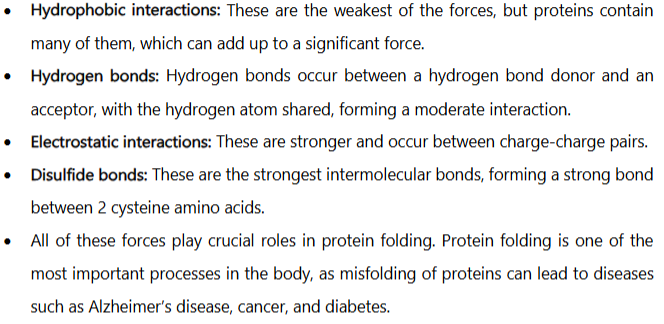
Forces involved in maintaining protein structure
Protein Denaturation
Denaturation is the process by which a protein loses its native structure due to external stress (e.g., heat, pH changes, chemical parameters, including salt concentration, solubility loss, etc.). This loss of structure results in the loss of function. Most forces that help maintain protein structure are broken (some reform randomly- disulfide bonds with free Cys residues) except for peptide bonds.
X-ray crystallography
Requires growing protein crystals (where, in general, nicer crystals yield better data, and some protein rigidity is required), but enables the collection of ultra-high-resolution data, useful for determining the location of ligand binding to a protein at ultra-high resolution <1.5 Å (nm).
Cryo electron microscopy (Cryo-EM)
Involves freezing many copies of a protein onto a grid, which is useful for dynamic proteins. Technique is the most emerging and continues to improve toward higher-resolution data collection.
Nuclear magnetic resonance (NMR): involving C13 or N15 Will collect the lowest-resolution data across all the experimental techniques taught.
AlphaFold
AlphaFold predicts the protein 3D structures from their amino acid sequences using Google DeepMind (an AI platform), using information gathered from existing experimental structures to predict the fold of a protein! And in most cases, it does do this relatively accurately, producing a computational model of the protein.

