Stereotyping & Prejudice Exam 2
 Call Kai
 Learn
Learn Practice Test
 Spaced Repetition
 Match
Match Flashcards
 Knowt Play
1/160

There's no tags or description
Looks like no tags are added yet.
Name | Mastery | Learn | Test | Matching | Spaced | Call with Kai |
|---|
No analytics yet
Send a link to your students to track their progress
161 Terms
What are the problems with claiming that someone has a “prejudiced personality”
You can’t label someone as “a prejudiced person” because prejudice is not consistent or predictable.
Situational factors strongly influence behavior
What is empathetic concern?
Sympathy and compassion for others in response to their suffering
Relationship between empathy & prejudice
Dispositional empathy (ability to understand others emotions) is slightly related to lower prejudice
Limits of empathy
We are more likely to be empathetic towards our ingroup than outgroup members
What is the “women are wonderful” effect?
Women are generally evaluated more positively than men by both men & women
However, women are percieved as less competent and less deserving of rights
What is the overall gender difference in prejudice?
Women are slightly but consistently less prejudiced than men.
How big are gender differences in prejudice? E.g., men being more prejudiced than women
Small but reliable (not large differences)
Do gender differences in receiving prejudice vary by group?
Yes—larger for gay men, smaller for lesbians
What is the overall takeaway about gender and prejudice?
Gender differences exist, but attitudes are complex and mixed
General rule of prejudice and race
Preference for own racial group over other groups
T/F: If you have a preference towards your own (stigmatized) racial group, it reduces your prejudice towards other stigmatized groups
False
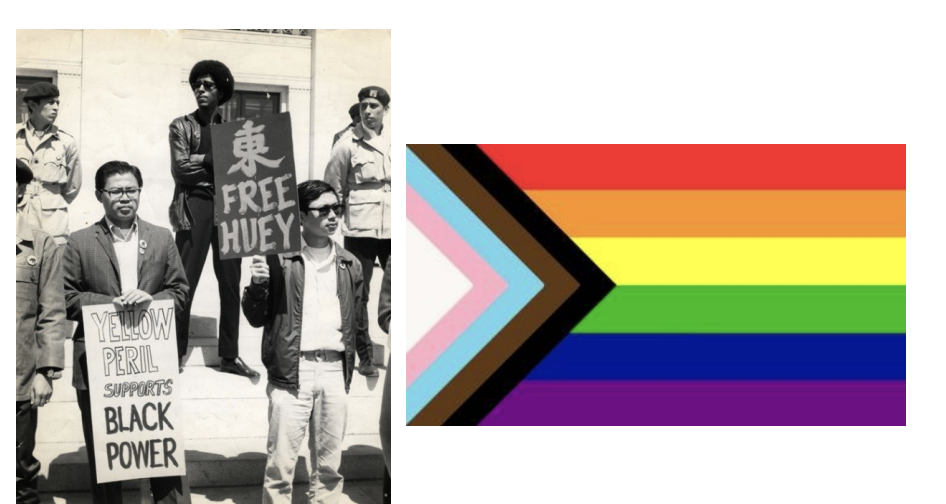
What are the two responses to being confronted with discrimination against one’s own group
Derogate other groups to maintain self-esteem
Bolster coalitional attitudes with other stigmatized groups
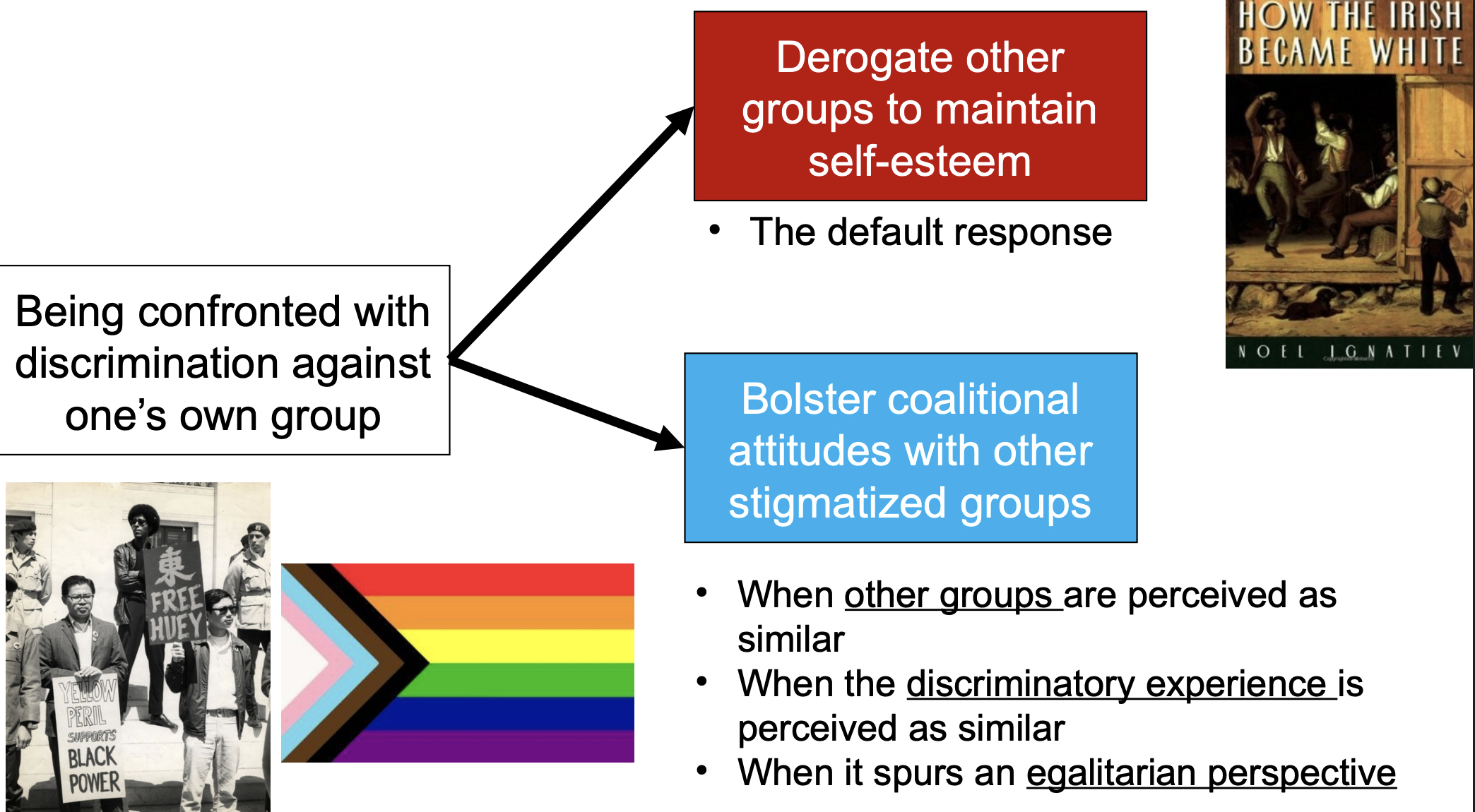
When one is being confronted with discrimination against their own group, what is the default response?
Derogate other groups to maintain self-esteem
ex: “How the Irish Became White” explains how Irish immigrants derogated Black Americans to elevate their status and gain acceptance as “White”
When one is being confronted with discrimination against their own group, when does one bolster coalitional attitudes with other stigmatized groups?
When other groups & their discriminatory experiences are perceived as similar
What is an ideology?
A system of beliefs and values about how social relationships should be managed
What are ideologies comprised of?
1. Beliefs about how the world is
2. Values about how the world should be
Core difference between liberal and conservative ideology across countries
Resistance vs. Openness to Change
Acceptance vs. Rejection of Inequality
T/F: Only conservatives are prejudiced
False, Libs/Cons are both prejudiced, but it’s directed toward different groups
Value Dissimilarity Hypothesis
Believing outgroup doesn’t share ingroup’s values
form of prejudice
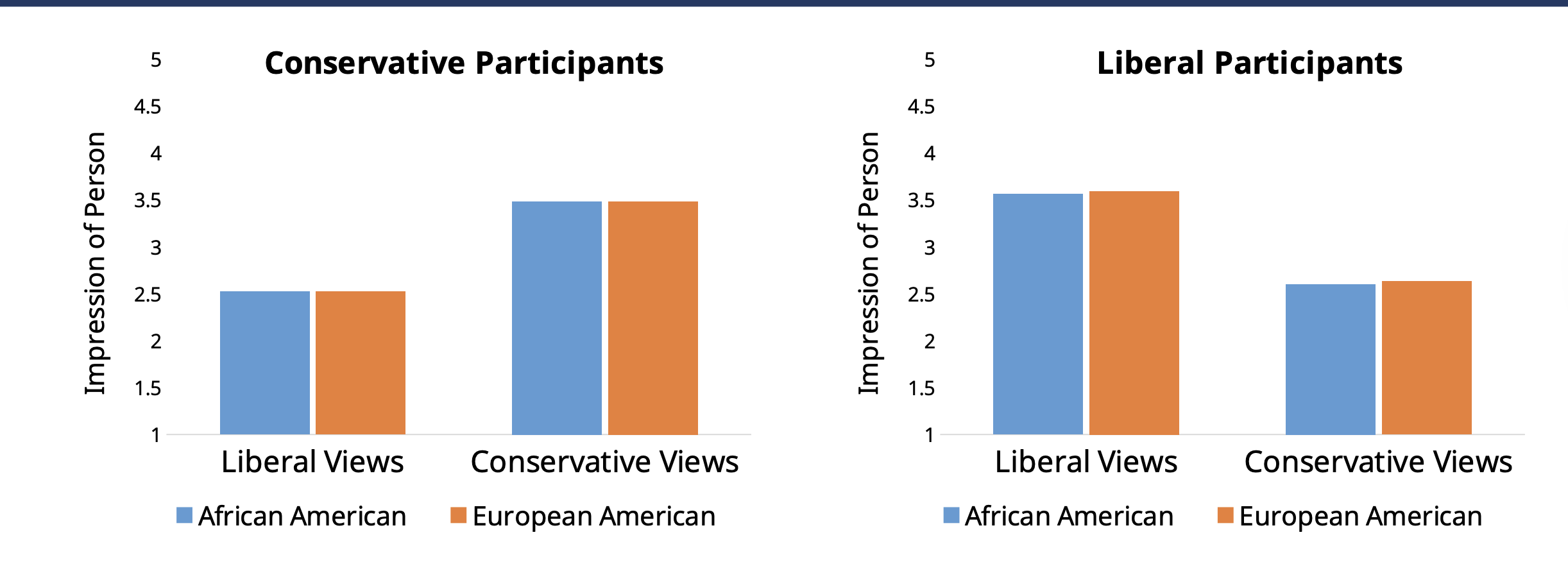
What was the research question in the Value Dissimilarity Study (Chambers et al., 2013)
What matters more for our attitudes toward others? Political-moral values or racial group?
What was the procedure in the Value Dissimilarity Study (Chambers et al., 2013)
Participants learned about a person (White or Black) who held values that were liberal or conservative, then rated their impressions of the person
What were the results of the Value Dissimilarity Study (Chambers et al., 2013) after participants learned about the persons race + political values
Political values mattered more for judging than racial prejudice.
In general, which political ideology is less prejudiced
In general, liberals are less prejudiced than conservatives.
However, the target of prejudice matters a lot.
Why does the target of prejudice matter when it comes to which political ideology is “more prejudiced”
Perception that the group’s values conflicts with your own → more negative attitudes & prejudice
What is Authoritarianism
Desire for sameness & obedience to authority
No diversity
ex: nazis
What is Social dominance orientation
Desire for group dominance
No equality
What is social dominance orientation brought on by?
Perceived group threat or competition (e.g., immigration, affirmative action)
System justification
Desire to justify a system as it is
no change
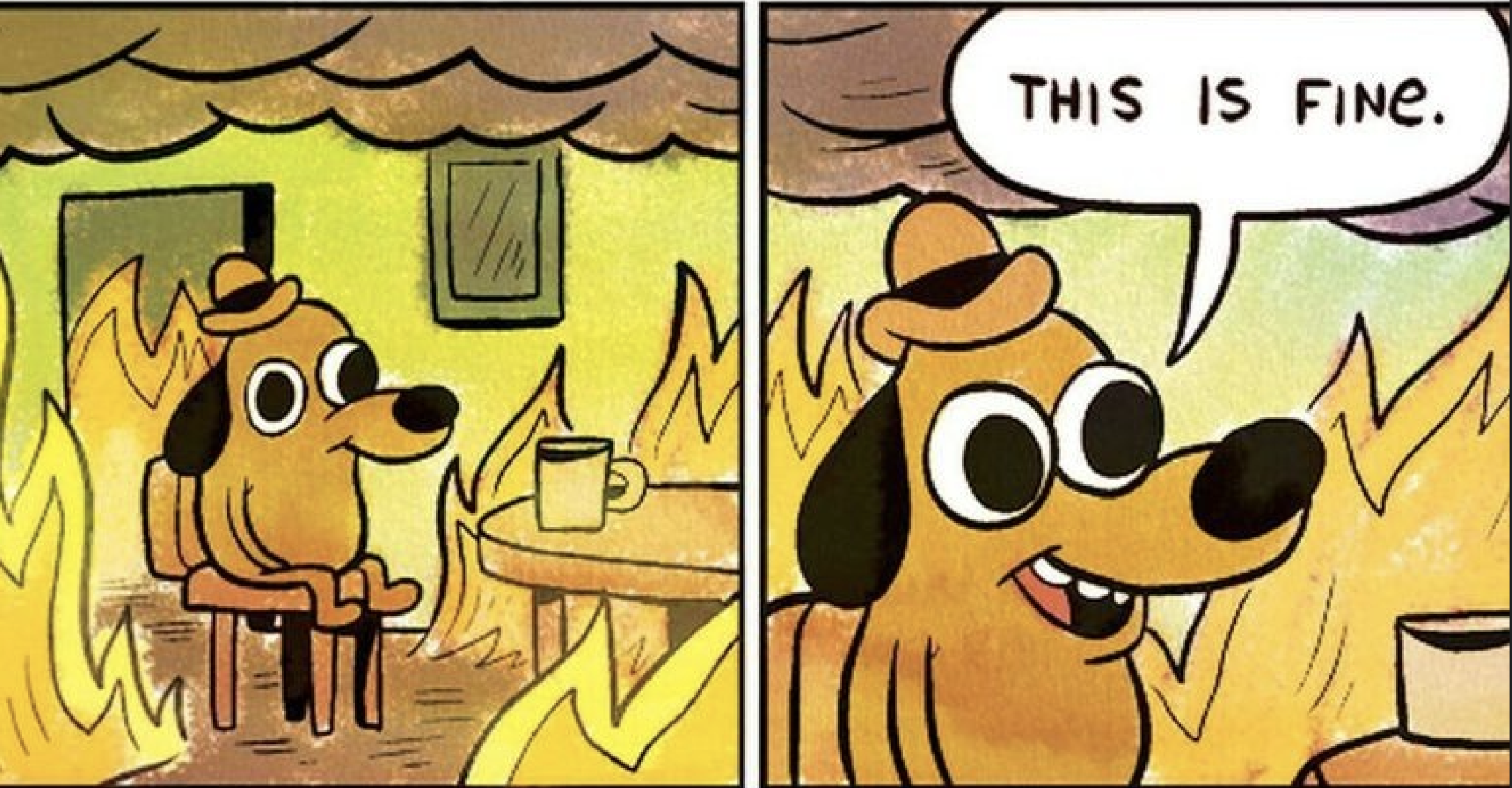
What are Authoritarianism, Social Dominance orientation, and System justification all linked to?
Conservatism
T/F: Authoritarianism, social dominance orientation, and system justification are always linked?
False
• Only weakly to moderately correlated with each other
Janice is a hardcore libertarian. To her, the Canadian govt has always been too powerful and coddles people with welfare. People should be free to follow their own self-interests. If some people become super-rich and others stay poor, that's fine by her.
What is Janice low/high in: Authoritarianism, Social dominance orientation, sytem justification
Low in authoritarinism
High in social dominance orientation
Low in system justification
What is an Authoritarian Personality
personality type that is more susceptible to unquestioning obedience to authority
What are the three basic concepts of Right-Wing Authoritarianism (RWA)
Authoritarian Submission: Submission to legitimate authorities
Conventionalism: Adherence to conventional norms
Authoritarian Aggression: Aggressiveness against groups that defy authorities or conventions
People high in RWA tend to be more
prejudiced against many groups
Mentally inflexible (more likely to rely on stereotypes)
Lack of openness to new experiences
Believe world is dangerous
See the world in terms of ingroups & outgroups
What is Social Dominance Theory?
An evolutionary theory explaining that societies naturally form group-based hierarchies, which lead to conflict and oppression between dominant and subordinate groups.
What are the key types and features of hierarchies in Social Dominance Theory?
Universal hierarchies:
Age-based
Gender-based (exist in all societies)
Arbitrary-set hierarchies:
Based on race, religion, class
Emerge when there is economic surplus
Variation:
Societies and individuals differ in how much they support or reduce hierarchy
What is the personality aspect of Social Dominance Theory
Social Dominance Orientation
Social dominance theory can manifest in support of..
Ingroup domination (if part of oppressor group)
Ingroup subordination (if part of oppressed group)
People high in Social Dominance Orientation (SDO) are more likely to…
Be prejudiced against many groups
See world as zero-sum
See society as competitive “dog eat dog” world
Pursue hierarchy-enhancing professions (ex: police officer)
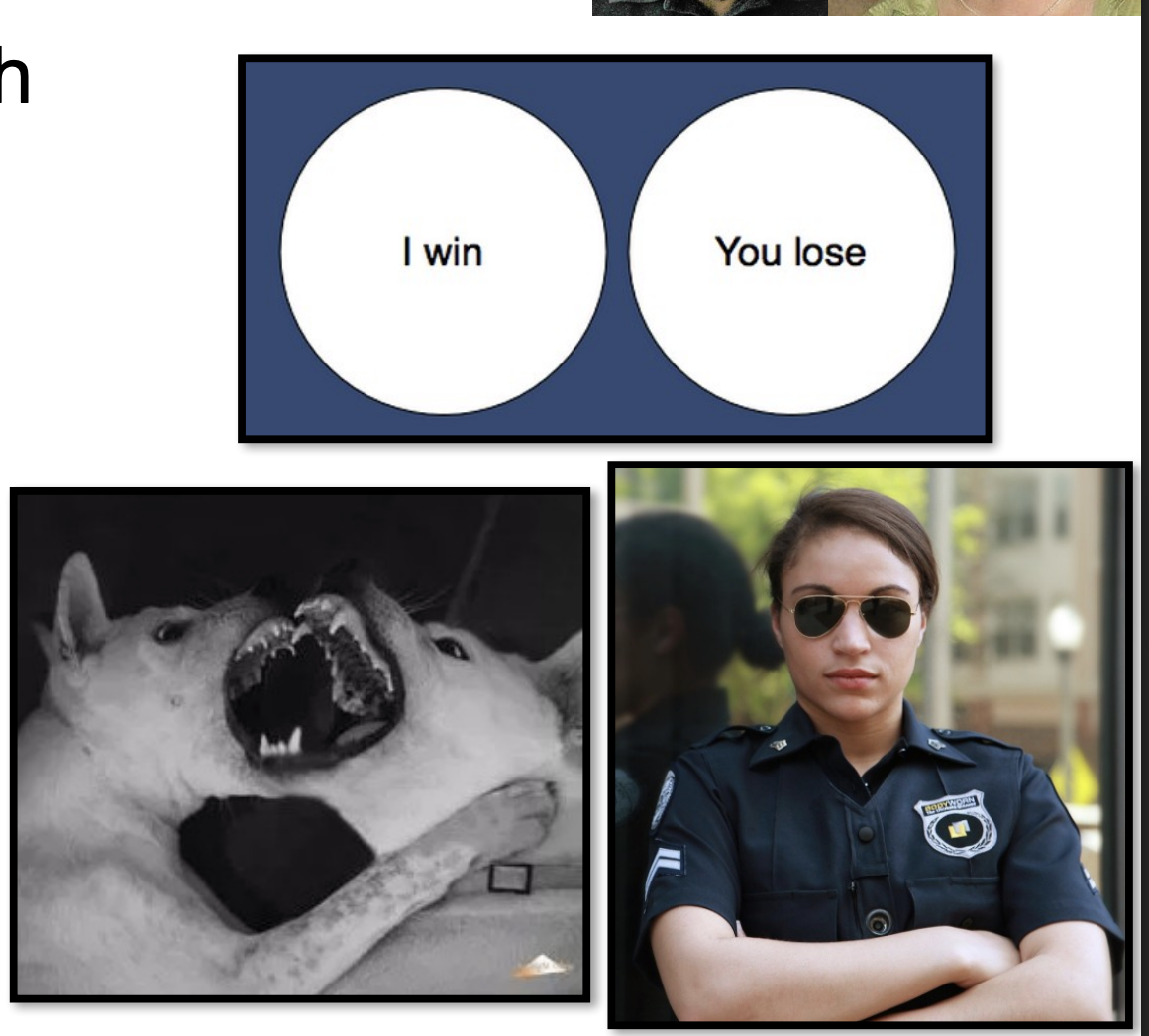
System Justification Theory
People are motivated to defend, bolster, and justify existing social systems
Ex: working class justify anti-labor laws
Why do we want to see unjustly systems as just?
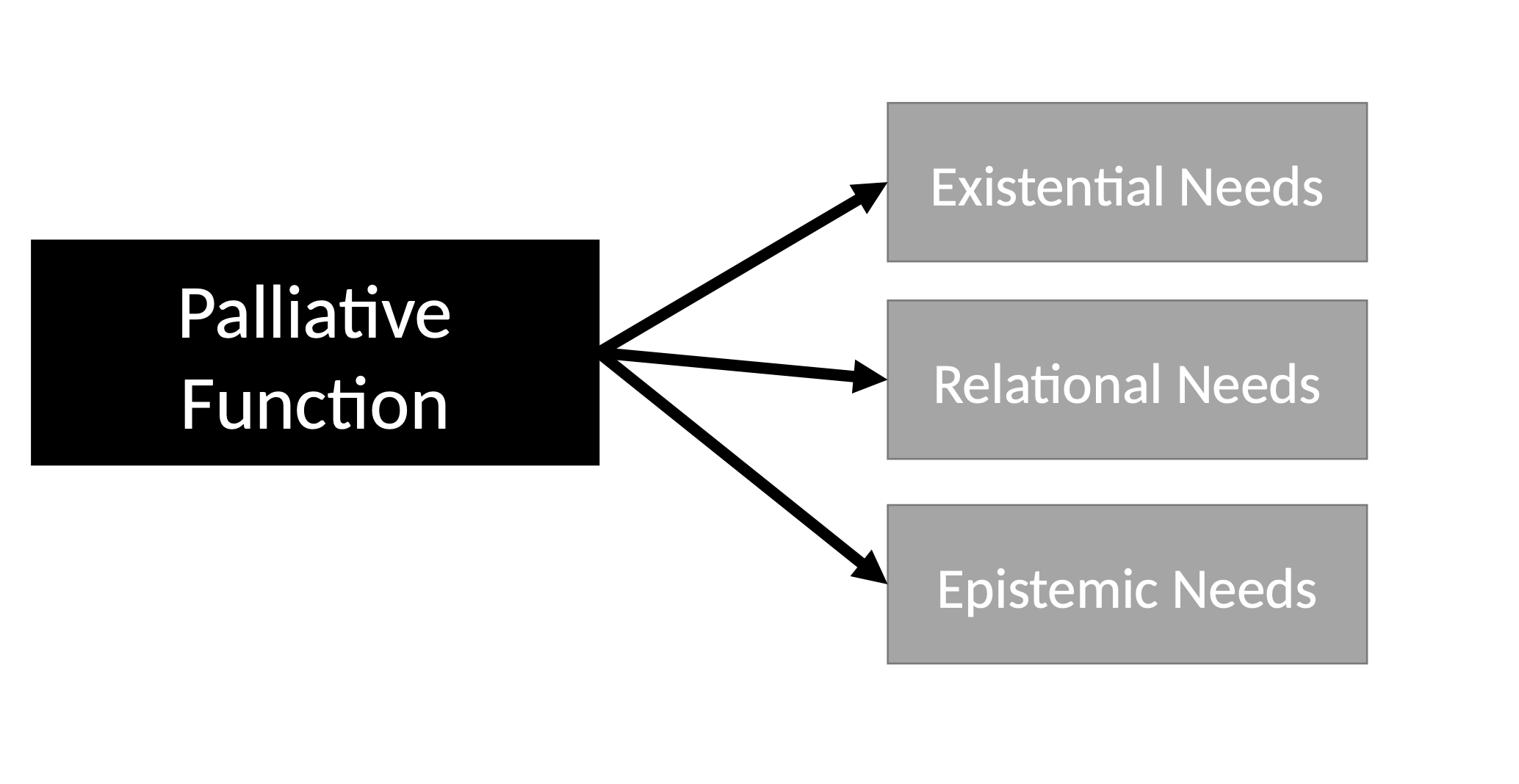
Palliative function: relieving pain w/o dealing with cause of pain
It is painful to believe there is injustice in world
What is an example of palliative function in the LGBT community?
LGBT people that minimize the extent to which their group is the target of discrimination report higher subjective well-being
What is the downside to palliative function in LGB ppl?
LGB people who minimized discrimination reported higher internalized stigma
would take up offer to become heterosexual if given chance
What is a manifestation of system justification?
Compensatory stereotypes: Stereotypes that compensate for a negative quality with a positive quality (or vice versa)
“poor but happy”
“rich but miserable”
asians: “smart, but uncreative”
System justification helps people meet which needs?
Existential needs: reduces threat + insecurity
Relational needs: Need to share similar perceptions of the world with others
Epistemic needs: Reduce uncertainty & ambiguity
When Alex learns that LGBT people are more likely to bullied, Alex reasons that is because LGBT people are doing something to egg their bullies on. What individual difference is Alex most likely to be high on?
System justification – "they must've done something to deserve it”
Explicit vs implicit prejudice
Explicit: Conscious and/or Deliberate & Slow and/or Controllable
Implicit: Unconscious and/or Automatic & fast and/or Difficult to control
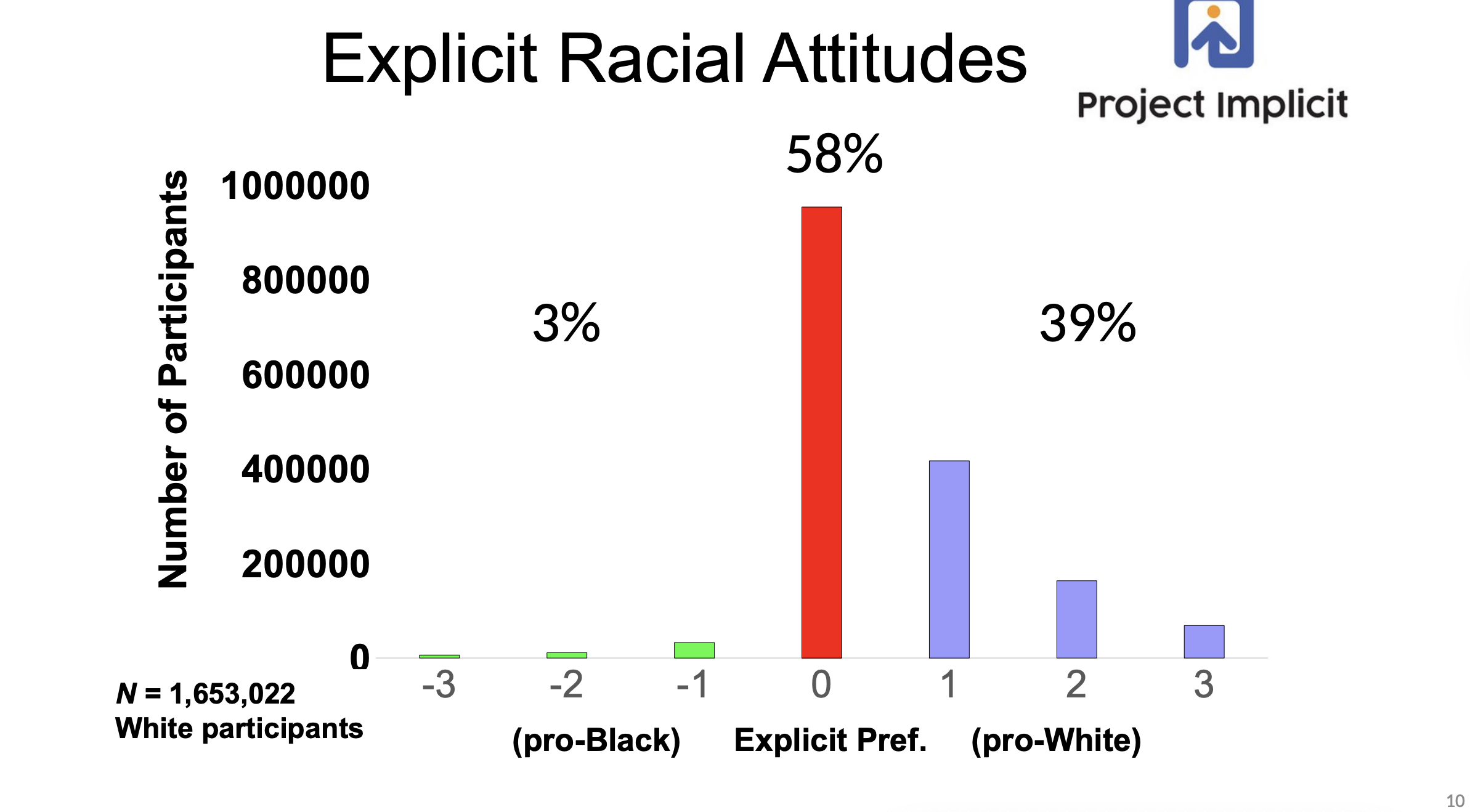
Explicit racial attitudes among white ppl
Most (58%) of white ppl claim they have no explicit pref for white or black ppl, 39% of ppl claim they have a preference for white ppl
but this is not the full story!
Implicit Measures
Measure for assessing thoughts outside or conscious awareness or control
How do implicit measures indirectly assess thoughts
Indirectly assess thoughts through performance on tasks, NOT self-report
Removes the lack of truth and self-control from self report
What types of evaluations do implicit tests reveal?
Evaluations that we
We hide from others
Are hidden from ourselves
Are difficult to control
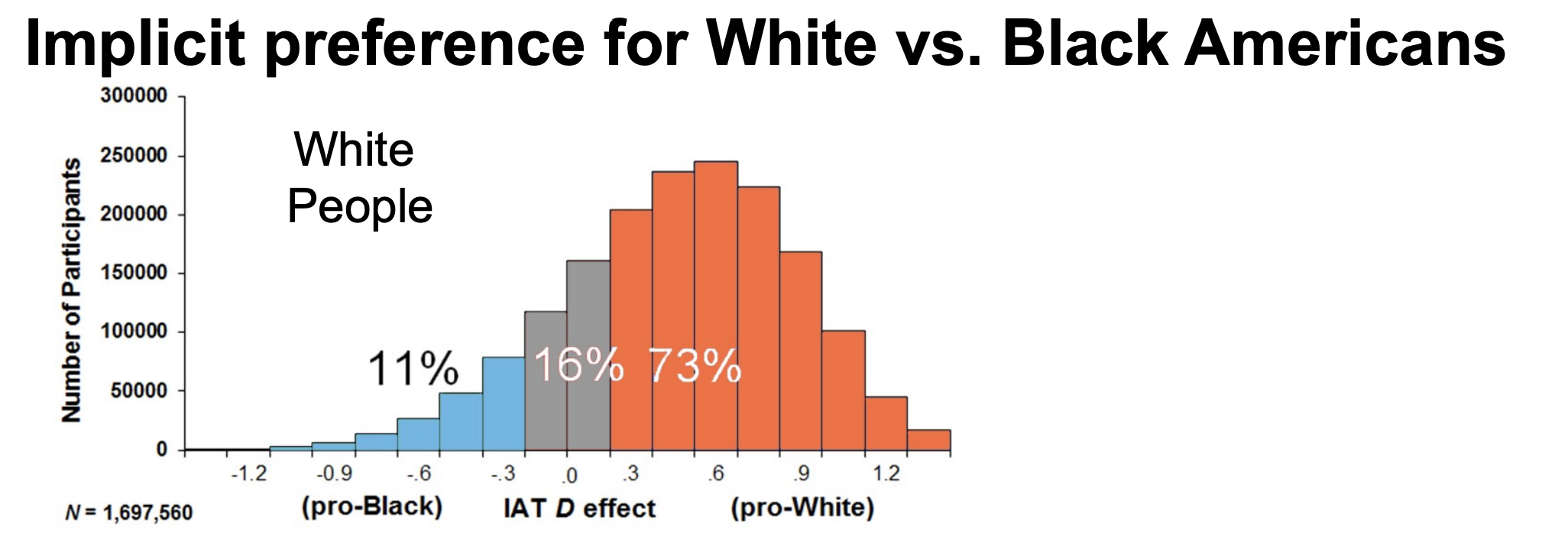
How do white ppl perform on the implicit bias test for race?
Most are pro-white
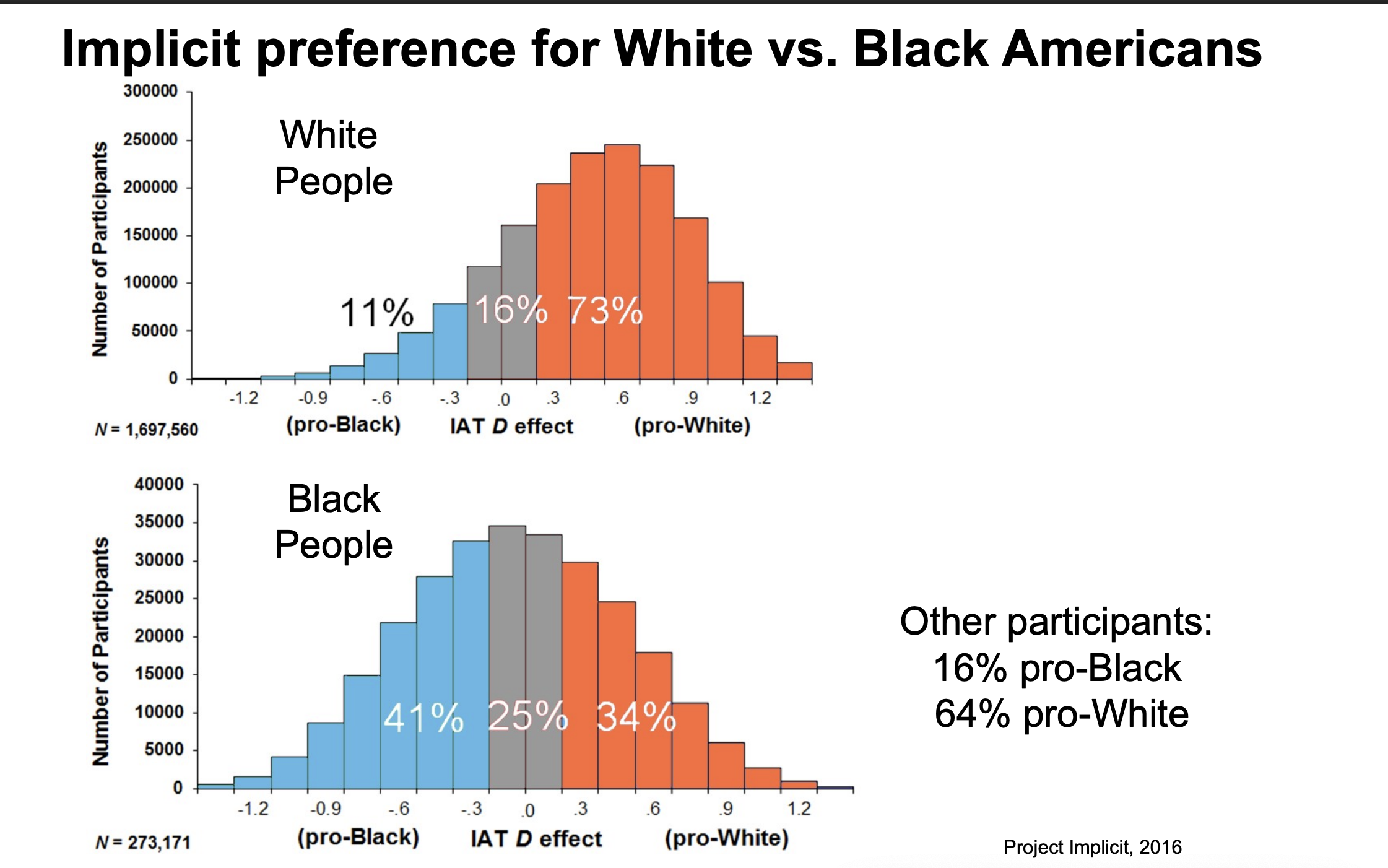
How do black ppl perform on the implicit bias test compared to white ppl?
More in the middle
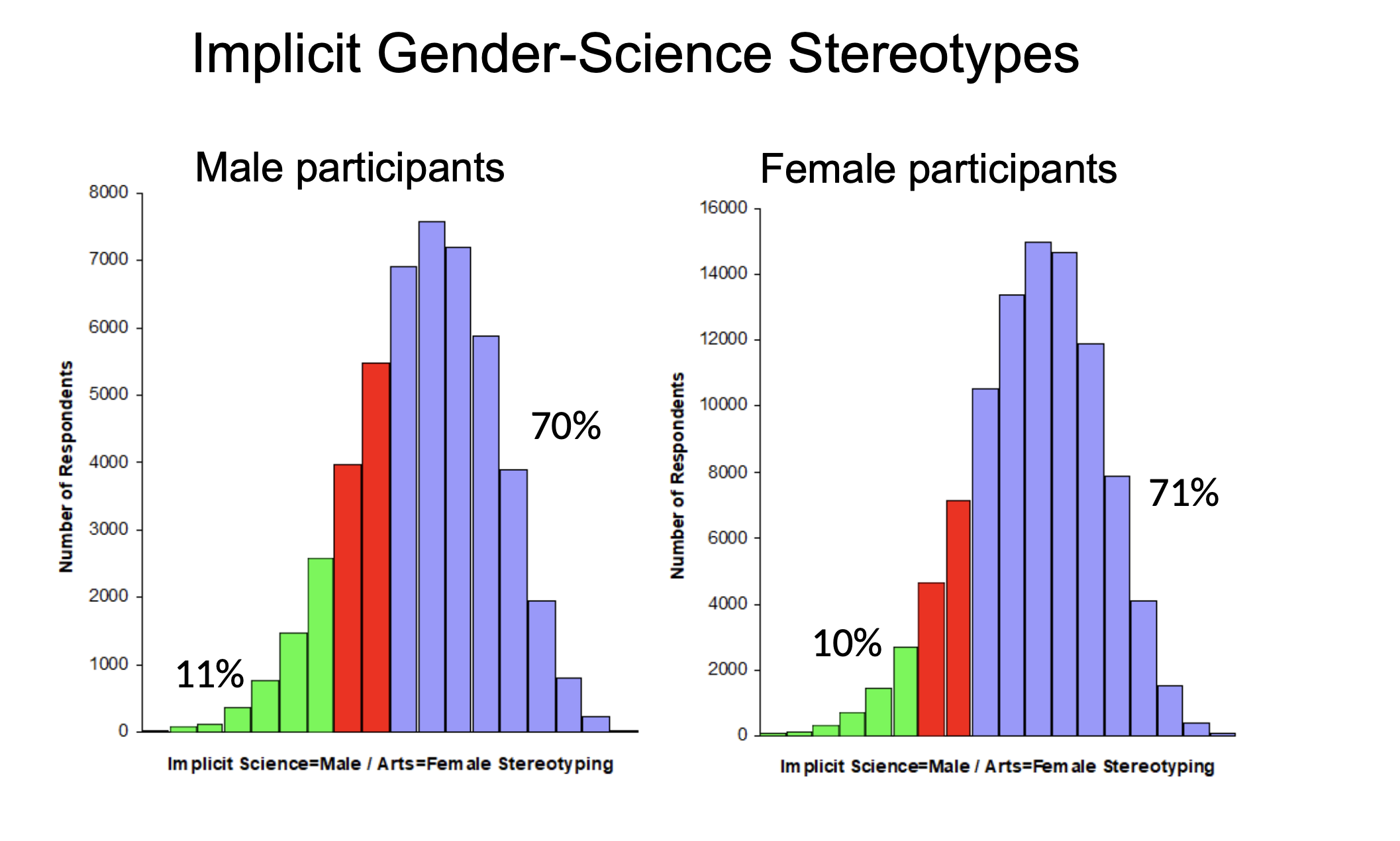
What is the implicit gender-science stereotype
Both genders are more likely to associate women w/ arts & men w/ science
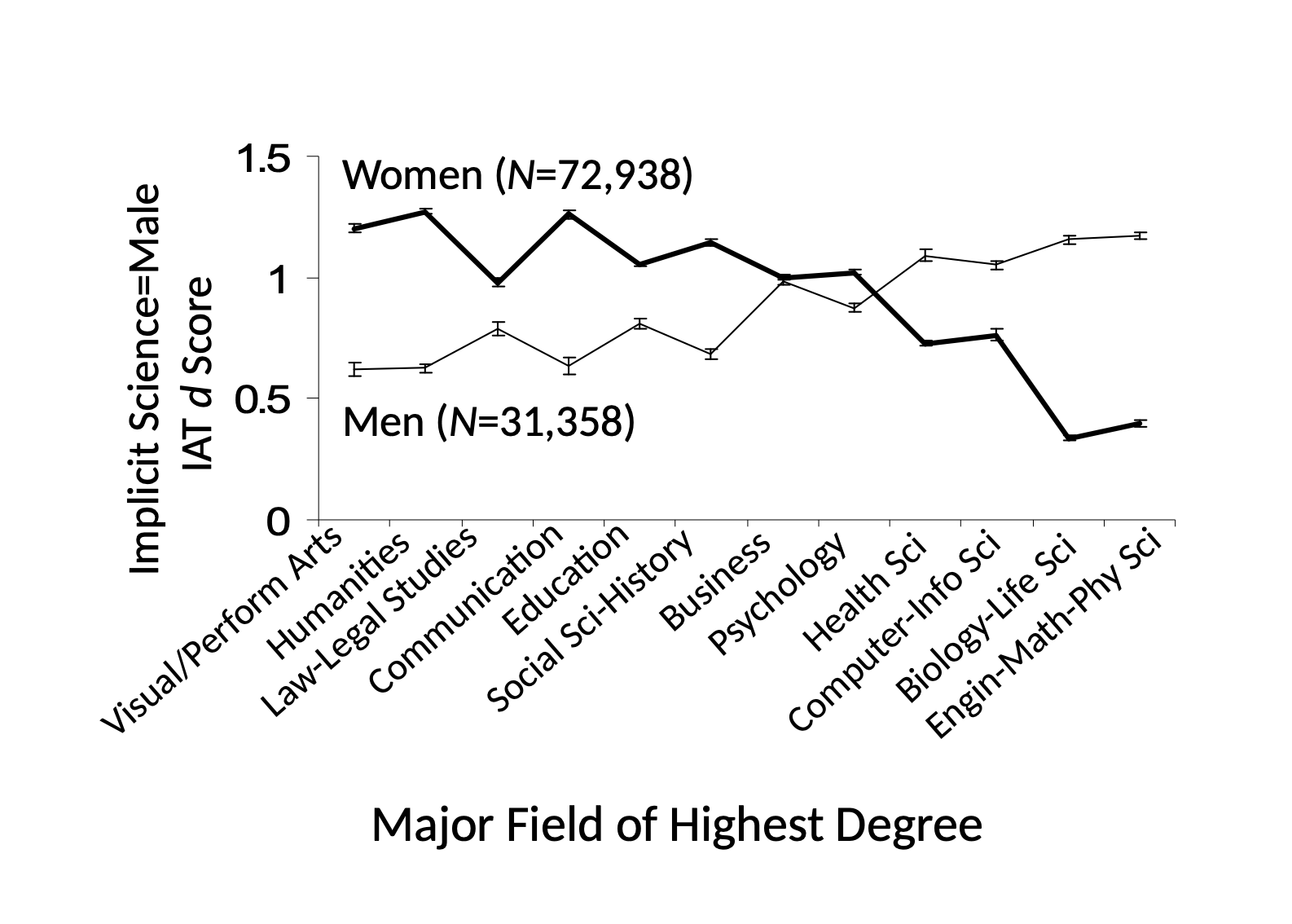
How does the implicit gender-science stereotype change based on your major?
Women in arts are more likely to have higher implicit stereotypes. Women in engineering or life sciences have lower implicit stereotypes rates
Men in arts show lower implicit stereotypes. Men in science show higher implicit stereotypes
Note: It only lowers & does not flip (no one ever associates science w/ women & arts w/ men)
Where do implicit prejudices & stereotypes come from?
Our understanding of social hierarchy: what groups are higher status
Our personal identity: Who we are, what our experiences have been
How can we measure when implicit bias plays a role in behavioral changes?
Through interpersonal interactions
Ex: White participants with higher implicit racial bias tended to have more awkward + stilted conversations with the Black experimenter
Ex: white doctors w/ highest implicit bias will have worse doctor-patient relationships w/ black patients
What does research on implicit bias in hiring show about methods and results?
Method: Sent applications with Swedish vs. Arab/Muslim names and measured hiring managers’ biases
Key finding:
Explicit bias → weak link to callbacks
Implicit bias → stronger negative effect on callbacks for Arab/Muslim applicants
When factors affect if implicit prejudices & stereotypes are influential in our behavior?
Motivation & Ability
Discretion
Organizations & Institutions
How does motivation and ability affect if implicit prejudices & stereotypes are influential in our behavior?
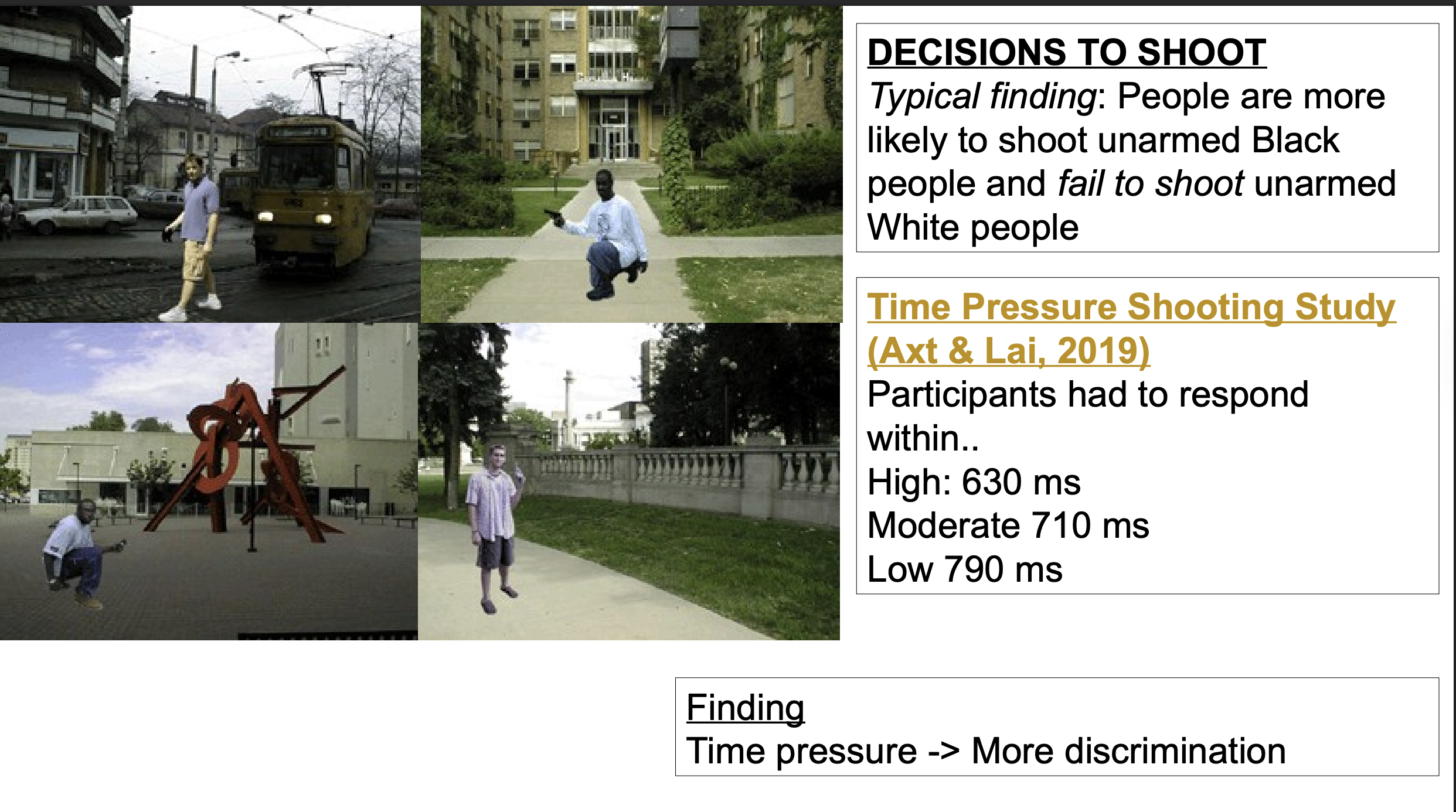
You have no time to think things through → more likely for implicit bias to affect behavior
Stressed, tired, drunk, lazy, on a deadline
When does discretion affect if implicit prejudices & stereotypes are influential in our behavior?
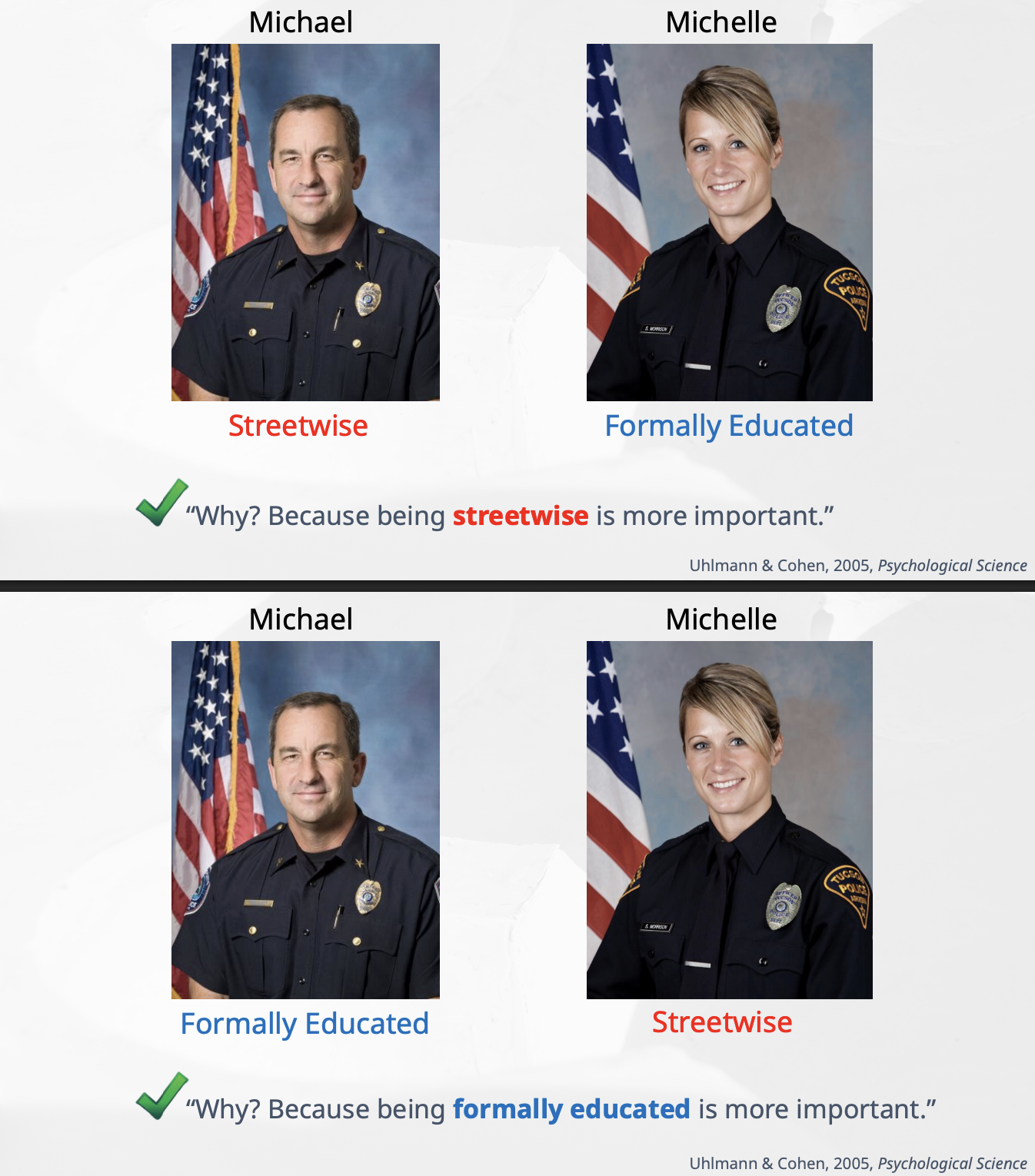
When criteria for decision making is unclear
When information is ambiguous or incomplete
Ex: Ppl usually think the man would be a better chief of police regardless of the ambiguous traits each officer is given
How does organizations & Institutions affect if implicit prejudices & stereotypes are influential in our behavior?
When policies & systems allow for it
ex: Prior to “blind auditions” for orchestras, mostly men were accepted. After “blind auditions,” women started being accepted as well
Forms of blinding
Blinding: Eliminating the possibility of knowing a person’s group
Dimming: Reducing the intensity of group status (ex: Don’t Google how a person looks)
Temporary Cloaking: Make a blinded decision, remove blinding, then see if there are unintended consequences
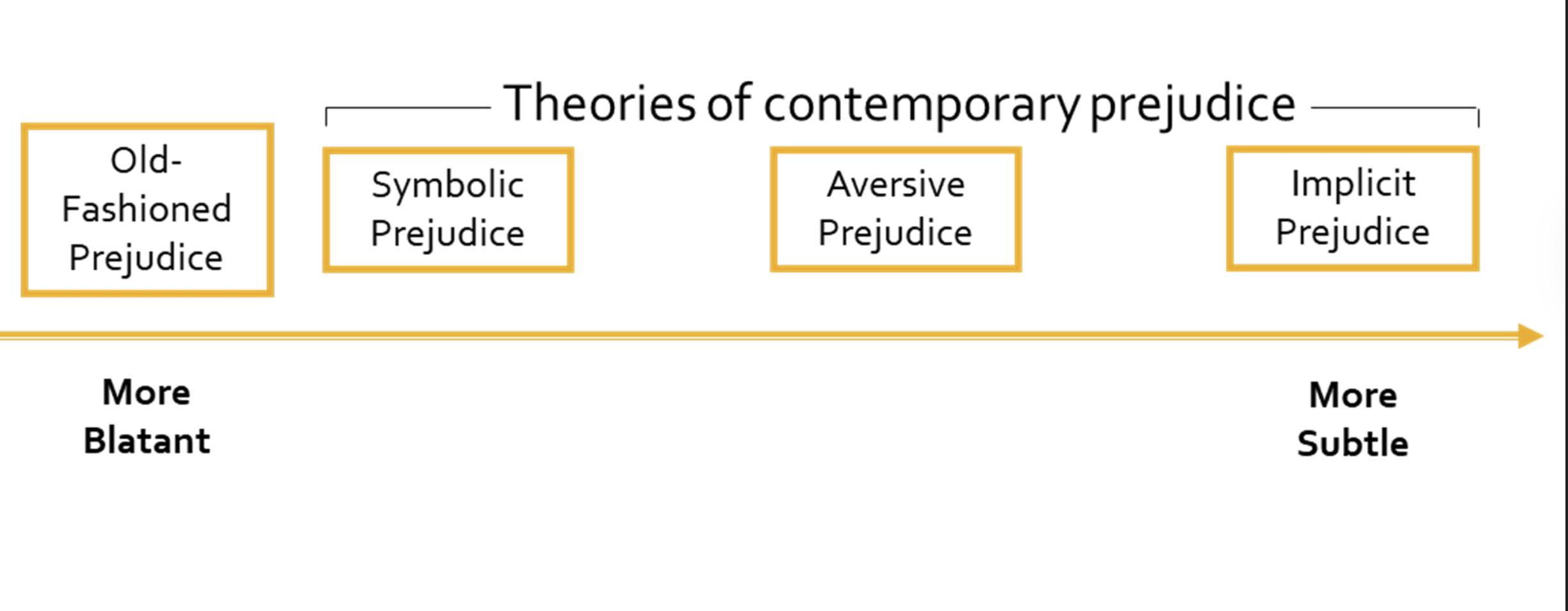
What is the prejudice continuum?
Prejudice exists on a continuum from blatant → subtle
What is Jim Crow Racism/old-fashioned racism
Whites’ absolute belief in their (biological) superiority over other races + firm belief racial separation
Use of government to establish a system of segregation and other forms of discrimination
Symbolic prejudice
Set of beliefs about Black ppl as an abstract group rather than as individuals
ex: Beliefs portray Black people as morally inferior because they violate traditional values (hardworking, self-reliant)
What does symbolic prejudice manifest as?
Support for acts that can be justified on a non-racial basis, but that maintain the racial status quo
Opposition to bussing (historically), welfare, affirmative action, voting against Black candidates, pro-school choice
Symbolic prejudice is characterized by themes that
Justify policies that are designed to promote inequality
Endorse equality as an abstract principle
Think anger over inequality & unfair treatment is unjustifie
Think black people seek special favors from the government rather than working harder
Think black people are getting more than they deserve economically
What is the misperception of racial inequality?
A lot of people underestimate the racial wealth inequality that exists in America
Ex: Asked “For every $100 in wealth accumulated by an average White family, how much wealth has the average Black family accumulated in 2010?”
2010 Perceived: $80
2010 Actual: $12
What is the paradox of symbolic prejudice
People with symbolic prejudice endorse racial equality in principle, but oppose policies that could bring it about
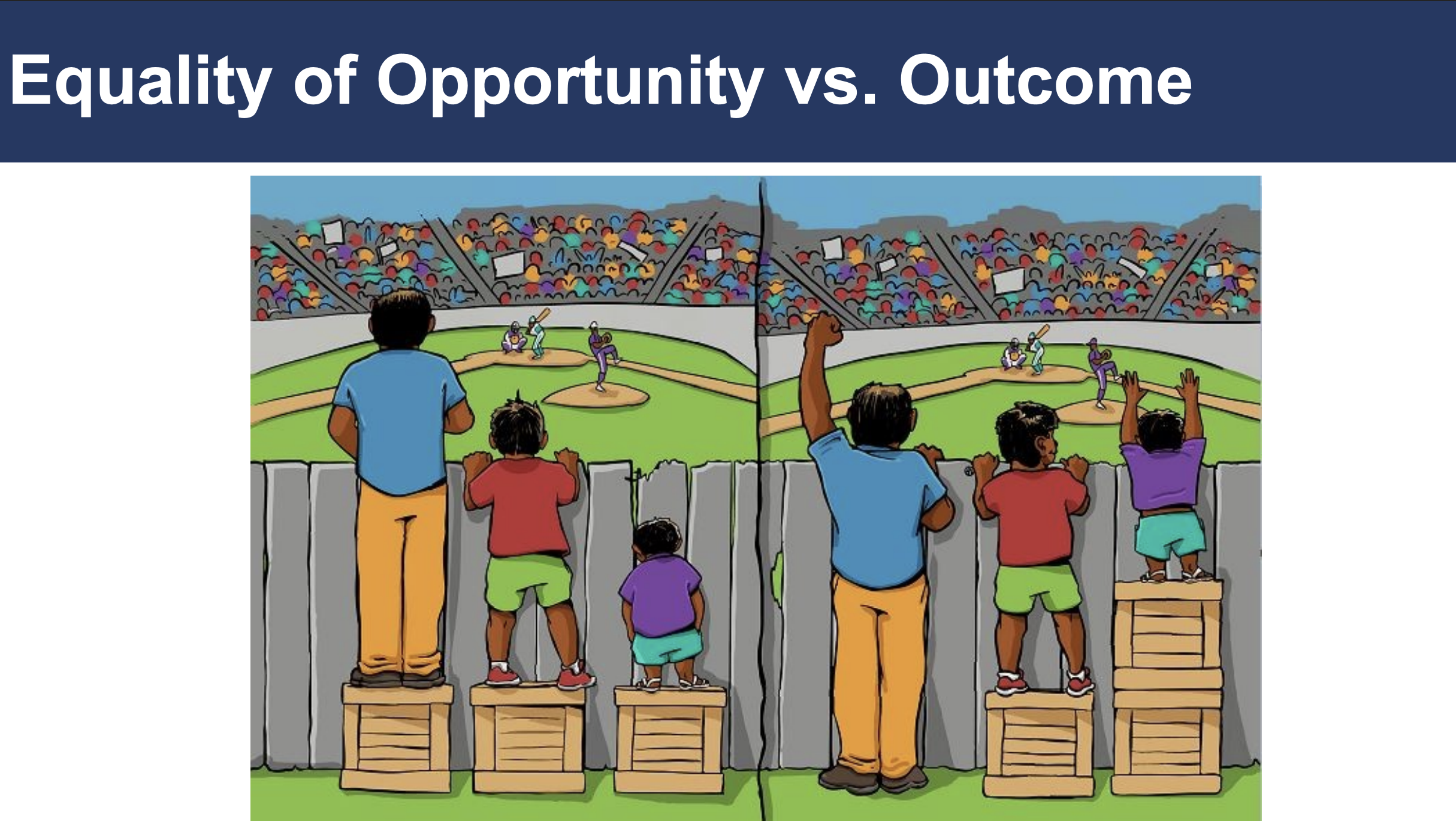
What is negative liberty? What is it related to?
The freedom from external restraints for ones’ actions
Equality of opportunity: Everyone deserves the same chance to succeed
What is positive liberty? What is it related to?
The ability to take control over one’s life and accomplish one’s goals
Equality of outcome: Everyone should have the same level of wellbeing
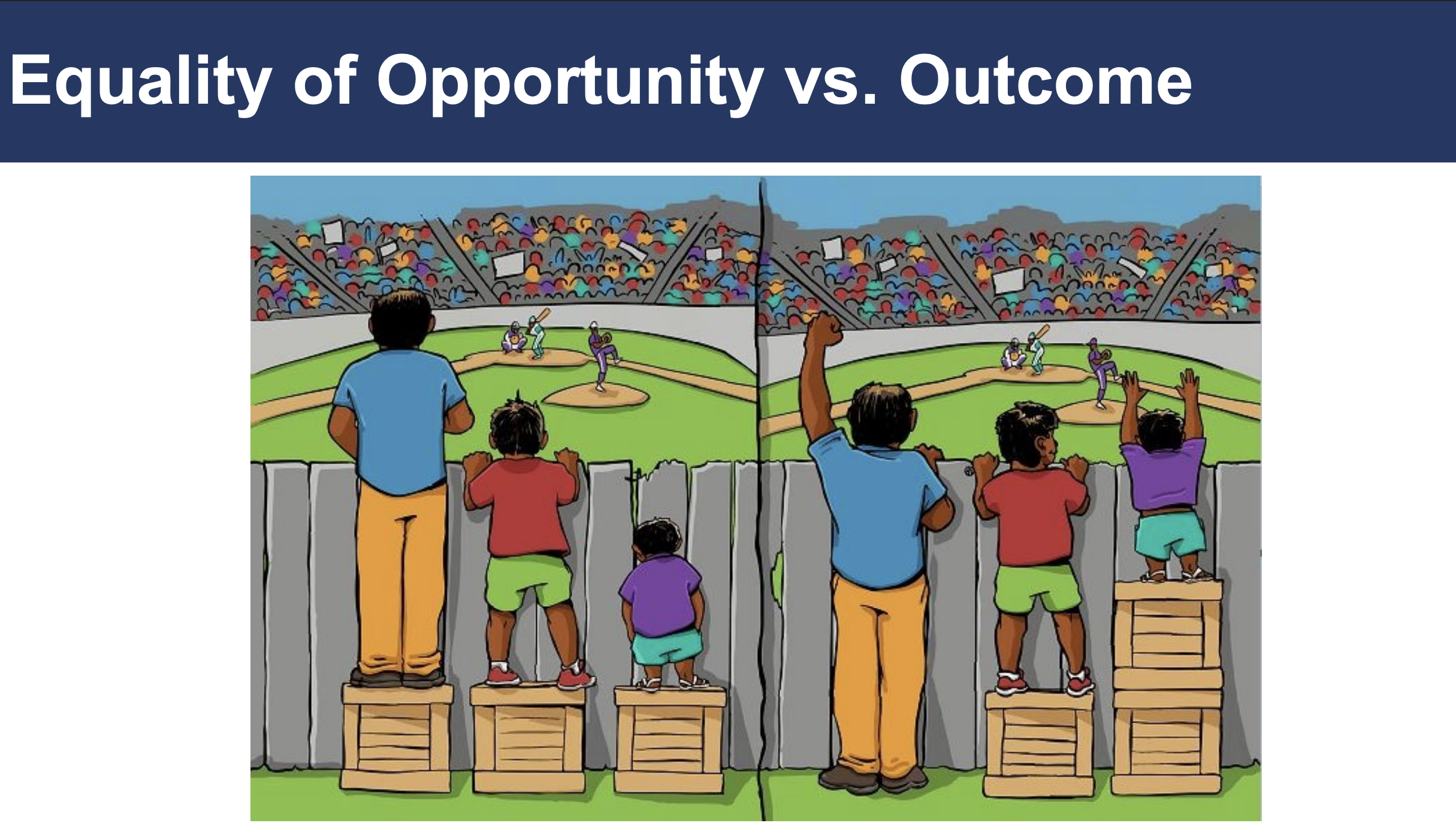
T/F: higher symbolic racism predict higher agreement with equality of outcome
False, it predicts lower agreemenet of equality of outcome
Equality of outcome: Everyone should have the same level of wellbeing
Key components of symbolic prejudice around the world
Move away from biological superiority
Focus on outgroup violation of shared cultural value
Justification of inequality and unfair treatment due to negative internal characteristics of outgroup
Ex: Malaysia prime minister saying that malays have to change their character for affirmative action to work
Aversive Prejudice
Having positive explicit attitudes toward Black people while holding negative implicit attitudes toward Black people
Characterized by feelings of unease and discomfort rather than
hostility
Ex: Clutching purse around black ppl
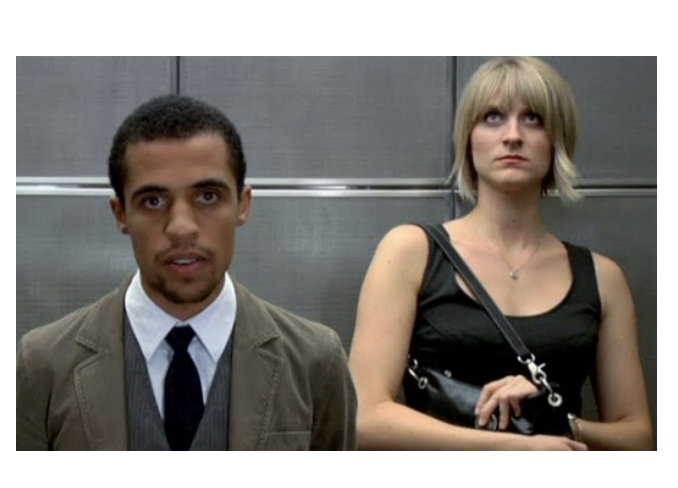
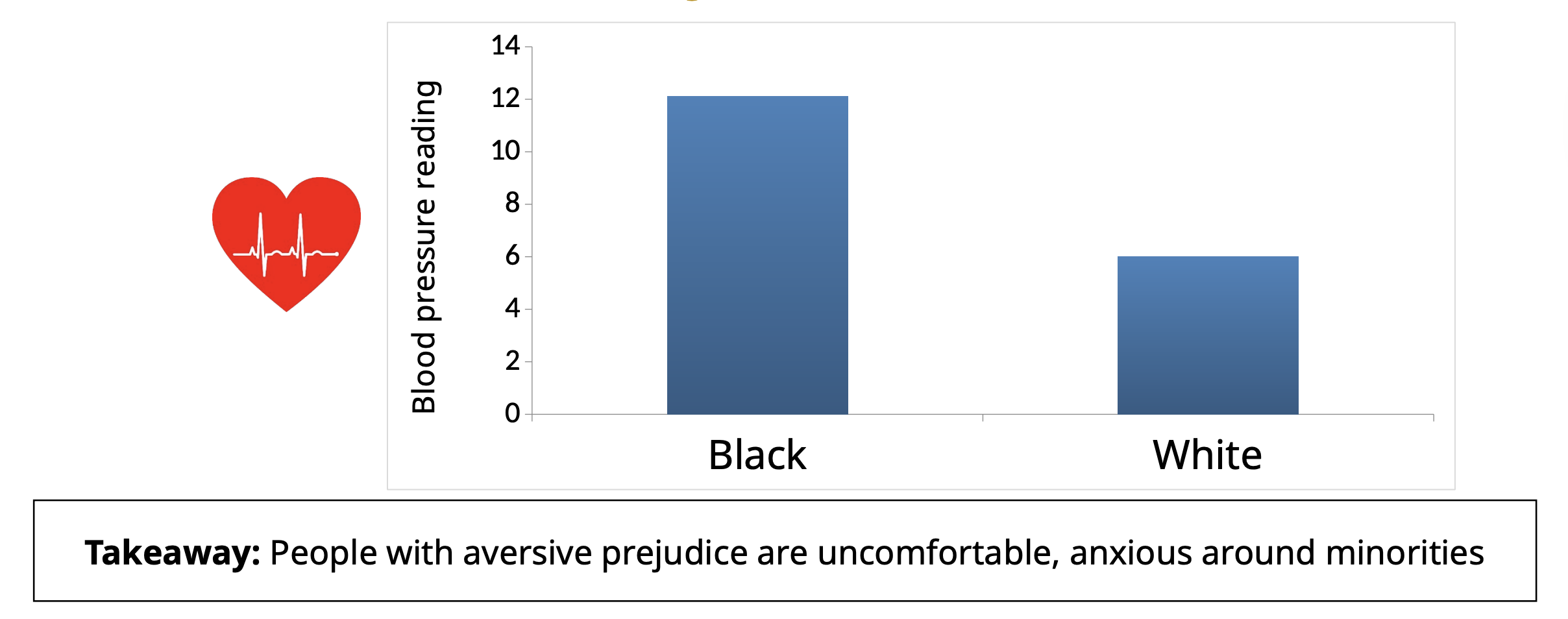
What is the Partner Discomfort Study?
Measured blood pressure of white participants after interacting with white ppl vs black ppl in a word search
Blood pressure much higher around black ppl – people w/ aversive prejudice are uncomfortable & anxious around minorities
T/F: Many aversive racists support equality & see themselves as egalitarian
True
This results in a strong motivation to appear unprejudiced
How does aversive racism lead to discrimination under certain conditions?
Clear “correct” behavior: Fair responses
Unclear “correct” behavior: discriminating responses
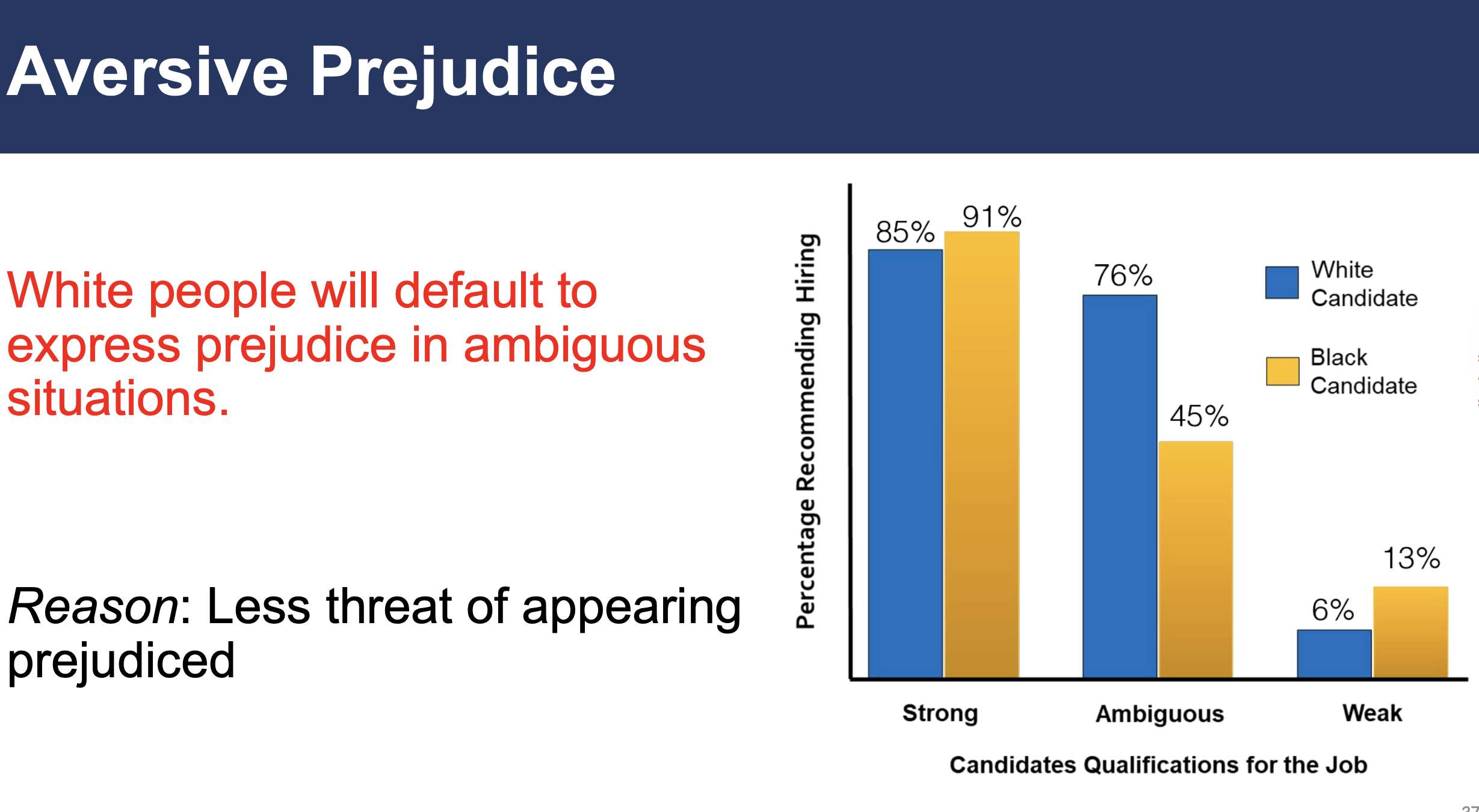
What two factors affect discriminating responses due to aversive racism?
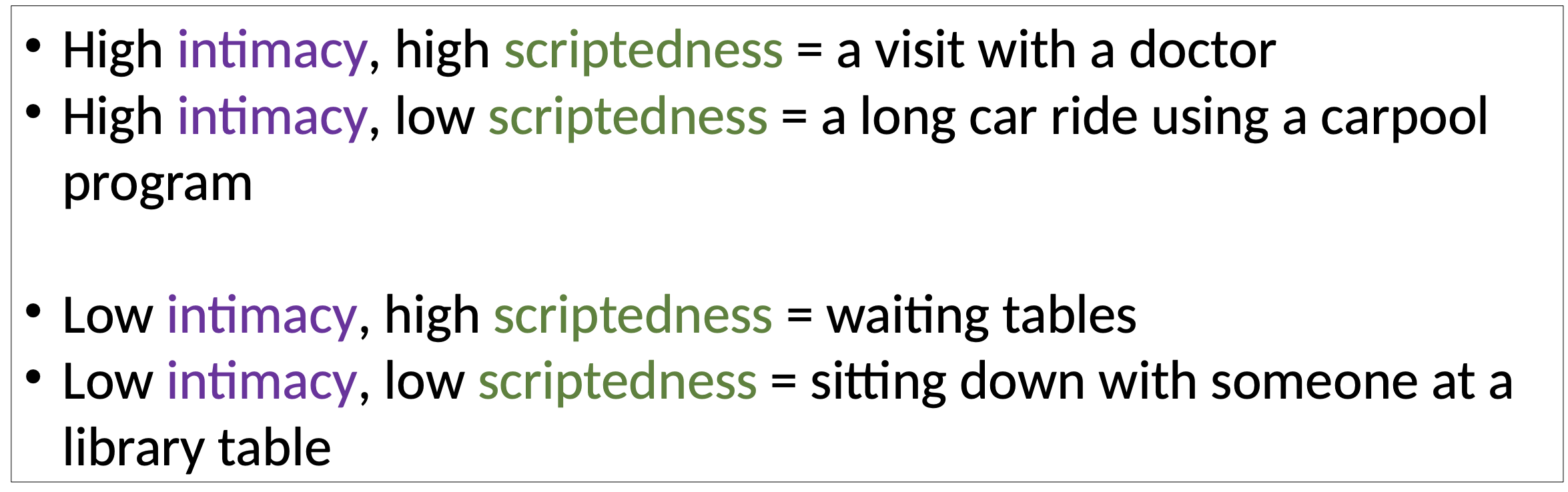
Intimacy: The degree to which you would feel intimate (close) to the person
Scriptedness: The degree to which there is a clear script that defines what behaviors are to be performed in an situation
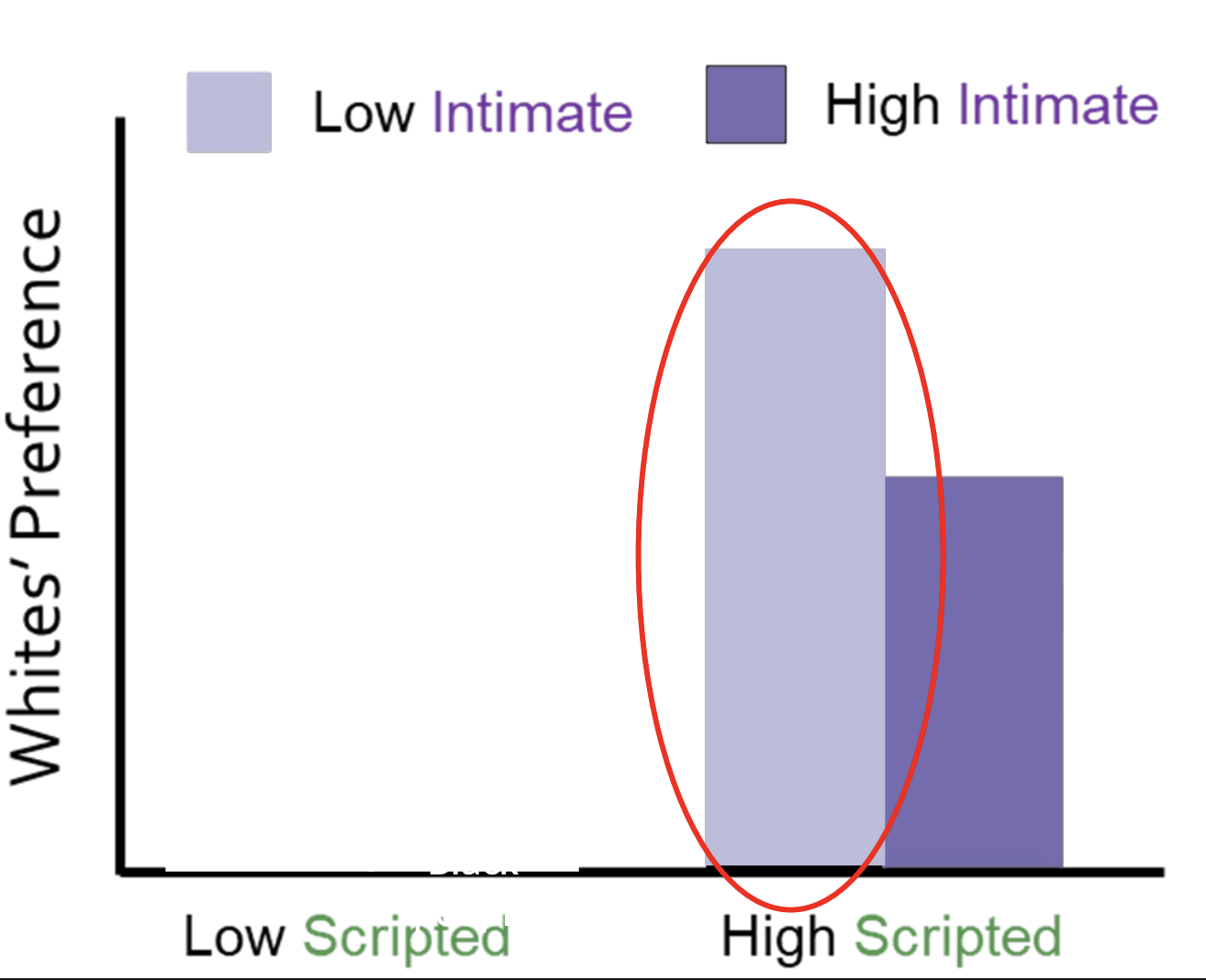
What type of interactions w/ black ppl do white people w/ aversive racism prefer
White ppl prefer interactions w/ Black ppl that are more scripted and less intimate
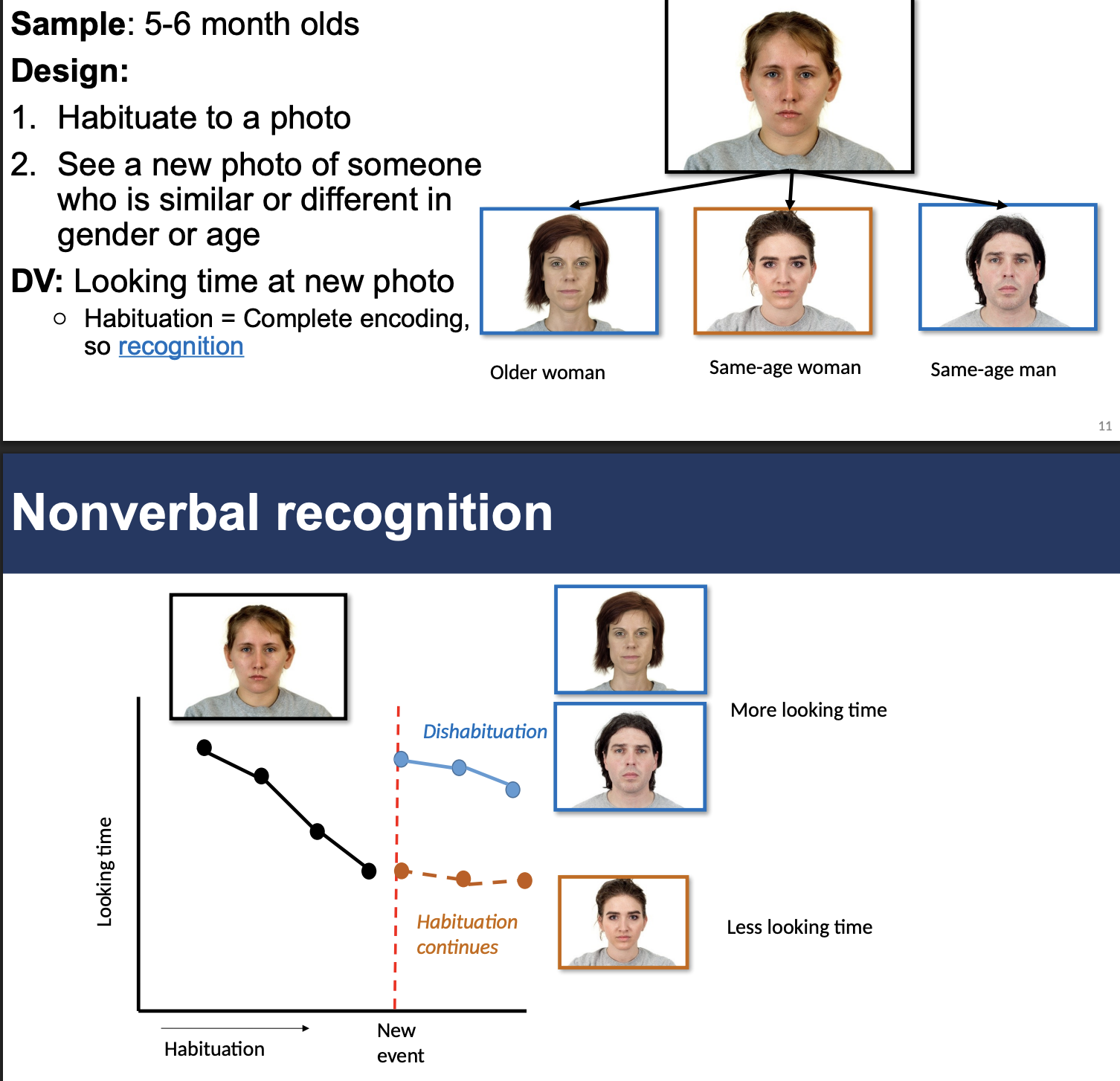
What is the habituation paradigm?
A method where infants are repeatedly shown the same stimulus until they get “bored” (look less), indicating it has been encoded.
What is dishabituation in infants and what does it tell us?
When a new stimulus is shown, infants will look longer if they detect a difference. This increase in looking time (dishabituation) shows they recognize something as novel or different.
How does the habituation paradigm show infants recognize social categories (e.g., age, gender)?
Infants are habituated to one type of face (e.g., same-age woman)
Then shown new faces:
Longer looking → different category (e.g., man or older woman)
Shorter looking → same category (e.g., same-age woman)
This shows they can distinguish categories.
What is the preferential looking method and how is it different from habituation?
Infants are shown multiple stimuli without prior habituation, and researchers measure which one they look at longer.
Longer looking = preference or interest, not necessarily recognition.
What determines what infants prefer to look at?
Often visually interesting/novel (“cool”) stimuli (baby will stare at fluorescent lights longer than a bottle of pepper even if they are both new stimuli)
With age, experience shapes preferences (e.g., exposure to certain faces)
How did they measure nonverbal race preferences in infants? What did they find?
White newborns AND 3-month olds saw images of people from different races (NO HABITUATION)
measured the looking time (preference) that each baby had
3 month olds: looked at white faces the longest → shows preference
newborns: no race-based differences in looking time
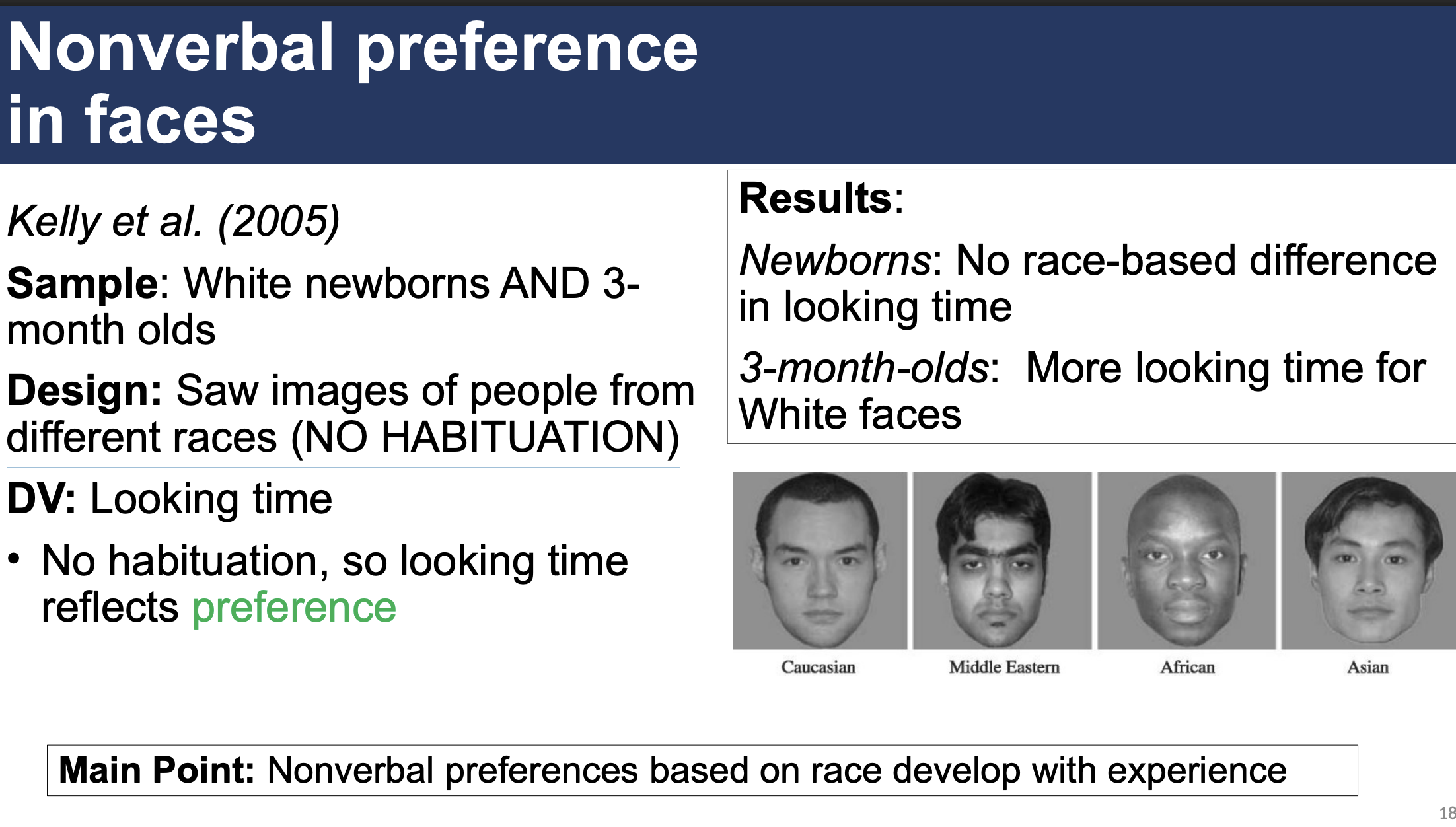
What does it mean that white 3 month olds had preferences for white faces while white newborns did not?
Nonverbal preferences based on race develop w/ experiences
How did they measure nonverbal accent preferences in newborns? What did they find?
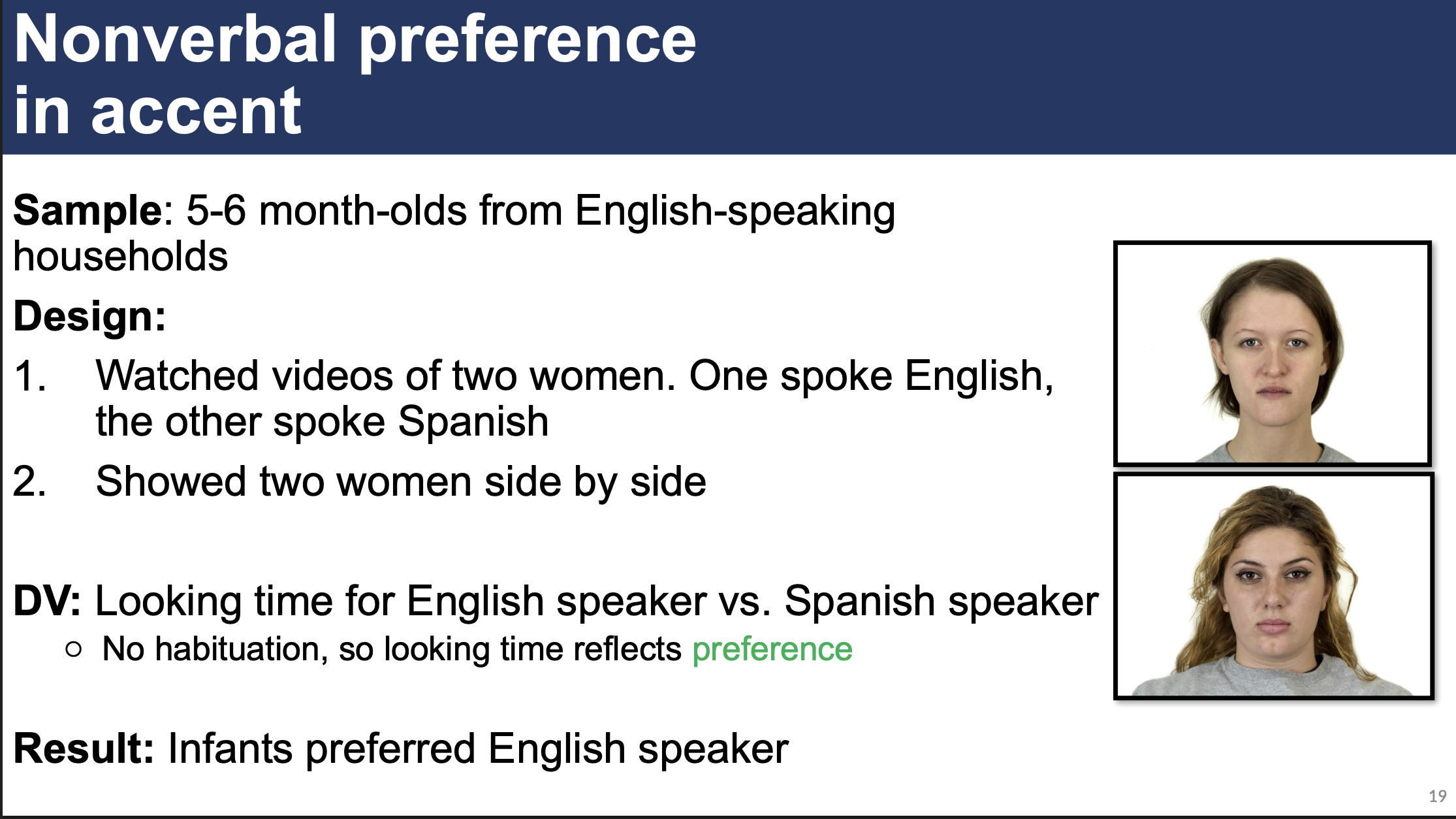
5-6 month-olds from English-speaking households watched videos of two women. One spoke English, the other spoke Spanish (NO HABITUATION)
Showed women side-by-side
Measured looking time for English speaker vs. Spanish speaker (preference)
Result: Infants preferred English speaker
When does conscious awareness of social categories begin?
With the development of language in babies
T/F: Development of awareness for all social categories occurs at the same time
False, the development specific social categories varies
Two rules for when awareness of social categories develops:
1. Visibility of social category
2. Primacy of social category in everyday life
Order of development of social categories
Age develops very early
Gender develops early (2-3 years)
Race/ethnicity comes later (4-5 years and up)
Varies based on your racial/ethnic identity and local culture
How did they measure what cues children & adults use to determine race?
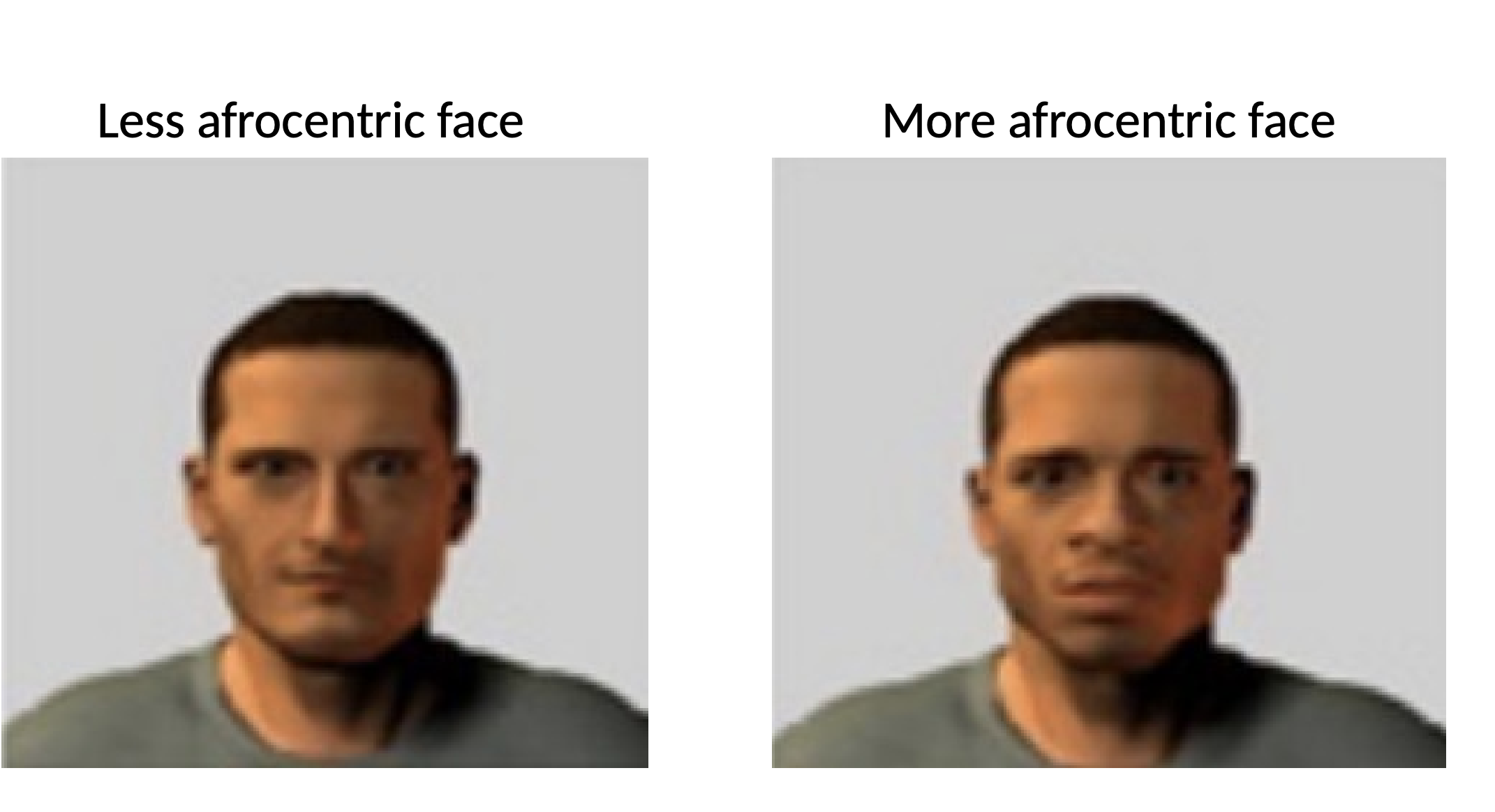
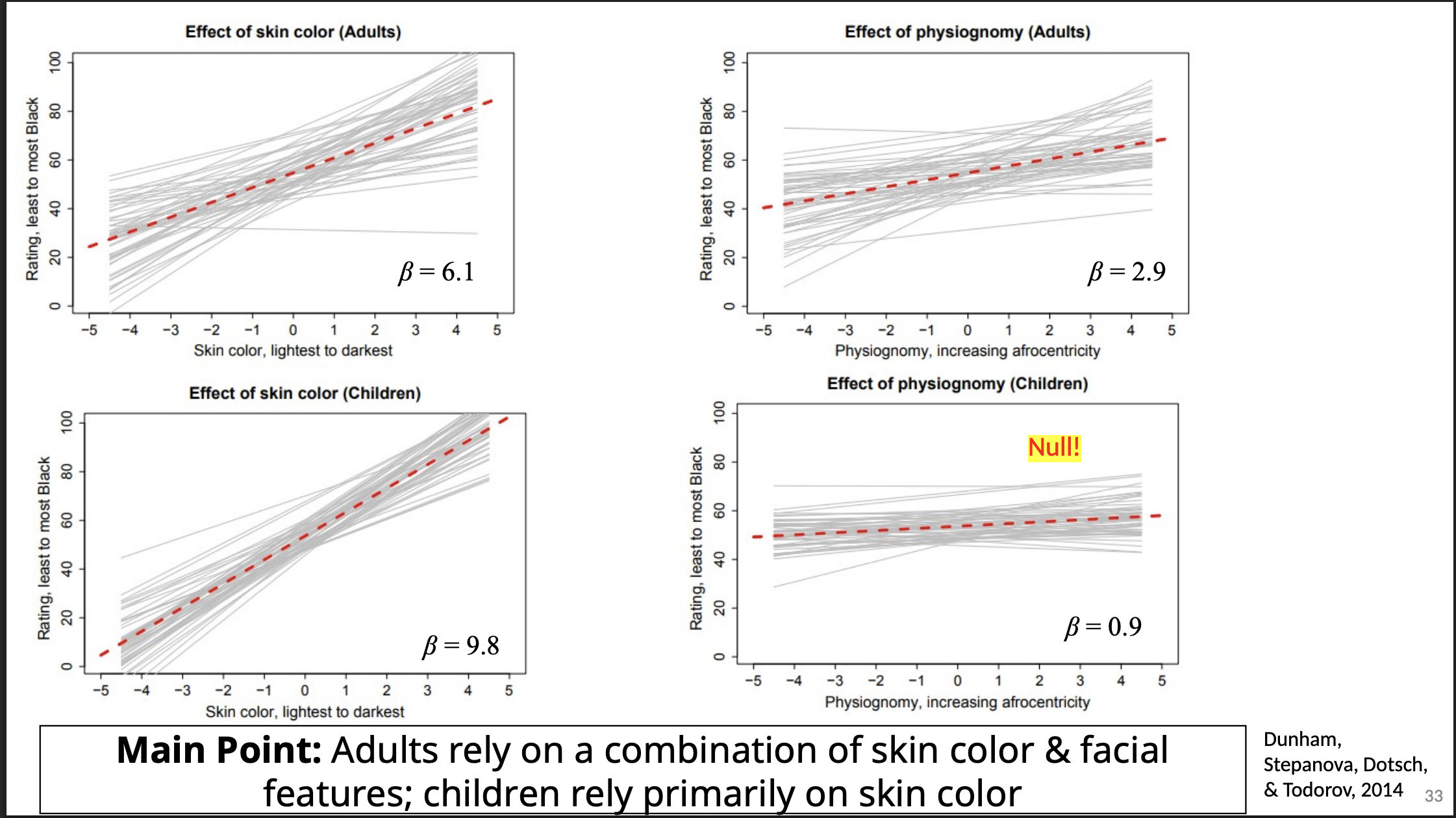
Adults & 4-9 year olds in Northeast US (81% White, 11% Black, 8% other) saw White & Black faces, had to label as “White or European-American” or “Black or African American
Faces differed in skin color & facial features (physiognomy)
What did they find from the study that measured what cues children & adults use to determine race?
Adults rely on a combination of skin color & facial features; children rely primarily on skin color
At what age does racial prejudice develop?
Prejudice tends to be higher around 5-7, when children:
Have internalized social categories
Haven’t internalized egalitarian norms yet
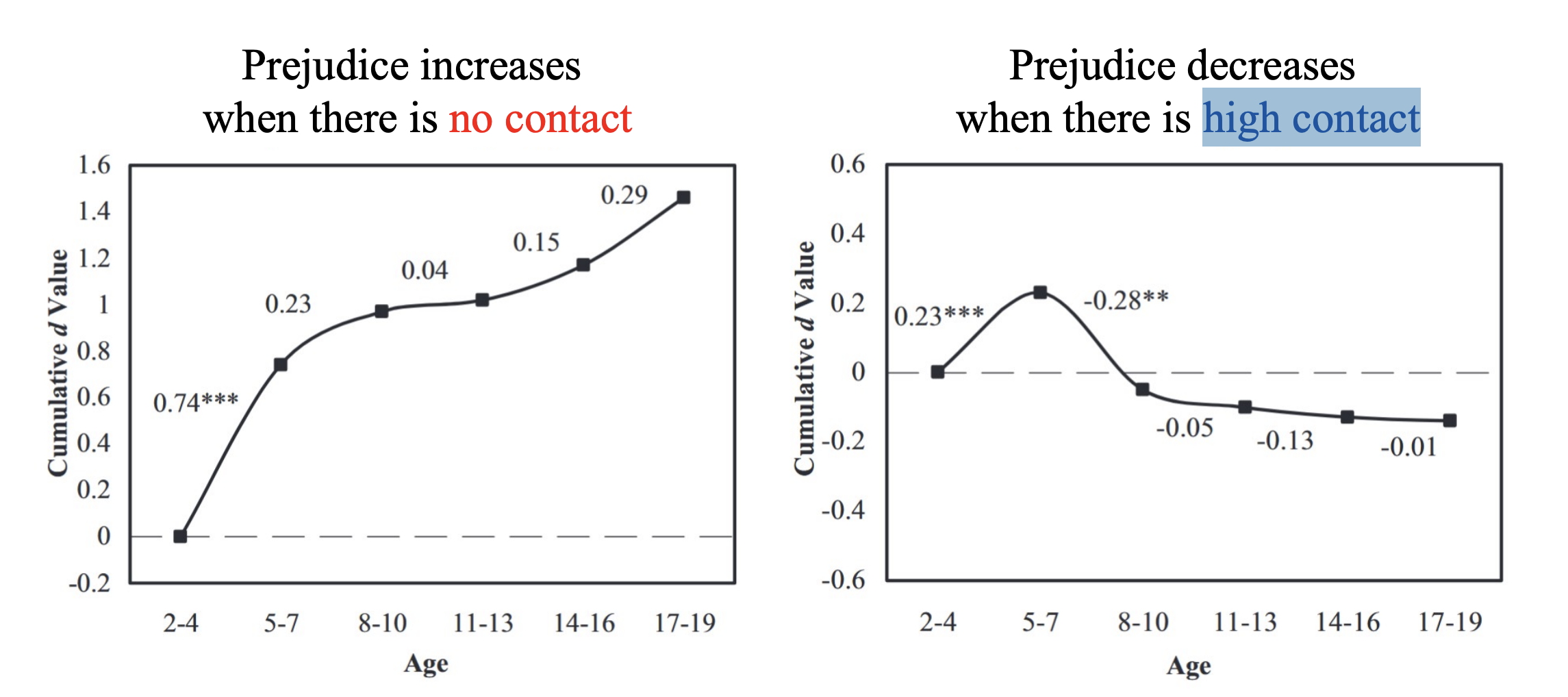
T/F: Prejudice increases with high amount of contact with outgroup members
False,
Prejudice increases when there is no contact
Prejudice decreases when there is high contact
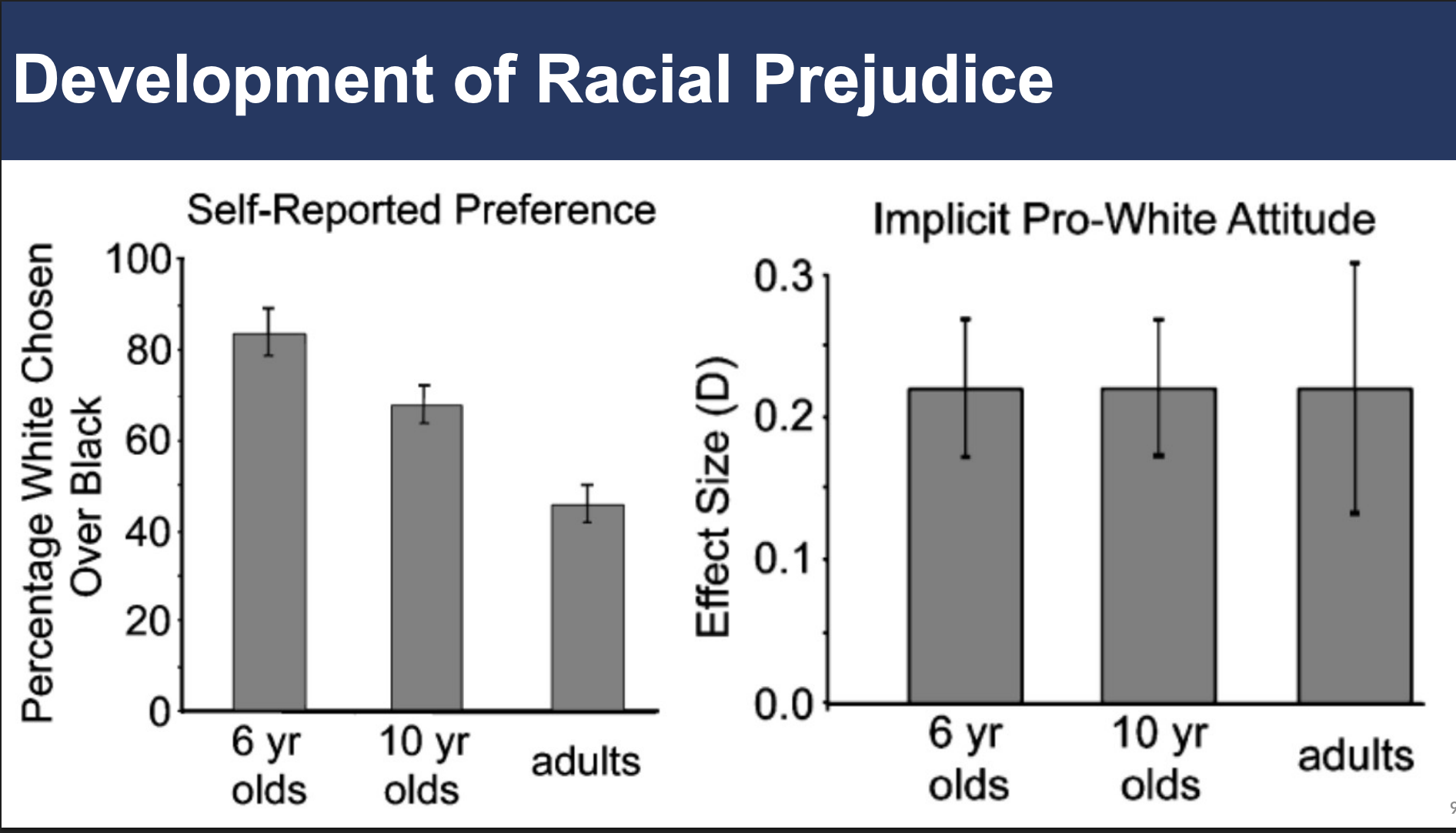
How did they measure implicit attitudes across development when there are high opportunities for contact w/ minority groups?
(predominantly) White participants in Boston from kindergartners → 5th graders → adults
measured self-reported preference & implicit pro-white attitdues
results: self-reported preference decreased, implicit pro-white attitude stayed same
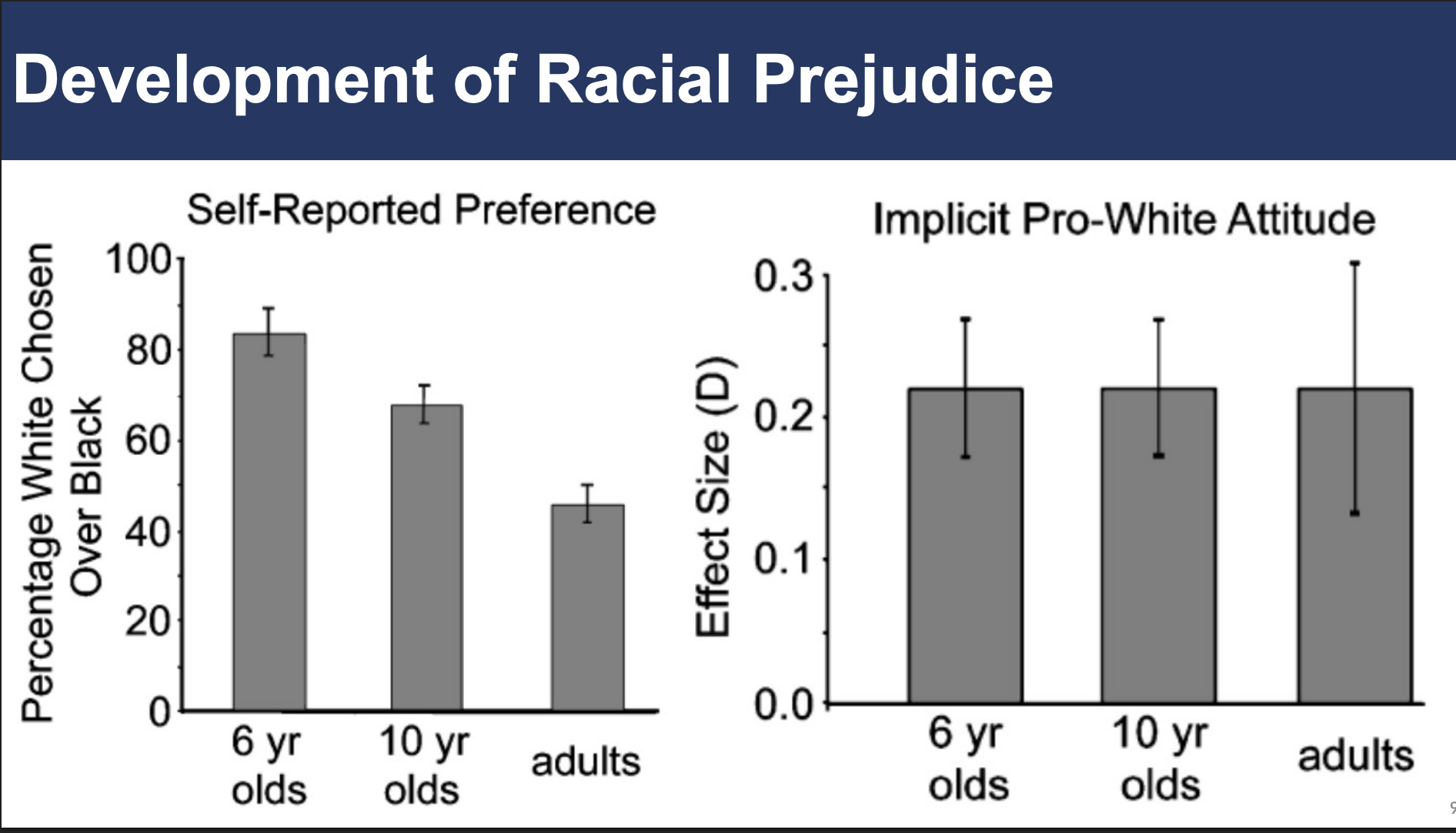
Why explicit prejudice declined for White participants in Boston?
Learn social and cultural norms about race
Internalize moral lessons about equality & fairness