2.3 Nucleic Acids
 Call Kai
 Learn
Learn Practice Test
 Spaced Repetition
 Match
Match Flashcards
 Knowt Play
1/26

There's no tags or description
Looks like no tags are added yet.
Name | Mastery | Learn | Test | Matching | Spaced | Call with Kai |
|---|
No analytics yet
Send a link to your students to track their progress
27 Terms
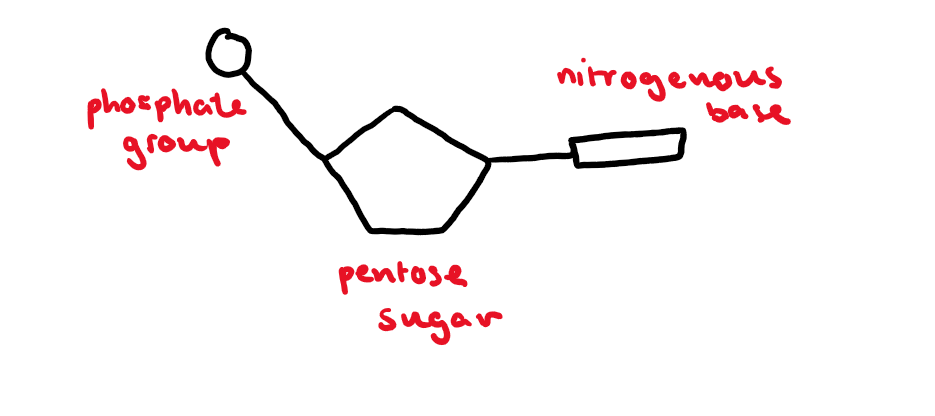
Structure of a nucleotide
Monomers from which DNA and RNA polymers are made
Contain
Pentose sugar
Nitrogenous base
Phosphate group
DNA vs RNA
DNA
Deoxyribose sugar
Contains one fewer oxygen than ribose
Carbon 2 has an H group
Four bases
Adenine
Cytosine
Guanine
Thymine
Double stranded
RNA
Ribose sugar
Carbon 2 has an OH group
Four bases
Adenine
Cytosine
Guanine
Uracil
Single stranded
Purines
Double ring structure
Adenine and guanine
PURE LAG (purines, long, a and g)
Pyrimidines
Single ring structure
Cytosine, thymine and uracil
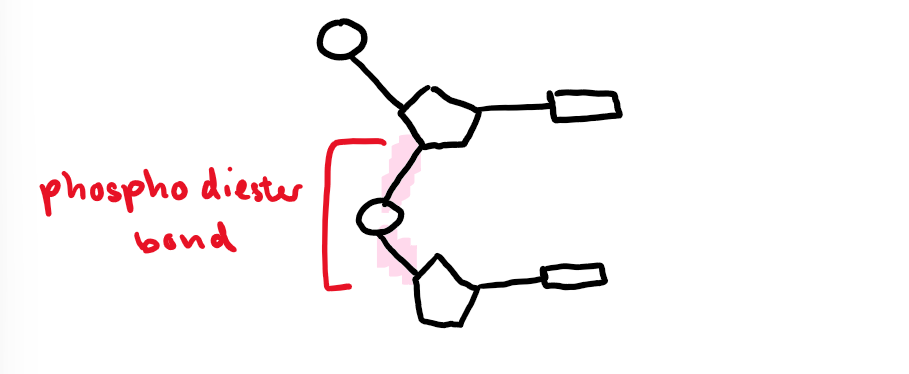
Phosphodiester bond
Bond that joins monomers of nucleotides together to form polymers of DNA and RNA
Joined via condensation reaction between phosphate group of one nucleotide and pentose sugar of next
Alternating pattern
Phosphate group and pentose group creates a sugar-phosphate backbone
DNA structure
Is made from two polynucleotide strands
Are antiparallel as they run in opposite directions
Double helix
Made of alternating deoxyribose sugars and phosphate groups
Form sugar-phosphate backbone
Covalent bonds known as phosphodiester bonds
5-carbon and 3-carbon
Hydrogen bonding
Holds strands together between nitrogenous bases
A - T (two hydrogen bonds)
C - G (three hydrogen bonds)
Complementary base pairing
Double helix
Three dimensional shape formed by twisting of molecule
Wound around histones (proteins)
Seen by x-ray diffraction
Energy
All organisms require energy
For anabolic reactions
For moving substances
In animals
For muscle contractions
Conduction of nervous impulses
ATP
From respiration
Is used to transfer energy in all energy-requiring processes in cells
This is why it is known as universal energy currency
Is a nucleotide
ATP structure
The energy carrying molecule
Is a type of nucleic acid so its structurally similar to nucleotides of DNA and RNA
Structure
Contains adenine (a nitrogenous base)
A pentose sugar (ribose)
3 phosphate groups
One is AMP
Two is ADP
Three is ATP
Condensation and hydrolysis reactions
Properties of ATP
Hydrolysis of ATP releases small amounts of energy
Little energy is lost as heat
Is broken down in one step so energy is released quick
Can rapidly resynthesise
Always readily available
Soluble
Easily transported
Bonds between phosphate groups are unstable
Low activation energy and easily broken
DNA replication
Semi-conservative
Produces DNA molecules of one original DNA strand and one newly synthesised DNA strand
Process of DNA replication
Helicase breaks hydrogen bonds between complementary bases
This unwinds the double helix and separates the strands
Each strand acts as a template as free nucleotides attract their complementary bases
DNA polymerase joins to free nucleotides together via condensation
In 5' to 3' directions
Forms phosphodiester bonds to create sugar-phosphate backbone
Two identical copies of DNA are made
Each made from one of original DNA strand
Conservative vs semi-conservative replication
Conservative
DNA molecules stay intact while new copy is built
After replication, one molecule has OG strand and the other has two new strands
Semi-conservative
Original DNA splits and each strand acts as template
Meselson-Stahl experiment
Bacteria were grown in medium containing N15 (DNA is heavy)
Bacteria were transferred to a medium with N14 for one round of replication
Lighter nitrogen was incorporated in any new strands of DNA made
Centrifuged the DNA which was extracted
Steps 2-3 repeated
Distribution was analysed to see how DNA was replicating
Heavier strands sunk to bottom
Intermediate (one strand of heavy, one of light)were in middle
Lighter at the top
Results of Meselson-Stahl Experiment
Parent generation
All heavy DNA
First replication
Original heavy strands separate
Each heavy strand acts as a template for new strand
Results in DNA molecule with one strand heavy and one light
Means all intermediate
Second generation
Both original strands and new strands act as templates
New light strands form complementary to all four templates
Means half are intermediate (mix of N15 and N14) and other half are light
What is DNA purification
Precipitation reaction to purify DNA
Marmur preparation (method used)
Consists of
Lysing the cell and disrupting the nuclear membranes to release DNA
Using enzymes to denature and remove the histones
Precipitating the DNA
DNA purification pt1 steps
Cut up onion into small pieces
Add washing-up liquid to 90cm3 of tap water in beaker
Add onions to beaker
Place beaker into water bath as 60C for 15 minutes
Detergent and heat disrupt phospholipid bilayer
Releases DNA
Heat denatures enzymes released from cell that would have digested DNA
Cool mixture in ice-water bath for 5 mins
Lowers temperature
Prevents DNA from breaking down
Continual stirring
Evenly distributes heat
DNA purification pt2 steps
Blend mixture in blender for 5 seconds
Breaks down cell wall
Only for short amount of time so that DNA does not get broken apart
Using filter paper, filter the mixture into another beaker
Removes cell debris and membrane fragments
Leaves on DNA and histones
Pour filtrate into test tube and add 2-3 drops of protease
Denatures and removes the proteins
Leaves just DNA
Add ice-cold ethanol to test tube
Nucleic acids are insoluble in ice-cold ethanol
DNA forms a precipitate
Genetic code structure
DNA is wound around histones
They get condensed to form chromatin which helps pack DNA into chromosomes
Genes
Section of DNA that codes for a protein
Each is located at specific position along a chromosome called a locus
Genetic code is: universal, degenerate, non-overlapping
Universal
Each DNA triplet codes for the same amino acid in all organisms
Degenerate
Most amino acids are coded for by more than one triplet
Non-overlapping
Each base in DNA sequence is only read once
mRNA
Messenger RNA
Features
Single stranded
Contains base sequence complementary to DNA
Contains codons (base triplets)
Small
Longer than tRNA
tRNA
Transfer RNA used in translation
Features
Single stranded folded into clover-leaf
Uses hydrogen bonds to hold it in shape
Has anticodon
Contains an amino acid binding site at the opposite end
Transcription
RNA polymerase binds to DNA in nucleus
Hydrogen bonds between complementary bases break
Two strands separate
Antisense strand acts as template
Free RNA nucleotides align with DNA template with complementary base pairing
U pairs with A, A pairs with T, C pairs with G
RNA polymerase catalyses formation of phosphodiester bonds
mRNA strand is formed and complementary
Process ends when RNA polymerase reaches stop codon
DNA rewinds and mRNA leaves via nuclear pore
Translation
Ribosome attaches to mRNA at start codon
A tRNA molecules with complimentary anticodon to codon binds to mRNA
Second tRNA molecule binds to next with specific amino acid
Amino acid carried by first two tRNA molecules link via peptide bond
First tRNA molecule detaches from mRNA
Ribosome moves along mRNA in codons and allows another tRNA molecule to bind to next mRNA
Polypeptide chain is made from amino acids
Sequence continues until ribosome reaches stop codon on mRNA
Polypeptide detaches and folds up

