econ unit 11 ppt

0.0(0)
studied byStudied by 0 people
0.0(0)
full-widthCall Kai
learnLearn
examPractice Test
spaced repetitionSpaced Repetition
heart puzzleMatch
flashcardsFlashcards
GameKnowt Play
Card Sorting

1/36

encourage image

There's no tags or description

Looks like no tags are added yet.

Study Analytics
Name
Mastery
Learn
Test
Matching
Spaced

No study sessions yet.

37 Terms

1
New cards

Externalities 

1. Fundamental Welfare Theorems — Background for Externalities

__ Welfare Theorem

  • In perfectly competitive markets, with ideal conditions, the market outcome is ___.

  • “Efficient” = maximizes total surplus.

first, efficient

2
New cards

___ Welfare Theorem

  • Any efficient allocation can be achieved by:

    1. ___ wealth first

    2. Then letting markets operate ___

  • Meaning: equality concerns ≠ efficiency concerns.

second, redistributing, freely

3
New cards

BUT these theorems depend on unrealistic assumptions:

  1. All markets must be perfectly ____
    – No market power, monopolies, or strategic behavior.

  2. All agents have ____ information and beliefs
    – No misinformation, uncertainty, or asymmetric information.

  3. No externalities
    – People only affect __

When any of these fail → markets can be inefficient.

competitive, perfect, themselves

4
New cards

2. What Are Externalities?

Externalities are the ___ of an economic choice that affect others who did not make the decision.

  • Positive externalities → third-party benefits

  • Negative externalities → third-party costs

Externalities occur in both production and consumption

  • Production: ____, bee pollination, R&D spillovers

  • Consumption: ___, congestion, Christmas lights

Externality = external effect.

consequences, pollution, noise

5
New cards

3. Examples from Daily Life (Slides 7–14)

“No man is an island” (John Donne, 1624)

Used to illustrate that: Individuals’ actions ____ affect others.

Negative Externalities

  • Congestion

  • Conflicting lawn maintenance

  • Household ___(Neve’s nasty nicotine addiction)

  • CO₂ emissions & climate change

  • Noise pollution

inevitably, trash

6
New cards

Positive Externalities

  • Christmas lights → neighborhood enjoyment

  • Education → societal productivity

  • ____ → herd immunity

  • Employment → reduced crime

  • Flowers & bees → pollination

  • Network spillovers → social media value increases with more users

Graph example: CO₂ emissions vs. temperature (Slide 12)

  • CO₂ emissions rising from 1900–2025 

Global temperature increases with emissions
→ Clear visual of negative externality: harm falls on everyone

vaccines

7
New cards

4. Externalities and Market Failure

Moral behavior vs. economic incentives

  • Ideally: people consider how their actions affect others

  • In reality: decisions are made based on ___ costs and benefits
    → Externalities are usually
    ___.

When externalities are ignored:

Private decision rule (selfish choice):

MC = MB

Social efficiency rule: MSC = MSB

  • MSC = MC + __
    (Marginal Social Cost = Private cost + Marginal External Cost)

MSB = MB + MEB
(Marginal Social Benefit = Private benefit + Marginal External Benefit)

private, ignored, MEC

8
New cards

5. Negative Externalities (Slides 18–22)

  • Pollution

  • ___ emissions

  • Traffic congestion

factory

9
New cards
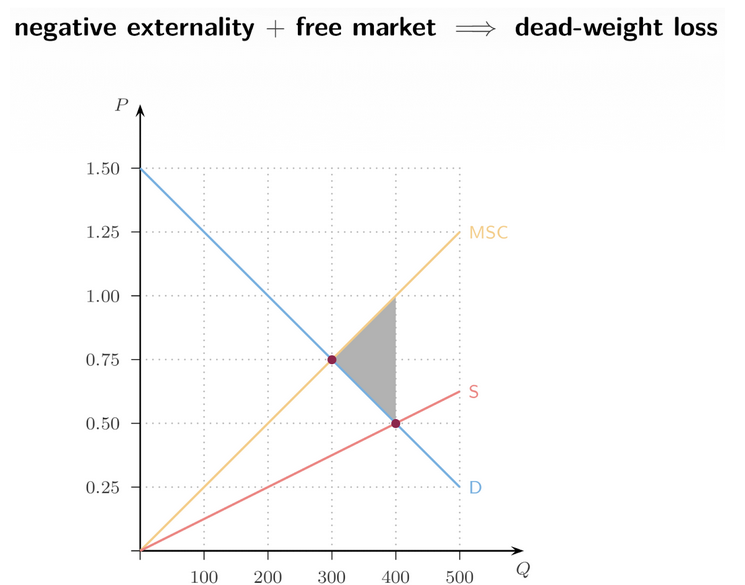
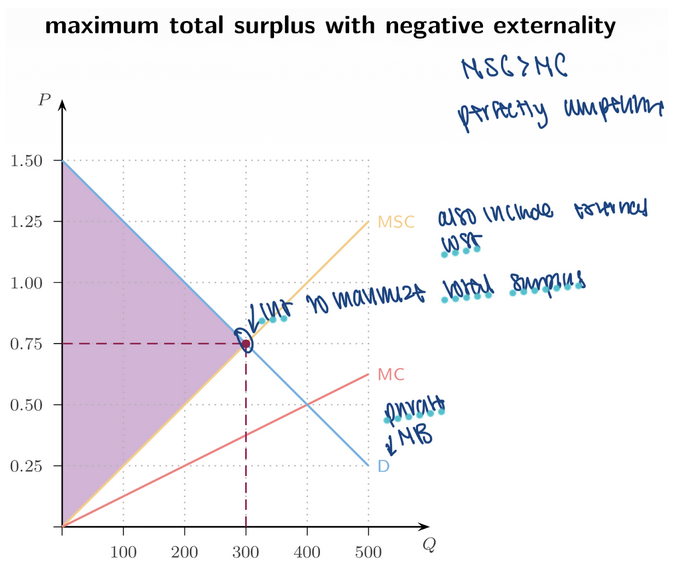
<p><span style="background-color: transparent; font-family: &quot;Times New Roman&quot;, serif;"><strong><span>Graph: Negative Externality (Slide 18)</span></strong></span></p><p><span style="background-color: transparent; font-family: &quot;Times New Roman&quot;, serif;"><span>Graph with Q (quantity) on x-axis and P (price) on y-axis.&nbsp;</span></span></p><p><span style="background-color: transparent; font-family: &quot;Times New Roman&quot;, serif;"><span>Curves:</span></span></p><ul><li><p><span style="background-color: transparent; font-family: &quot;Times New Roman&quot;, serif;"><strong><span>____ (private cost)</span></strong><span> = ___ curve ignoring external costs</span></span></p></li><li><p><span style="background-color: transparent; font-family: &quot;Times New Roman&quot;, serif;"><strong><span>MSC (social cost)</span></strong><span> = MC + external cost<br> → lies </span><em><span>___***</span></em><span> MC</span></span></p></li><li><p><span style="font-family: &quot;Times New Roman&quot;, serif;"><span>Vertical distance between MSC and MC = </span><strong><span>____*** (external cost)</span></strong></span></p></li></ul><p><span style="background-color: transparent; font-family: &quot;Times New Roman&quot;, serif;"><span>Producers do not bear the full cost → they overproduce </span></span></p>

Graph: Negative Externality (Slide 18)

Graph with Q (quantity) on x-axis and P (price) on y-axis. 

Curves:

  • ____ (private cost) = ___ curve ignoring external costs

  • MSC (social cost) = MC + external cost
    → lies
    ___*** MC

  • Vertical distance between MSC and MC = ____*** (external cost)

Producers do not bear the full cost → they overproduce

MC, supply, above, MEC
10
New cards
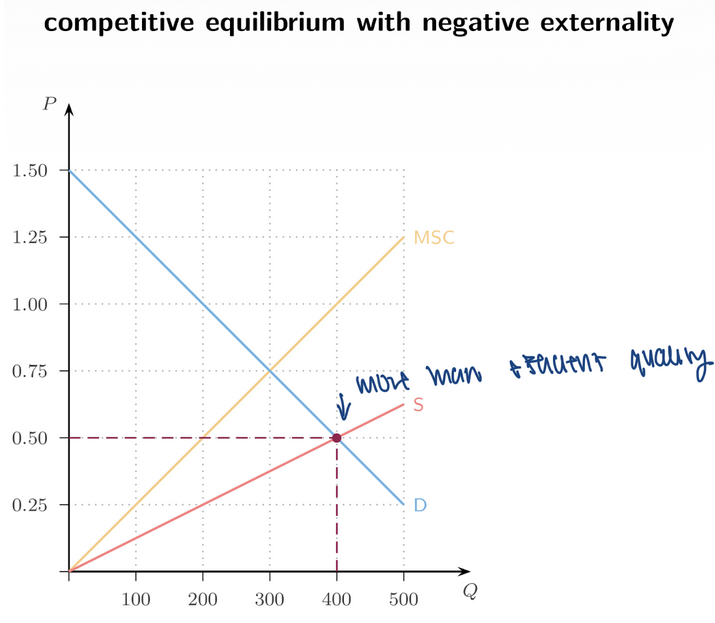
<p><span style="background-color: transparent; font-family: &quot;Times New Roman&quot;, serif;"><strong><span>Socially Efficient Outcome (Slide 19)</span></strong></span></p><p><span style="background-color: transparent; font-family: &quot;Times New Roman&quot;, serif;"><span>Add the </span><strong><span>demand curve (D)</span></strong><span>.</span></span></p><ul><li><p><span style="font-family: &quot;Times New Roman&quot;, serif;"><span>Efficient Q = intersection of </span><strong><span>___ and D</span></strong></span></p></li><li><p><span style="font-family: &quot;Times New Roman&quot;, serif;"><span>Free-market Q = intersection of </span><strong><span>___ ****and D</span></strong></span></p></li></ul><p><span style="background-color: transparent; font-family: &quot;Times New Roman&quot;, serif;"><span>The efficient quantity is </span><strong><span>____</span></strong><span>.</span></span></p><p><span style="background-color: transparent; font-family: &quot;Times New Roman&quot;, serif;"><span>→ Society prefers ___ production than the market produces.</span></span></p>

Socially Efficient Outcome (Slide 19)

Add the demand curve (D).

  • Efficient Q = intersection of ___ and D

  • Free-market Q = intersection of ___ ****and D

The efficient quantity is ____.

→ Society prefers ___ production than the market produces.

MSC, MC, lower, less
11
New cards
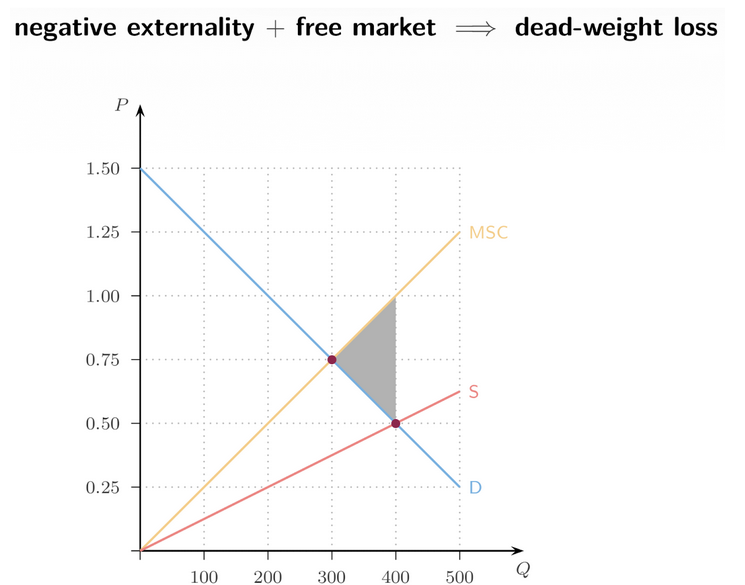
<p><span style="background-color: transparent; font-family: &quot;Times New Roman&quot;, serif;"><strong><span>Competitive Equilibrium (Slide 20)</span></strong></span></p><p><span style="background-color: transparent; font-family: &quot;Times New Roman&quot;, serif;"><span>The market produces where: </span><strong><span>D intersects ___ (private supply)<br></span></strong><span> → Overproduction</span></span></p>

Competitive Equilibrium (Slide 20)

The market produces where: D intersects ___ (private supply)
→ Overproduction

MC
12
New cards
<p><span style="background-color: transparent; font-family: &quot;Times New Roman&quot;, serif;"><strong><span>Negative Externality Summary</span></strong></span></p><p><span style="background-color: transparent; font-family: &quot;Times New Roman&quot;, serif;"><span>Free market results in:</span></span></p><ol><li><p><span style="background-color: transparent; font-family: &quot;Times New Roman&quot;, serif;"><strong><span>___</span></strong></span></p></li><li><p><span style="background-color: transparent; font-family: &quot;Times New Roman&quot;, serif;"><strong><span>Too ___ a price</span></strong></span></p></li><li><p><span style="background-color: transparent; font-family: &quot;Times New Roman&quot;, serif;"><strong><span>___</span></strong></span></p></li></ol><p></p>

Negative Externality Summary

Free market results in:

  1. ___

  2. Too ___ a price

  3. ___

overproduction, low, DWL

13
New cards
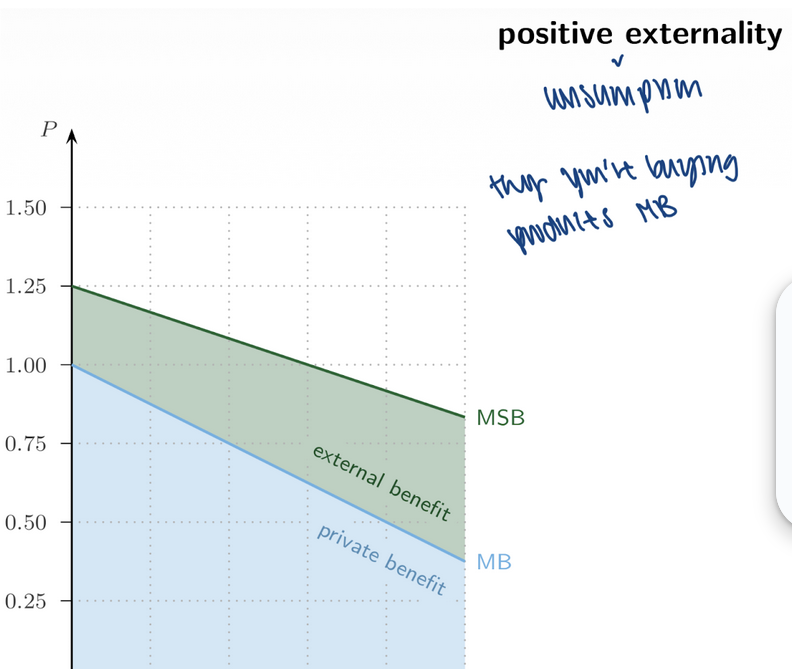
<p><span style="background-color: transparent; font-family: &quot;Times New Roman&quot;, serif;"><span>Graph: Deadweight Loss (Slide 22)</span></span></p><p><span style="background-color: transparent; font-family: &quot;Times New Roman&quot;, serif;"><span>DWL = triangular area between:</span></span></p><ul><li><p><span style="background-color: transparent; font-family: &quot;Times New Roman&quot;, serif;"><span>__&nbsp;</span></span></p></li><li><p><span style="background-color: transparent; font-family: &quot;Times New Roman&quot;, serif;"><span>__</span></span></p></li><li><p><span style="background-color: transparent; font-family: &quot;Times New Roman&quot;, serif;"><span>__<br>between the efficient Q and the market Q.</span></span></p></li></ul><p></p>

Graph: Deadweight Loss (Slide 22)

DWL = triangular area between:

  • __ 

  • __

  • __
    between the efficient Q and the market Q.

MSC, MC, Demand
14
New cards
<p><span style="background-color: transparent; font-family: &quot;Times New Roman&quot;, serif;"><strong><span>6. Positive Externalities (Slides 23–27)</span></strong></span></p><ul><li><p><span style="background-color: transparent; font-family: &quot;Times New Roman&quot;, serif;"><span>Education</span></span></p></li><li><p><span style="background-color: transparent; font-family: &quot;Times New Roman&quot;, serif;"><span>Vaccinations</span></span></p></li><li><p><span style="background-color: transparent; font-family: &quot;Times New Roman&quot;, serif;"><span>R&amp;D</span></span></p></li><li><p><span style="background-color: transparent; font-family: &quot;Times New Roman&quot;, serif;"><span>Public __</span></span></p></li><li><p><span style="background-color: transparent; font-family: &quot;Times New Roman&quot;, serif;"><span>Well-maintained lawns</span></span></p></li></ul><p></p>

6. Positive Externalities (Slides 23–27)

  • Education

  • Vaccinations

  • R&D

  • Public __

  • Well-maintained lawns

art

15
New cards
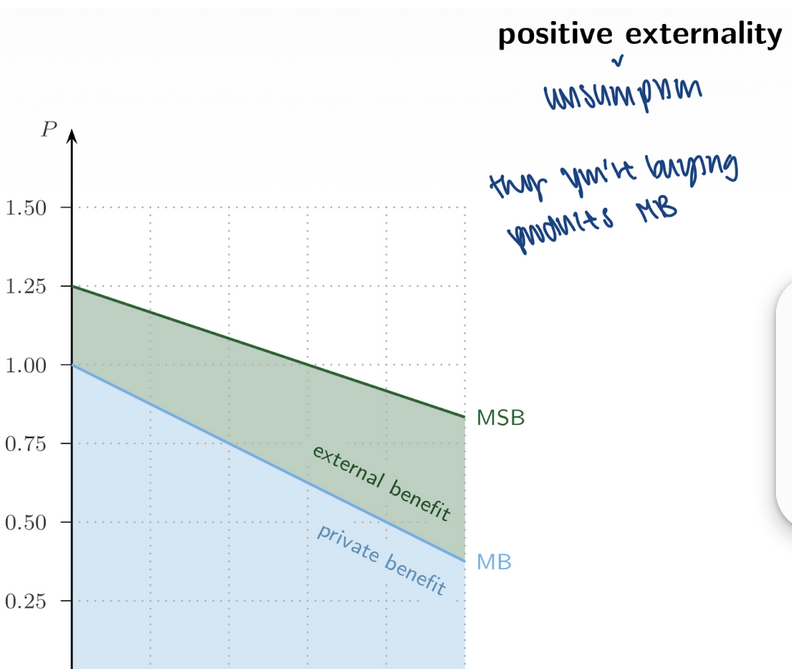
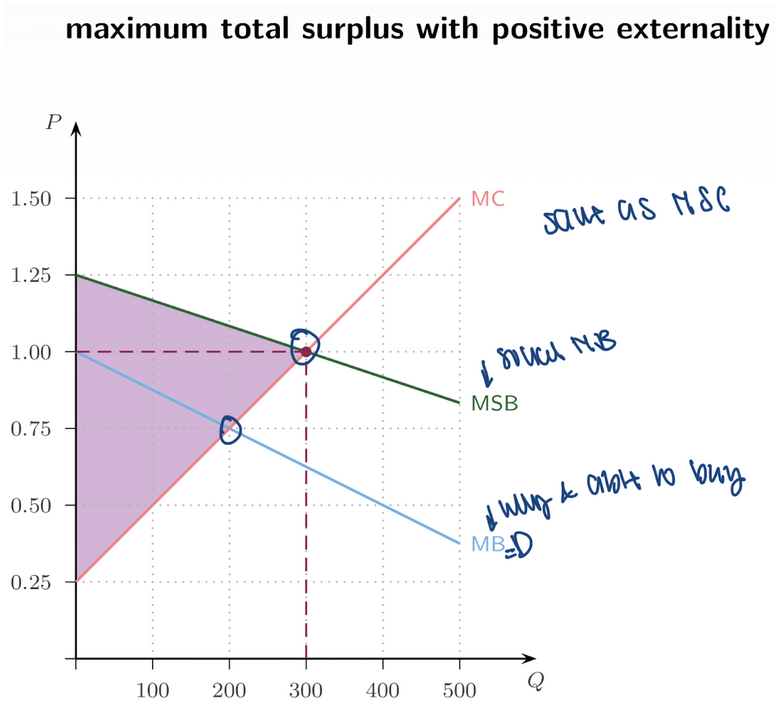
<p><span style="background-color: transparent; font-family: &quot;Times New Roman&quot;, serif;"><strong><span>Graph: Positive Externality (Slide 23)&nbsp;</span></strong></span></p><p><span style="background-color: transparent; font-family: &quot;Times New Roman&quot;, serif;"><span>Curves:</span></span></p><ul><li><p><span style="background-color: transparent; font-family: &quot;Times New Roman&quot;, serif;"><strong><span>MB (private benefit)</span></strong><span> = demand curve</span></span></p></li><li><p><span style="background-color: transparent; font-family: &quot;Times New Roman&quot;, serif;"><strong><span>MSB (social benefit)</span></strong><span> = MB + external benefit<br>→ lies </span><em><span>above</span></em><span> MB</span></span></p></li></ul><p><span style="background-color: transparent; font-family: &quot;Times New Roman&quot;, serif;"><span>Distance between MSB &amp; ___ = </span><strong><span>MEB (external benefit)</span></strong></span></p>

Graph: Positive Externality (Slide 23) 

Curves:

  • MB (private benefit) = demand curve

  • MSB (social benefit) = MB + external benefit
    → lies
    above MB

Distance between MSB & ___ = MEB (external benefit)

MB
16
New cards
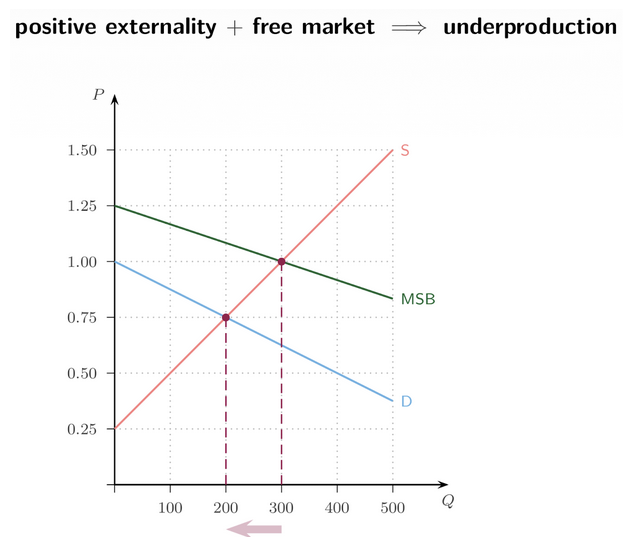
<p><span style="background-color: transparent; font-family: &quot;Times New Roman&quot;, serif;"><strong><span>Efficient Outcome (Slide 24)&nbsp;</span></strong></span></p><p><span style="background-color: transparent; font-family: &quot;Times New Roman&quot;, serif;"><span>Efficient Q = intersection of: </span><strong><span> ____and </span></strong><span>___</span></span></p><p><span style="background-color: transparent; font-family: &quot;Times New Roman&quot;, serif;"><strong><span>Market Outcome (Slide 25)</span></strong></span></p><p><span style="background-color: transparent; font-family: &quot;Times New Roman&quot;, serif;"><span>Market chooses: </span><strong><span>___ intersects ___</span></strong></span></p><p><span style="background-color: transparent; font-family: &quot;Times New Roman&quot;, serif;"><span>→ </span><strong><span>__</span></strong></span></p>

Efficient Outcome (Slide 24) 

Efficient Q = intersection of: ____and ___

Market Outcome (Slide 25)

Market chooses: ___ intersects ___

__

MSB, MC, MB, MC underproduction

17
New cards
<p><span style="background-color: transparent; font-family: &quot;Times New Roman&quot;, serif;"><strong><span>Market Outcome (Slide 25)</span></strong></span></p><p><span style="background-color: transparent; font-family: &quot;Times New Roman&quot;, serif;"><span>Market chooses: __</span><strong><span> intersects </span></strong><span>__</span></span></p><p><span style="background-color: transparent; font-family: &quot;Times New Roman&quot;, serif;"><span>→ </span><strong><span>__</span></strong></span></p>

Market Outcome (Slide 25)

Market chooses: __ intersects __

__

MB, MC, underproduction

18
New cards
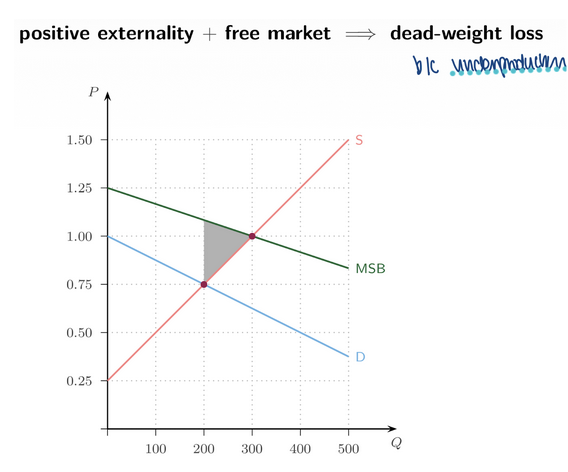
<p><span style="background-color: transparent; font-family: &quot;Times New Roman&quot;, serif;"><strong><span>Positive __ Summary</span></strong></span></p><p><span style="background-color: transparent; font-family: &quot;Times New Roman&quot;, serif;"><span>Free market results in:</span></span></p><ul><li><p><span style="background-color: transparent; font-family: &quot;Times New Roman&quot;, serif;"><strong><span>Underproduction</span></strong></span></p></li><li><p><span style="background-color: transparent; font-family: &quot;Times New Roman&quot;, serif;"><strong><span>Too low a quantity</span></strong></span></p></li></ul><p><span style="background-color: transparent; font-family: &quot;Times New Roman&quot;, serif;"><strong><span>Deadweight loss<br></span></strong><span> (DWL between MSB &amp; MB between the two quantities)</span></span></p>

Positive __ Summary

Free market results in:

  • Underproduction

  • Too low a quantity

Deadweight loss
(DWL between MSB & MB between the two quantities)

externality

19
New cards

7. Why Markets Fail with Externalities

Competitive markets are efficient only if:

  • Every person is an ___ decisionmaker

  • No unintended ___ exist

But: In almost all real-world activities, externalities exist
→ Therefore,
policy interventions can improve efficiency.

isolated, spillovers

20
New cards

8. Controlling Pollution (Slides 29–30)

Three major policy approaches:

1. Price Controls (bag fees)

  • Toronto considering $2 fee on plastic bags

  • Federal ban on single-use plastics (ongoing legal battle)

Effect: Raising price reduces __ = lower pollution.

QD

21
New cards

8. Controlling Pollution (Slides 29–30)

Three major policy approaches:

2. Quantity Controls (Quotas / Cap-and-Trade)

  • Canada drafting national cap-and-trade

  • Systems in: Quebec, California, EU, China

Mechanism:

  • Government sets a cap on total emissions

  • Firms receive or buy ___

  • They can trade permits → ensures ___ reduction.

permits, least-cost

22
New cards

8. Controlling Pollution (Slides 29–30)

Three major policy approaches:

3. Pigouvian Taxes (___ Taxes)

Canada:

  • Federal carbon tax + ___ since 2019

  • BC + Quebec have provincial systems

  • Canada reached peak emissions in 2023

Purpose: Make firms/consumers pay the full ___ cost.

carbon, rebates, social
23
New cards
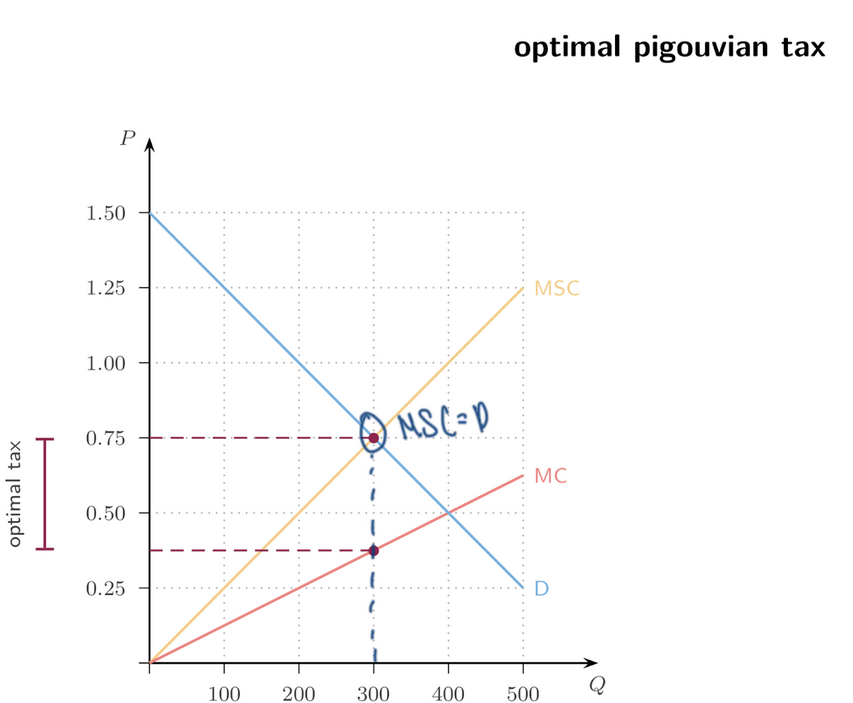
<p><span style="background-color: transparent; font-family: &quot;Times New Roman&quot;, serif;"><strong><span>9. Pigouvian Taxes (Slides 33–35)</span></strong></span></p><p><span style="font-family: &quot;Times New Roman&quot;, serif;"><strong><span>A Pigouvian tax is a tax set equal to the marginal external cost (MEC).</span></strong></span></p><p><span style="font-family: &quot;Times New Roman&quot;, serif;"><strong><span>T = ____</span></strong></span></p><p><span style="background-color: transparent; font-family: &quot;Times New Roman&quot;, serif;"><span>Effect on price:</span></span></p><p><span style="font-family: &quot;Times New Roman&quot;, serif;"><span>Price consumers pay becomes: </span><strong><span>___ + ___ = ____ + MEC = </span></strong><span>MSC</span></span></p><ul><li><p><span style="font-family: &quot;Times New Roman&quot;, serif;"><span>The tax </span><strong><span>internalizes</span></strong><span> the external cost</span></span></p></li><li><p><span style="font-family: &quot;Times New Roman&quot;, serif;"><span>Market outcome becomes </span><strong><span>efficient</span></strong><span> again.</span></span></p></li></ul><p><span style="background-color: transparent; font-family: &quot;Times New Roman&quot;, serif;"><span>Assumptions (important for exams):</span></span></p><p><span style="background-color: transparent; font-family: &quot;Times New Roman&quot;, serif;"><span>Government must be able to:</span></span></p><ol><li><p><span style="background-color: transparent; font-family: &quot;Times New Roman&quot;, serif;"><span>Accurately measure __</span></span></p></li><li><p><span style="background-color: transparent; font-family: &quot;Times New Roman&quot;, serif;"><span>Have correct incentives (not use tax as cash grab)</span></span></p></li></ol><p></p>

9. Pigouvian Taxes (Slides 33–35)

A Pigouvian tax is a tax set equal to the marginal external cost (MEC).

T = ____

Effect on price:

Price consumers pay becomes: ___ + ___ = ____ + MEC = MSC

  • The tax internalizes the external cost

  • Market outcome becomes efficient again.

Assumptions (important for exams):

Government must be able to:

  1. Accurately measure __

  2. Have correct incentives (not use tax as cash grab)

MEC, P + T, MC, MEC
24
New cards
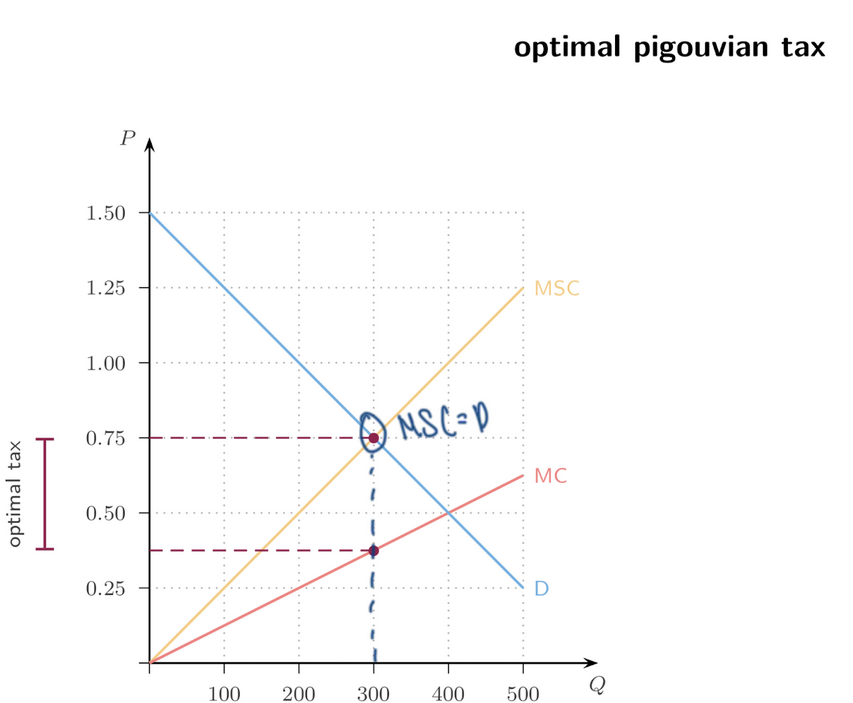
<p><span style="font-family: &quot;Times New Roman&quot;, serif;"><strong><span>Graph: Optimal Pigouvian Tax (Slide 34)&nbsp;</span></strong></span></p><p><span style="font-family: &quot;Times New Roman&quot;, serif;"><span>Curves:</span></span></p><ul><li><p><span style="font-family: &quot;Times New Roman&quot;, serif;"><span>MC = private supply</span></span></p></li><li><p><span style="font-family: &quot;Times New Roman&quot;, serif;"><span>MSC = MC</span><strong><span> + </span></strong><span>__</span></span></p></li><li><p><span style="font-family: &quot;Times New Roman&quot;, serif;"><span>Demand</span></span></p></li></ul><p><span style="font-family: &quot;Times New Roman&quot;, serif;"><span>The tax vertically shifts supply upward until: </span><strong><span>New supply intersects demand at the efficient quantity</span></strong></span></p>

Graph: Optimal Pigouvian Tax (Slide 34) 

Curves:

  • MC = private supply

  • MSC = MC + __

  • Demand

The tax vertically shifts supply upward until: New supply intersects demand at the efficient quantity

tax

25
New cards
<p><span style="background-color: transparent; font-family: &quot;Times New Roman&quot;, serif;"><strong><span>Graph: Efficiency Restored (Slide 35)</span></strong></span></p><ul><li><p><span style="background-color: transparent; font-family: &quot;Times New Roman&quot;, serif;"><span>New supply = </span><strong><span>supply + </span></strong><span>tax</span></span></p></li><li><p><span style="background-color: transparent; font-family: &quot;Times New Roman&quot;, serif;"><span>Intersection with __ = efficient Q</span></span></p></li><li><p><span style="background-color: transparent; font-family: &quot;Times New Roman&quot;, serif;"><span>No deadweight loss → maximized total surplus</span></span></p></li></ul><p></p>

Graph: Efficiency Restored (Slide 35)

  • New supply = supply + tax

  • Intersection with __ = efficient Q

  • No deadweight loss → maximized total surplus

demand

26
New cards

10. Are Carbon Taxes Good? (Slide 36)

Benefits

  • Increase ___

  • Increase efficiency

  • Reduce pollution

Political skepticism

  • People perceive it as a “cash grab”

  • Public concern: ___

  • Despite rebates where 70–90% of households get back more than they pay.

Economist consensus

Large majority support carbon pricing:

  • Canadian open letter

  • American open letter

  • Global expert surveys

revenue, inflation

27
New cards

11. Producing Knowledge (Slides 37–39)

Knowledge production has positive externalities, so markets underproduce it.

Policies to promote knowledge:

1. Public __

  • Public universities (including Western University)

Western’s revenue:

  • 54% tuition

  • 33% government

  • 13% other sources

provision

28
New cards

11. Producing Knowledge (Slides 37–39)

Knowledge production has positive externalities, so markets underproduce it.

Policies to promote knowledge:

2. Subsidies / Vouchers

  • Work like negative Pigouvian taxes

  • Reduce the price to consumers

  • Vouchers = more consumer ___

  • Provinces offering vouchers: AB, QC, MB, SK (some extent)

choice

29
New cards

11. Producing Knowledge (Slides 37–39)

Knowledge production has positive externalities, so markets underproduce it.

Policies to promote knowledge:

3. Intellectual Property Rights

  • Patents

  • Copyrights

  • ___

These give creators temporary ___ profits → incentive to __.

trademark, monopoly, innovate

30
New cards

12. Coase and Transaction Costs (Slides 40–42)

Coase (1988) Quote - Markets exist to reduce ___ costs.

Coase’s Theory of the Firm

Why do some transactions occur ___ firms instead of in markets?

Because of:

  • Search __

  • __ frictions

  • Incomplete contracts

  • Contract enforcement problems

  • Misaligned ___

Firms exist to reduce these costs.

transaction, inside, frictions, information, incentives

31
New cards

Property Rights & Externalities

Assigning property rights can ___ externalities.

  • Patent owners can license ___

  • River owner can sell pollution ___

  • Knowledge creators earn ___ profits

Effectiveness depends on:

  • __ costs

  • ___ costs

Sometimes:

  • Private regulators work best

  • Sometimes government is needed

internalize, innovations, rights, monopoly, enforcement, transaction

32
New cards

13. Public Goods (Slides 44–46)

  1. Rival vs Nonrival

  2. Excludable vs Nonexcludable

Rival good - Consumption by one person reduces ___ for others.

  • Food

  • Fish in a river

  • Underground __

Nonrival good - One person’s consumption ___ reduce availability.

  • __

  • Streaming services

  • Pathways

availability, water, doesn’t, knowledge

33
New cards

Excludable good - ___ to prevent someone from using it (through ___ or access).

  • ___

  • Concert ticket (ERA’s tour)

Nonexcludable good - Cannot prevent ___ from using it.

  • Public ___

  • Clean air

  • __

  • Law enforcement

  • Carbon capture

possible, price, house, nonpayers, parks, firefighters

34
New cards

Public Goods Grid (Slide 46)

Rival

Nonrival

Excludable

House, food

ERA’s Tour (___)

Nonexcludable

Fish in rivers, water

Firefighters, law, carbon capture, pathway, social media

Key idea: Public goods → nonrival + nonexcludable → free rider problem → underprovided by market.

concert

35
New cards

Externalities

  • MEC, MEB

  • MSC = MC + MEC

  • MSB = MB + MEB

Negative Externalities

  • ___

  • price too low

  • DWL on __ side

overproduction, right

36
New cards

Positive Externalities

  • Underproduction

  • Price too low

  • DWL on ___ side

Pigouvian Tax

  • T = ___

  • Makes MC → MSC

  • Eliminates __

Cap-and-Trade

  • Fixed quantity

  • ___ permits

  • Achieves efficient allocation

left, MEC, DWL, tradable

37
New cards

Public Goods

  • Nonrival + nonexcludable

  • Free rider problem

  • Underprovided by markets

__ Theory

  • Property rights internalize externalities

  • Works best when transaction costs low

coase