coordinate geometry and trig identities
 Call Kai
 Learn
Learn Practice Test
 Spaced Repetition
 Match
Match Flashcards
 Knowt Play
1/18

There's no tags or description
Looks like no tags are added yet.
Name | Mastery | Learn | Test | Matching | Spaced | Call with Kai |
|---|
No analytics yet
Send a link to your students to track their progress
19 Terms
what is the 3d and 2d equation for a circle
(x-a)^2+(y-b)^2+(z-c)^2=r^2
(x-a)^2+(y-b)^2=r^2
converting degrees to radians
\frac{180}{\pi}*radians = degrees
\frac{\pi}{180}*degrees=radians
what are polar coordinates
→ how is it written
describes position using an angle \theta anticlockwise and a distance r from a center point
(r,\theta)
what are cartesian coordinates
describes position using XYZ values
how do you convert from cartesian ←→ polar coordinate
cartesian → polar
r=\sqrt{x^2+y^2}
\theta=tan^-1 (\frac{y}{x})
polar → cartesian
x= r~cos(\theta)
y=r~sin(\theta)
what are cylindrical coordinates
→ how is it written
describes a 3D position using:
anticlockwise angle from an origin: \theta~or~\varphi
radius r or \rho
height: z
(r,\theta,z) or (\rho,\varphi,z)
cartesian ←→ cylindrical
cartesian → cylindrical:
r=\sqrt{x^2+y^2}
\theta=tan^-1 (\frac{y}{x})
Z = Z
cylindrical → cartesian:
x= r~cos(\theta)
y=r~sin(\theta)
Z = Z
what are spherical coordinates?
describes a 3D position depending on:
radius: r
zenith/elevation angle: \theta
azimuthal angle (flat ange): \varphi
(r,\theta,\varphi)
cartesian ←→ spherical
cartesian → polar
r=\sqrt{x^2+y^2+z^2}
\theta=cos^{-1}(\frac{z}{r})
\varphi=tan^{-1}(\frac{y}{x})
spherical → cartesian
z=r~cos(\theta)
x=r~sin(\theta)cos(\varphi)
y=r~sin(\theta)sin(\varphi)
what is a solid angle?
→ how is it calculated
→ what are the units?
solid~angle (\Omega) =\frac{surface~area~of~object}{radius~of~unit~sphere^2} REMEMBER THE UNIT CIRCULE RADIUS IS SQUARED
→ measured in steradians
what are the assumptions when calculating unit circle
the object you are observing can be considered as a circle of which you can calculate the surface area of (
you are standing at the center of the unit circle (apex)
what it tan
\frac{sin}{cos}
what are sec, csc, and cot
sec=\frac{1}{cos} csc=\frac{1}{sin} cot=\frac{1}{tan} = \frac{cos}{sin}
what are the power of trig identities
cos^2(x)+sin^2(x)=1
sec^2=1+tan^2(x)
csc^2=cot^2+1
these are based on pythagorea’s theoremw
what are the double angle trig identities
sin(2X)=2(cos(X)sin(X))
cos(2x) = cos^2(x)-sin^2(X) = 2cos^2(x)-1 = 1-2sin^2(x)
tan(2x)=\frac{2tan(x)}{1-tan²(X)}
half-angle trig formulas
sin(\frac{x}{2})=\pm\sqrt{\frac{1-cos(x)}{2}}
\cos(\frac{x}{2})=\pm\sqrt{\frac{1+cos(x)}{2}}
\tan(\frac{x}{2})=\pm\frac{1-cos(x)}{\sin\left(x\right)}
sum and differences
sin(a\pm b)=sin(a)cos(b)\pm cos(A)sin(b)
\cos(a\pm b)=\cos(a)cos(b)\pm\sin(A)sin(b)
tan(a\pm b)=\frac{tan(A)\pm tan(b)}{1\pm tan(A)tan(B)}
product to sum
sin(A)sin(b)=\frac{1}{2} (cos(a-b)-cos(a+b))
\cos(A)\cos(b)=\frac{1}{2}(cos(a-b)+cos(a+b))
\sin\left(A)\cos(b\right)=\frac{1}{2}(\sin(a+b)+\sin(a-b))
\cos(A)sin(b)=\frac{1}{2}(\sin(a+b)-\sin(a-b))
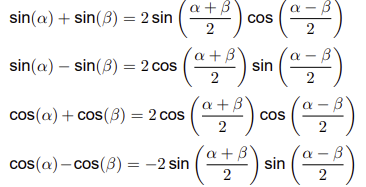
sum to product