Critical Thinking Skills and Logical Reasoning Principles
 Call Kai
 Learn
Learn Practice Test
 Spaced Repetition
 Match
Match Flashcards
 Knowt Play
1/53

There's no tags or description
Looks like no tags are added yet.
Name | Mastery | Learn | Test | Matching | Spaced | Call with Kai |
|---|
No analytics yet
Send a link to your students to track their progress
54 Terms
What is the goal of the course on logical reasoning?
To improve logical reasoning skills, also known as critical thinking skills.
Define critical thinking.
Critical thinking is thinking clearly and intelligently.
List some abilities involved in critical thinking.
Getting someone's point, generating reasons for your own point, evaluating reasons given by others, deciding what to do, deciding what information to accept or reject, explaining complicated ideas, applying quality control in thinking, and resisting propaganda.
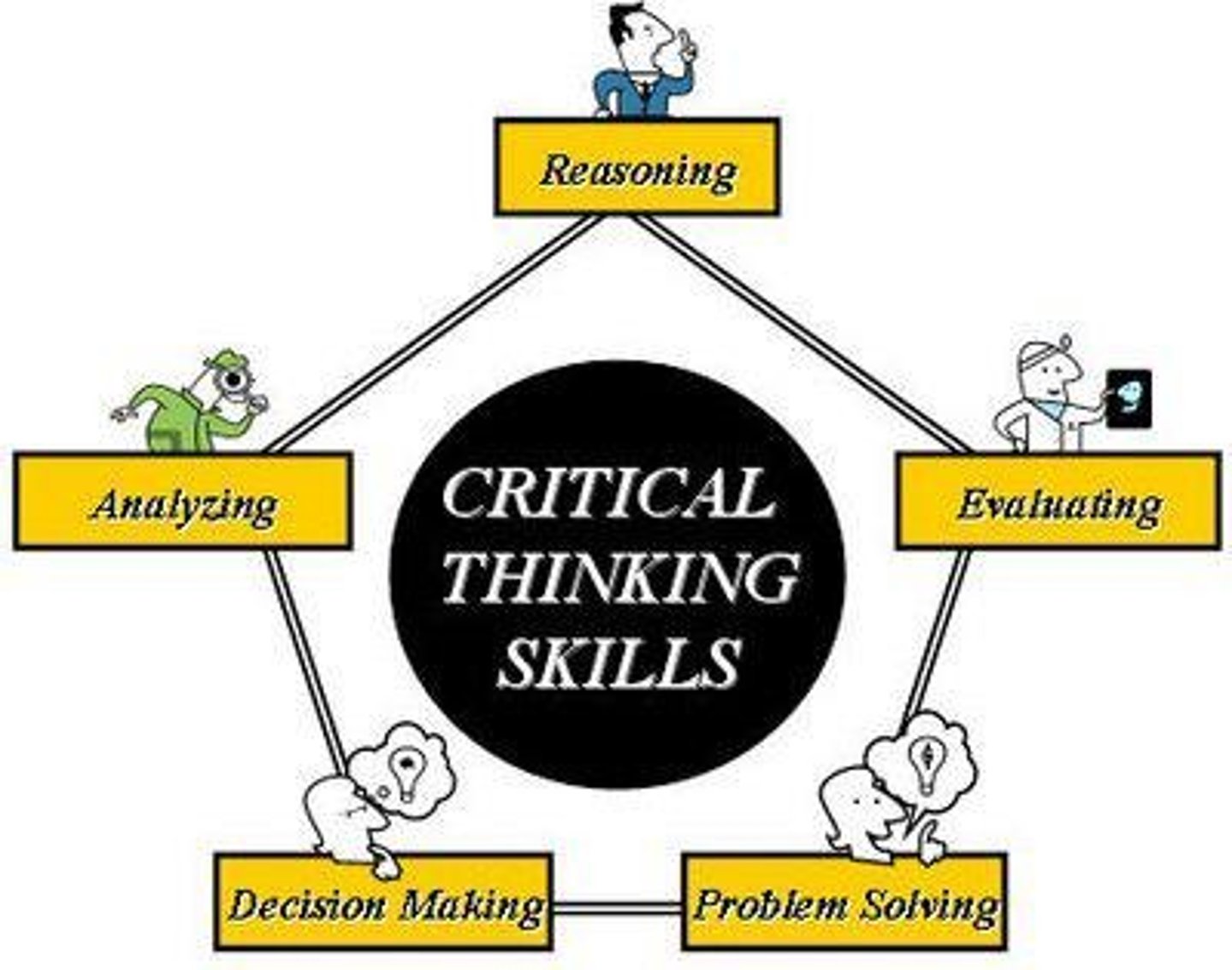
What are the main focuses of the course?
Writing skills, detecting inconsistencies, spotting issues and arguments, avoiding fallacies, and generating and improving arguments.
What is the most important critical thinking skill?
The ability to make judgments that require careful reasoning.
What is an example of poor logical reasoning?
Searching for 'Gorilla' in the telephone book instead of using the Internet for a gorilla suit.
What are the critical thinking standards?
Clarity, precision, accuracy, relevance, consistency, logical correctness, completeness, and fairness.
What does clarity in critical thinking entail?
Striving for clarity of language and maximum clarity of thought.
Why is precision important in critical thinking?
It ensures precise answers to precise questions, especially in specialized fields.
What is the difference between logical and practical inconsistency?
Logical inconsistency involves holding beliefs that cannot all be true, while practical inconsistency involves saying one thing and doing another.
What does it mean to think logically?
To reason correctly and draw well-founded conclusions from beliefs.
What is required for complete thinking?
Thinking should be deep rather than shallow and thorough rather than superficial.
What is the principle behind giving reasons for conclusions?
If you expect acceptance of your conclusion, you must provide reasons that others can appreciate.
Define an argument in logical reasoning.
An argument is a conclusion (claim) backed up by one or more reasons (premises).
What should you consider when assessing pros and cons?
Possible courses of action, consequences of those actions, and the probabilities of those consequences occurring.
What is the impact of time pressure on decision-making?
Under time pressure, it may be more rational to act on intuitions or gut instincts.
What does it mean to be a flexible thinker?
Being able to adapt thinking processes and make quick decisions when necessary.
What principle of logical reasoning is violated if one takes statements too literally?
The principle that reasons should be tailored to the audience.
What is the significance of background knowledge in drawing conclusions?
It helps in evaluating the validity of arguments and claims.
What is required for extraordinary claims?
Extraordinary claims require extraordinarily good evidence to be considered logical.
What should be avoided in logical reasoning?
Being stubborn or dogmatic by holding strong beliefs based on flimsy reasons.
What is the purpose of the concept check questions in the course?
To assess understanding of logical reasoning principles and identify arguments.
What is the formula for an argument?
Argument = Claim (conclusion) + Reasons (premises).
What does fairness in critical thinking require?
Thinking that is open-minded, impartial, and free of biases.
What is the role of evaluating consequences in logical reasoning?
It helps in making informed decisions based on potential outcomes.
What should logical reasoners do when time is limited?
They should recognize the need to make quick decisions and may rely on trusted sources.
What is the importance of clarity in critical thinking?
It ensures that both language and thought are easily understood.
What is the best basis for making decisions according to logical reasoning?
Decisions should be based on facts.
How can we distinguish facts from opinions?
A fact is a truth that does not change based on acceptance.
What is inconsistency in reasoning?
Statements are inconsistent if they conflict, implying that at least one must be false.
What is the first step in problem-solving?
Define the problem clearly and succinctly.
What should you do after defining the problem?
Research and investigate to gather relevant information.
What is the purpose of identifying pathways in problem-solving?
To determine multiple specific pathways available for solving the problem.
What is the fourth step in the problem-solving process?
Select a solution by critically assessing its potential effectiveness.
What comes after implementing a solution?
Evaluate the solution to see how well it worked.
What should you do if the implemented solution was not effective?
Revise the solution based on the evaluation.
What is egocentrism in critical thinking?
The tendency to see reality as centered on oneself, hindering rational thinking.
What is sociocentrism?
The tendency to see reality as centered on the group, which can hinder rational thinking.
What are unwarranted assumptions?
Beliefs taken for granted without proof or conclusive evidence.
What is relativistic thinking?
The view that truth is a matter of opinion, including subjectivism and cultural relativism.
What is moral relativism?
The belief that moral truth is determined by individual or cultural beliefs.
What is wishful thinking?
Believing something without good evidence because one wishes it to be true.
What is the significance of Alex's problem in the practice problem?
Alex must balance academic responsibilities with financial obligations.
What could be a consequence of Alex missing the presentation?
Missing the presentation could result in a zero for that part of the final grade.
What is the role of peer pressure in critical thinking?
Peer pressure can act as a barrier to critical thinking by influencing decisions uncritically.
What is the definition of bias in critical thinking?
A tendency to favor one perspective over another, affecting objectivity.
What is the impact of poor reading skills on critical thinking?
Poor reading skills can hinder the ability to analyze and understand information effectively.
What does the term 'scapegoating' refer to?
Blaming an innocent party for problems, which can obstruct critical thinking.
What is the definition of rationalization?
Inventing excuses to avoid facing real motives.
What is the importance of evaluating a solution in problem-solving?
It helps determine the effectiveness of the solution and informs future revisions.
What is the significance of consistency in reasoning?
Being consistent helps avoid contradictions and strengthens arguments.
What does 'face-saving' mean in the context of critical thinking?
Maintaining a good self-image, which can hinder honest evaluation of one's beliefs.
How does selective perception act as a barrier to critical thinking?
It leads individuals to notice only information that supports their existing beliefs.
What is the role of emotions in critical thinking?
Overpowering emotions can cloud judgment and hinder rational decision-making.

