7B- Channels and transporters
 Studied by 0 people
 Call Kai
 Learn
Learn Practice Test
 Spaced Repetition
 Match
Match Flashcards
 Knowt Play
1/27

There's no tags or description
Looks like no tags are added yet.
Name | Mastery | Learn | Test | Matching | Spaced | Call with Kai |
|---|
No analytics yet
Send a link to your students to track their progress
28 Terms
generally it is slightly more ( ) inside of the cell due to ( )
negative
nucleic acids & metabolites & ions
look at slide 5
bruh
pure ( ) serve as barriers for large and/or charged molecules
phospholipid bilayers
Why is it important for cells to restrict movement in and out?
-Control activities/functions
-enhance binding n certain areas of the cell
-organization/grouping of proteins for a specific function
and prevent activities that are detrimental
-proper signaling
-causes polarity of cells
proteins in membranes ( ) molecules across the membrane- many span the membrane, they are called what?
transport
trans-membrane proteins
Impermeable molecules are moved using ( ) , which are often proteins complexes- often ( )
transporters or channels
multimers
look at slide 9
okayyyy
transporters/carriers requires ( ) for each molecule passing through
conformational change
channels, once open, molecules can ( ), no further conformational change is needed
pass through
both transporters/carriers and cannels are ( )
selective
transporters can be one of three types, what are they?
uniporter
symporter
antiporter
( )- moves just molecule to be transported
( )- moves molecule to be transported ALONG with co-transported molecule in SAME direction
( )- moves molecule to be transported ALONG with another molecule in opposite directions
uniporter
symporter
antiporter
Passive transporter- moves solutes with/down their ( ) and this does not require ( )
concentration gradient
energy
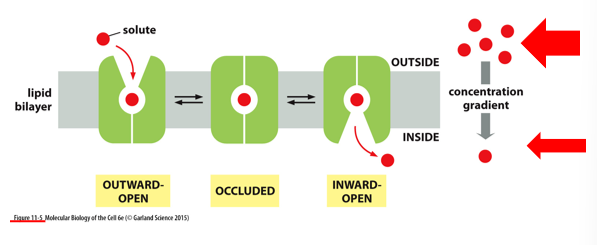
model for how ( ) in transporter could ( )
conformation change
mediate passive movement of solute
There are 2 ways ions or molecules are moved across the membrane:
( )- does not require energy, because movement is ( ) concentration gradient
( )- requires energy, because movement is ( ) concentration gradient
passive transport
down/with
active transport
up/against
active transporter- moves ( ) up/against their concentration gradient
solutes (simple ions or molecules-which can be ions too)
Active transport requires energy from one of 3 sources, what are they?
1) co-transport/ coupled transport- down a gradient- can be antiport or symport
2) often ATP is used
3) light energy also used
Na+/K+ATPase is an ( ), consumes ~ ( ) of resting cell’s ATP, pumps ( ) out and ( ) into cell, both ( )
active antiporter
60
Na+
K+
AGAINST concentration gradient
Often active transport across the plasms membrane is “coupled” to ( ) gradient, to move glucose against its ( ), energy comes from movement of ( ) down/with a concentration gradient (symport here)
Na+
concentration gradient
Na+
look at slide 17-18
okay
Trans-cellular (across the cell) transport of glucose in intestines:
-active, ( ) transport to get glucose into ( )
-passive transport to get glucose from intestinal epithelium cell to ( )
symport
intestinal epithelium cells
extracellular fluid
Ion channels passively allow rapid ( ) of ( ) down their concentration gradient, but this is usually controlled by a “( )“
diffusion
ions
gate
some channels are gated, gates open due to what changes and what is the name of the gate?
voltage-gated: voltage changes
ligand-gated (extracellular ligand): ligand binds outside
ligand-gated (intracellular ligand): ligand binds inside
mechanically gated: mechanical deformation of membrane
Voltage-gated Na+ channels are responsible for ( ) in ( ), when open, ( ) due to opening channels and ion movement.
action potentials
nerves
polarity switches
look at slide 28-30
okayyy
( ) act at neuromuscular junctions to control ( )
acetylcholine-gated (so ligand-gated) cation channel
(so both a ligand-gated ion channel and ion-channel-coupled receptor)
control muscle contractions
( ) at the neuromuscular junctions to control ( )
many events
muscle contraction
( ) cation channels act at neuromuscular junctions to control muscle contraction
Acetylcholine-gated (ACh-gated- so ligand gated)
 Note
Note  Flashcards (20)