general patient care
 Call Kai
 Learn
Learn Practice Test
 Spaced Repetition
 Match
Match Flashcards
 Knowt Play
1/52

There's no tags or description
Looks like no tags are added yet.
Name | Mastery | Learn | Test | Matching | Spaced | Call with Kai |
|---|
No analytics yet
Send a link to your students to track their progress
53 Terms
pregnancy testing
Urine or blood is screened for the presence of human chorionic gonadotropin (hCG) antibodies
hCG is a Hormone secreted by the placenta during pregnancy.
a urine sample is obtained to evaluate for the presence of hCG.
Rapid Streptococcus Testing
Throat swabs are obtained to screen for group A streptococcus. Both sides of the posterior throat/tonsil area are swabbed and tested for the presence of the group A antigen.
Dipstick, Tablet, or Multi-Stick Urinalysis
The urinalysis is a screening tool for analytes that are excreted in the urine. The urine sample is performed and tested with a reagent strip.
Analytes - A substance or chemical that is being identified and measured.
glucometer
Whole blood is analyzed for a quantitative glucose level and is a screening test for diabetes, performed using capillary blood from a fingerstick.
Hemoglobin A1C
This capillary blood test determines the approximate control of blood glucose levels over a 3-month period.
Cholesterol Testing
Lipids are evaluated from a capillary blood sample. The sample is placed on a reagent strip and analyzed in a cholesterol testing machine.
Helicobacter Pylori
A whole blood sample can screen for the presence of H. pylori antibodies.
Mononucleosis Screening
This screening tool tests for the presence of the Epstein-Barr virus in a capillary blood sample.
Nasopharyngeal Swab Specimen for Influenza Types A and B
This screening is a qualitative test for multiple influenza antigens using a swab that is inserted into the nostril to obtain the sample specimen.
Drug Testing
Substances such as recreational drugs and medications can be detected in urine and blood samples.
Fecal Occult Blood
This test is performed to screen for hidden blood in the stool. This test is performed with a fecal occult blood testing kit using the patient’s stool specimen.
CLIA-waived testing
most common designation for ambulatory care and is the lowest level of complexity
could be performed in the home environment or easily conducted in the medical office with minimal risk of incorrect results. They pose no reasonable risk of harm to the patient if the tests are performed incorrectly.
Nonwaived tests
Moderate- and high-complexity tests
must have a CLIA certificate and undergo inspections to ensure standards are being met. These tests are typically performed in a reference or hospital laboratory.
quality control
Action is performed to ensure the reliability of test results by detecting and eliminating error.
quality assurance
Maintenance of a desired level of quality related to a service or piece of equipment.
Hemoglobin Normal values
Male: 14 to 18 g/dL
Female: 12 to 16 g/dL
Hematocrit (HCT) normal values
Male: 42% to 50%
Female: 37% to 47%
Complete Blood Count (CBC)
White blood cell count | 4,000 to 11,000/mm3 |
Red blood cell count | 4.2 to 5.9 million/µL |
Platelet count | 150,000 to 450,000/mm3 |
Granulocyte ratio | 50% to 70% (of all white blood cells) |
Hgb | (See above) |
Hct | (See above) |
MCV | A value score of 80 to 98fL |
glucose normal range
70 to 99 mg/dL (fasting)
Hemoglobin A1C normal range
4 to 5.6%
Cholesterol
Cholesterol Panel/Lipid Profile normal range
Total Cholesterol | Less than 200 mg/dL |
LDL | Less than 100 mg/dL |
HDL | Males: Greater than 40 mg/dL Females: Greater than 50 mg/dL |
Triglycerides | Less than 150 mg/dL |
surgical asepsis
Techniques to eliminate pathogenic and other potentially harmful microbes related to invasive procedures.
biopsy
The surgical removal of tissue for later microscopic examination.
Removal of a foreign object
Surgical removal of an object, such as a small splinter, or a larger object, such as a piece of wood or metal that is embedded in tissue. Splinter forceps are commonly used with this procedure.
Endoscopy
Procedure that uses an endoscope to view a hollow organ or body cavity, such as the larynx, bladder, colon, sigmoid colon, stomach, abdomen, and some joints.
Colposcopy
Examination of the vagina and cervix performed using a colposcope, which is a specialized type of endoscope. With the patient in the lithotomy position, the colposcope allows the health care provider to observe the tissues of this area in detail through light and magnification.
Cryosurgery
Procedure using local application of intense cold liquid or special instrument called a cryoprobe to destroy unwanted tissue.
Incision and drainage (I & D)
Lancing a fluid or pressure buildup under the skin to allow it to drain and relieve pressure.
Lancing a pressure buildup caused by pus or other fluid under the skin.
Severe hypoglycemia
Low blood glucose levels are a serious heath risk for patients with diabetes. Also called insulin reaction or insulin shock, it can occur when there is an imbalance between insulin levels and blood glucose in the body.
Hypovolemic shock
This occurs when a patient loses an excessive amount of body fluids or blood. It can result from internal or external hemorrhaging (hemorrhagic shock), prolonged vomiting or diarrhea, or severe dehydration.
Heat exhaustion or heat stroke
When the body temperature varies too much over its normal range.
Hypothermia or frostbite
Exposure to cold temperatures. Frostbite occurs when the skin and tissue are exposed to freezing temperatures. Tissues are not able to get oxygen supply due to the freezing, causing the tissue to die. The tissues of the nose, ears, fingers, and toes are the most susceptible.
Syncope, or fainting
A brief episode of unconsciousness. Syncope is not a disease but the result of an underlying condition or disease.
Sprain
Stretched or torn ligament
Strain
Stretched or torn tendon or muscle
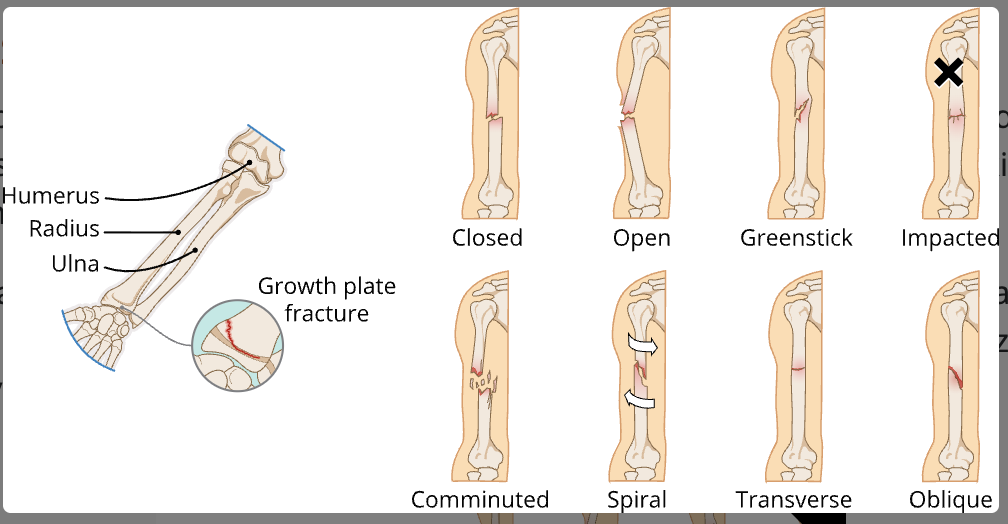
Bone fractures
Shock
The response of the cardiovascular system to the presence of adrenaline, resulting in capillary constriction. This causes inadequate circulation of blood to the body tissues, lowered blood pressure, and decreased kidney function.
Hemorrhage
Excessive bleeding
Anaphylactic Shock
The response of the body to an allergen such as a medication or an insect bite or sting.
Seizure
Uncontrolled muscle activity, seizures can be caused by high body temperature, head injuries, drugs, and epilepsy. During the seizure, steps should be taken to prevent injury to the patient. Help them to the floor if they are sitting or standing. Do not try to restrain them. Move objects out of their way and turn them to the side to prevent aspiration or choking. After the seizure, or the postictal phase, the patient can be confused, complain of headache, and be exhausted. Allow the patient to rest.
Abrasion
outer layers of skin are rubbed away because of scraping; will generally heal without scarring.
Incision
smooth cut resulting from a surgical scalpel or sharp material, such as razor or glass; can result in excessive bleeding and scarring if deep.
Laceration
edges are torn in an irregular shape; can cause profuse bleeding and scarring.
puncture
made by a sharp, pointed instrument such as a bullet, needle, nail, or splinter; external bleeding is usually minimal, but infection can occur because of penetration with a contaminated object, and there can be scarring.
arterial bleeding
most severe and urgent type of bleeding. It can result from a penetrating injury, blunt trauma, or damage to organs or blood vessels. Arterial bleeding is high pressure, and, thus, the bleeding is bright red in spurts. If a large artery, such as the aorta, is ruptured or bleeding has occurred for several minutes, this is a potentially life-threatening situation and can lead to death. This type of bleeding can be hard to control because of the pressure in the blood vessels. The first step should be to put pressure on the wound with sterile gauze. Elevate the site of the bleeding. In some cases, a tourniquet will need to be applied, above the site of the bleed, if the bleeding continues. The health care provider should be notified and should advise if a tourniquet should be used.
Venous bleeding
steady flow of dark red blood. Similar to an arterial bleed, the site of the wound should be covered with a clean cloth or gauze, pressure should be exerted on the wound, and the area should be elevated.
Capillary bleeding
Capillaries are the smallest blood vessels, and bleeding is minimal. There will be a small and steady flow of blood from the site, but it will clot on its own within minutes.
Inflammation
body’s protective response to trauma and invasion by micro-organisms; it is generally localized around the site of trauma or infection
signs - erythema, swelling, warmth, pain
Inflammatory phase (3 to 4 days)
Marked by pain, swelling, and loss of function at the site of the wound. Blood clot forms to stop bleeding and plug the opening of a wound.
Proliferating phase (4 to 21 days)
Fibrin threads extend across the opening of a wound and pull edges together; cells multiply to repair the wound, and eschar or scab begins to form to keep out micro-organisms.
Maturation phase (21 days to 2 years)
Tissue cells strengthen and tighten the wound closure, forming a scar; scar eventually fades and thins.
Dehiscence
Partial or total separation of a wound's edges.
Evisceration
Separation of wound edges and protrusion of abdominal organs.

