Myth in Art Week 7: Mythological Wall Paintings
 Call Kai
 Learn
Learn Practice Test
 Spaced Repetition
 Match
Match Flashcards
 Knowt Play
1/81

There's no tags or description
Looks like no tags are added yet.
Name | Mastery | Learn | Test | Matching | Spaced | Call with Kai |
|---|
No analytics yet
Send a link to your students to track their progress
82 Terms
When was the golden age of painting in the ancient world?
The classical period is often referred to as a golden age of painting, a number of famed paintings and artists were present- we know of these from literary sources
Why did panel paintings begin to be imported to Rome?
Panel paintings imported into Rome in wake of Roman conquests.
To what extent do frescoes from Rome and Campania copy/echo Greek original paintings?
Some described in literary sources.
Comparison often shows too many differences exist to confidently state they are copies.
Originals provided inspiration to Roman painters.
Artistic creative innovations/involvement of the patron.
What evidence do we have of pattern books existing?
Similarities seen across empire and different genres of artworks.
Workshops used pattern books to copy predetermined figures/motifs/compositions.
Differences between paintings of the same composition suggest individuality through choices/adaptations.
How many styles are there of Roman wall paintings?
Four
Was there a chronological progression in these styles?
Chronological description of progression in style- but one style did not necessarily replace another, there is a house with all four styles inside
Describe the first style- its dates and key features
No mythological imagery
Also called incrustation, structural or masonry style
Dates from 2nd century BCE
Key features: Painted blocks; resemble masonry and marble. 3D effect created by each rectangle being surrounded by stucco moulding. Vivid colours.
Describe the second style- its dates and key features
Architectural style
Dating 110-80 BCE to 20-10 BCE
Some myth appears mostly in friezes
Feeling of realism to it but also has an idea of creating an illusion for the viewer
Key features: “Architectural” details: columns, buildings, doors, gates. (Possibly inspired by stage sets). Sometimes incorporated First Style marble blocks at base of wall. Illusion of looking through a window to the outside; perspective used to create depth. Realistic feel; still life imagery; focal figures framed in alcoves.
Describe the third style- its dates and key features
Ornate or ornamental style- colourful and finessed
Dating of 12-40 BCE
Key features:
Myths appear in central picture panels – often vertical oblongs.
Illusionary depth disappears, walls divided into horizontal and vertical zones, divided by columns, foliage.
Larger expanses of same colour on walls – black, red and yellow popular, as is green/blue.
Describe the fourth style- its dates and key features
Called the intricate style
Dating from 40Ce onwards
Key features:
Mythological imagery in central pictures; more square and generally smaller than Third Style.
Effect of a mosaic of framed pictures on some walls.
Eclectic, elements of previous styles used in combination.
Identify this style:
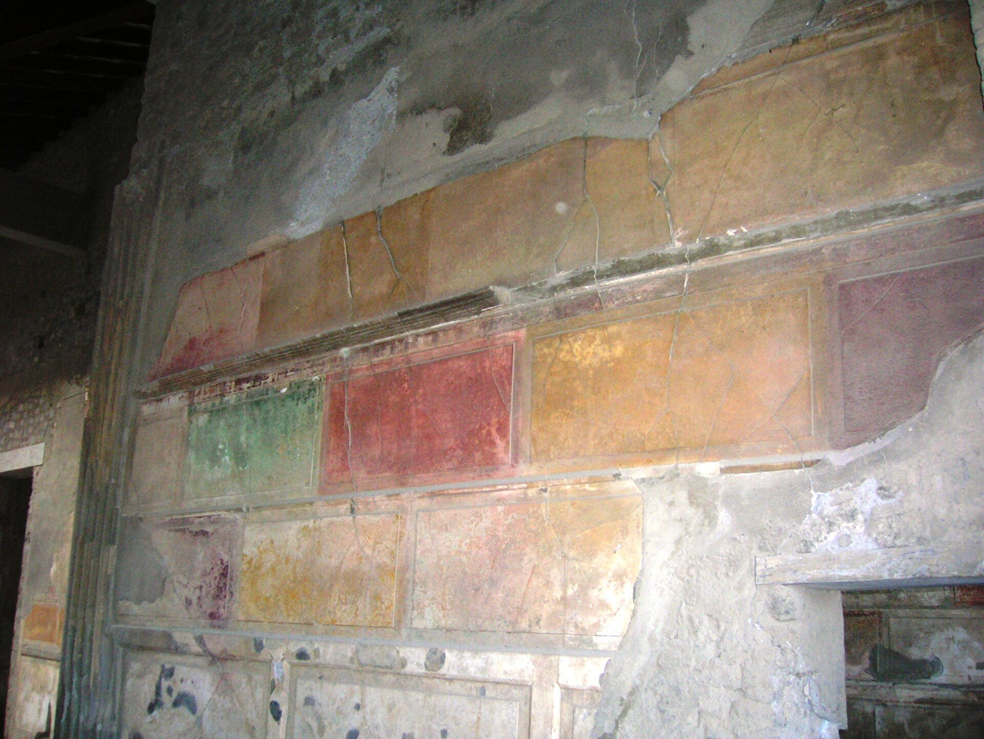
The first style- House of Sallust, VI 2 4, Pompeii.
Identify this style:
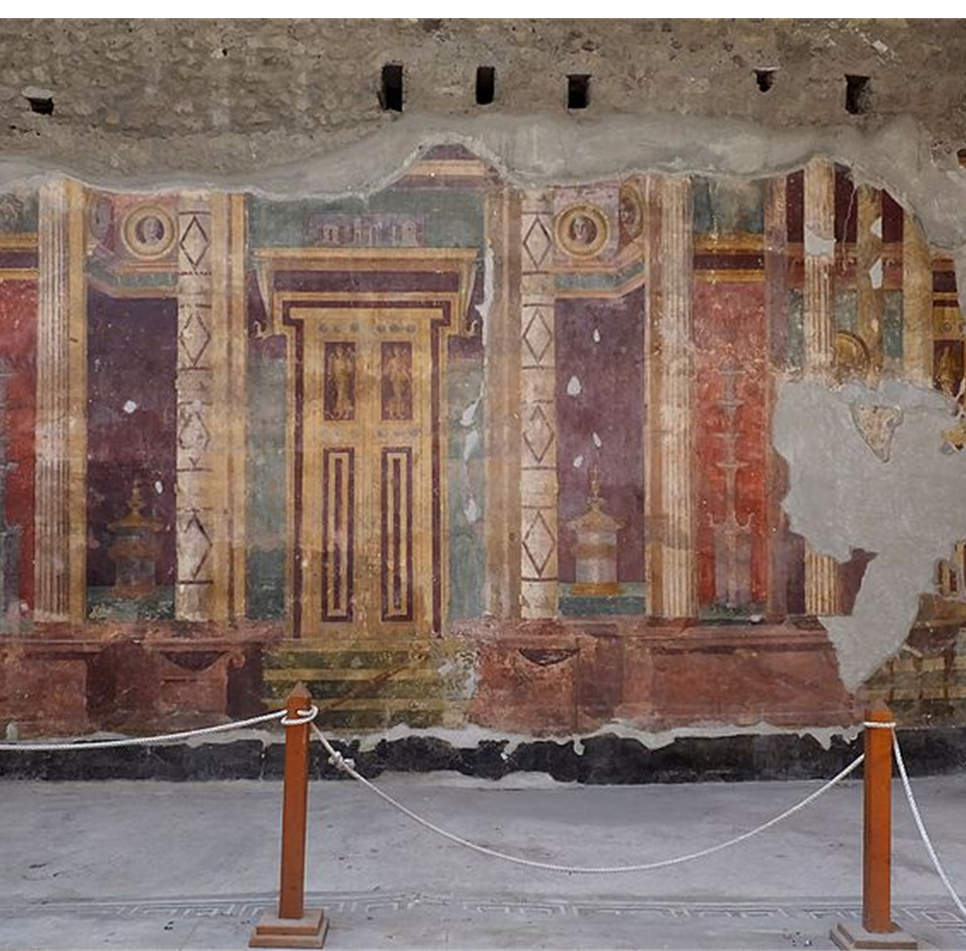
The second style- Villa Poppaea, Oplontis
Identify this style:
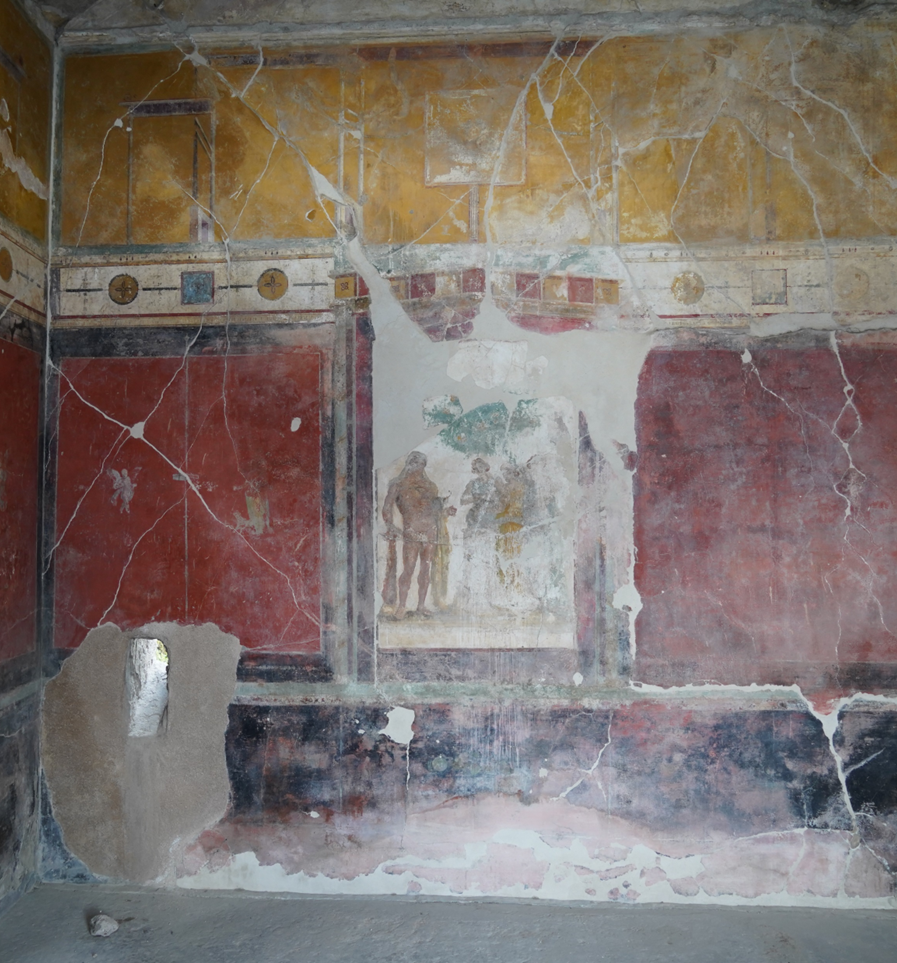
The third style- House of the Priest Amandus, I 7 7, Pompeii.
Identify this style:
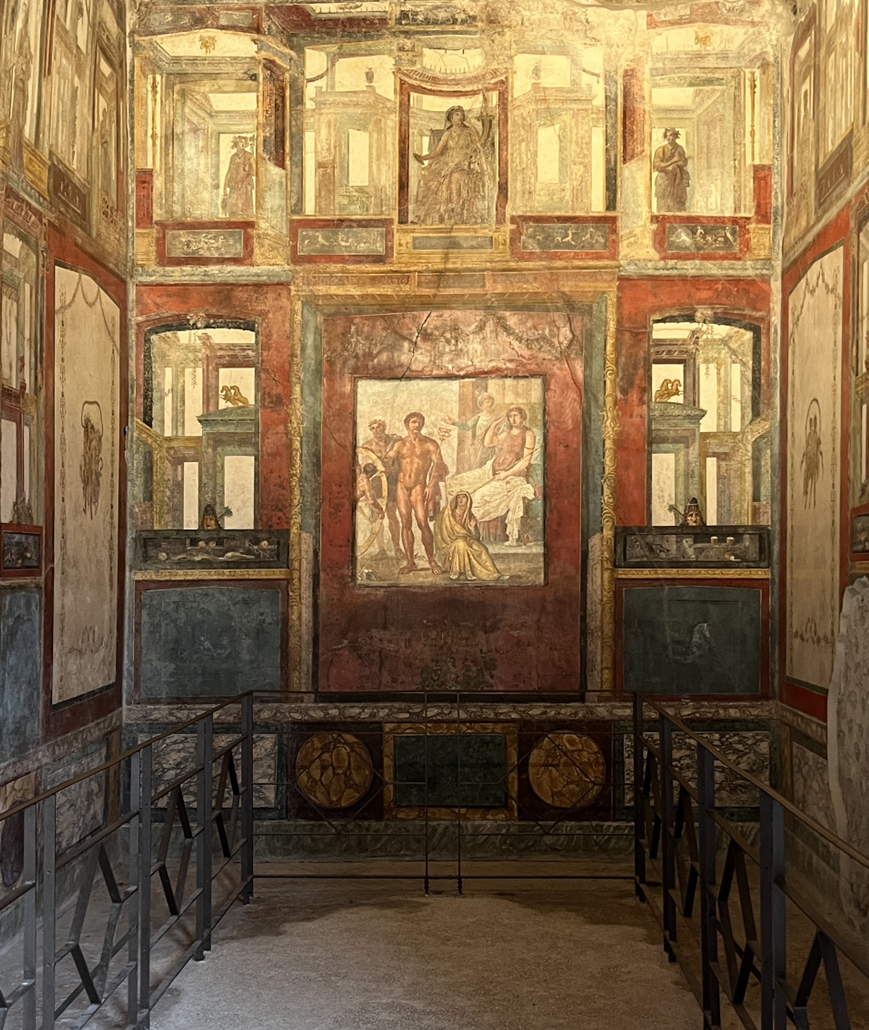
The fourth style- House of the Vetti, VI 15 1, Pompeii
What is the atrium and peristyle?
Atrium: central reception space; multi-functional; gave access to smaller rooms arranged around it. Usually the entranceway leads into the atrium, would hold ancestral shrines- a very mulit-functional space
Peristyle: open garden areas; main rooms such as a dining room (triclinium) opening from it.
Why did art within the house hold so much importance?
The house played a major role in social (and political) communication and demonstrated social standing:
Patrons received clients/guests in the atrium and tablinum.
Dinner held in the triclinium – further inside the house.
Division of public/private spaces.
What are the main questions to ask when looking at Roman wall-paintings?
How is the narrative being told? What form is the narrative taking
Why this myth? Why here? What elements were resonating with the patron
Why it was chosen for thespace it appears in
Are the paintings linked together in specific rooms? Can we see a program in a room with imagery linked by theme or composition, or is there contrast between the paintings?
Can we see any links between types of imagery and the spaces they decorate?
How were the viewers supposed to relate and respond to the images?
What did they tell us about the patron? Why were they choosing that imagery?
Which style featured large central picture panels?
The third style
Which style often featured mythological landscape scenes?
The third style
What were features of mythological landscape scenes?
Provide the viewer with an illusionary space beyond the actual wall. (idea of looking out a window and seeing outside)
Similarities in composition; naturalistic settings- trees, rocks, some architectural features.
‘Other’ world ambience to the myths; visual atmospheric aid to the viewer.
Narratives – sometimes continuous, with repeating characters. However these repeated characters are quite limited
By having the myths in an outdoor setting it separates them from the viewers interior setting
Give details about the Villa of Agrippa Postumus at Boscotrecase
Villa decoration dated to ca. 11 BCE.
Only partly excavated, 4 rooms with paintings.
Paintings came from Room 19 – the Mythological Room.
Accessibility – two entrances – one from peristyle corridor (west wall) and another from a southern terrace/promenade.
Who does this painting from the House of Agrippa Postumus at Boscotrecase display:
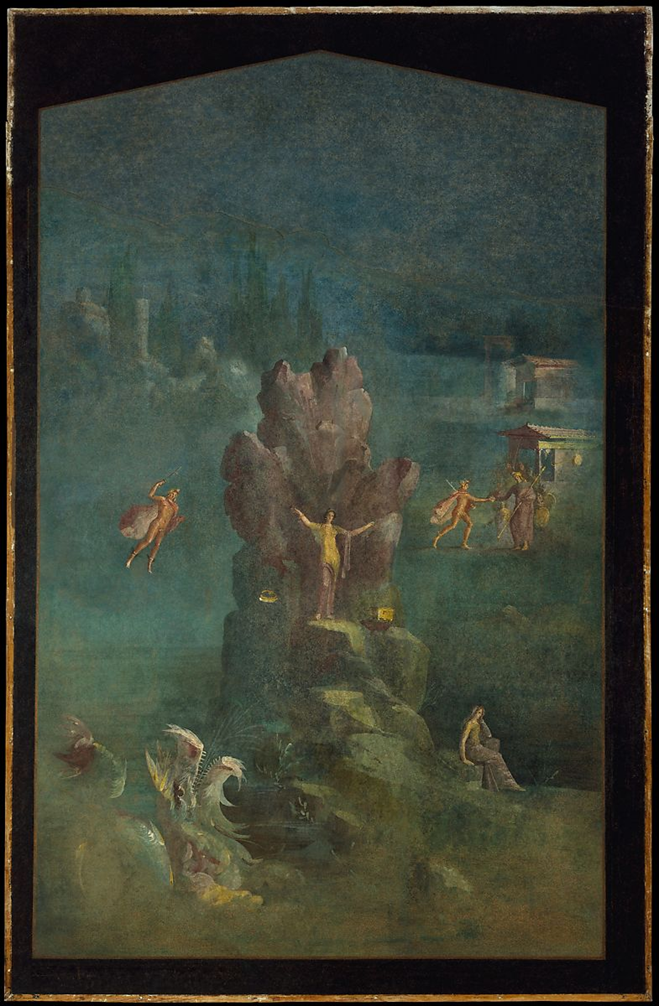
Perseus and Andromeda
How many paintings of Perseus and Andromeda were found in Campania?
42 in/from Campania (that depict Perseus and Andromeda); different compositions/elements of myth.
Nine mythological landscapes, but only two are continuous/polyscenic.
Who is Andromeda and what is the myth surrounding her and Perseus?
Andromeda was the daughter of a king and queen who boasted that she was more beautiful than the sea nymphs, in revenged Poseidon sent a flood to wreck havoc on their kingdom and to fix this the king needs to sacrifice Andromeda to this monster- Perseus is flying through he catches sight of her and falls in love with her, so he makes a bargain with the king that if he saved her he could marry her- which he did.
How do we know this is Perseus and Andromeda?
Perseus is wearing a winged cap
Shaking the hand of Andromeda’s father; forming a contract to kill Cetus for marriage
Andromeda is characteristically chained to a rock.
Perseus’ attributes: cap, winged sandals, harpe
The ketos (sea monster) in the foreground of the image.
What are the different scenes portrayed in the paitning/how do they connect to the narrative?
First meeting on the rock with sea monster below
Deal made with her father to kill the monster
Does not include scene of Perseus killing the monster
Cassiopeia- Andromedas mother (probably) seated on rock with gesture of grief/despair (hand to head)
What type of narrative is used in this painting?
It could be a continuous narrative as there is a repetition of perseus, however he only appears twice so you could argue against that- polyscenic can be used to describe it instead as there are multiple scenes from this story in one image
What impression does the image give you?
We get an otherworldly impression ethereal sense from the hazy green/blue colour scheme, fantasy landscape which is highly atmospheric- foreboding and dramatic feel to it due to the colours that are used.
Does the composition aid the narrative?
Vivid, contrasting colours of the figures draws you to focus on them rather than the location.
Rock behind Andromeda frames her and highlights the sacrificial element.
Focus on P about to save A - heroic action - gender idealism?
The contrast helps aid the narrative, highlights the immediate danger that Andromeda is in
What are the different eversions of the myth surrounding Polyphemus and Galateas love?
Earliest known source is lost dythrambic poem by Philoxenus of Cythera.
Different versions of narrative in later literary sources:
Polyphemus loves the Nereid Galatea, whilst she rejects him; and instead loves Acis, whom Polyphemus tries to kill but Acis is turned into a river god (Ovid, Metamorphoses, 13.738-897).- Polyphemus love for Galatea is unrequited
Galatea loves Polyphemus in return (Lucian, Dialogue of the Sea Gods 1).- she defends him as her lover
Children of Polyphemus and Galatea referred to in Appian, Roman History 9.2. Obviously it suggests that they were a couple and had children
There is an aspect of ambiguity of if the story is about reciprocal love or unrequited love
How many wall paintings of Polyphemus and Galatea have been found?
Twenty-two in total; seventeen with Galatea; four showing them as lovers.
Identify the characters shown in this painting:
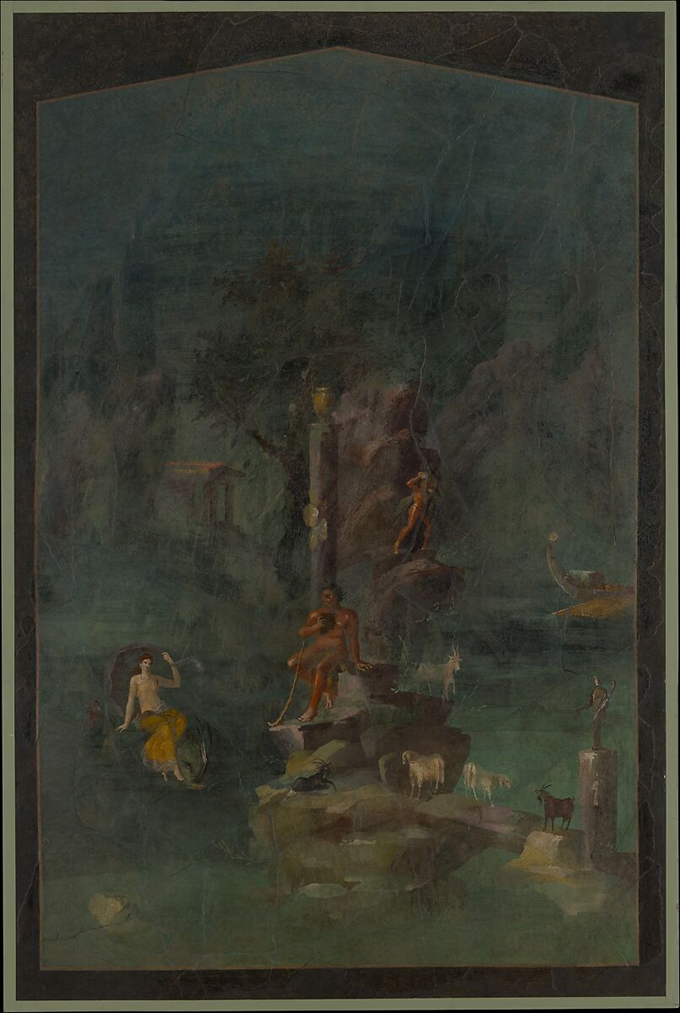
(From the house of Agrippa)
Poylphemus and Galatea
What are the different narrative parts that can be picked out?
Polyphemus looks longingly at Galatea
Throwing rocks at Odysseus’ boat
Goats
Acis doesn’t appear (lover of Galatea who is killed by Polyphemus)
Temporally separate elements of Polyphemus’ story.
Which version of the narrative do you think we are seeing?
Polyphemus trying to woo her- he is playing his pan pipes and there is an idyllic setting, Gakatea looks quite comfortable she doesn’t look fearful, an argument could be made that this is the point in the story where he is trying to woo her. Galatea is sitting on a dolphin
Other image of Polyphemus standing on a cliff throwing rocks at Odysseus
Again twig snapshots of different stories are happening, both are happening at the same time in the art but temporally theyre happening at very different times
Idea of emotion that we get from the whole painting, Polyphemus is acting in anger but also a moment of him trying to woo her- a lot of varying emotions occurring
What are the thematic connections between the painting of Perseus and Polyphemus?
Contrast with Polypehmus and Perseus, Perseus is coming in to sae the day- very different to Polyphemus who is acting in anger.
They have similar backgrounds, dark greens and blues and rocky backgrounds, land and the sea present in both- idea of blending the real with the mythical
What themes are apparent in both paintings?
Love either complementary or contrasting dependent on whether we see Polyphemus/Galatea as reciprocal or unrequited love.
Violence but also contrast between this and the idyllic settings.
Both Andromeda and Galatea are wearing yellow - connecting them as the objects of desire? Beautiful women contrast with monstrous beings (ketos and Polyphemus)
Possible gender role reversal in positioning of main characters.
How could this connect to the wider context of Roman society?
Could be seen to promote love/marriage
How do the landscape settings contribute to both compositions?
Figures as focal points.
Similar compositional elements: rocky/marine settings, trees, buildings.
Elements from real world but also fantasy world.
Blend of myth and reality.
What room were these paintings in and how large were they?
Paintings came from Room 19 – the Mythological Room.
Perseus/Andromeda on west wall, Polyphemus/Galatea on east wall.
Paintings large (approx. 160 x 118 cm). They would have dominated the room, and they almost face each other- possibly invited comparison?
What paintings are found in the House of the Priest Amandus?
•Paintings in triclinium (b) on floorplan.
•Echoes of Boscotrecase.
•Perseus and Andromeda.
•Polyphemus and Galatea.
•Fall of Icarus.
•Herakles in the gardens of the Hesperides.
Identify who is in this painting:
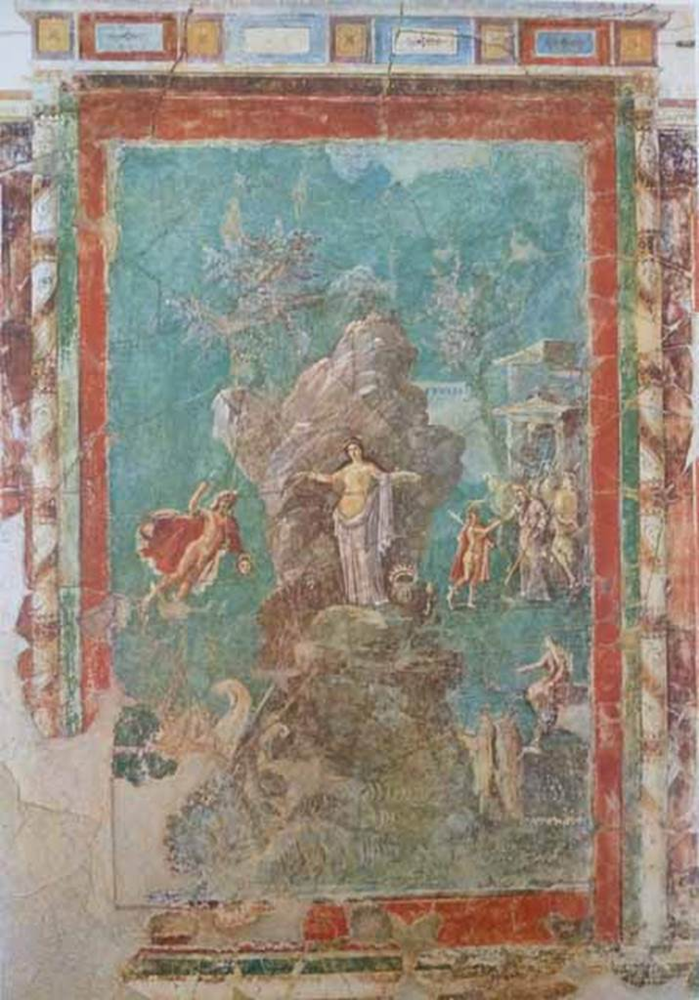
Perseus and Andromeda
Identify who is in this painting:
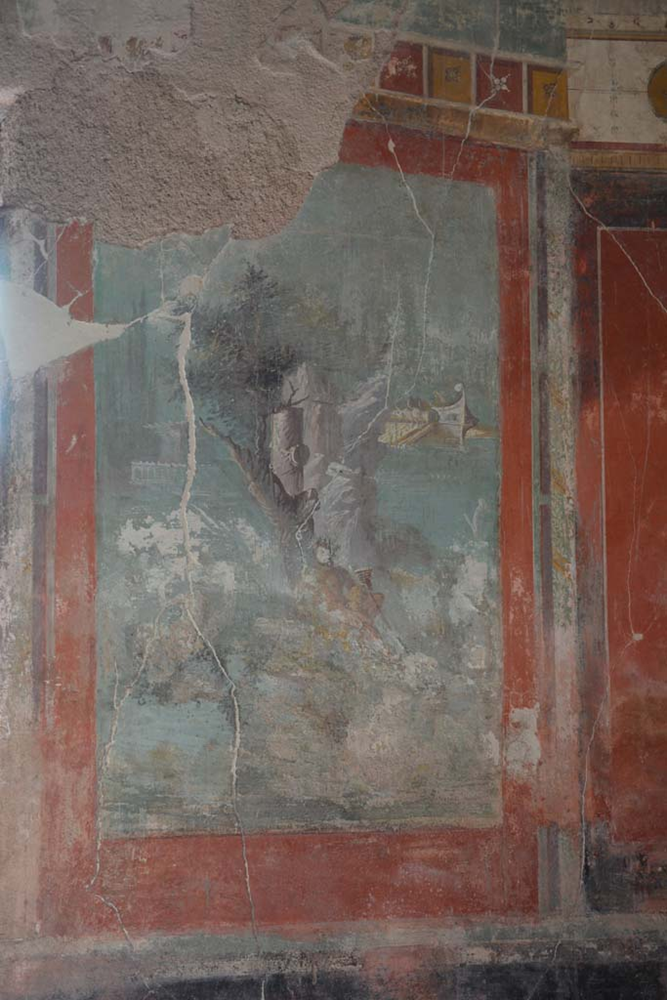
Polyphemus and Galatea
Identify who is in this painting:
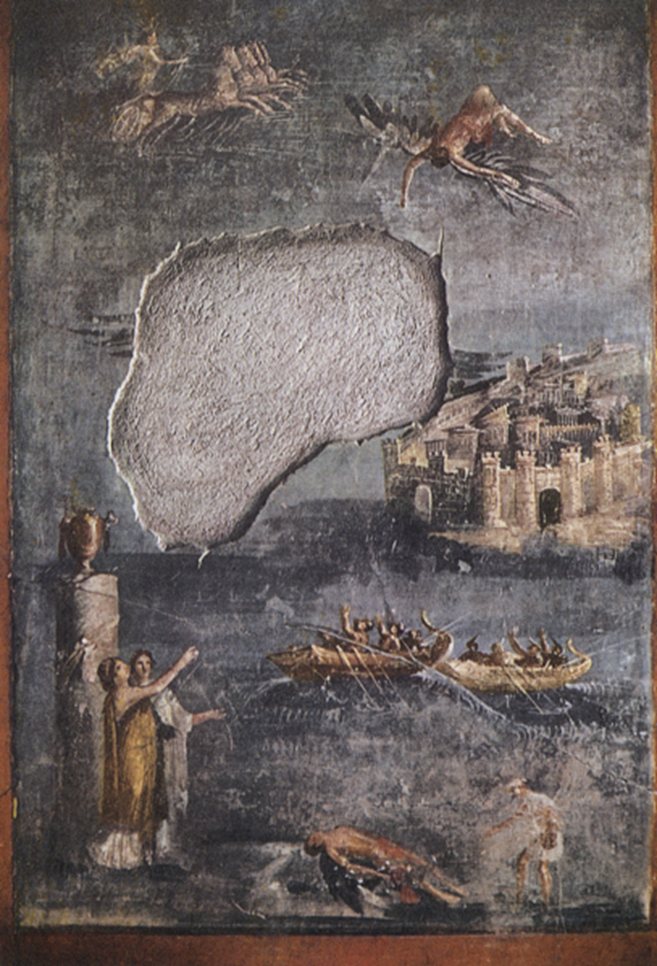
Fall of Icarus
Identify the sscene shown in this painting:
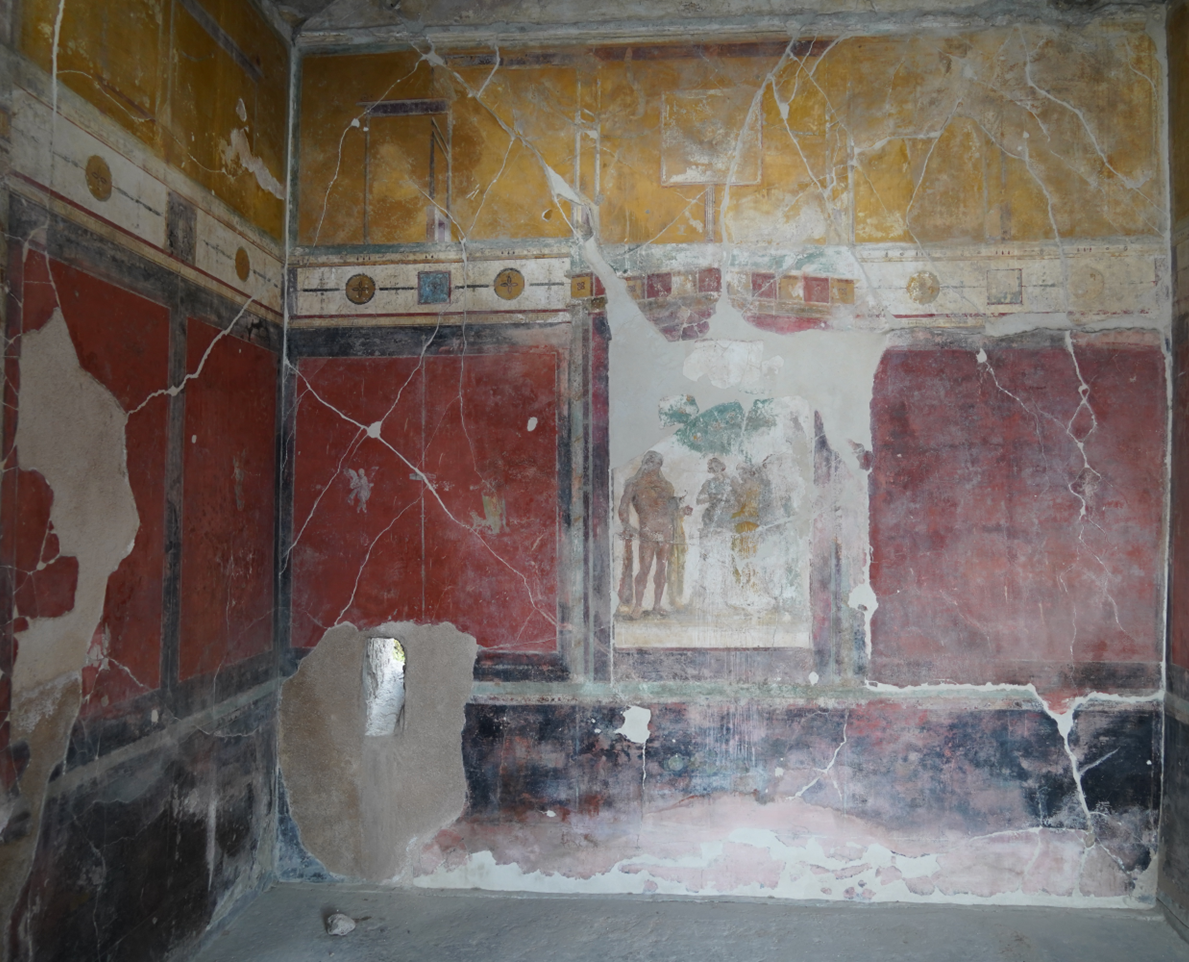
Herakles in the Garden of the Hesperides
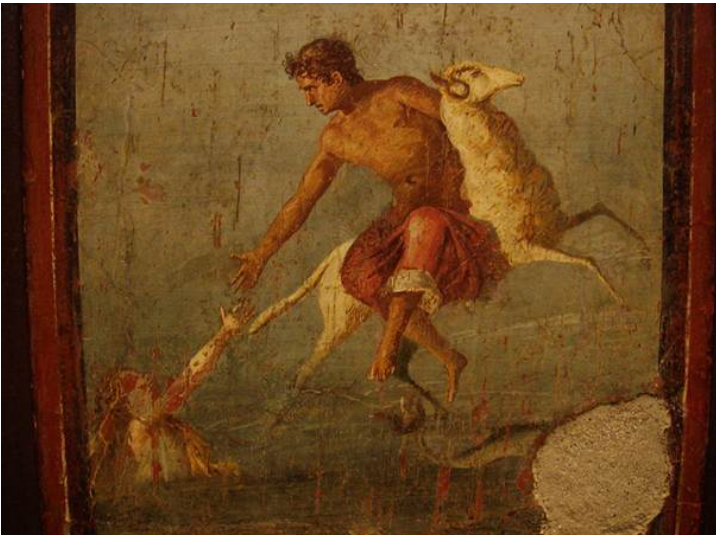
Identify the myth in this painting:
Phrixus and Helle: different versions of this myth. They were the children of Athamas, king of Boeotia, and Nephele (cloud nymph). Stepmother Ino hated them and tried to sacrifice them to ward off a famine, but Nephele sends a flying ram with a golden fleece to rescue them. Helle falls off during their escape and drowned in the strait between Europe and Asia, which then took her name - the Hellespont - myth is aetiological. Phrixus gets to Colchis and this is where the story of the golden fleece originates.
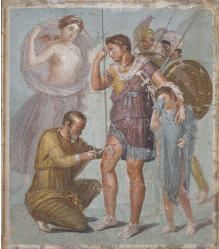
Identify the story in this painting:
Aeneas having his wound treated by Iapyx, Iulus in tow, Venus looking on.
Venus carrying either myrtle or healing herbs. She is almost in flight with drapery swirling around her - conveys a sense of motion and divinity.
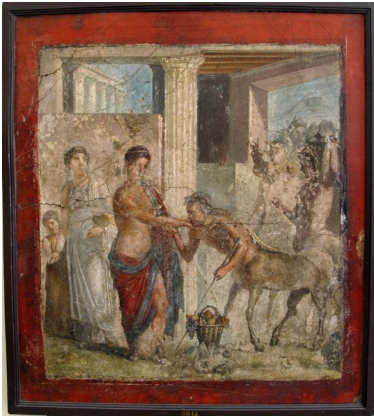
Identify the myth in this painting:
Lapiths vs centaurs? Beginning of conflict?
Pirithous and Hippodamia’s wedding
Possibly Hippodamia standing behind him
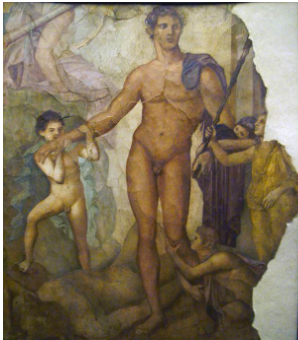
Identify what is happening in this painting:
Small children clinging to him in thanks- very heroic moment
Theseus standing over the body of the Minotaur
Children nibbling man.
Artemis in top corner- bow.
Head of minotaur at bottom left of the picture
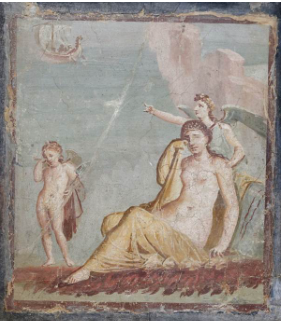
Identify what is happening in this painting:
Ariadne weeping on the shore and the departing ship of Theseus in the left corner
Ariadne is wearing a hair net- contemporary reference to hairnets worn by women in the time period
Either Ariadne being abandoned by Theseus✔ - crying, pointing at ship.
White sails on ship, curious detail that somewhat divorces this image from the ending of the myth
Cupid, possibly two
Ariadne being abandoned by Theseus. She is wearing a hairnet – reference to contemporary hairstyle/accessory. Note nudity and eroticism. Departing ship. Not Dido as the limited number of paintings of her show her fully robed, enthroned, and with maidservants.
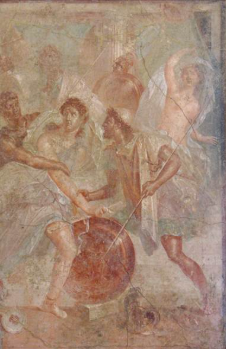
Identify what is occurring in this painting:
Achilles on skyros, where he had disguised himself as a woman to not take part in the Trojan war
Odysseus, recognised by his beard and white hat
Achilles (maybe? holding a shield and spear? Or they are around him)
Odysseus to his right? Beard and hat
Mid conflict, portrayed as busy and chaotic
Discovery of Achilles on Skyros, female clothing, anklet; other women in disarray. Odysseus recognisable from white pileus/hat. Achilles grabbing shield. Thetis hid him on Skyros (King Lycomedes court) disguised as one of his daughters to prevent him from going to the Trojan War. Exposed when Odysseus and comrades blew a war signal on trumpet and Achilles picked up weapons.
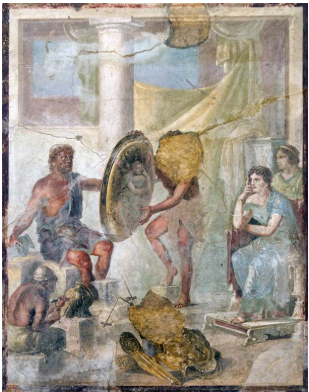
Identify what is occurring in this painting:
Hephaestus presenting the armour for achilles to thetis
Perseus slaying Medusa using shield as mirror? ✔
Fourth Style - it’s intricate (although it’s oblong, which tends to be a feature of Third Style)
Thetis getting armour from Hephaestus. Bronzeworker in front working on helmet. Shield being presented to Thetis, armour and greaves in foreground. Shield works as a mirror.
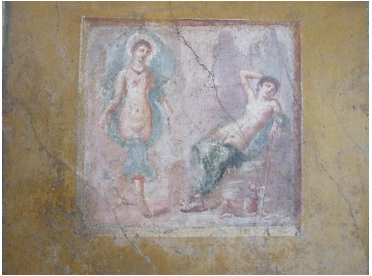
Identify what is occurring in this painting:
Selene (goddess of moon) Similar to Venus here, discovering Endymion (asleep) cupid inclusion hints at love/passion. Zeus granted him eternal sleep. Diff versions of story.
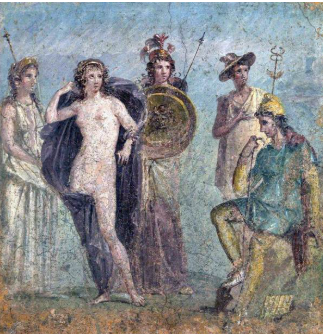
Identify what is occurring in this painting:
Judgement of Paris
Can you identify specific characters? How?
Aphrodite - nude, goddess of love
Athena - in her military garb
Hera - wearing a diadem
Hermes with the caducaeus and hat
Do you know the narrative being portrayed? What tells you this?
This is the judgement of Paris - this is shown through the three goddesses who are all facing and looking at Paris, who seems stuck in indecision
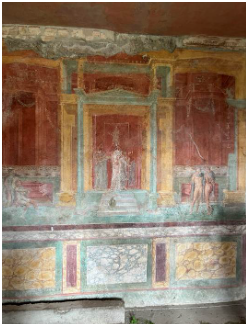
Identify what is occurring in this painting:
Iphigenia among the Taureans
She is coming out of the temple accompanied by two attendants
Style 2 or 4
Iphigenia at Taurus. As a priestess.
Orestes/Pylades in foreground to right, Thoas to left
Give information about the house of Menander in Pompeii (owner,size decoration style, type of paintings)
Extended over time to become a very large atrium-peristyle style house (over 2,000 square metres).
Likely belonged to the gens Poppaea (seal bearing the name of Quintus Poppaea found in room 43).
Redecorated in the Fourth Style between 45-55 CE.
Mythological paintings in ala, room 4 on plan (and others).
Atrium, ala and tablinum (room 8) all have similar wall decoration and flooring; similar colours throughout but used differently to differentiate the spaces.
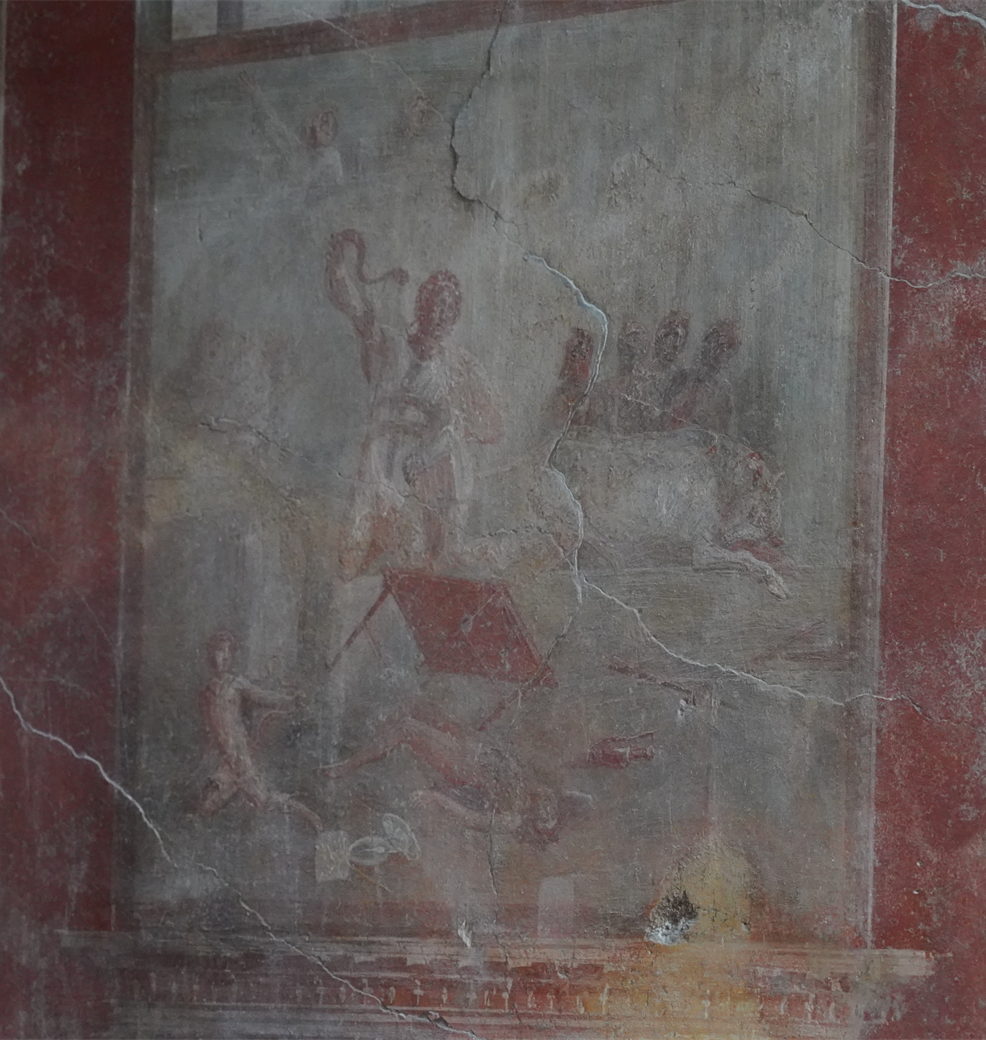
Identify the scene in this wall-painting:
Laocoon being attacked by the snakes- Ala, room 4, south wall
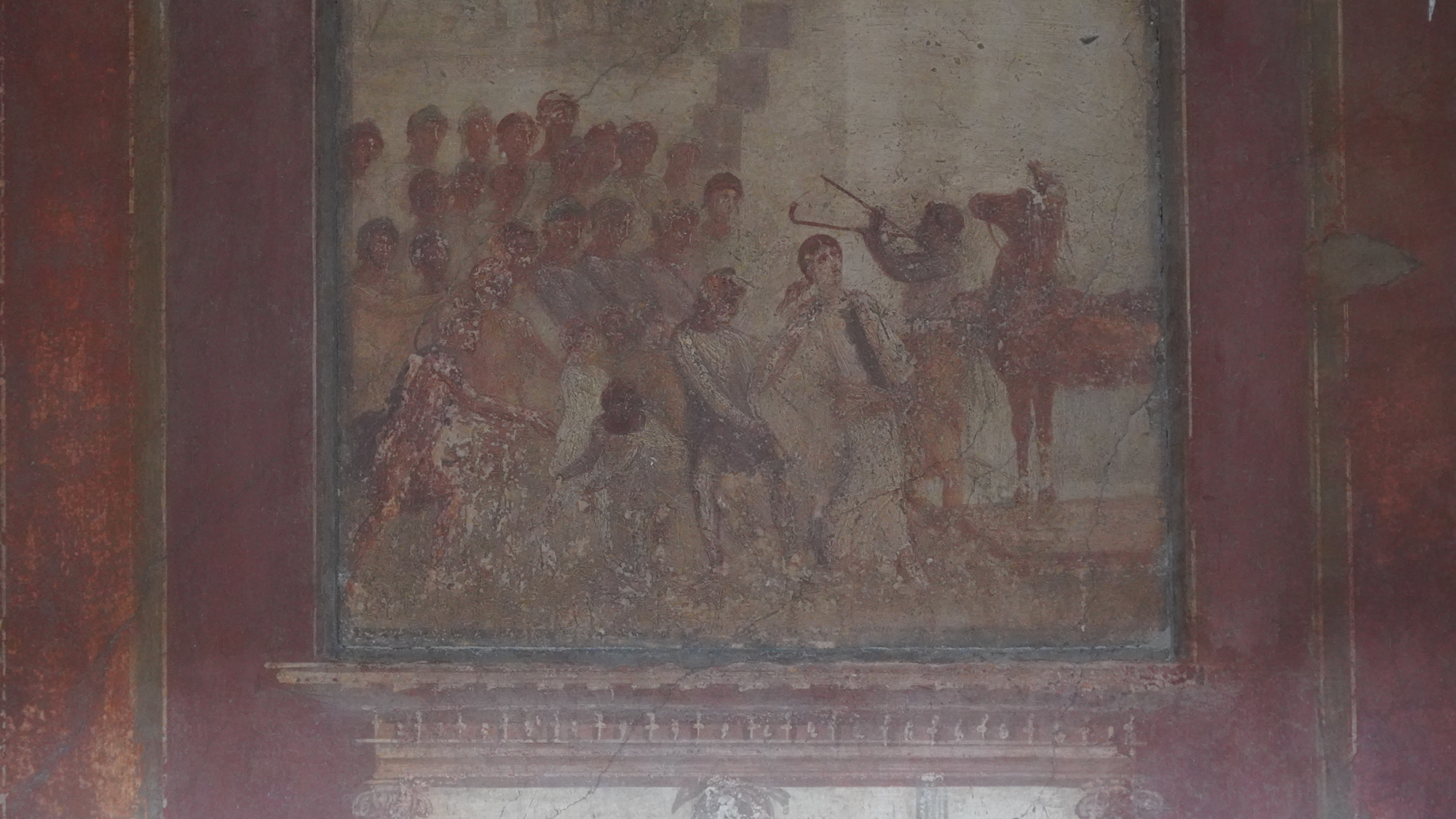
Identify the scene occurring in this wall-painting:
Trojan Horse
Identify the scene occurring in this wall-painting:
Rape of Cassandra - clinging to the statue
Are the paintings linked together by theme, or composition?
Linked by theme - Narrative: The Trojan War (as seen in Virgil’s Aeneid Book 2)
There is similar colour scheme/decoration - decorated at a similar time therefore
What does their location tell us?
Off the Atrium
In a public space - no doorway - so people could walk past
Could people see it from the street? Laocoon on a wall - could they see in?
Large open doorway higher than the others - more important space?
Can we see any links between types of imagery and the spaces they decorate?
The atrium, ala and tablinum have similar decoration in terms of flooring and the colours used on the walls; but these colours are used differently in the spaces to differentiate them.
How were viewers supposed to respond to these images?
Full of action and drama, disturbing?
Scenes which were likely recognisable to viewers.
What do the paintings tell us about the patron?
Demonstration of power and cultural knowledge - where clients would have walked past - therefore able to show off their knowledge of the Roman myths of their own origins
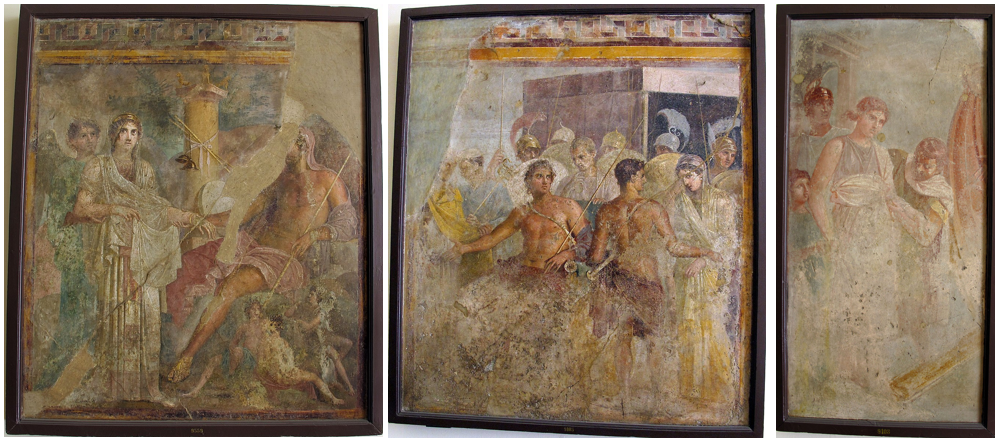
Identify these three paintings in the atrium of the house of the tragic poet:
Zeus and Hera - he has a gold stick and holds her arm, she does not look happy
Brises being escorted out of Achilles tent to be brough to Agamemnon
Helen- Helen of sparta boarding the ship to go to Troy with Paris- paris behind her wearing a big shiny helmet. Might not be Paris, just a soldier?
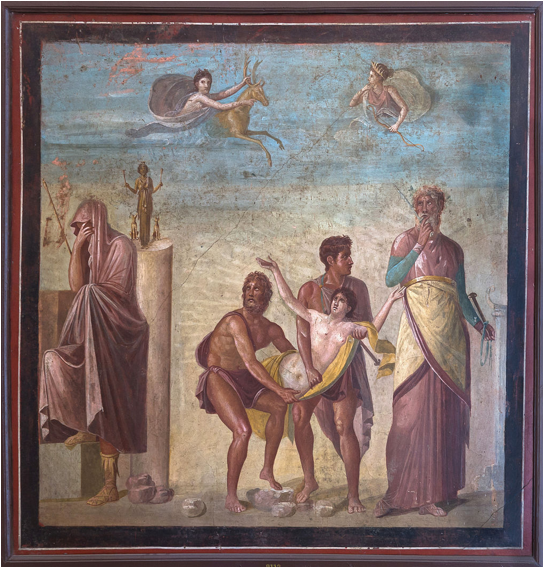
Identify the scene depicted in this wall painting in the peristyle of the house of the tragic poet
Standalone painting in peristyle: Painting of iphigenia being nearly sacrificed and rescued by Artemis- flying away on an animal. Synoptic storytelling. Right near the entrance, surrounded by columns- possibly a second room
Peristyle painting shows Artemis in the top right corner carrying a bow. In the top left corner (opposite Artemis) is a nymph carrying the stag to be swapped on the altar with Iphigenia.
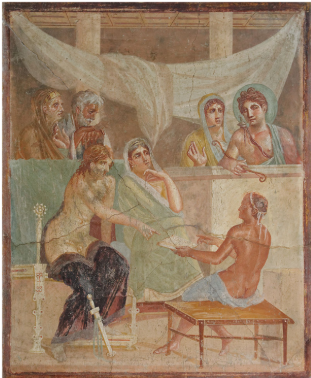
Identify the scene depicted in this wall painting in the tablinum of the house of the tragic poet
Ademetus and Alcestis, Calydonian Boar hunt, scene in which Ademetus is read the message which makes him realise he cannot cheat death, and that someone must take that burden for him. Ademetus reaching out for the message, looking for finer details, meanwhile Alcestis deep in thought, immediately recognising that she must sacrifice herself, sombre onlookers or eagerly leaning over to see more. Picture of resignation and tragedy, what a wife will sacrifice for her lover (husband). Elderly onlookers are Admetus’ parents.
What is the thematic link between the paintings?
Thematic link- all scenes that are iliad-adjacent?? Atrium, helen and briseis next to each other, theme of kidnapped women. Theme of pictures depicting preludes to a war or tragedy, acceptance of death and resignation to their fate.
How are the atrium paintings linked?
Atrium paintings are linked by compositional elements: colour, postures and clothing. Men are heroically nude and darker skinned than the women who wear pastel colours. Gender idealism? Some repeated gestures - interlocking hands.
Other thematic connections between Hera, Briseis and Helen.
Pregnant moments - anticipation of change.
All are women in transition but different situations: Hera goddess bride, Briseis war prize, Helen abducted or adulterous queen. Themes of opposites: love/war; passion/reason, gods/mortals. Relationships between men and women: marriage, master/slave, adultery, abduction.
Bergmann (1994) article discusses these paintings as being rhetorical memory aids. Literary sources tell us that orators used images to recall thoughts and ideas and also used the placing of these in an imaginary house.
What do paintings locations promote?
Paintings’ location again promote patron’s erudition; quality of paintings demonstrate wealth. Impressive to visitor.
How are the viewers of these paintings relevant?
Viewers: stimulating material evokes response - prompts for comparison/discussion of themes. Standalone nature of Iphigenia and Alcestis/Admetus paintings suggests they were used for discussion/debate.
Give details about the House of the Vettii, VI 15 1, Pompeii (who owned it, style of decoration, layout, type of paintings)
House owned by two freedmen brothers: A. Vettius Restitutus and A. Vettius Conviva.
Fourth style decoration, after earthquake of 62 CE
Priapus painting in doorway.
Unusual layout – has no tablinum.
Mythological paintings throughout (focus here on room n and p).
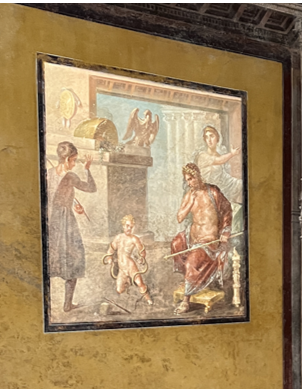
Identify the scene occurring in this painting in the oecus, room n in the house of the Vetti
Baby Herakles wrestling snakes (to adults’ surprise) Note that Herakles has the face of a grown man
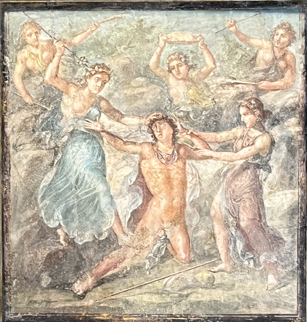
Identify the scene occurring in this painting in the oecus, room n in the house of the Vetti
Death of Pentheus painting
His mother + Bacchants tearing him limb from limb
Pentheus’ mother and sister discover him
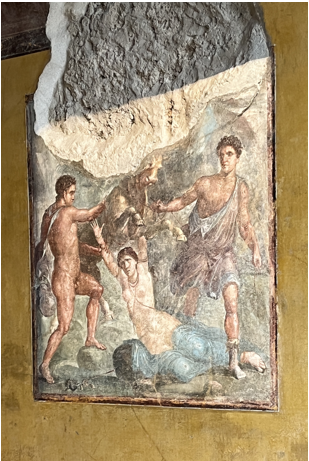
Identify the scene occurring in this painting in the oecus, room n in the house of the Vetti
Punishment of Dirce (slide 43 right)
A bull
Different versions of this myth but the two men are the brothers Zethus and Amphion, sons of Zeus and Antiope (daughter of king of Thebes) who are taking their vengeance on their stepmother Dirce for years of slavery she inflicted on Antiope.
What are the thematic connections between these three paintings?
Compositionally they are connected well by colours; nudity of “victims” = vulnerability
Involvement of gods: Zeus, Hera, Dionysus, Zeus; retribution/punishment/vengeance connects Dirce/Pentheus. Difficult I think to connect the Herakles painting with the other two - only real connection is via the idea of parents/children and violence/strength.
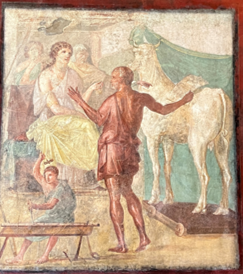
Identify the scene occurring in this wall-painting in room p of the house of vetti (fourth style)
Painting of Daedalus making the bull for Pasiphae (so she can hide inside and be impregnated by Cretan Bull- creates Minotaur)
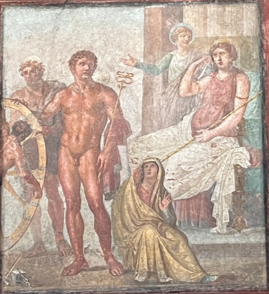
Identify the scene occurring in this wall-painting in room p of the house of vetti (fourth style)
Punishment of Ixion. King of lapiths, got punished by getting attached to a spinning wheel because he wanted hera (you can see him attached to said wheel in the corner of the image)
Maybe hera, lounging to the side? She appears displeased
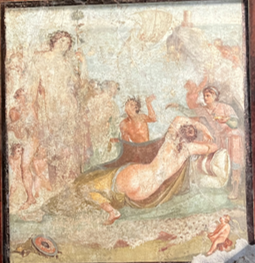
Identify the scene occurring in this wall-painting in room p of the house of vetti (fourth style)
Painting of Ariadne after abandoned by Theseus. Dionysus looks on (will take her as a bride). Reminiscent of sleeping hermaphrodite. Absence of Theseus shown in abandoned armour and ship in distance.
Links by theme or composition?
All depict scenes of mythology
Linked by colours and all include bystanders.
Love/sexual relationships, passion, that can be disastrous – Ariadne abandoned by Theseus, death for Ixion, perversion Pasiphae.
Contrasts?
Sensuality of Ariadne, with matronly appearance of Hera and authority of Pasiphae? Ariadne a victim, Pasiphae in control?
What is the significance of room n and p?
Room n and p are both considered as oeci, so used as reception rooms and possibly for dining. More private – invited guests only. Look out to peristyle so paintings visible from there. Possible that both rooms have thematic connections: power of the gods, care for innocents (Herakles and Ariadne) punishment for transgressors (Ixion, Dirce).

