1 - Receptors/Signal Transduction Pathways
 Studied by 0 people
 Call Kai
 Learn
Learn Practice Test
 Spaced Repetition
 Match
Match Flashcards
 Knowt Play
1/31

There's no tags or description
Looks like no tags are added yet.
Name | Mastery | Learn | Test | Matching | Spaced | Call with Kai |
|---|
No analytics yet
Send a link to your students to track their progress
32 Terms
Receptor
Binds a ligand (drug or endogenous molecule)
Transduces that binding event into a biological response
Drug-cell communication process
Reception – drug binds receptor
Transduction – signal is converted inside the cell
Response – cell function changes
What does receptor type determine?
Where communication occurs
How fast the effect begins
How long the effect lasts
List receptor types from fastest to slowest
ligand-gated ion channels, GPCRs, enzyme-linked receptors, intracellular receptors
Ligand-gated ion channel signal transduction steps
Reception: Ligand (e.g., acetylcholine, GABA) binds to the channel on the cell membrane
Transduction: Channel undergoes a conformational change → pore opens
Response: Rapid ion flow (Na⁺, K⁺, or Cl⁻) alters membrane potential
Examples of ion-gated channel receptors
- Nicotinic acetylcholine receptor → Na⁺ influx → depolarization
- GABA-A receptor → Cl⁻ influx → hyperpolarization
GPCR signal transduction
Signal Transduction Steps
Reception: Ligand binds GPCR on cell membrane
Transduction:
GDP → GTP exchange on G protein
Activated G protein regulates an effector enzyme
Response:
Second messengers activate kinases
Kinase cascades phosphorylate target proteins
Major GPCR pathways (Gs, Gi, Gq)
Gs → β-adrenergic receptors → ↑ cAMP → PKA activation
Gi → α₂-adrenergic receptors → ↓ cAMP
Gq → M₁ (and M₃) receptors → ↑ IP₃, DAG, Ca²⁺ → PKC activation
Enzyme-linked receptor signal transduction steps
Reception: Ligand binds extracellular domain → receptor dimerization
Transduction:
Autophosphorylation of intracellular tyrosine residues
Recruitment of adaptor proteins (e.g., IRS)
Activation of signaling pathways (PI3K–Akt, MAPK)
Response:
Changes in metabolism
Protein synthesis
Gene expression changes
Intracellular receptor signal transduction steps
Reception: Ligand diffuses into the cell and binds intracellular receptor
Transduction:
Receptor dissociates from chaperones
Receptor dimerizes
Complex binds DNA hormone response elements (HREs)
Response:
Altered gene transcription
New protein synthesis
Long-term physiological effects
Receptor theory framework
Receptors exist in two states:
Ri = inactive
Ra = active
Even without a drug, some receptors have basal (constitutive) activity
Drugs differ in how they shift the equilibrium between R and R*
Agonists
binds to the receptor and stabilizes the active (Ra) state, producing a biological response.
Partial agonist
activates the receptor but produces a lower maximal effect, even when all receptors are occupied
Inverse agonist
binds to the same receptor as an agonist but reduces receptor activity below basal levels (Ri).
Antagonists
binds to the receptor but has no intrinsic activity, blocking agonist effects without altering basal activity
Drug efficacy
the maximum effect (Emax) a drug can produce, determined by receptor activation
Drug potency
the amount of drug needed to produce a given effect
Often measured by EC₅₀ (dose producing 50% of max response)
T/F: activation of a receptor immediately causes a physiological effect
false
arrange in order of onset of action after receptor activation:
enzyme-linked
GPCR
ligand-gated ion channel
intracellular
ligand-gated ion channel
GPCR
enzyme-linked
intracellular
Tazarotene, a topical retinoid, binds an intracellular receptor. Should results be expected within a few minutes?
no
Drugs that bind intracellular receptors require changes in _______ to elicit a physiological effect
gene expression
An immediate physiological effect typically occurs with activation of which receptor?
ligand-gated ion channel
Where are ion channels, GPCRs, and enzyme-linked receptors located?
cell membrane
Drugs that bind an intracellular receptor go where after binding?
cell nucleus
On a dose-response curve, what is represented on the x-axis?
drug dose
On a dose-response curve, what is represented on the y-axis?
effect/response
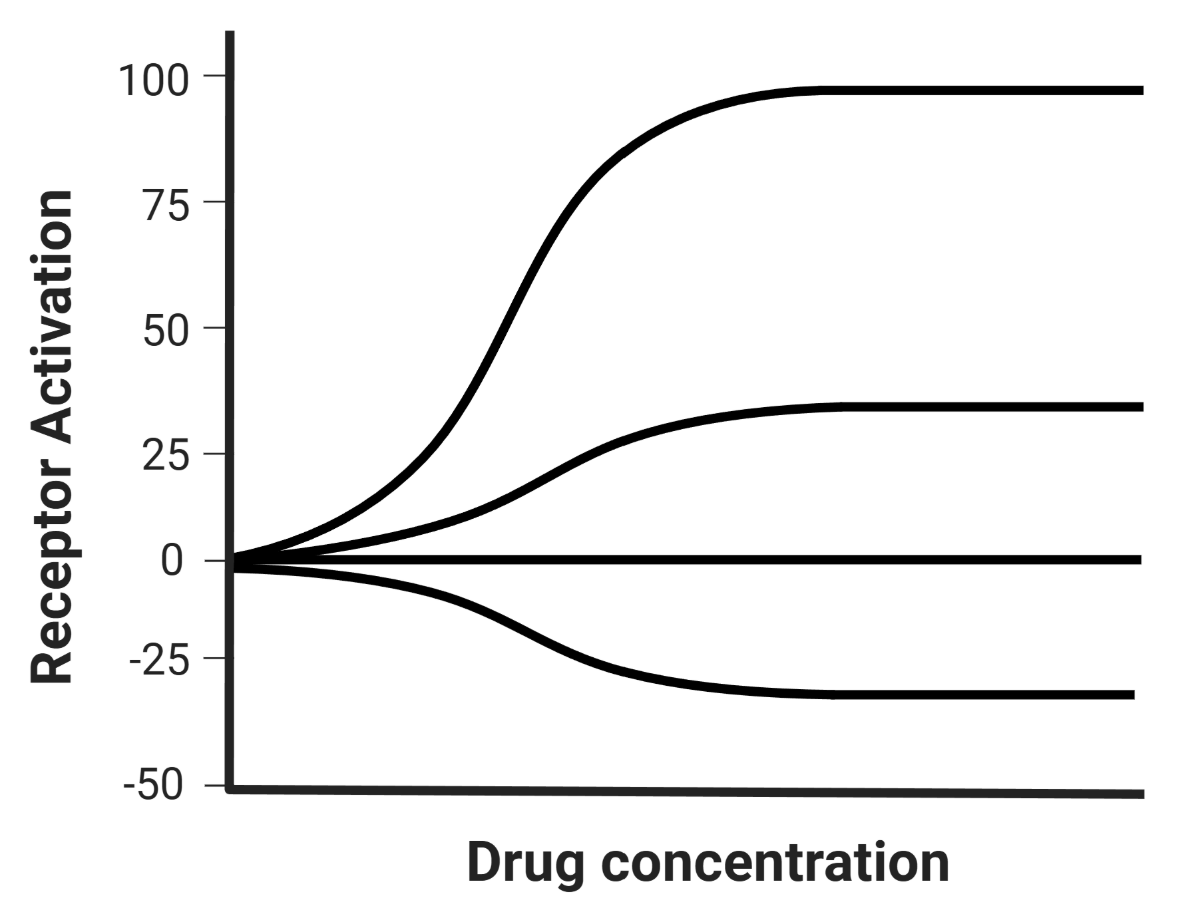
List what receptors represent each line on the dose-response curve:
full agonist
partial agonist
antagonist
inverse agonist
T/F: GPCRs always require an agonist for activation
false
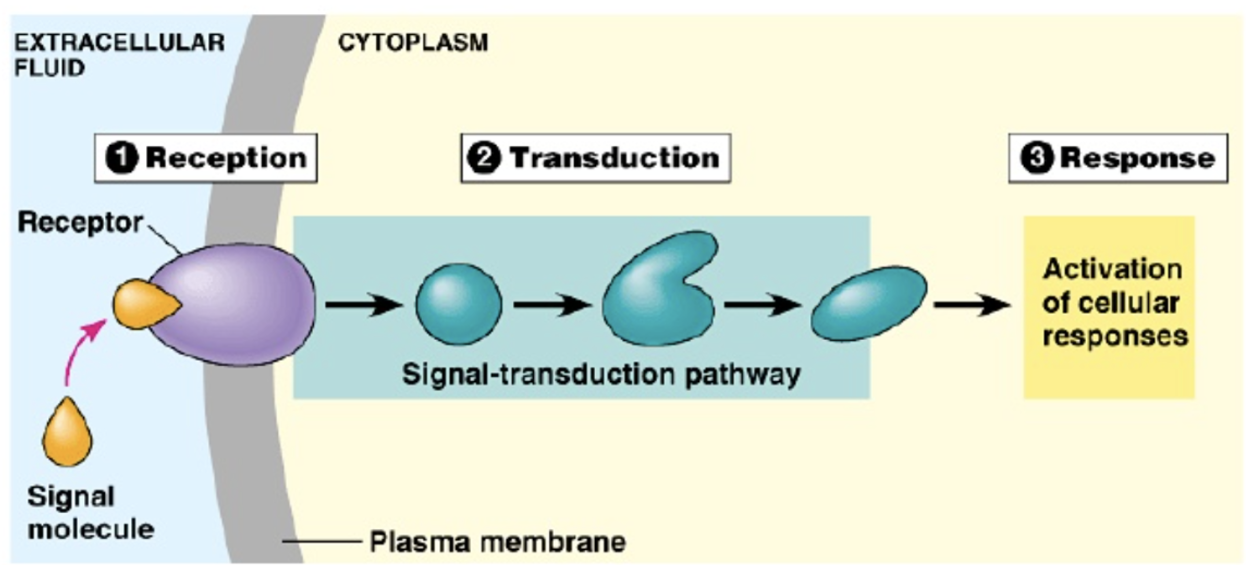
Which receptors are most accurately depicted by this graphic?
GPCRs, enzyme-linked receptors
A drug has a markedly delayed onset despite high receptor affinity. which receptor type does it most likely bind?
intracellular receptor
A drug has an immediate effect despite low receptor affinity. which receptor type does it most likely bind?
ion channel
Full, partial, and inverse agonists are terms commonly used to describe binding to which type of receptor?
GPCRs
 Note
Note  Flashcards (44)