Ch 10
5.0(1)
 Studied by 3 people
 Call Kai
 Learn
Learn Practice Test
 Spaced Repetition
 Match
Match Flashcards
 Knowt Play
Card Sorting
1/34

There's no tags or description
Looks like no tags are added yet.
Last updated 6:48 PM on 4/18/23
Name | Mastery | Learn | Test | Matching | Spaced | Call with Kai |
|---|
No analytics yet
Send a link to your students to track their progress
35 Terms
1
New cards
In a population of fruit flies, genetic changes from one generation to the next, leading to an increase in time until death from starvation, is evidence of ___.
Evolution
2
New cards
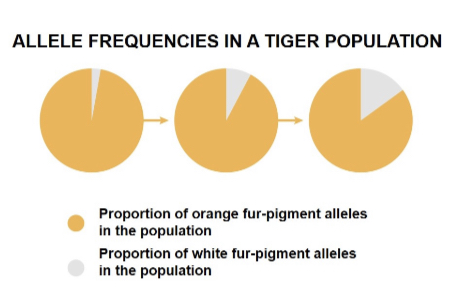
Using the results shown in this figure, has evolution occurred in this tiger population?
Yes
3
New cards
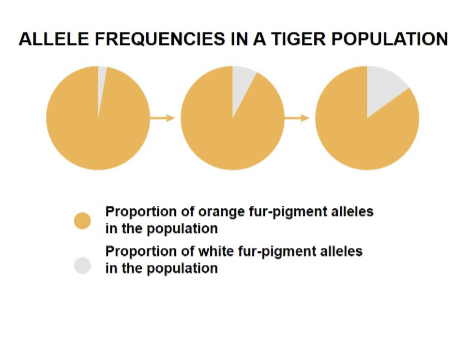
Is the evolution in this population a consequence of natural selection?
Maybe
4
New cards
The scientist who established that physical features of the earth were constantly changing over time was ___.
Charles Lyell
5
New cards
The discovery of fossilized remains of large animals no longer found on earth indicated that ___ was a fact.
Extinction
6
New cards
On the Galápagos Islands, Darwin noticed that finches were variable in their traits yet still closely resembled the single finch species living on mainland Ecuador. What could explain this pattern?
The mainland and island birds share a common ancestor
7
New cards
Darwin’s ideas were confirmed independently by ___, another biologist working in Malaysia
Alfred Russel Wallace
8
New cards
___ are the physical remains and traces of past life and provide direct evidence of evolution.
Fossils
9
New cards
Evolution is ___ level process and happens when an allele’s market share changes from one generation to the next.
A population
10
New cards
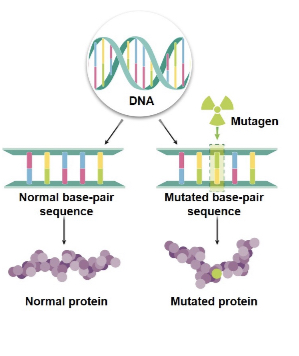
Which mechanism of evolution is illustrated here?
Mutation
11
New cards
Of the following, which is not a mechanism of evolution?
A. Mutation
B. Genetic drift
C. Migration
D. Natural selection
E. None of the above
A. Mutation
B. Genetic drift
C. Migration
D. Natural selection
E. None of the above
E. None of the above
12
New cards
The ultimate source of genetic variation in any population is ___.
Mutation
13
New cards
Genetic drift is a mechanism of evolution that results from ___.
Random changes in allele frequencies
14
New cards
A natural disaster cause deaths of a large proportion of individuals in a population so that allele frequencies change in the population. This is an example of evolution caused by ___.
A bottleneck effect
15
New cards
Which is the best explanation for the increased frequency of polydactyly in the new population?
The new, isolated population had a higher frequency of the polydactyly allele
16
New cards
Which answer choice correctly identifies each requirement for natural selection?
A. 1-differential reproductive success, 2-heritability, 3-variation
B. 1-heritability, 2-variation, 3-differential reproductive success
C. 1-variation, 2-heritability, 3-differential reproductive success
A. 1-differential reproductive success, 2-heritability, 3-variation
B. 1-heritability, 2-variation, 3-differential reproductive success
C. 1-variation, 2-heritability, 3-differential reproductive success
C. 1-variation, 2-heritability, 3-differential reproductive success
17
New cards
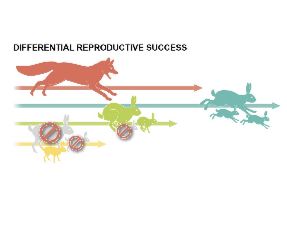
Describe what will happen in this figure.
The turquoise rabbits will survive, and the fast running trait will increase in frequency
18
New cards
Of the following, which is not a condition for natural selection to occur?
A. Variation in a trait within a population
B. Sexual reproduction
C. Heritability
D. Differential reproductive success
E. All of the above are necessary
A. Variation in a trait within a population
B. Sexual reproduction
C. Heritability
D. Differential reproductive success
E. All of the above are necessary
B. Sexual reproduction
19
New cards
In a population, more organisms struggle to survive, and some organisms are more likely to survive and reproduce, leading to ___ in the population.
Differential reproductive success
20
New cards
Fur color in kangaroo rats is controlled by a single gene with just two alleles. One allele occurs in the population at a frequency of 0.20, so you know that the frequency of the other allele is ___.
0\.80
21
New cards
An individual in a population who contributes many new individuals to the population has high ___.
Fitness
22
New cards
An inherited trait that enables an organism to survive and reproduce successfully in its environment is called ___.
An adaptation
23
New cards
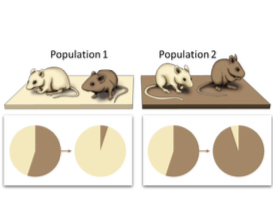
describe what is shown in the figure
Individuals with fur color similar to their environment will have higher fitness than those with contrasting fur color
24
New cards
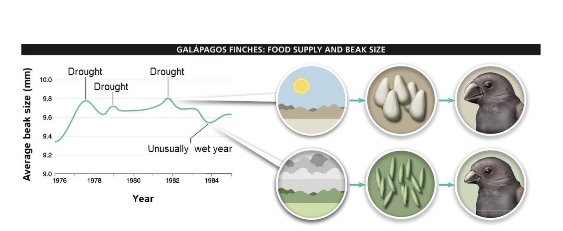
Explain the results in the figure
Finches with thinner beaks starve to death during drought years
25
New cards
Artificial selection is a special case of natural selection in which ___ determine(s) differential reproductive success among individuals in a population.
Humans
26
New cards
The elimination of extreme phenotypes in favor of an intermediate phenotype is the outcome of ___.
Stabilizing selection
27
New cards
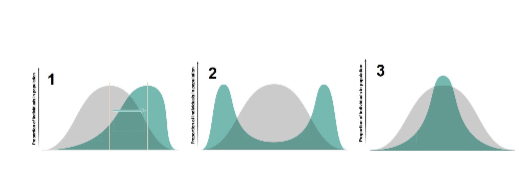
Species“X”variesinlengthfrom20to80cm.A predator is introduced that prefers individuals between 20 and 40 cm in length. Which of the three figures below reflects how length in “X” will change with this new pressure?
1
28
New cards
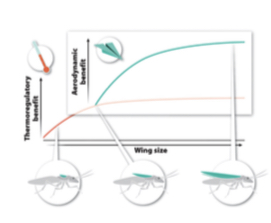
This figure illustrates that ___.
Selection originally favored the largest wings because they provided the greatest thermoregulatory benefit
29
New cards
The absolute age of a fossil is determined by ___.
Radiometric dating
30
New cards
The fossil record is incomplete because ___.
A. many fossils have yet to be discovered
B. soft-bodied organisms don’t preserve well
C. erosion events destroy fossils
D. decomposition can interfere with fossilization
E. All of the above
A. many fossils have yet to be discovered
B. soft-bodied organisms don’t preserve well
C. erosion events destroy fossils
D. decomposition can interfere with fossilization
E. All of the above
E. All of the above
31
New cards
Studying the patterns of distribution of life on earth is the science of ___ and evidence for evolution.
Biogeography
32
New cards
Two structures are defined as ___ if, even though different, they are found to have been inherited from a shared ancestor.
Homologous
33
New cards
___ offer(s) a direct measure of relatedness between organisms by analyzing similarities in ___.
Molecular biology, DNA and the products of DNA
34
New cards
True or False: evolution can be observed.
True
35
New cards
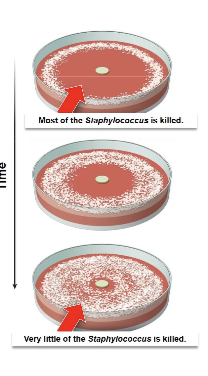
This figure is showing how the Staphylococcus population has ___.
Evolved resistance to the antibiotic secreted by the fungi
 Note
Note  Flashcards (87)