Bio 171 - Lecture 15 (B&C)
 Call Kai
 Learn
Learn Practice Test
 Spaced Repetition
 Match
Match Flashcards
 Knowt Play
1/49

Earn XP
Description and Tags
Meiosis
Name | Mastery | Learn | Test | Matching | Spaced | Call with Kai |
|---|
No analytics yet
Send a link to your students to track their progress
50 Terms
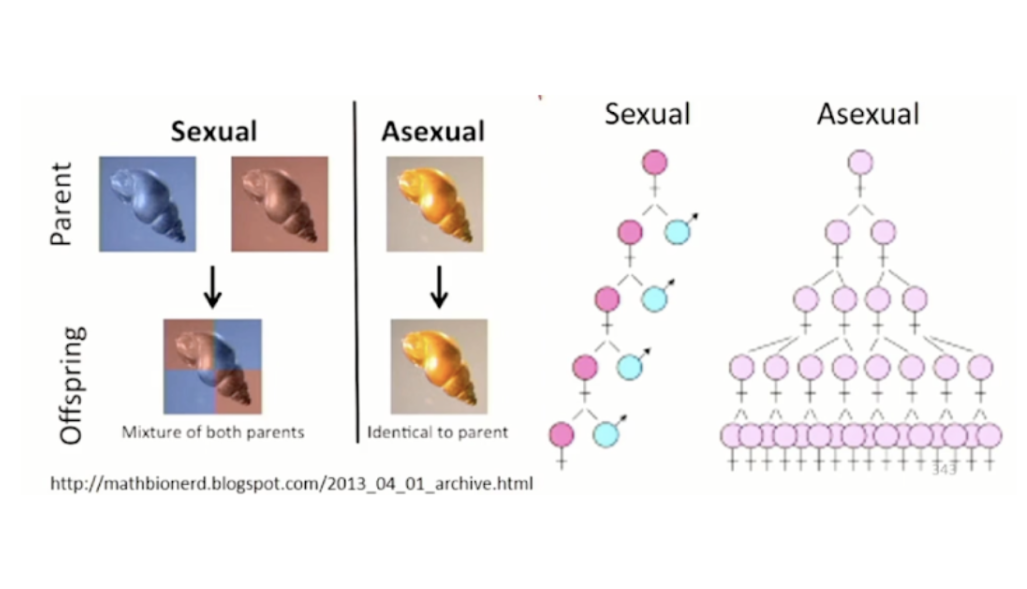
Reproduction
a fundamental property of living things
can be sexual or asexual
different types of sexual and asexual organisms
some shift from one to the other
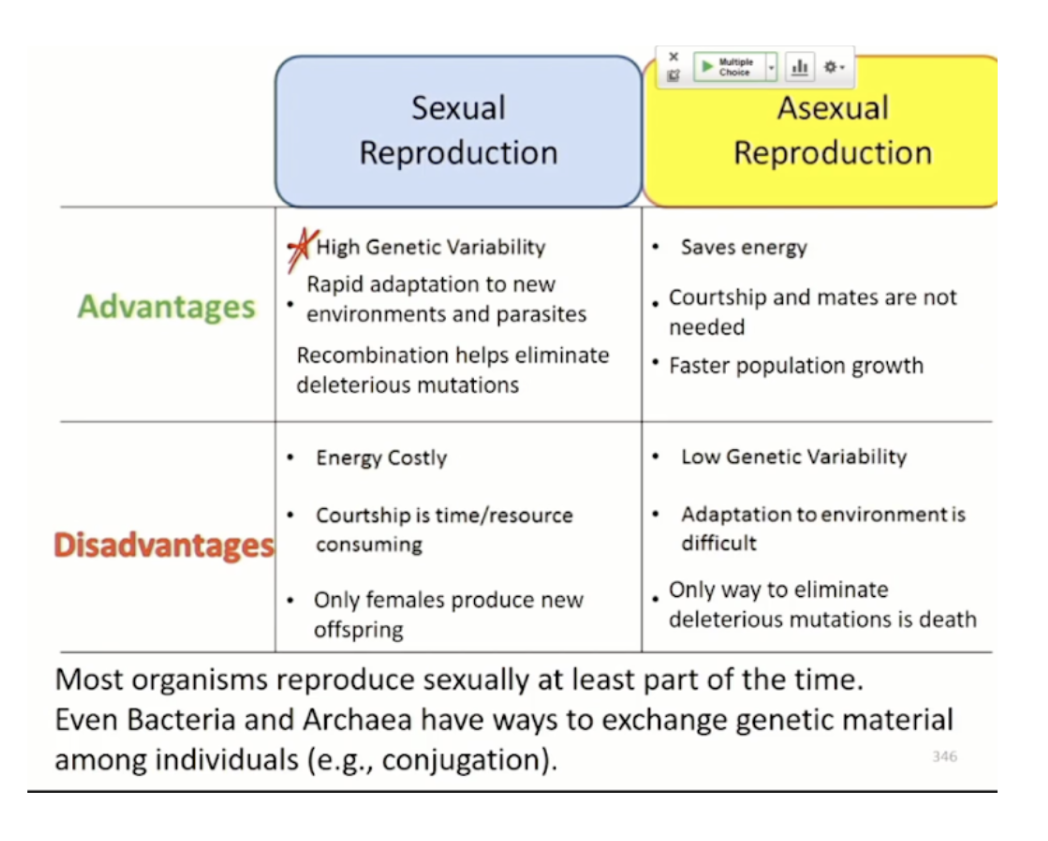
asexual reproduction
one parent produces genetically identical offspring (clonal
sexual reproduction
2 individuals combine genetic information and produce offspring that are genetically different from parents
contain half of the DNA of each parent
you can have faster population growth with _______ reproduction
asexual
_______ limit population growth
females
in ________ reproduction there all females so their all contributing to population growth
asexual
(because there all having babies where in sexual reproduction only half of them are)
in humans germ cells are in the _______ and _______
testes, ovaries
at the end of meiosis you have ________ cells
haploid (n)
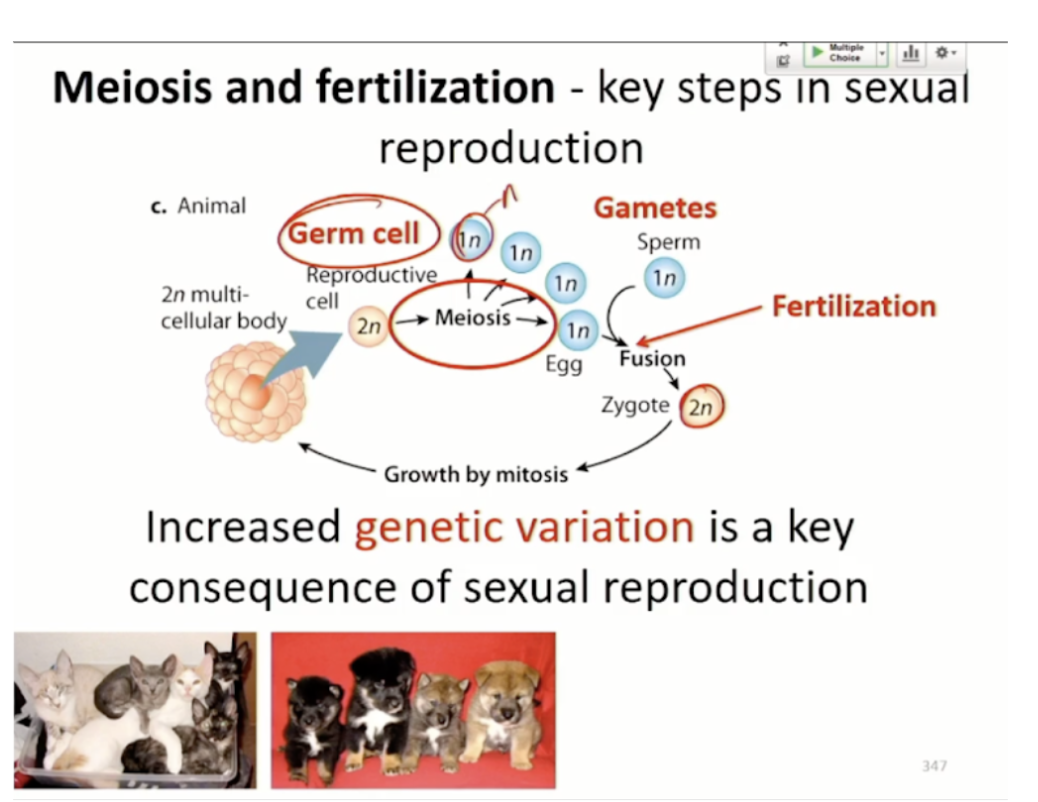
the end process of of meiosis in a germ cell, in an ovary is an ______
the end process in a testis is _______
______ when they fuse (fertilization)
end up with a _______
egg, sperm, haploid, zygote
what is the end result of of the proces of meiosis
4 gametes
genetically distinct from parent cells
eggs or sperm
how many rounds of cell division occur in in meiosis?
2 rounds
how many daughter cells are produced? ploidy?
4 haploid daughter cells
what kind of cells undergo meiosis? where are the cells located?
germ cells, ovaries and testes
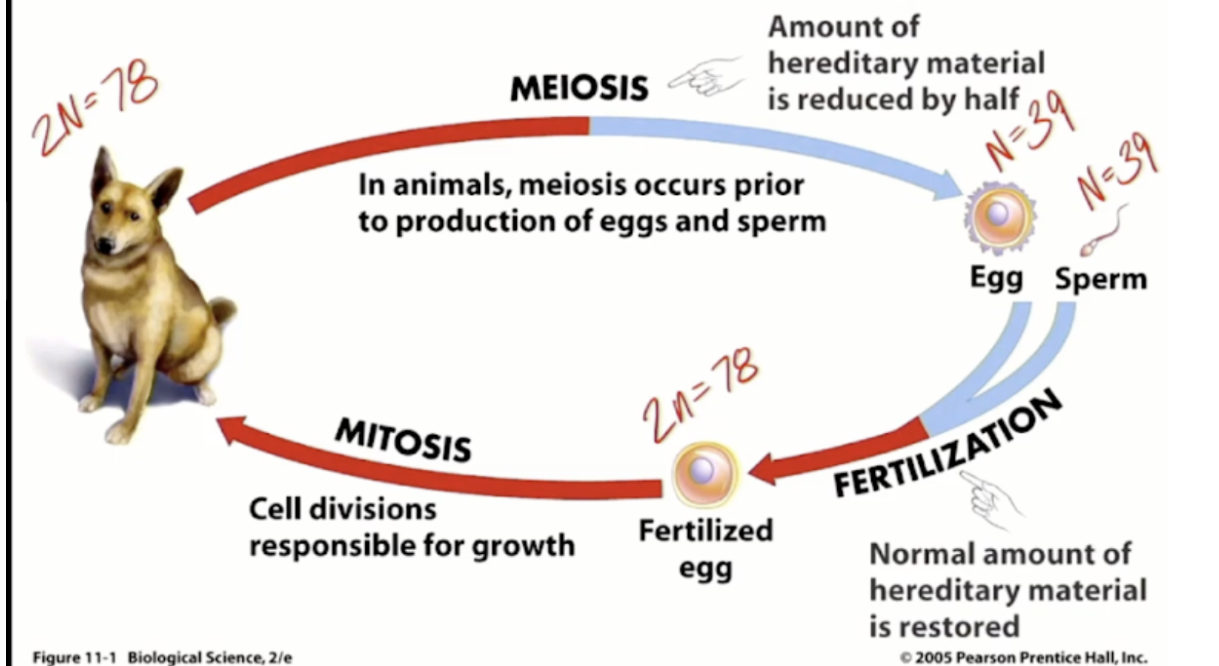
meiosis produces _____ cells that have ______ as many chromosomes as the parental _____ cell
haploid, half, diploid
meiosis occurs in _______ cells that have pairs of ____________ chromosomes
diploid, homologous
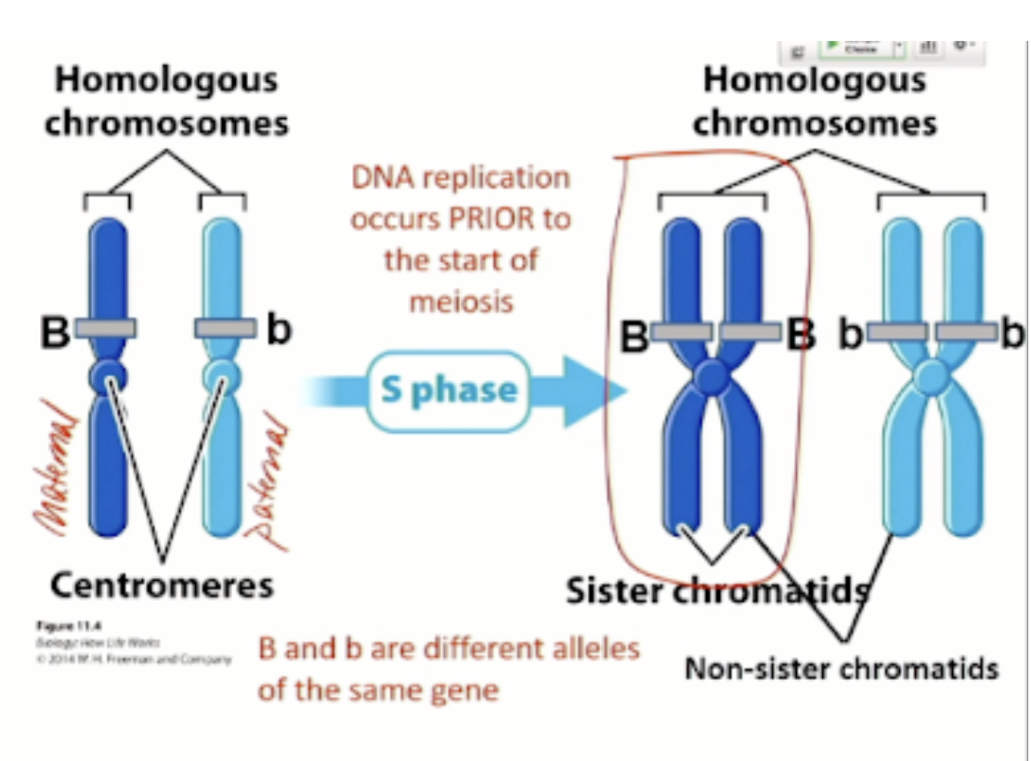
characteristics of homologous chromosomes
similar in size and shape
have same genes, in the same order
have similar (but not identical) DNA sequences
can have different alleles of the same genes
unreplicated
maternal & paternal
DNA _________ happens before the start of meiosis
replication
after S-phase then we have _______ ___________
sister chromatids
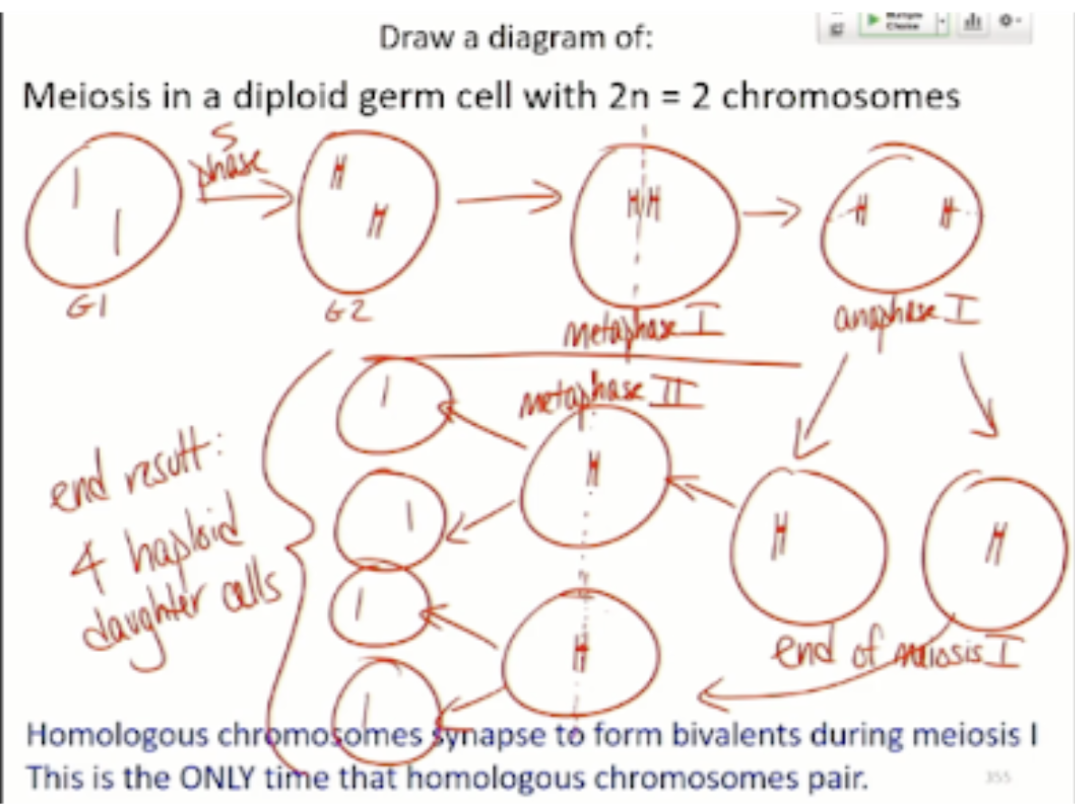
Meiosis in a diploid germ cell with 2n = 2 chromosomes
Meiosis 1
Start with 2 homologous chromosomes
S-phase
End up with 2 replicated chromosomes
Metaphase 1
Homologous chromosomes line up on metaphase plate (only time they line up together)
Anaphase 1
Move to opposite ends of the cells
End of meiosis 1
1 of those chromosomes in one cell and the other chromosomes in the other cell
haploid
Meiosis 2
Metaphase 2
End result is 4 haploid daughter cells
Genetically different
maternal and paternal chromosome ________ during meiosis
recombine
_________ holds homologous chromosomes together
chiasmata
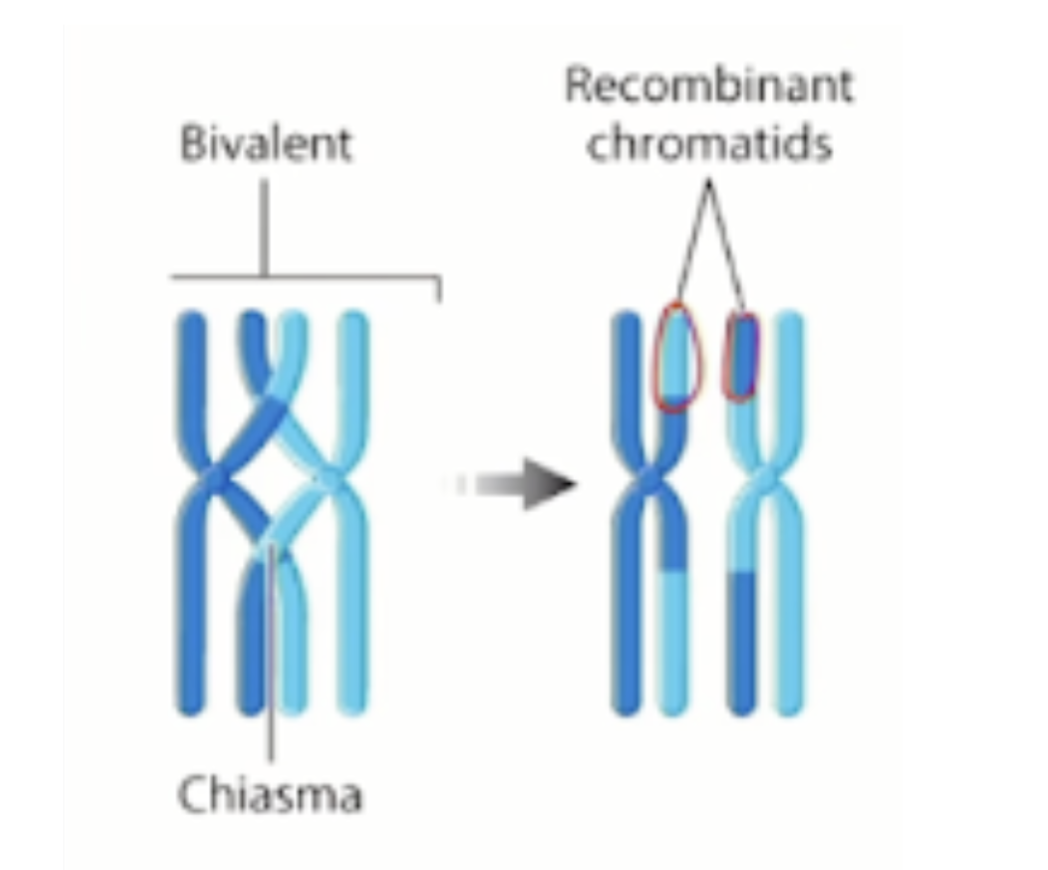
increase in genetic variation cause DNA exchange between ________ ___________ resulting in recombination between maternal and paternal chromosomes
non-sister chromatids
1-3 chiasmata typically form per chromosome during __________
prophase 1
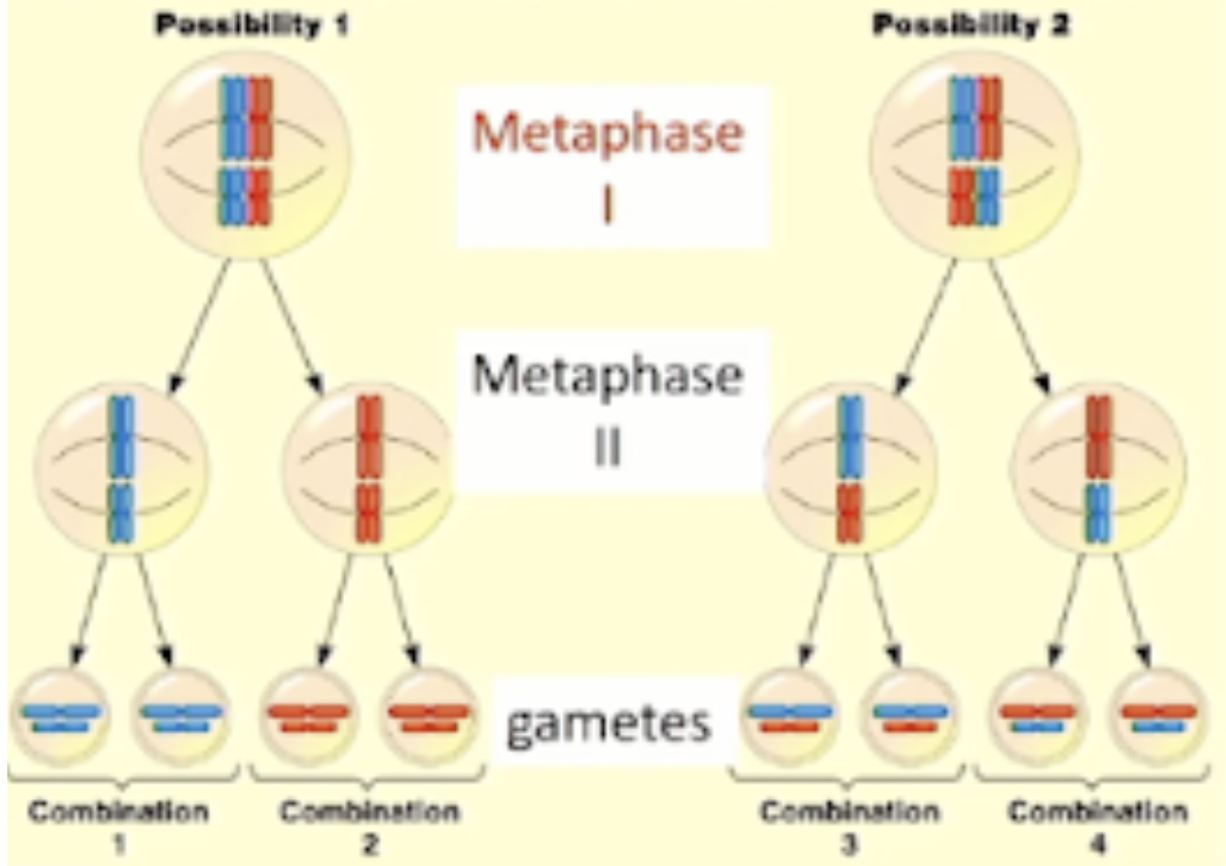
homologous chromosomes assort ______________
in the end have ___ different possible combinations in gametes
independently, 4
to figure out number of combination
2n combinations, where n = haploid # of chromosomes
One human can make gametes with 223 or 8 million different combinations of chromosomes
male and female gametes combine ________ at fertilization
the possible egg and sperm is random which end up _________
randomly, fusing
what type of cell division only occurs in eukaryotes and in somatic cells
mitosis
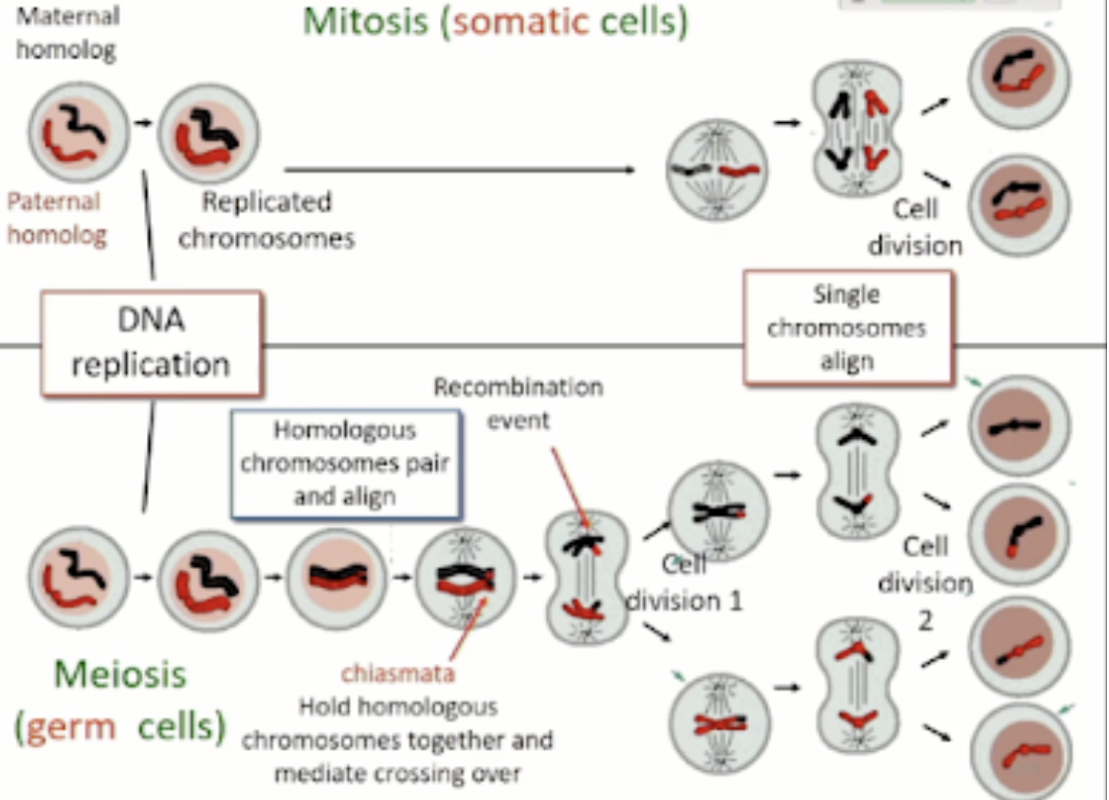
mitosis produces 2 genetically ________ daughter cells
identical
what type of cell division occurs only in eukaryotes and in germ cells?
meiosis
meiosis produces 4 daughter cells (gametes) and the daughter cells are genetically _________
different
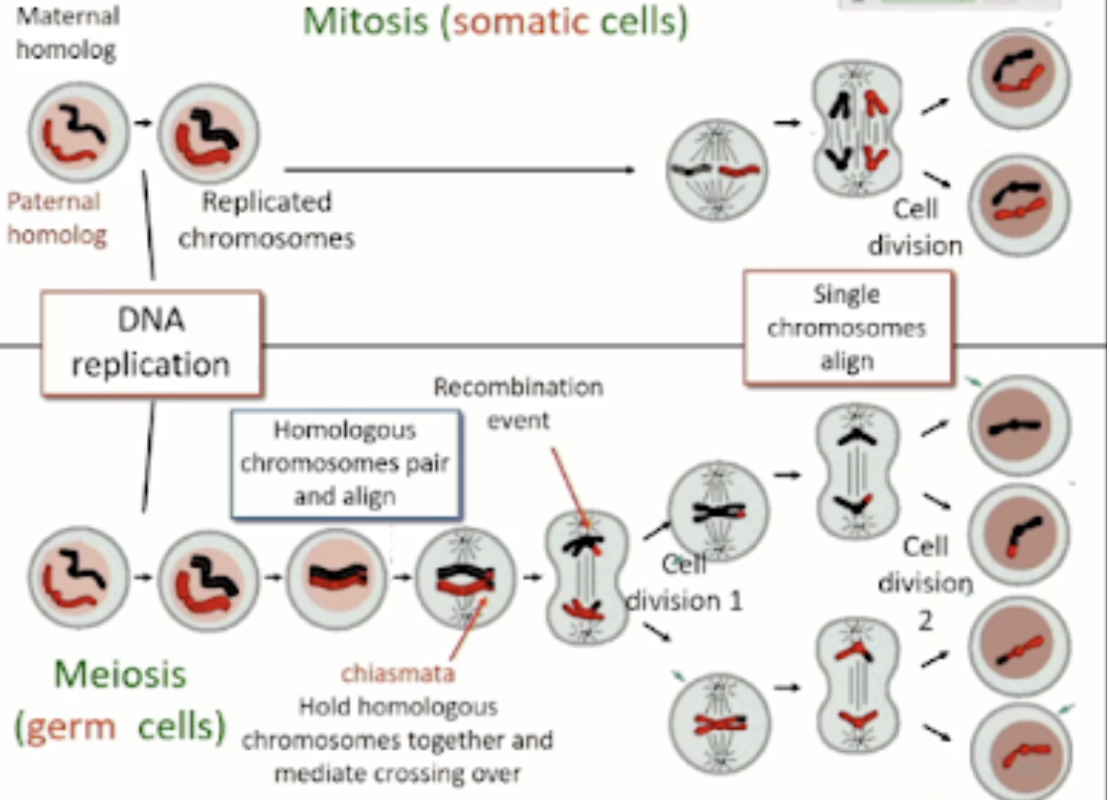
Compare and contrast the functions of mitosis and meiosis in eukaryotes.
Feature | Mitosis | Meiosis |
Purpose | Growth, repair, asexual reproduction. | Production of gametes (sex cells) for sexual reproduction. |
Location | Occurs in somatic cells (all body cells except germ cells). | Occurs in germ cells (in ovaries/testes or equivalent plant structures). |
Number of Divisions | One. | Two (Meiosis I and Meiosis II). |
DNA Replication | Once, before division. | Once, before Meiosis I. |
Synapsis (Pairing) | No. Homologous chromosomes do not pair up. | Yes. In Prophase I, homologous chromosomes pair up to form tetrads. |
Crossing Over | No. | Yes. Occurs during Prophase I when homologous chromosomes are paired. |
Chromosome Number in Daughter Cells | Same as parent cell (diploid). | Half the number of the parent cell (haploid). |
Genetic Composition of Daughter Cells | Genetically identical to each other and to the parent cell. | Genetically different from each other and from the parent cell due to crossing over and independent assortment. |
Number of Daughter Cells | Two. | Four. |
Identify cell division in a life cycle; apply key steps in the cell cycle to a life cycle of a eukaryotic organism.
Mitosis is for growth and maintenance of the multicellular body. It occurs constantly in somatic cells.
Meiosis is a specialized event that happens only in germ cells to produce haploid gametes.
Fertilization restores the diploid number, creating a zygote that then undergoes mitosis to develop into a new organism.
Compare and contrast sexual and asexual reproduction; describe evolutionary advantages and disadvantages of sexual and asexual reproduction
Feature | Asexual Reproduction | Sexual Reproduction |
Parents | One. | Two (typically). |
Offspring Genetics | Genetically identical to the parent (clones). | Genetically unique; a combination of both parents. |
Cell Division Used | Mitosis (or binary fission in prokaryotes). | Meiosis (to make gametes) + Fertilization. |
Time & Energy | Fast, efficient, no need to find a mate. | Slower, requires more energy and the risk of finding a mate. |
Evolutionary Advantage | Stability. If the parent is well-adapted to a stable environment, all offspring will be equally successful. Allows for rapid colonization. | Variation. In a changing or unpredictable environment, some offspring are likely to have a trait that helps them survive. It allows populations to adapt faster. |
Evolutionary Disadvantage | Lack of variation. If the environment changes (e.g., new disease, climate shift), the entire population may be wiped out as they are all susceptible. | Dilution of good genes. A successful parent only passes on 50% of its genes to each offspring. The other 50% from the other parent might not be as advantageous. |
Explain the function of germ cells in multicellular organisms
Germ Cells: Specialized cells in multicellular organisms (located in reproductive organs) that are set aside for reproduction. They are diploid and their sole function is to undergo meiosis to produce haploid gametes. They are the "bridge" to the next generation.
In a multicellular organism, describe the genetic information found in somatic cells, germ cells and gametes.
Feature | Somatic Cells | Germ Cells | Gametes (Sperm/Egg) |
Ploidy | Diploid (2n) | Diploid (2n) | Haploid (n) |
Chromosome Number (Human Example) | 46 chromosomes (23 pairs) | 46 chromosomes (23 pairs) | 23 chromosomes (one from each pair) |
DNA Content (C-value) | 2C (before S phase) | 2C (before S phase) | 1C |
Genetic Composition | Genetically identical to each other and the original zygote (under normal mitosis). Contains a full set of genetic instructions for the organism. | Contains a full set of genetic instructions, but DNA has been replicated (4C) just before meiosis begins. This is the only place where crossing over occurs. | Genetically unique. Contains only one allele for each gene. Combination is the result of crossing over and independent assortment. |
Homologous Chromosomes | Present. For every chromosome, there are two copies (homologous pairs). | Present. Homologous chromosomes exist and will pair up during Meiosis I. | Absent. Only one copy of each chromosome type exists. |
Sister Chromatids | Absent in G1. Present in G2 and M phase (before anaphase). | Present after S phase (just before Meiosis I begins). | Absent in mature gametes. (They separate in Meiosis II). |
Function of Genetic Material | To code for proteins that allow the cell to perform its specific job (muscle contraction, nerve impulse, etc.). | To be recombined (crossing over), divided by reduction (Meiosis I), and then divided again (Meiosis II) to produce haploid gametes. | To fuse with another gamete during fertilization to restore the diploid number and create a genetically unique zygote. |
Describe how ploidy differs before, during, and after meiosis
Before meiosis begins: 2n (diploid)
After DNA replication but before division: still 2n, but 4 copies of DNA (4C)
After Meiosis I: n (haploid), but each cell has 2 sister chromatids per chromosome
After Meiosis II: n, single chromatids — true haploid gametes
how to interpret a karyotype
1. Count the Total Number of Chromosomes
The Rule: A normal human cell should have 46 chromosomes.
Look: Just count the distinct structures (each centromere counts as one chromosome, even if it looks like an "X").
Abnormality: If you count 47 or 45, you have identified a condition called aneuploidy.
2. Look for Homologous Pairs
The Rule: Chromosomes are arranged in 23 pairs. Pairs 1 through 22 are autosomes (non-sex chromosomes). Pair 23 is the sex chromosomes.
Look: Check if every chromosome has a partner that is the same size and shape.
Abnormality: If a chromosome is missing its partner (an unpaired chromosome at the end), something is wrong.
3. Identify the Sex (Biological Sex)
The Rule:
If pair #23 consists of two large chromosomes that look the same (both have the centromere in the middle), they are X chromosomes. The genetic sex is Female (XX) .
If pair #23 consists of one large chromosome (X) and one small, squiggle-shaped chromosome (Y) , the genetic sex is Male (XY) .
Explain the impact of recombination, independent assortment, and random fertilization on genetic variation
Crossing Over (Recombination): it shuffles alleles within a chromosome, creating new combinations.
Independent Assortment: During Metaphase I of meiosis, the way the homologous chromosome pairs line up at the equator is random. For a human with 23 pairs, this creates 2^23 (over 8 million) possible combinations of chromosomes in the gametes, just from this one process alone.
Random Fertilization: Any one sperm (from 8 million possibilities) can fuse with any one egg (from 8 million possibilities). This results in a zygote that is one of 2^23 * 2^23 = 2^46 (over 70 trillion) possible genetic combinations, not even counting the effects of crossing over.
What are some examples of organisms that reproduce asexually?
Bacteria (binary fission), yeast (budding), hydra (budding), aphids (parthenogenesis), Komodo dragons (facultative parthenogenesis), many plants (runners, tubers, cuttings).
When in a life cycle do mitosis and meiosis occur? What is the result of meiosis?
Mitosis: Occurs throughout the life of a multicellular organism. It is responsible for growth, development, and repair of somatic (body) cells. In unicellular organisms, it is the basis of asexual reproduction.
Meiosis: Occurs only at a specific time in the life cycle, usually when the organism is mature and ready to reproduce. It happens in the germ cells located in the reproductive organs (ovaries and testes in animals).
Result of Meiosis: The production of four genetically unique haploid (n) gametes (sperm or egg cells)
Why does meiosis requires at least 2n DNA content
Meiosis I separates homologous chromosomes — one from each pair goes to each daughter cell. If there is only one copy of each chromosome (already haploid), there are no homologs to separate, and meiosis I cannot occur properly.
How might two sister chromatids acquire different alleles of the same gene? How might two non-sister chromatids of the same homologous pair acquire different alleles of the same gene?
Sister Chromatids: Sister chromatids are produced by DNA replication and are initially identical copies of each other. They can only acquire different alleles if a mutation occurs in one of them during or after the replication process.
Non-Sister Chromatids (of the same homologous pair): Non-sister chromatids come from different parents (one maternal, one paternal). They already may have different alleles to begin with. Additionally, during crossing over in Prophase I of meiosis, they exchange segments of DNA, which can create new combinations of alleles on each chromatid.
What events occur in each part of meiosis? What key parts of meiosis do you need to know so you can trace the movement of genetic information between germ cells and gametes?
Before Meiosis (S Phase): DNA replicates. Each chromosome now consists of two identical sister chromatids. The cell is still diploid (2n), but now has 4x DNA (4C).
Meiosis I (Reduction Division):
Prophase I: Crossing over occurs between non-sister chromatids of homologous chromosomes, shuffling alleles.
Metaphase I: Homologous pairs (tetrads) line up at the metaphase plate. Independent assortment occurs here.
Anaphase I: Homologous chromosomes (each still made of two sister chromatids) separate and move to opposite poles.
Telophase I: Two cells form. Each cell is now haploid (n) , but each chromosome is still duplicated.
Meiosis II (Equational Division):
Metaphase II: Chromosomes (still duplicated) line up singly.
Anaphase II: Sister chromatids separate.
End Result: Four haploid (n) , genetically unique gametes, each with unduplicated chromosomes.
If there are two rounds of cell division during meiosis, does that also mean DNA replication occurs twice?
No. DNA replication occurs only once. It happens during the S phase before Meiosis I begins. The two rounds of division (Meiosis I and Meiosis II) serve to separate the chromosomes twice: first separating homologous chromosomes, then separating sister chromatids.
What is the ploidy of the cells undergoing meiosis after meiosis I and after meiosis II, assuming we start with a diploid germ cell?
After Meiosis I: The two cells are Haploid (n) . They have one complete set of chromosomes, but each chromosome is still duplicated (consists of two sister chromatids).
After Meiosis II: The four cells are Haploid (n) . They have one complete set of unduplicated, single chromosomes.
What are the 3 key places where genetic variation increases during meiosis? How much variation is gained by each of these?
Crossing Over (in Prophase I):
Variation gained: Creates new combinations of alleles on a single chromosome. The number of possible combinations is essentially infinite, as crossovers can occur at nearly any point along the chromosome.
Independent Assortment (in Metaphase I):
Variation gained: The number of possible ways the homologous pairs can line up is 2^n, where n is the haploid number. For humans (n=23), this is over 8 million (2^23) different combinations of chromosomes in the gametes.
Random Fertilization:
Variation gained: Any one sperm (from 8 million+ possibilities) can fuse with any one egg (from 8 million+ possibilities). This results in 2^n × 2^n = 2^46 possible combinations, which for humans is over 70 trillion, not even counting the variation from crossing over.
In independent assortment, describe what is assorting independently. If a germ cell with 2n = 4 undergoes meiosis, how many unique gametes will result, assuming no mutations occur?
What is assorting independently? The homologous chromosomes (specifically, the maternal and paternal chromosomes within each pair) assort independently of each other. Which pole the maternal chromosome of pair #1 goes to does not affect which pole the maternal chromosome of pair #2 goes to. They line up and separate randomly.
Calculation for 2n=4 (n=2):
Number of unique gametes from independent assortment = 2^n = 2^2 = 4 unique gametes.
How does meiosis differ from mitosis? How are the two processes similar?
Both involve DNA replication before division and use the same mechanical machinery (spindle, centromeres). Mitosis: one division → 2 diploid identical daughter cells. Meiosis: two divisions → 4 haploid genetically unique cells; includes pairing of homologs, crossing over, and independent assortment — none of which occur in mitosis.
recombination
Recombination happens during Prophase I of meiosis, inside the cell's nucleus. At this point, homologous chromosomes (one maternal, one paternal) have already replicated and are paired up tightly in a structure called a bivalent (or tetrad — 4 chromatids total). While paired, non-sister chromatids from opposite homologs physically break and rejoin at points called chiasmata. The result is that segments of maternal and paternal DNA are swapped onto the same chromosome strand, creating a brand-new combination of alleles that never existed before.
The key insight: recombination shuffles alleles within a chromosome. A single chromosome that was entirely "mom's" can come out with some of dad's alleles inserted into the middle of it.
independent assortment
happens at Metaphase I, when all the bivalents (paired homologs) line up at the middle of the cell. The key is that each homologous pair lines up independently of every other pair. There's no rule that says "all the maternal chromosomes go to the same side." Each pair randomly orients itself — maternal could go left or right — and it doesn't influence what any other pair does.
When Anaphase I pulls them apart, each daughter cell gets a random mixture of maternal and paternal chromosomes. With 2 pairs (2n = 4), there are 2² = 4 possible gamete combinations. With humans (23 pairs), that's 2²³ ≈ 8 million possible combinations from assortment alone.

