Lipids and Membranes
 Call Kai
 Learn
Learn Practice Test
 Spaced Repetition
 Match
Match Flashcards
 Knowt Play
1/25

There's no tags or description
Looks like no tags are added yet.
Name | Mastery | Learn | Test | Matching | Spaced | Call with Kai |
|---|
No analytics yet
Send a link to your students to track their progress
26 Terms
What are lipids
Non-polar organic compounds, not soluble in water
What are the 3 main biological functions of lipids
membrane forming/ structural
energy storage
Precursors to signalling molecules
What are fatty acids composed of
Carboxylic acid with long carbon chains
can be saturated or unsaturated
What fatty acids have higher melting points saturated or unsaturated and why
Saturated fatty acids have higher melting points than unsaturated fatty acids
Saturated fatty acids have linear chains, this means they pack more closely together, this means there are more hydrophobic interactions
So more energy is needed to break the hydrophobic interactions
Unsaturated fatty acids have non-linear chains and chains are bent, this means they can’t pack closely together, there are less hydrophobic interactions, so less energy is needed to break the interactions
What are polyunsaturated fatty acids used for
Signal molecule precursors e.g
Arachidonic acid is the precursor for prostaglandins
What are the main functions of triacylglycerols
How are triacylglycerols formed
The main function is energy storage
Formed by condensation reactions of 3 fatty acid molecules with one glycerol
This forms ester bonds and 3 mol of water is released
What are phospholipids and what is their function
An amphipathic molecule
Hydrophilic head group ( contains heteroatoms)
Hydrophobic lipid tail group ( fatty acids)
They are structural lipids used to form membranes
What is the function of cholesterol (2)
It increases fluidity of the membrane as it decreases packing making the membrane more rigid
It is a precursor for biosynthesis
E.g
It is a precursor for testosterone, cholic acid, Vitamin D3
What is compartmentalisation for membranes
Lipids membranes create compartments where different reactions occur and is an essential part of cellular machinery and so competing metabolic processes can be carried out simultaneously
What is the role of compartmentalisation and membranes
structure and containment
Control internal conditions of compartment
Control passage of molecules
Receive and transmit messages
What do phospholipids do in aqueous environments
They self-assemble and form non-covalent interactions with each other
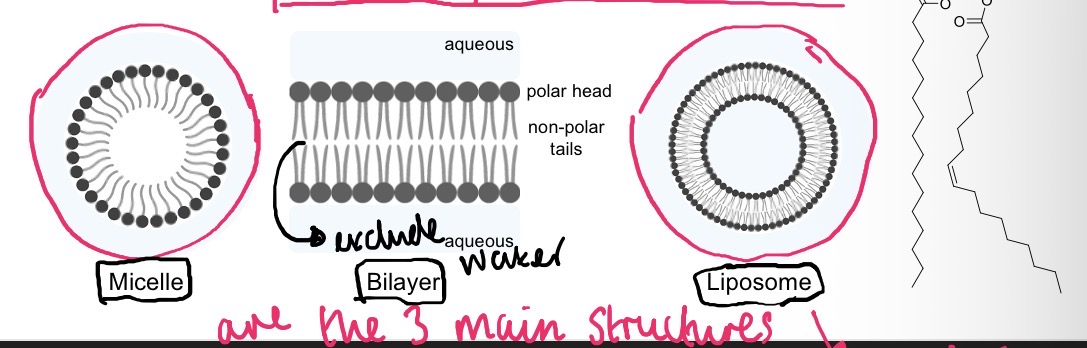
What are the 3 main structures lipids form when they self assemble and why are these favourable
Micelles
Phospholipid bilayer
Liposomes
They maximise favourable interactions and expel water
What are the main characteristics of the lipid bilayer?
What does it let in, what doesn’t it let in
it is fluid ( cholesterol)
impermeable to water and polar compounds
permeable to small uncharged compounds, lipid-soluble compounds and water (via aquaporins)
What is the eukaryotic cell membrane composed of
phospholipids
Carbohydrates used for signalling ( glycoproteins/ glycolipids)
Proteins : used for transport and signalling ( peripheral or integral)
Cholesterol
What are the two different membrane proteins
Integral proteins
Peripheral proteins
Are membranes asymmetrical or symmetrical and why
Asymmetrical
as different lipids, proteins and carbohydrates are unevenly distributed between the inner and outer layer of the membrane
It is important to have the correct protein orientation for function
What are the two main methods of membrane transport
transmembrane proteins selectively transporting specific molecules and ions
Endocytosis or exocytosis ( bulk transport and required membrane fluidity)
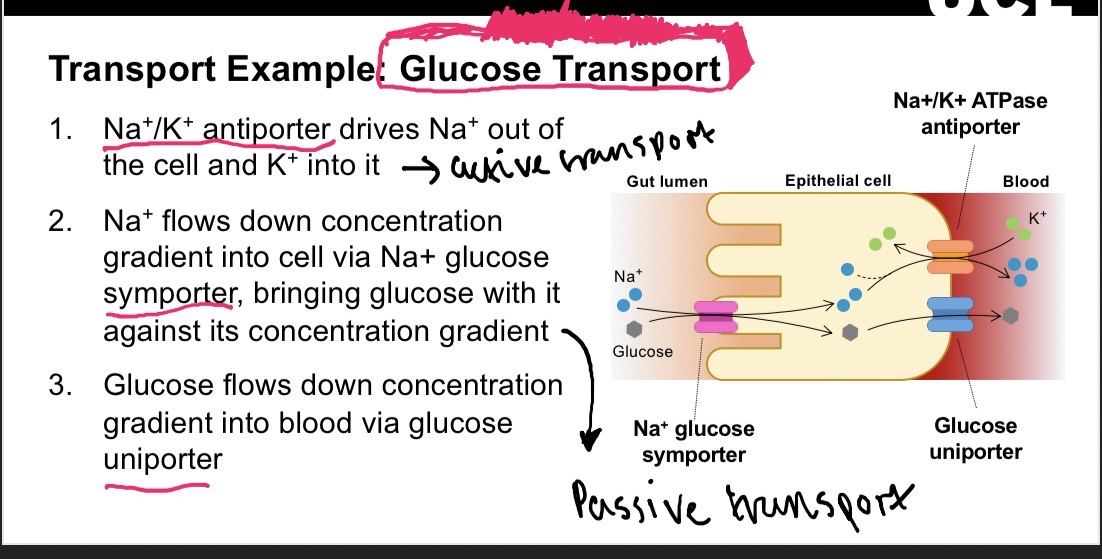
What is passive diffusion
The solute/ion is conveyed down it’s concentration gradient
Doesn’t require metabolic energy
What are the three different types of passive diffusion
simple passive diffusion across a membrane
Simple passive diffusion via a channel ( water and aquaporins)
Facilitated passive diffusion via carrier proteins
What is active transport
Solute/ion travels against its concentration gradient bua a carrier protein
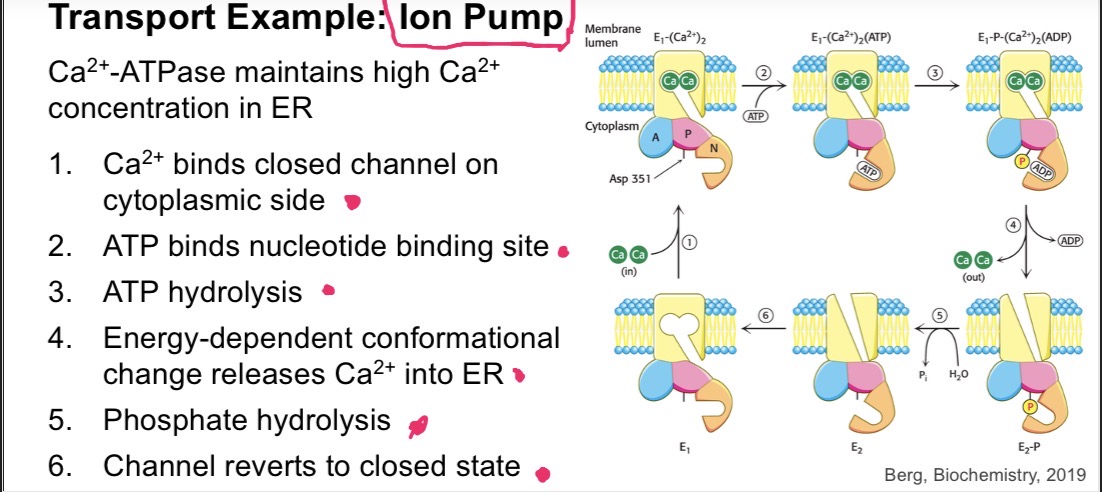
Requires metabolic energy (ATP)
What happens to the carrier protein in active transport
ATP binds to the carrier protein and is hydrolysed causing a conformational change in the carrier protein
What are the three different types of carrier proteins
uniport : transport of one type of specific solute
symport : transport of two solutes in the same direction
Antiport: transport of two solutes in different directions
How is glucose transported into the blood from the ileum
How is a high Ca2+ concentration maintained in the ER
What happens to the membrane during Endocytosis
The membrane creates a vesicle by sealing itself around the substance
The membrane then self heals
Examples of Endocytosis
Phagocytosis

