Comprehensive Guide to Atmospheric Dispersion, Photochemistry, and Air Quality Models
 Studied by 0 people
 Call with Kai
 Learn
Learn Practice Test
 Spaced Repetition
 Match
Match Flashcards
 Knowt Play
1/90

There's no tags or description
Looks like no tags are added yet.
Name | Mastery | Learn | Test | Matching | Spaced | Call with Kai |
|---|
No study sessions yet.
91 Terms
What is atmospheric dispersion modeling?
The prediction of the dispersal of air pollutants in the atmosphere.
What factors influence pollutant dispersal in the atmosphere?
Local meteorology, including temperature, wind speed, direction, and atmospheric stability.
Why is atmospheric dispersion modeling important?
It plays a useful role in air pollution engineering, despite models being imperfect.
Who stated, 'All models are wrong ... some are useful'?
George E.P. Box in 1987.
What happens to a pollutant stream emitted from a stack?
It rises, bends over, and travels with the wind, dispersing horizontally and vertically.
What causes pollutants to disperse in the atmosphere?
Diffusion and eddies in turbulent flow, which can be caused by thermal and mechanical means.
What is the Gaussian Dispersion Equation used for?
Modeling the dispersion of a nonreactive gaseous pollutant from an elevated source.
How does downwind concentration relate to source strength?
The downwind concentration at any location is proportional to the source strength, Q.
What is the relationship between downwind concentration and wind speed?
The downwind ground level concentration is generally inversely proportional to wind speed.
What happens to elevated plume centerline concentrations as downwind distance increases?
They decline with increasing distance.
What is the effect of atmospheric turbulence on dispersion parameters?
Dispersion parameters 𝜎𝑦 and 𝜎𝑧 increase with increasing atmospheric turbulence (instability).
What method was developed for estimating dispersion coefficients?
A quantitative method developed by Pasquill and Gifford in the early 1960s.
What conditions were used for the tests conducted to estimate dispersion coefficients?
Tests were conducted in level, open terrain using short-term concentrations along with emissions rates and wind speed.
How are atmospheric conditions classified for dispersion modeling?
They are grouped into six stability classifications to determine the 𝜎𝑦 and 𝜎𝑧 dispersion coefficients.
What happens to maximum ground level concentrations as effective stack height increases?
The maximum ground level concentrations decrease as effective stack height increases.
What is the significance of the distance from the stack with maximum concentration?
It increases with stack height.
What does the Gaussian model use to account for underground emissions?
It creates a fictitious image source underground to capture predicted dispersion of pollutants.
How does wind velocity change with altitude according to the power law?
Wind velocity generally increases with height, approximated by the formula: u2/u1 = (z2/z1)^p, where p varies based on atmospheric stability.
What is the significance of the EPA treating Gaussian model concentrations as 1-hour averages?
To be conservative, as longer time-averaged concentrations are expected to be lower due to wind shifts and turbulence.
Where do maximum downwind ground level concentrations occur according to the Gaussian model?
They occur on the plume centerline and decrease with distance.
What effect do elevated inversions have on pollutant dispersion?
They act as a lid, preventing upward dispersion and reflecting pollutants similarly to ground reflection.
What is fumigation in the context of air quality modeling?
Fumigation occurs when an unstable boundary layer grows into a fanning plume, mixing it vertically throughout the distance to the ground.
What factors influence plume rise of gases emitted from a stack?
Plume rise is influenced by stack parameters such as molecular weight, exit temperature, and velocity.
What is plume downwash?
It is the phenomenon where air flowing past a structure creates a low-pressure region, leading to recirculating eddies and a wake.
What are the primary functions of air quality models?
They simulate physical and chemical processes affecting air pollutants, helping to identify source contributions and design reduction strategies.
How can air quality models assist during the permitting process?
They verify that new sources will not exceed ambient air quality standards and determine additional control requirements if necessary.
What are the three most commonly used air quality models?
Dispersion modeling, photochemical modeling, and receptor modeling.
What is the purpose of dispersion modeling?
To estimate the concentration of pollutants at specified ground-level receptors surrounding an emissions source.
What does photochemical modeling assess?
It simulates impacts from all sources by estimating pollutant concentrations and deposition over large spatial scales.
What is receptor modeling used for?
It identifies and quantifies source contributions to receptor concentrations using observational techniques.
What are the potential sources of human exposure to pollutants?
Contact with contaminated air, water, soils, food, drugs, and consumer products.
What is a key characteristic of human exposure to pollutants?
Exposures may be dominated by a single medium or involve concurrent contacts with multiple media.
What two factors largely determine the nature and extent of pollutant exposures?
Human factors and the concentrations of a pollutant in the exposure media.
What does the EPA use modeling results for?
To inform regulatory decision-making processes when setting standards, such as the National Ambient Air Quality Standards (NAAQS).
What was the focus of the EPRI's 2019 Risk Screening Assessment?
Analyzing risks related to hazardous air pollutant (HAP) emissions from combustion turbines after implementing the CT NESHAP.
How many facilities did EPRI analyze for potential screening-level risks?
251 facilities.
What models did EPRI use in their analysis?
Human Exposure Model (HEM3), AERMOD, and TRIM.FaTE.
What was the outcome of the EPRI analysis regarding environmental risk?
All facilities analyzed showed potential adverse environmental risk below EPA environmental screening thresholds.
What is cross-state air pollution?
Pollution emitted at one location (upwind) that is blown by wind to another location (downwind).
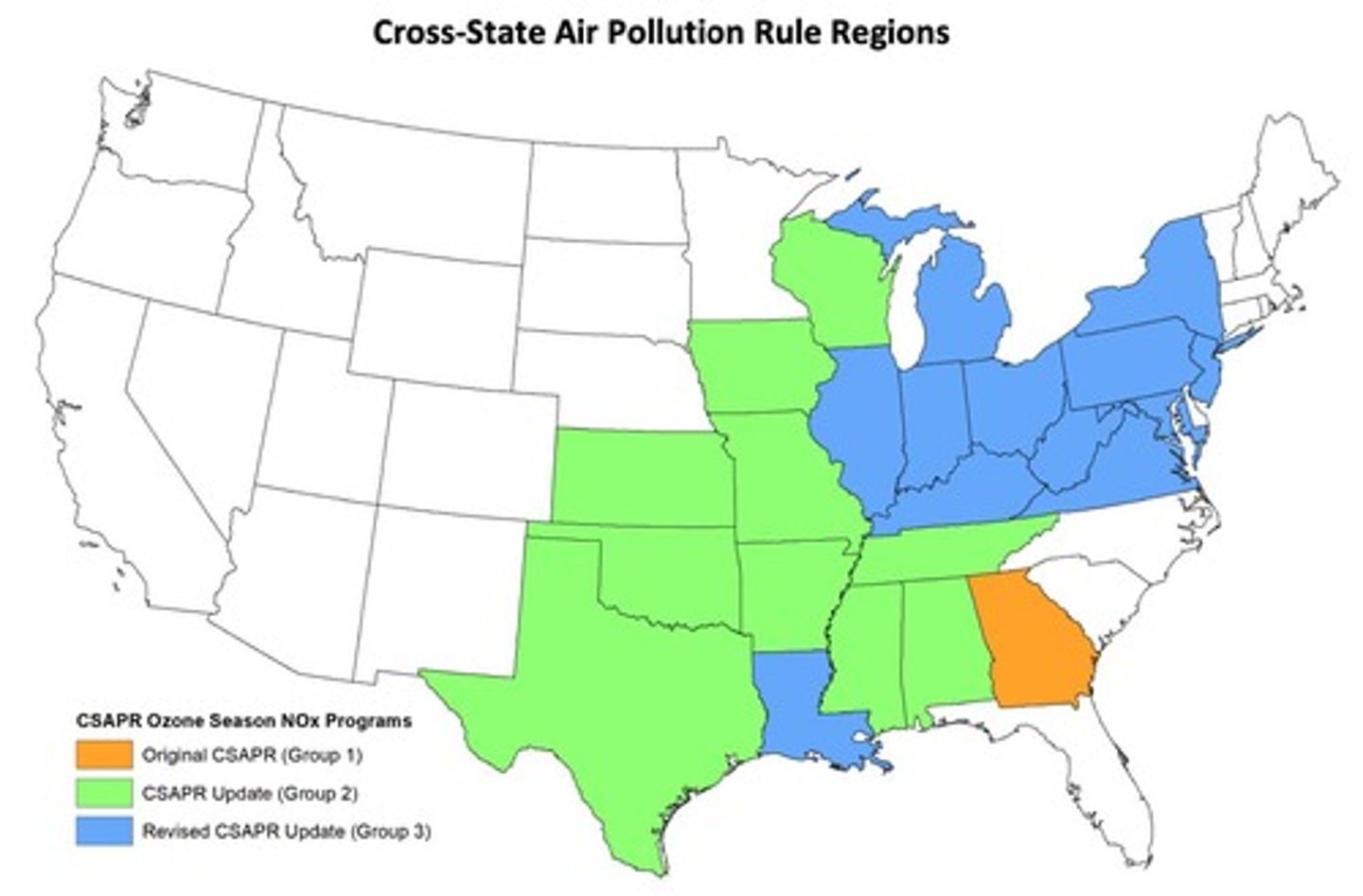
Which pollutants can travel great distances and affect regional air quality?
Sulfur dioxide (SO2) and nitrogen oxides (NOX), which can form fine particle pollution (PM2.5) and ground-level ozone.
What does the Clean Air Act (CAA) require states to do regarding interstate transport of air pollution?
States must submit State Implementation Plans (SIPs) to eliminate significant pollution contributions to nonattainment of NAAQS.
What happens if states do not submit approvable SIPs according to the CAA?
The EPA is required to issue Federal Implementation Plans (FIPs) to address interstate pollution.
What is the first step in the EPA's process to address transport for the ozone NAAQS?
Identify downwind receptors expected to have problems attaining or maintaining the NAAQS.
What does the EPA use to determine which upwind states contribute to downwind air quality problems?
Computer modeling to assess contributions above a minimum threshold.
What is the purpose of emissions trading programs?
To reduce emissions effectively while allowing individual sources flexibility in compliance.
What are some alternative names for emissions trading programs?
Cap and trade, cap and invest, allowance trading, or market-based emissions reduction programs.
What was the Acid Rain Program (ARP)?
The first large-scale cap and trade program initiated in 1995 affecting coal-burning electric utility plants.
What geographic conditions favor the implementation of emissions trading programs?
When environmental and public health concerns span a large area, and emissions sources are numerous and measurable.
What was the outcome of most emissions trading programs?
They have reduced emissions earlier than and beyond the original reduction goals.
What pollutants can NOX emissions create when they react in the atmosphere?
Ground-level ozone (smog) pollution.
What is the significance of the EPA's 2021 CSAPR Update Rule?
It addressed emissions in certain states by updating the emissions trading program for NOx.
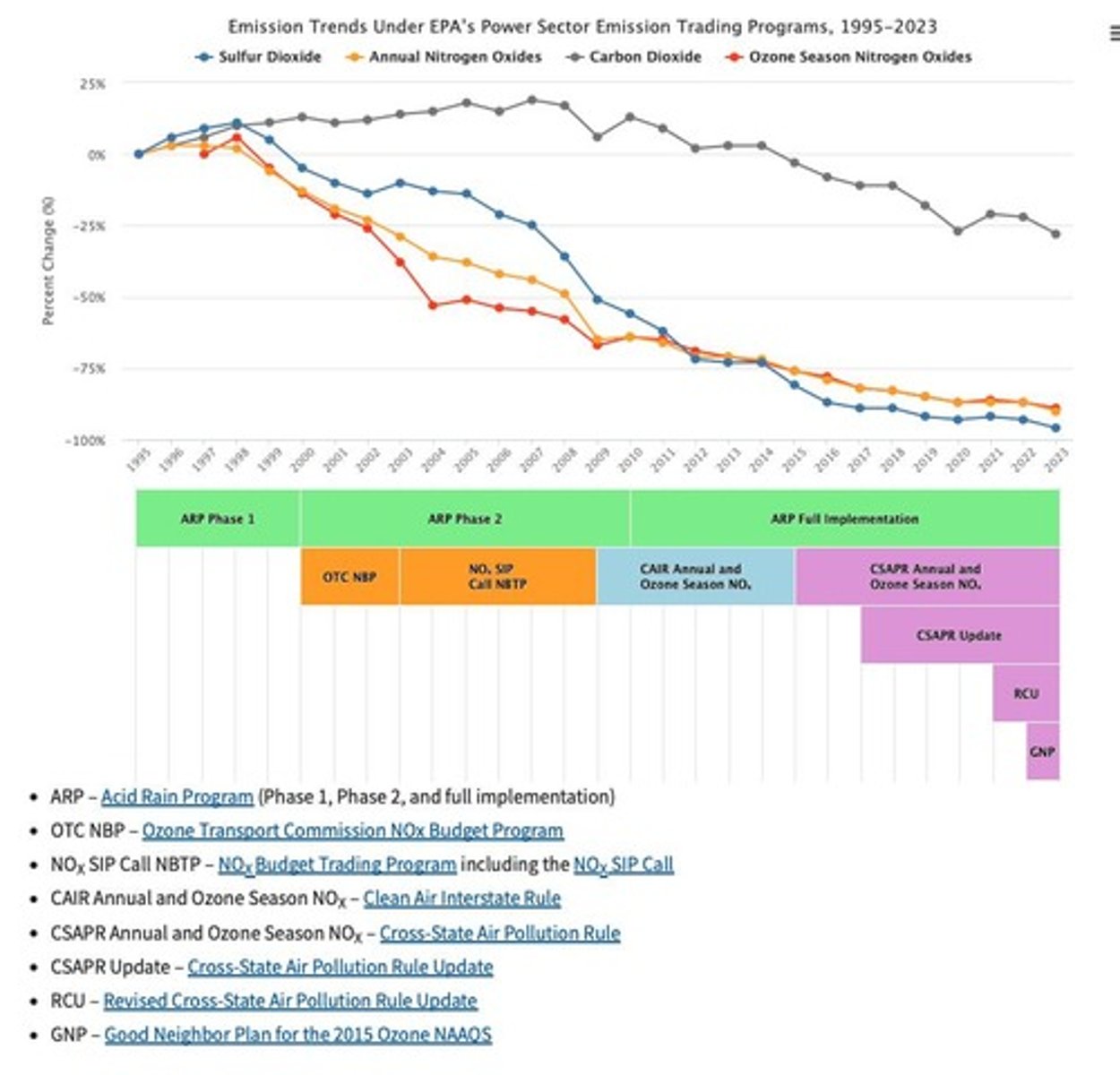
What is the purpose of emissions caps in trading programs?
To set a national, state, or regional limit on the overall amount of emissions allowed, incentivizing effective pollution control and protecting public health.
What happens to emissions caps over time in some trading programs?
They may decrease in phases to ensure overall emission reduction goals are achieved.
What do sources in a trading program receive to authorize emissions?
Allowances that permit them to emit a certain amount of pollution over a specific time.
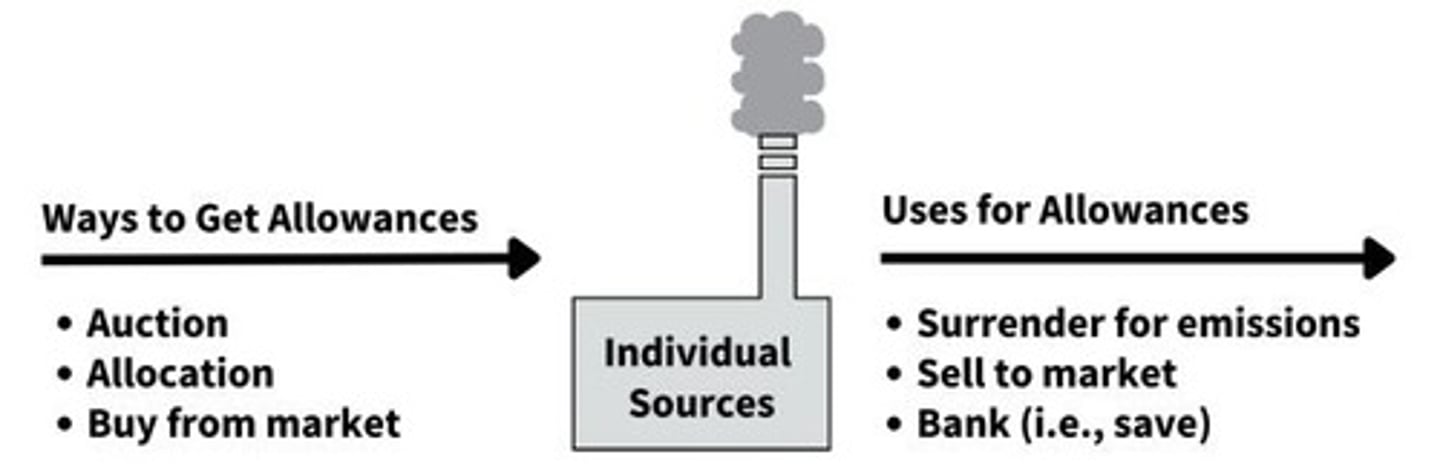
In the EPA's Acid Rain Program, what does each allowance authorize?
Each allowance authorizes a source to emit one ton of SO2 during an annual compliance period.
How can sources utilize their allowances in emissions trading programs?
They can cover emissions, sell them in the market, or bank them for future use.
What flexibility do emissions trading programs provide for compliance?
They allow sources to choose an optimal compliance approach, such as trading allowances or reducing emissions below the cap.
What is one benefit of banking allowances for later use?
It encourages sources to reduce emissions below the cap early, resulting in more emission reductions sooner than required.
List one option sources have for complying with emissions caps.
Install emission reduction control technologies, such as FGD or SCR.
What atmospheric pollution type did Los Angeles experience post-World War II?
Smog.
What geographical features exacerbated Los Angeles smog?
Mountains on three sides and an ocean on the fourth.
What was found to cause the injurious effects of smog in Los Angeles?
Oxidants, primarily ozone, produced in the lower atmosphere.
What two compounds are involved in the photochemical smog formation process?
Nitrogen oxides (NOx) and various hydrocarbons.
What is the formula that represents the qualitative relationship for ozone formation?
PPL = (ROG)(NOx)(Light Intensity)(Temperature) / (Wind Velocity)(Inversion Height).
What does PPL stand for in the context of photochemical pollution?
Photochemical pollution level.
What condition can trap emissions close to the ground?
An inversion, where the ambient temperature increases with altitude.
What is photochemistry?
The branch of chemistry concerned with the chemical effects of light.
What type of radiation can cause photochemical reactions?
Ultraviolet, visible, or infrared radiation.
Which molecule can absorb light to cause photochemical dissociation?
Nitrogen Dioxide (NO2).
How is a photon of light represented mathematically?
h𝜐, where h is Planck's constant and 𝜐 is the light frequency.
What is the formula for the energy of a photon?
E = h𝜐 = hc/𝜆, where c is the velocity of light and 𝜆 is the wavelength.
What is the energy required to dissociate 1 gmol of NO2?
Approximately 72 kcal/gmol at wavelengths less than 4000 Å.
What is the photolytic cycle of nitrogen dioxide?
NO2 + hυ → NO + O; O + O2 → O3; O3 + NO → NO2 + O2.
What provides an additional pathway for the conversion of NO to NO2?
Photochemical oxidation of reactive organic gases (ROG).
What are reactive organic gases (ROG)?
Primarily olefinic compounds, aromatic compounds, and aldehydes.
What is the reaction of ROGs with atomic oxygen and ozone?
ROG + O + O3 → R• + ሶROC + RO• + OH•.
How do peroxy radicals (RO2•) contribute to ozone formation?
They react with NO to provide an alternative NO to NO2 conversion pathway: RO2• + NO → RO• + NO2.
What is the outcome of hydrocarbon oxidation in the atmosphere?
Hydrocarbons are oxidized to form carbon dioxide and water.
What is a major chain-terminating reaction in photochemical smog?
The reaction between hydroxyl radical and NO2 to form nitric acid: OH• + NO2 → HNO3.
How does reducing ROGs affect ozone production?
It always leads to a slowing of ozone production with constant NOx.
What happens when the ratio of ROG to NOx is greater than 6?
There is a shortage of NO, and NOx levels control O3 formation.
What occurs when the ratio of ROG to NOx is less than 5?
Reducing NOx levels can actually increase the amount of ozone produced.
What factors affect general atmospheric circulation patterns?
Solar heating and cooling, friction layer, Earth's rotation, topography, and surface heating variations.
What is the air pressure gradient force?
It causes air to move from areas of high pressure to low pressure.
What is the Coriolis force?
A deflective force due to Earth's rotation, affecting wind direction.
What is the Dry Adiabatic Lapse Rate (DALR)?
The rate at which dry air cools adiabatically with height, approximately 0.98° C per 100 meters.
What is the Wet Adiabatic Lapse Rate (WALR)?
The lapse rate for saturated air, approximately 3° F per 1,000 feet.
What is a temperature inversion?
A stable atmosphere where the actual lapse rate is negative, trapping emissions near the ground.
What is a frontal inversion?
Occurs at high altitudes when a warm air mass overruns a cold air mass.
What is a subsidence inversion?
Occurs when cold dry air flows onto a land mass surrounded by mountains, affecting large areas.
What is a radiation inversion?
Occurs at low levels during clear weather and light winds, caused by rapid ground cooling.
 Note
Note  Flashcards (22)