Bio 1010- Exam 1 Study Guide
 Studied by 0 people
 Call with Kai
 Learn
Learn Practice Test
 Spaced Repetition
 Match
Match Flashcards
 Knowt Play
1/331

There's no tags or description
Looks like no tags are added yet.
Name | Mastery | Learn | Test | Matching | Spaced | Call with Kai |
|---|
No analytics yet
Send a link to your students to track their progress
332 Terms
What is Life?
It’s everywhere!!
It’s Diverse
Around 8.7 million species on Earth (doesn’t include bacteria)
Some species aren’t even identified yet (i.e., depths of the ocean and ever-evolving bacterial species)
What are the Requirements of Life?
Must be organized
Requires materials and energy
Requires ability to reproduce and develop
Capability to respond to environment
Maintain an internal environment
Ability to adapt to environment(s)
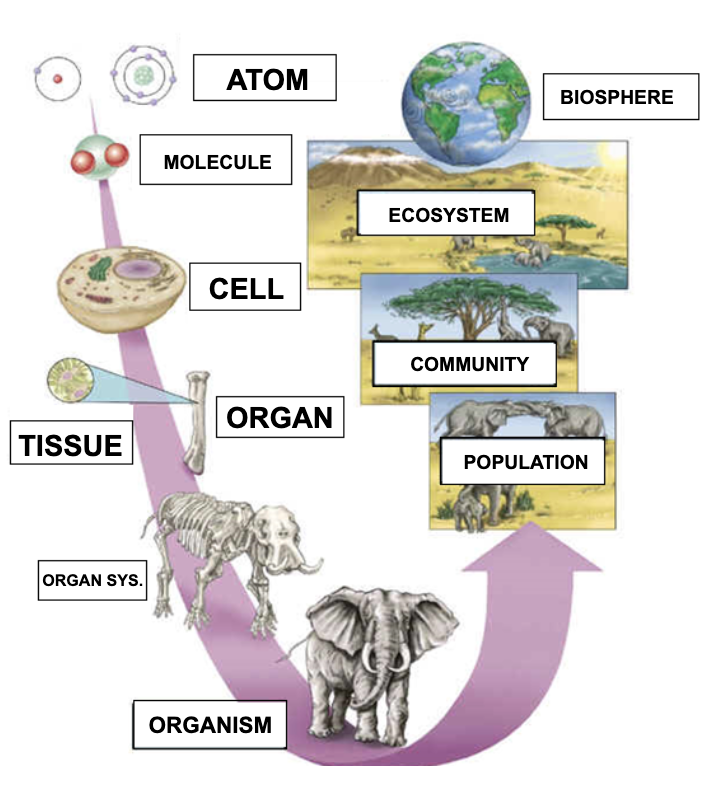
What is the following picture showing?
This picture is showing that life is Hierarchical (one of life’s requirements)
When talking about the Requirements of Life, what does “Must be Organized” mean?
It means that life is Hierarchical
(smallest)
Atom
Molecule
Cell
Tissue
Organ
Organ System
Organism
Species
Population
(largest)
What is: Atom?
Smallest unit of an element
What is: Molecule?
Two or more atoms joined together
What is: Cell?
Membrane-bound unit that contains fundamental molecules of life; all living organisms have cells
What is: Tissue?
Group of cells with common structure and function
What is: Organ?
Tissues that function together for a specific task
What is: Organ System?
Several organs that work together
What is: Organism?
An individual that contains organ systems
What is: Species?
Group of similar, interbreeding organisms
What is: Population?
Organisms of the same species within an area
When talking about the Requirements of Life, what does “Requires materials and energy” mean?
We need energy to survive and maintain our organ system
Food —> nutrients —> energy (ability to do work)
Plants make their own food using Carbon Dioxide, Water, and Sunlight (Autotrophs)
Humans must acquire materials and energy by eating foods from their environment (Heterotrophs)
Some nutrients are broken down to build things we need, such as proteins = metabolism
Ultimate energy source for all life on Earth = sun
What is: Metabolism?
Some nutrients are broken down to build things we need, such as proteins
What is: Sun?
It’s the ultimate energy source for all life on Earth
What is: Chemical Cycling?
Producers (plants) take in solar energy (from the sun), they’ll also use nutrients to make organic nutrients via photosynthesis
Consumers (humans, mammals) take up those organic nutrients that are produced by the producers
Decomposers recycle the nutrients from dead organisms and allows for inorganic nutrients to be returned to the producers again
Inorganic Nutrients is without _____; Organic Nutrients is with _____
carbon (x2)
What is: Energy Flow?
Sun —> plants —> other organisms —> returns to atmosphere as heat
When talking about the Requirements of Life, what does “Requires ability to reproduce and develop” mean?
“Life comes only from life”
Reproduction: make another organism like themselves
Genes pass on to the next generation
Ensures that offspring has a new set of new & different characteristics
Mutations provide variation in genetic information
Not all mutations are bad — allows for evolution!
What is: Reproduction?
The process of making another organism like themselves
T or F: ALL mutations are bad
False, some mutations allow for evolution to occur
When talking about the Requirements of Life, what does “Capability to respond to environment” mean?
We rely on information we receive AND perceive from the environment = stimuli
Ex: when you put a plant by a window, hormones within the plant detect sunlight, allowing the plant to bend toward the sun
What is: Stimuli?
We rely on information we receive and perceive from the environment
When talking about the Requirements of Life, what does “Maintain an internal environment” mean?
Internal environments (cells, your body) must be stable
This tendency toward a stable environment is called homeostasis
Ex: Body temperature, hunger
What is: Homeostasis?
Maintenance of a relatively constant internal environment by an organism, or even by a single cell
When talking about the Requirements of Life, what does “Ability to adapt to environment(s)” mean?
Environments can change quickly or over long periods of time
Either way, organisms must adapt to survive
When an organisms becomes more suited for a new environment, it is believed to have adapted to that environment
In result, they live longer and produce more offspring (natural selection)
What is: Taxonomy?
The discipline of identifying and grouping organisms
What is: Systematics?
The study of evolutionary relationships between species
What is: Taxa?
The basic classification strategies (organized from most to least inclusive)
Domain, Kingdom, Phylum, Class, Order, Family, Genus, and Species
What is the strategy to remember Taxa Groups?
Dear King Philip Came Over For Great S3x
Domain, Kingdom, Phylum, Class, Order, Family, Genus, and Species
What are the 3 domains of life?
Archaea
Bacteria
Eukarya
Why and how are organisms named?
They are named in a binomial fashion, created by Carolus Linnaeus
First word = Genus, ALWAYS capitalized
Second word = Specific epithet, ALWAYS lowercase
What’s the difference between typing and writing an organisms name?
Typing = names are always italicized
Writing = names are always underlined
T or F: Escherichia Coli is the correct way to format an organisms name
False, the specific epithet should be lowercase (Escherichia coli)
What is: Scientific Method?
Standard series of steps used in gaining new information
What is: Observation?
Formal way of watching the natural world
What is: Hypothesis?
A possible explanation for a natural event (must be an informed statement)
What is: Experiment?
Series of procedures to TEST a hypothesis
What are some challenges facing science?
Climate Change
Biodiversity and Habitat Loss
Diseases
Why is Climate Change a challenge that faces science?
Global warming
Increase in Carbon Dioxide and other gases in the atmosphere absorb and radiate heat back to earth via the Greenhouse Effect
Why is Biodiversity and Habitat Loss a challenge that faces science?
Biodiversity: total number and relative abundance of a species, gene variability, and different ecosystems in which they live
Extinction: death of a species
Threats to these mostly due to anthropogenic (human-caused) effects
Ex: Coral reefs and tropical rainforests
What is: Greenhouse Effect?
The increase of Carbon Dioxide and other gases in the atmosphere, that are absorbed and radiates heat back to earth
Like a sheet around Earth
What is: Biodiversity?
Total number and relative abundance of a species, gene variability, and different ecosystems in which they live
What is: Extinction?
Death of a species
What does anthropogenic effects mean?
They are human-caused
Why is Diseases a challenge that faces science?
Avian flu, swine flu, SARS, and MERS are emerging diseases because they are new to humans
Reemerging diseases are also of concern, but not as much because of low incidence levels of humans (ex: Ebola)
Bacteria grow very quickly (divide every 20 min) —> faster mutation rates —> can evolve faster —> can surprise us with diseases faster!
Life is ____, so we’ve got to have a way of organizing it so that it makes sense to us
diverse
Life has ___ _______ (in order for life to exist)
6 requirements
Doing science is ____ _____, mind boggling, yet ______
time consuming; rewarding
There are many _____ facing scientists today
challenges
Who was Anton van Leeuwenhoek, and why is he important?
He made some of the earliest microscopes
Who was Robert Hooke, and why is he important?
He confirmed Leeuwenhoek’s findings
Was the first to term the word “cell”
Was observing cork from a plant when he coined this term
What is: Cell Theory?
Organisms are made up of basic living units (cells)
All cells come from previously existing cells
What are the two types of cells?
Prokaryotic
Eukaryotic
What is: Prokaryotic Cell?
Lacks a membrane-bound nucleus
Includes bacteria and archaea
What is: Eukaryotic Cell?
Contains a membrane-bound nuclei that contains genetic info
Includes plants, fungi, animals, and protists
All cells (regardless of prokaryotic or eukaryotic) are surrounded by a _____ ______!!
Plasma Membrane
What is: Plasma Membrane?
Made of a phospholipid bilayer (containing phosphates and lipids)
Hydrophobic tails (water-fearing) are inside
Hydrophilic heads (water-loving) face outwards
Can be fluid - allows certain molecules to pass through freely
Fluid mosaic model - molecules are constantly moving
Can also be restrictive - proteins within the membrane that are selective to molecules that can leave/enter cell
What are the functions of the Plasma Membrane?
Separates contents of cell from surrounding environment
Regulation of molecule passage (physically protects the cell)
Identify the Domain of life (Archaea, Bacteria, or Eukaryotes)
Plasma Membrane: Yes
Nucleus: No
Ribosomes: Yes
This is describing BOTH Archaea and Bacteria
Identify the Domain of life (Archaea, Bacteria, or Eukaryotes)
Plasma Membrane: Yes
Nucleus: Yes
Ribosomes: Yes, larger than prokaryotic
This is describing Eukaryotes
What are the defining characteristics of a Eukaryotic Cell?
Distinguishing feature: possession of a nucleus
Some have cell walls that surround the plasma membrane (NOT animal cells and some protists)
Organelles: any well defined sub-cellular structure that performs a particular function
What is: Organelles?
Any well defined sub-cellular structure that performs a particular function
Both animal and plant cells are ______
eukaryotic
When talking about Eukaryotic Cells, the plant cell has a ____ ____, but the animal cell doesn’t
cell wall
What Organelles does the Animal Cell include?
Cytoskeleton
Cytoplasm
Nucleus
Endoplasmic reticulum
Rough
Smooth
Mitochondria
Golgi apparatus
Lysosome
What is the function of: Cytoskeleton?
Maintains cell shape & movement of cell parts
What is the function of: Cytoplasm?
Semifluid matrix outside nucleus that contains organelles
What is the function of: Nucleus?
“Brain” of cell that contains genetic material
What is the function of: Rough ER?
Has ribosomes; processes proteins
What is the function of: Smooth ER?
Doesn’t have ribosomes; makes lipids
What is the function of: Mitochondria?
Carries out respiration and makes ATP (energy)
What is the function of: Golgi apparatus?
Processes, packages, and secretes cell products
What is the function of: Lysosome?
Vesicle that digests macromolecules
What is: Endosymbiotic Theory?
It proposes that a prokaryotic cell entered a host cell, and then they began to live together in symbiosis
Explains origin of mitochondria, chloroplasts, and internal membranes of eukaryotic cells
Proposes that a chloroplast used to be a photosynthetic bacterium (called Cyanobacteria)
Who proposed the Endosymbiotic Theory?
It was proposed by Lynn Margulis
T or F: eukaryotic cells require constant maintenance, regulation, and organization
True, this is because they are extremely complex systems that are squeezed into a teeny-tiny cell
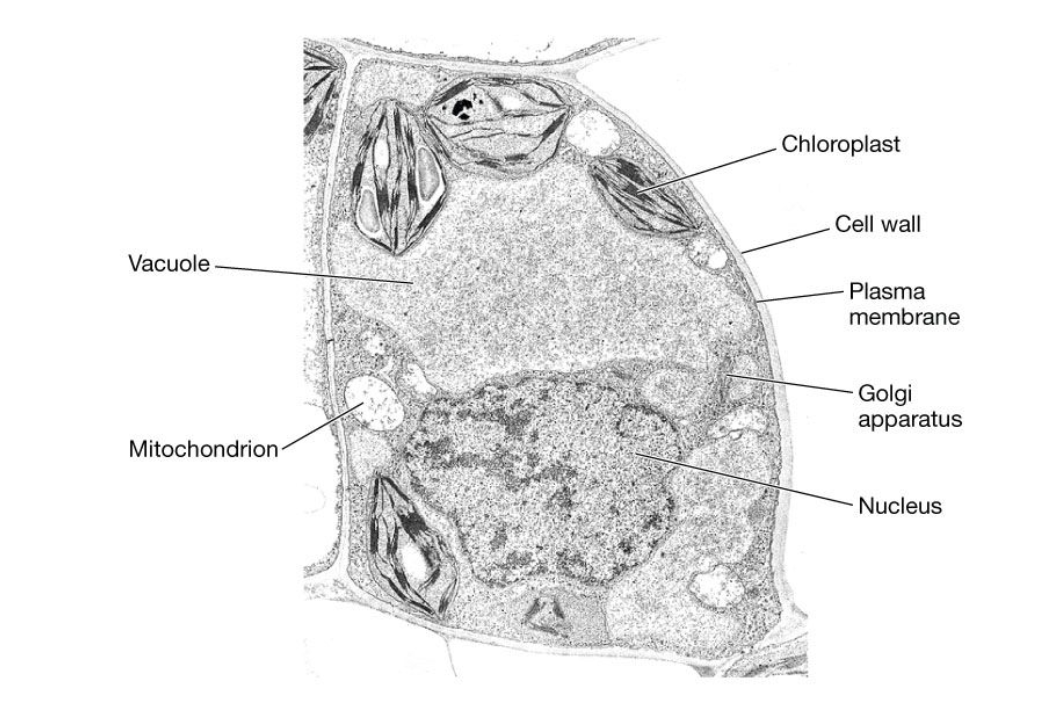
What type of cell is the following picture showing?
This is showing a plant cell
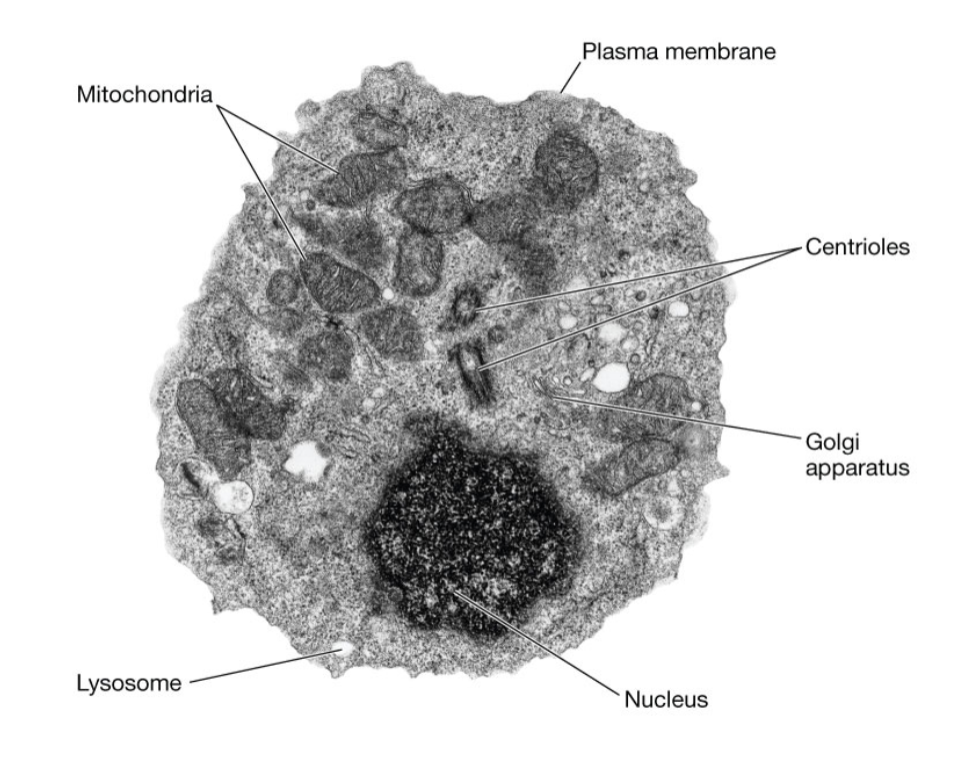
What type of cell is the following picture showing?
This is showing an animal cell
T or F: internal environmental conditions are always constant
False, the internal state of body is in a constant dynamic state
What happens if this internal state (of the body) is disrupted?
We get disease
What is: Disease?
It’s an abnormality in your body’s normal processes that significantly impairs homeostasis
What are the three Components of Homeostatic Mechanisms?
Sensor/receptor
Control Center
Effector
When talking about the Components of Homeostatic Mechanisms, what does the sensor/receptor do?
It detects change in internal conditions
When talking about the Components of Homeostatic Mechanisms, what does the control center do?
It directs the response to bring conditions back to normal. Once normal, the sensor is no longer activated
When talking about the Components of Homeostatic Mechanisms, what does the effector do?
This is organ/tissues that receive the information from the control center and act to bring about change(s) to maintain homeostasis
Identify the Components of Homeostatic Mechanisms when talking about Body Temperature
Sensor/receptor: thermoreceptors found in your skin
Control center: hypothalamus
Effector: muscles, blood vessels
What are the two types of Homeostatic Mechanisms?
Negative Feedback
Positive Feedback
What is: Negative Feedback?
It’s the primary homeostatic mechanism that keeps a variable as close as it can to a particular value
What is a non-biological example of Negative Feedback?
Air Conditioning
Goal: to keep the air as close to the set temperature of the thermometer
What are biological examples of Negative Feedback?
Body temperature regulation
Goal: to keep your temperature as close as it can to optimum degrees
Blood sugar regulation
Goal: to keep your glucose levels as close as it can to optimum value
What is: Positive Feedback?
It’s mechanisms that bring about rapid change in the same direction as the stimulus
What are biological examples of Positive Feedback?
Blood clotting
Platelets go to injured area and release factors that stimulate further clotting
Birth
As labor continues, cervix is continually stimulated and contractions continue and become stronger until the baby is born
What is all included in the Integumentary System?
Skin and its accessory organs (nails, hair, oil glands, sweat glands)
What is the functions of the Integumentary System
The main function of the skin is protection
Protects underlying tissue from physical trauma
Protects against pathogen invasion
Prevents water loss
Other functions include:
Helps regulate body temperature
Synthesizes vitamin D
Allows us to communicate through touch via sensory receptors
What are the 3 Regions/Layers of the Skin?
Epidermis
Dermis
Subcutaneous layer
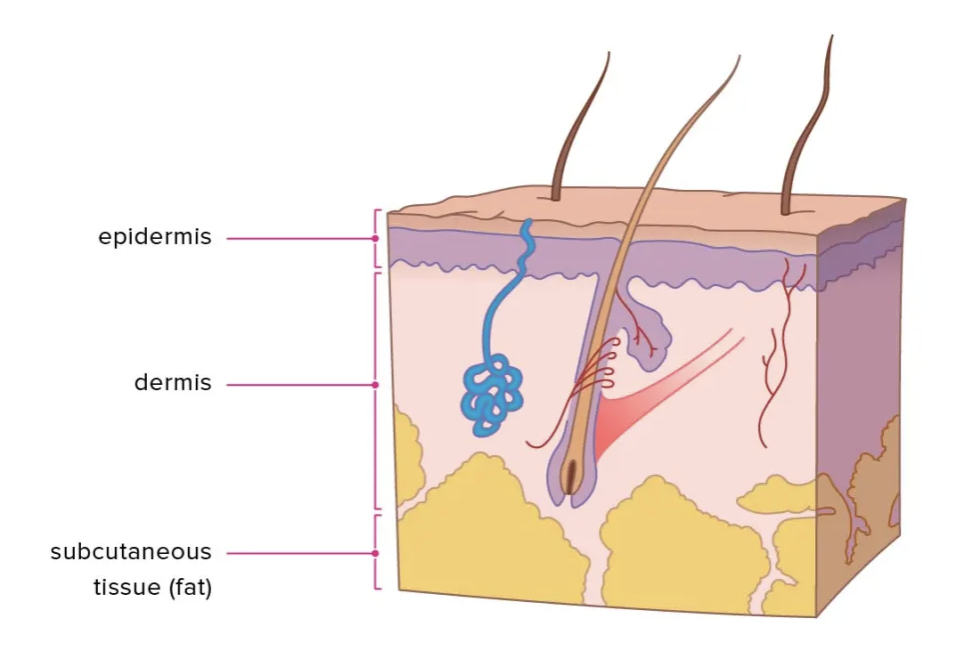
What is the following picture showing?
This is showing the 3 regions/layers of the skin
T or F: there is only one type of epithelial cells
False, there are many different orientations of these cells
What are characteristics of the Epidermis Layer of the Skin?
First/top layer of “skin”
Stratified squamous epithelium
Stratum corneum: outermost layer
Stratum basale: innermost layer
Melanocytes give skin its color and protects against UV rays
Cells become hardened and flat because these cells produce keratin
Fingerprints and footprints — made by thick layer of keratinized cells organized in spiral/random patterns
 Note
Note  Flashcards (74)