Sensation and Perception Unit Review
 Studied by 2 people
 Call with Kai
 Learn
Learn Practice Test
 Spaced Repetition
 Match
Match Flashcards
 Knowt Play
1/88

There's no tags or description
Looks like no tags are added yet.
Name | Mastery | Learn | Test | Matching | Spaced | Call with Kai |
|---|
No analytics yet
Send a link to your students to track their progress
89 Terms
sensation
awareness resulting from the stimulation of a sense organ
perception
the organization and interpretation of sensations by the brain.
transduction
the conversion of stimuli detected by receptor cells to electrical impulses that are then transported to the brain
hertz
vibration per second
absolute threshold
the minimum stimulation needed to detect a particular stimulus 50% of the time
hit
occurs when we, as the listener, correctly say “yes” when there was a sound.
false alarm
occurs when we respond “yes” to no signal.
miss
saying “no” when there was a signal
correct rejection
saying “no” when there was in fact no signal
sensitivity
the true ability of the individual to detect the presence or absence of signals.
response bias
a behavioral tendency to respond “yes” to the trials, which is independent of sensitivity.
difference threshold (or just noticeable difference [JND])
the change in a stimulus that can just barely be detected.
Weber’s Law
States that for an average person to perceive a difference two stimuli must differ by a constant proportion, not a constant amount (Ex: imagine holding an object that weighs 10 grams. If we increase the weight by 10% by adding one gram to it, we will notice the difference. Now imagine holding an object that weights 100 grams. If we increase the weight by a mere 1% by adding that same one gram to it, we will not notice the difference.)
blindsight
a condition in which people are unable to consciously report on visual stimuli but nevertheless are able to accurately answer questions about what they are seeing.
Infrared
Means “below red.” These electromagnetic waves are just below red in the visible spectrum, so our eyes cannot see them.
cornea
a clear, convex covering that bends light waves toward the pupil.
pupil
a small opening in the center of the eye
iris
the colored part of the eye is a muscle that controls the size of the pupil by constricting or dilating in response to light intensity.
lens
transparent structure surrounded by muscles that change its thickness to focus light waves onto the retina
retina
the layer of tissue at the back of the eye that contains photoreceptor cells.
visual accommodation
The lens takes the light waves that come in through the cornea and focuses them onto the retina
if the focus is in front of the retina, we say that the person has
myopia (is nearsighted)
if the focus is behind the retina we say that the person has
hyperopia (is farsighted)
If the focus is skewed or has multiple focal points, we say that the person has an
astigmatism
Photoreceptor cells in the eye’s retina are responsible for
converting light into signals that are sent to the brain.
The retina contains layers of neurons specialized to respond to light. As light falls on the retina, it first activates the photoreceptor cells known as ___________.
rods and cones
optic nerve
collection of millions of axons that sends vast amounts of visual information, via the thalamus, to the visual cortex in the occipital lobes of brain.
fovea
the central point of the retina
blind spot
hole in our vision
hue
shade of color
Young-Helmholtz trichromatic color theory
the color we see depends on the mix of signals from the three types of cones: red, green, and blue
opponent-process color theory
proposes that we analyze sensory information from our retina’s cones as three sets of “opponent colors”: red-green, yellow-blue, and white-black.
gestalt
a meaningfully organized whole. The idea of is that the “whole is more than the sum of its parts.”
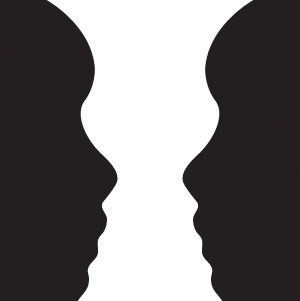
Figure and ground
We structure input such that we always see a figure (image) against a ground (background).
At right, you may see a vase or you may see two faces, but in either case, you will organize the image as a figure against a ground.
Similarity
Stimuli that are similar to each other tend to be grouped together.
You are more likely to see three similar columns among the XYX characters at right than you are to see four rows.

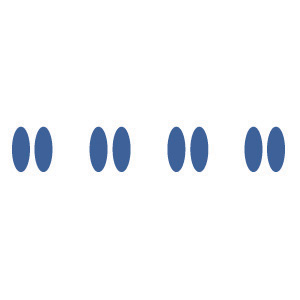
Proximity
We tend to group nearby figures together.
Do you see four or eight images at right? This principle may suggest that you might see only four.
Continuity
We tend to perceive stimuli in smooth, continuous ways rather than in more discontinuous ways.
At right, most people see a line of dots that moves from the lower left to the upper right, rather than a line that moves from the left and then suddenly turns down. This principle leads us to see most lines as following the smoothest possible path.

Closure
We tend to fill in gaps in an incomplete image to create a complete, whole object.
This principle leads us to see a single spherical object at right rather than a set of unrelated cones. The Necker cube is also an example of this principle.

Depth perception
the ability to perceive three-dimensional space and to accurately judge distance.
Visual cliff
a mechanism that gives the perception of a dangerous drop-off, in which infants can be safely tested for their perception of depth
depth cues
messages from our bodies and the external environment that supply us with information about space and distance.
oculomotor depth cues
depth cues that come from the muscles of the eyes.
convergence
the inward turning of our eyes that is required to focus on objects that are less than about 50 feet away from us
accommodation
as the lens changes its curvature to focus on distant or close objects, information relayed from the muscles attached to the lens helps us determine an object’s distance.
binocular depth cues
depth cues that are created by retinal image disparity
monocular depth cues
depth cues that help us perceive depth using only one eye.
Relative height
The horizon line separates earth from sky. Objects on the ground that are higher toward the horizon line are perceived as being farther away than objects that are lower. Objects in the sky that are lower toward the horizon line are perceived as being farther away than objects that are higher.
We perceive the buildings near the horizon line in the middle of this photo as being farther away than the buildings that are at the bottom of the photo. We perceive the clouds near the horizon line as being farther away than the clouds that are at the top of the photo.

Relative size
Assuming that the objects in a scene are of similar size, smaller objects are perceived as farther away.
At right, the cars in the distance appear smaller than those nearer to us.

Linear Perspective
Parallel lines appear to converge at a distance.
We know that the tracks at right are parallel. As the rails appear to move closer together, we perceive them as being farther away.

Light and Shadow
The eye receives more reflected light from objects that are closer to us. Normally, light comes from above, so darker images are in shadow.
We see the images at right as raised or indented according to their shadowing. If we invert the picture, our perception of the images will reverse.

Interposition
When one object overlaps another object, we view it as closer.
At right, because the blue star covers the pink bar, it is seen as closer than the yellow moon.

Aerial Perspective
Objects that appear hazy are perceived as being farther away.
In this photo, the greater the haze, the farther away we perceive the hills to be.

Bottom-up processing
real time, data-driven sensory analysis
1. Sensory data brought to retina
2. Data transmitted to visual cortex
3. Data processed to form visual experience
Top-down processing
Information processing guided by higher level mental processes; Constructs perceptions based on previous experience and expectations (Ex: speaking Spanish in an English accent (using English phonics))
frequency
wavelength of the sound wave, measured in hertz
pitch
the perceived highness or lowness of a tone
amplitude
height of the sound wave
loudness
the degree of sound volume
decibel
the unit of relative loudness
pinna
the external and visible part of the ear
tympanic membrane (or eardrum)
The membrane at the end of the ear canal that relays vibrations into the middle ear.
ossicles
The three tiny bones in the ear (hammer, anvil, and stirrup) that relay sound from the eardrum to the cochlea.
cochlea
a snail-shaped, liquid-filled tube in the inner ear.
oval window
the membrane covering the opening of the cochlea
cilia
hair cells
frequency theory of hearing
A theory of pitch perception that proposes that nerve impulses corresponding to the pitch of a sound wave are sent to the auditory nerve.
place theory of hearing
A theory of pitch perception that proposes that different areas of the cochlea respond to different sound frequencies.
Conductive hearing loss
caused by physical damage to the ear (such as to the eardrums or ossicles) that reduced the ability of the ear to transfer vibrations from the outer ear to the inner ear.
Sensorineural hearing loss
caused by damage to the cilia, the auditory nerve, or the auditory cortex in the temporal lobes is the most common type of hearing loss.
tinnitus
a ringing or buzzing sensation
cochlear implant
a device made up of a microphone that sits behind the ear and a series of electrodes that are placed inside the cochlea. The device bypasses the cochlear cilia by stimulating the auditory nerve directly.
supertasters
have many more taste buds than the average person
non-tasters
have fewer taste buds than the average person.
Why are children who are non-tasters are much more likely to have cavities than children who are supertasters?
Because they prefer things that are very sweet since they can’t taste true level of sweetness
anosmia
the inability to smell
Proprioception
The ability to sense the position and movement of our body.
vestibular system
A set of liquid-filled areas in the inner ear that monitors the head’s position and movement, maintaining the body’s balance.
gate control theory of pain
proposes that pain is determined by the operation of two types of nerve fibers in the spinal cord
The perception of pain is affected by
distraction and endorphins.
sensory interaction
The different senses working together to create experience.
McGurk effect
An error in perception that occurs when we misperceive sounds because the audio and visual parts of the speech are mismatched.
synesthesia
A mixing of senses in such a way that experiencing one sensation triggers an experience from a different sense.
selective attention
The ability to focus on some sensory inputs while tuning out others.
sensory adaptation
A decreased sensitivity to a stimulus after prolonged and constant exposure. (Ex: When we step into a swimming pool, the water initially feels cold, but after a while we stop noticing it)
saccades
thousands of tiny eye movements
perceptual constancy
The ability to perceive a stimulus as constant despite changes in sensation.
Illusions
occur when the perceptual processes that normally help us correctly perceive the world around us are fooled by a particular situation so that we see something that does not exist or that is incorrect.
Perceptual set
When our expectations influence us to perceive some things and not others.
Human factors
The field of psychology that uses psychological knowledge, including the principles of sensation and perception, to improve the development of technology.
 Note
Note  Flashcards (24)