Ch. 14: Gene variant and DNA repair
 Call Kai
 Learn
Learn Practice Test
 Spaced Repetition
 Match
Match Flashcards
 Knowt Play
1/30

There's no tags or description
Looks like no tags are added yet.
Name | Mastery | Learn | Test | Matching | Spaced | Call with Kai |
|---|
No analytics yet
Send a link to your students to track their progress
31 Terms
Basis of genetic function
-DNA molecule stores, replicates, transmits, and decodes information
-Changes in DNA sequences give rise to variations: results in phenotypic variability, adaptation to environmental changes, and evolution
-Provide the basis for genetic analysis: act as markers for specific genes
Base substitutions
-are the primary mechanism behind Single Nucleotide Polymorphisms (SNPs) if that represent less than 1% of the gene
-Transitions
-Transversions
Transitions
Pyrimidine replaces pyrimidine or purine replaces purine
Transversions
Purine and pyrimidine are interchanged
Silent variants
base substitution, amino acids are not altered
Frameshift variants
-Result from insertions or deletions of nucleotide
-Loss or addition of nucleotide causes shift in reading frame
-Frame of triplet reading during translation is altered
-Altered triplets may code for stop codon (UAA, UAG, UGA)
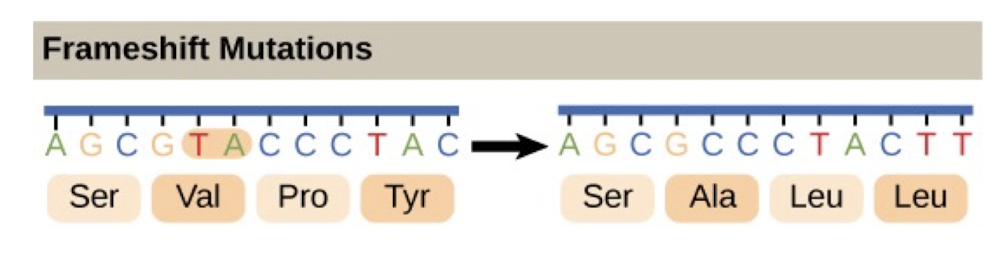
Missense variants
Substitution change the codon
Nonsense variants
Converts an amino acid-coding codon into a premature stop codon
Sickle cell disease
due to missense variant
Promoter
may increase or decrease the rate of transcription
Regulatory element/operator site
May disrupt the ability of the gene to be properly regulated
5’-UTR/3’-UTR
May alter the ability of mRNA to be translated; may alter mRNA stability
Splice recognition sequence
May alter the ability of pre-mRNA to be properly spliced
Trinucleotide Repeat Expansions
-Insertion of triplet repeats leads to extra amino acids
-The longer proteins shut down the cells (cell apoptosis)
-Trinucleotide repeat expansion (TNRE) disorders
-Length of repeat increase above a certain critical size
-Number of repeats correlates with earlier onset and more severe phenotype- leading to progressive neurological and neuromuscular degeneration, such as Huntington’s disease (CAG), Fragile X syndrome (CGG), and Fridreich’s ataxia (GAA)
Germ-line variants
-occurs in gametes and are heritable
-Somatic variants occur in somatic cells are not heritable, but often lead to altered cellular function and cancer
-Variants can occur spontaneously or they can be induced
-Spontaneous variants have no known cause and are due to errors in normal biological/chemical processes (DNA replication)
-Induced variants are due to exposure to mutagens (radiation)
Base damage
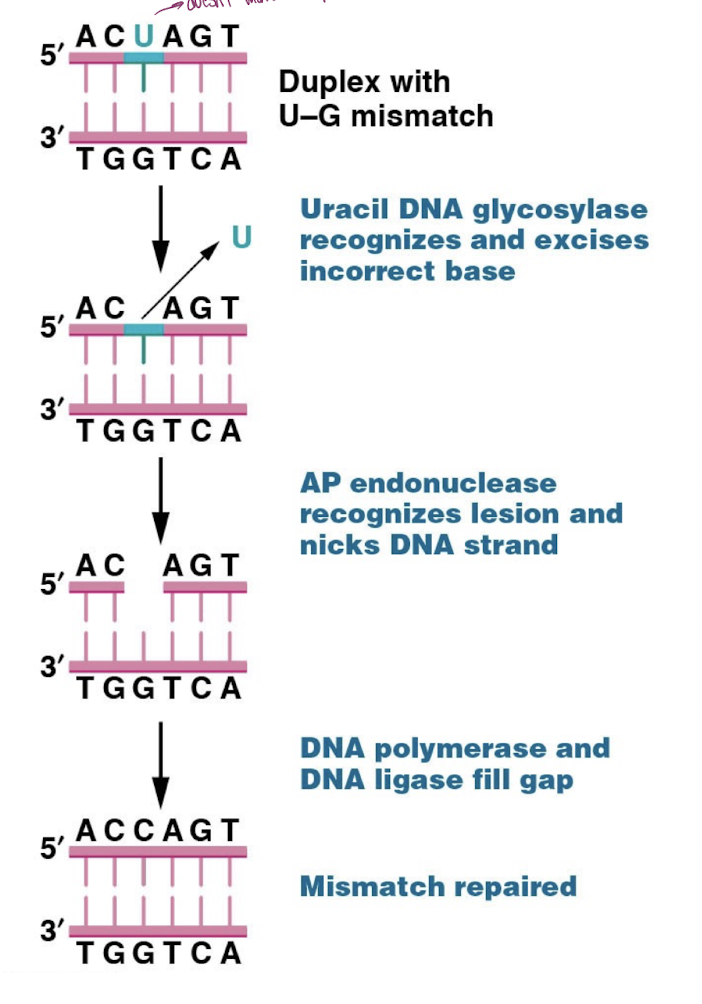
-Deamination: loss of amino group (NH2)
-Cytosine → Uracil or 5-methylcytosine → Thymine
-Base excision repair (BER)
-Point mutations; cancer hot spots; epigenetic aging
DNA base loss
-Depurination and deamination → loss of nucleotide
-Common causes of spontaneous variants
-Lead to new base pairing and variants
-Result: A=T converted G=C
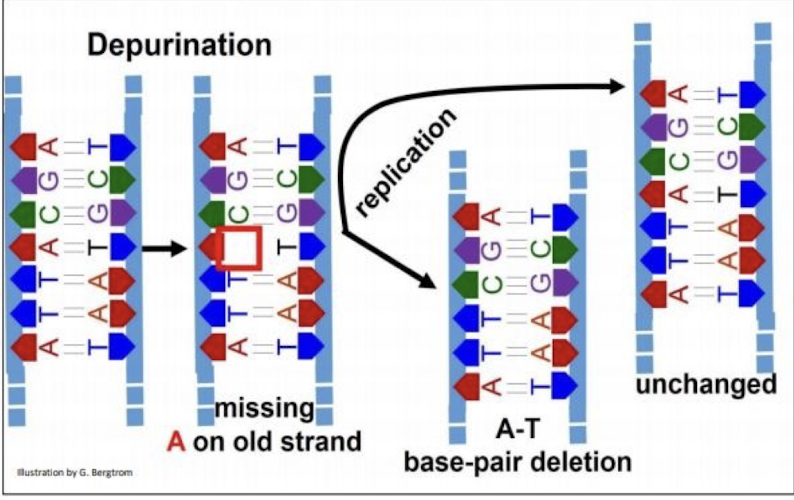
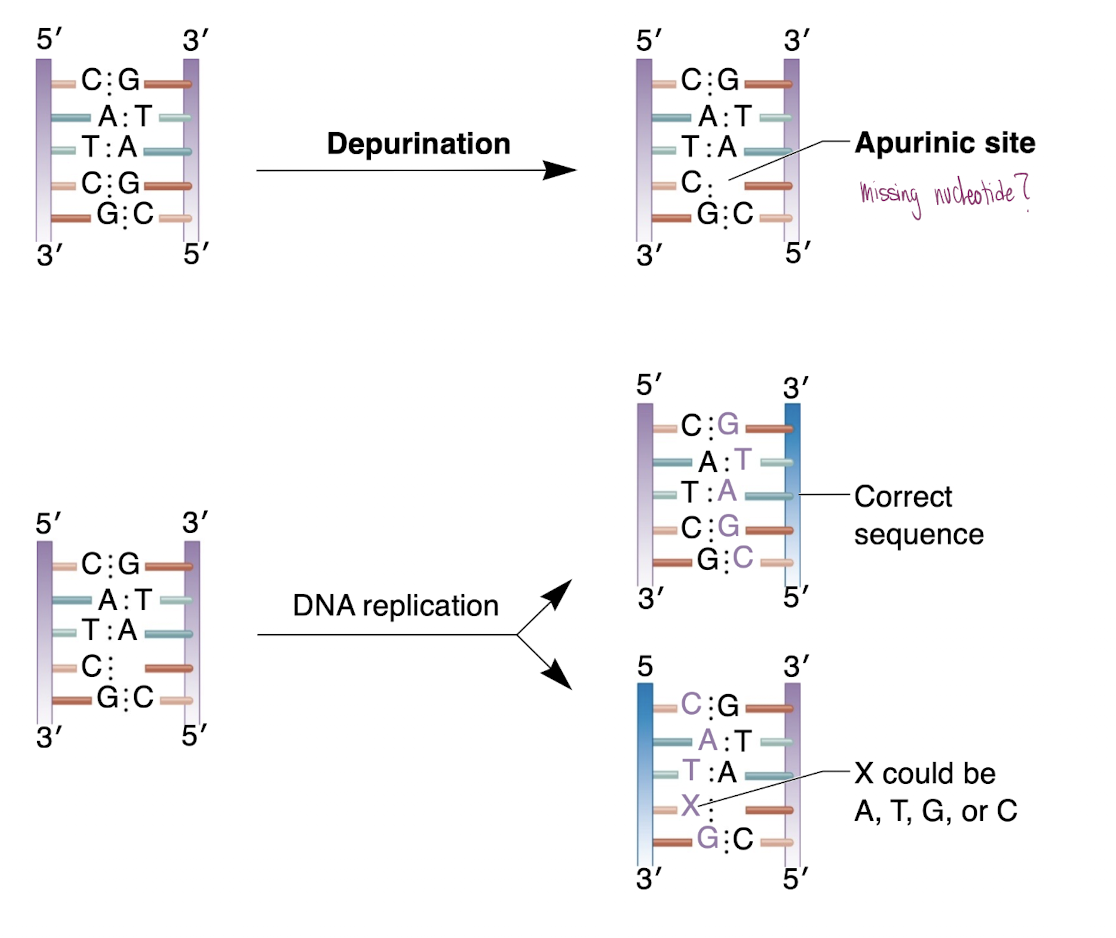
Depurination
-Loss of nitrogenous bases
-Usually a purine- guanine or adenine- leads to apurinic site (without purine)
Deamination
-Amino group in cytosine or adenine converted to keto group
-Cytosine converted to uracil- adenine converted to hypoxanthine; causes a switch in base pair
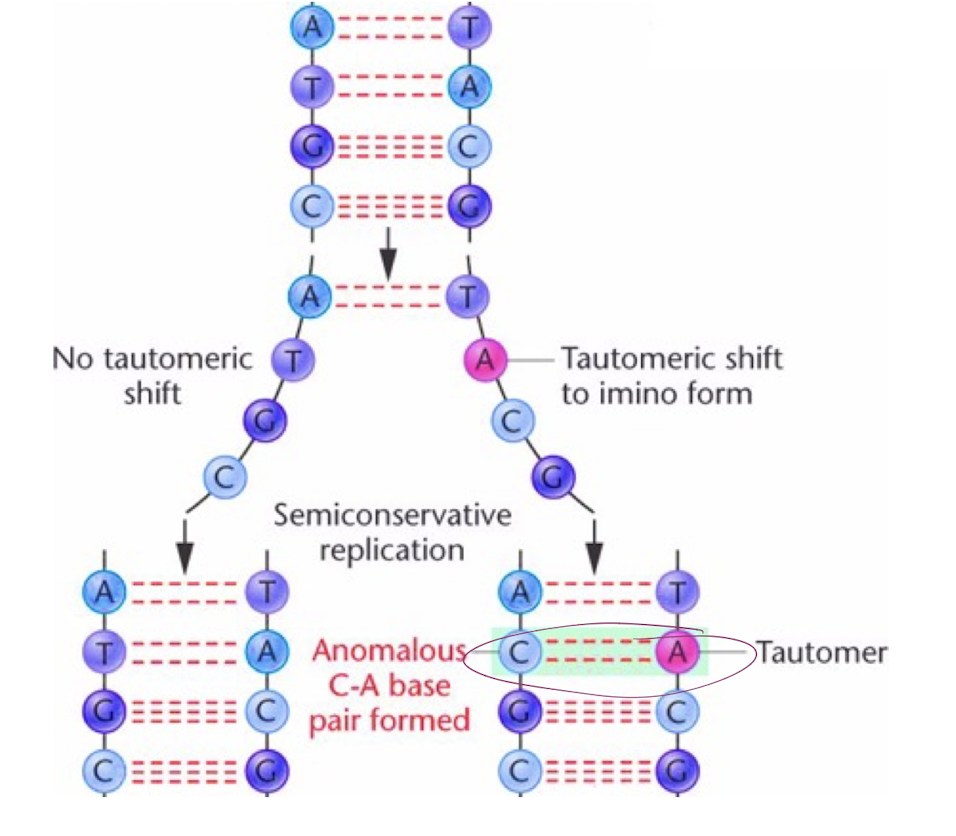
Tautomers
-Purines and pyrimidines exist in tautomeric forms- alternate chemical forms
-Same elements but they switch positions
Tautomeric shifts
-Can change the bonding structure, allowing noncomplementary base pairing
-May lead to permanent base-pair changes and variants
-causes an anomalous base-pairing, causing an alternative chemical form that differ by only a single proton shift in the molecule
DNA damage vs. variant
-DNA damage is the change in DNA structure caused by a damaging agent (or mutagen)
-Variant is the change in DNA sequence or coding potential that comes from the resolution of DNA damage
-DNA damage can be resolved without variant! But, more DNA damage leads to higher amounts of variant, constant damage of DNA will cause a variant
Oxidative damage
-Due to by-products of normal cellular processes
-Reactive oxidants
Increase in reactive oxygen species (electrophilic oxidants)
Superoxides (O2-) most active free radical
Hydroxyl radicals (OH) not very reactive
Hydrogen peroxide (H2O2) weak radical that can still cause modification
-Result in modification of bases, loss of bases, and single-stranded breaks
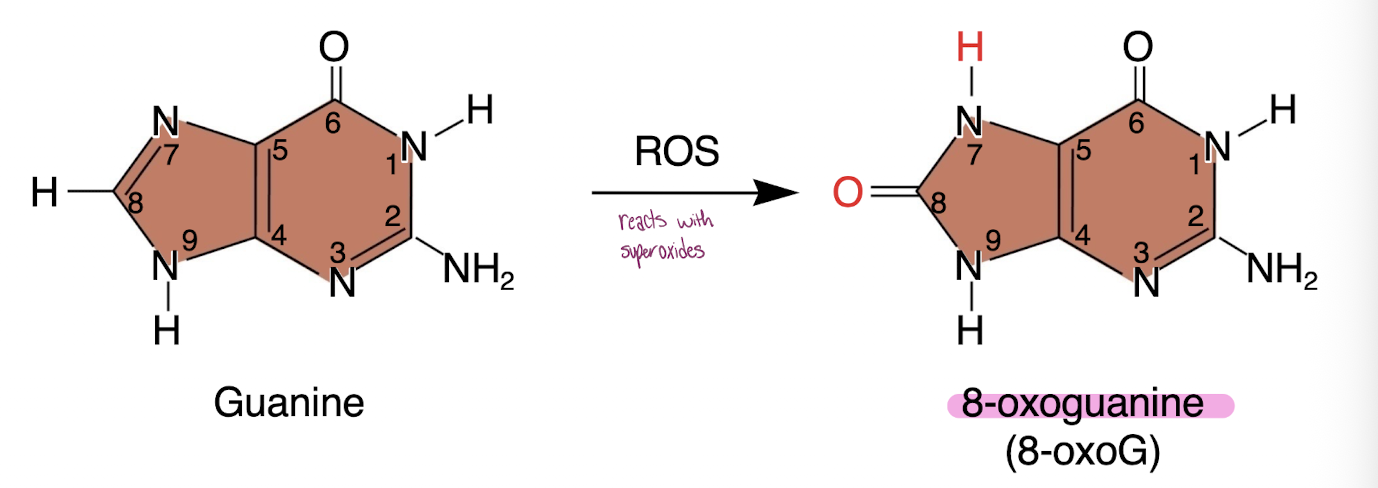
Guanine is very susceptible to…
-oxidative stress, another cause of variants
-8-oxoG base pairs with adenine during DNA replication
-Causes GC pairs to become TA pairs, very common damage of DNA; induced with again, DNA
-Oxidative damage also occurs from environmental exposures
-UV light, X rays, chemicals, pollution, etc
Variants arise from replication
-Replication is imperfect
-DNA polymerase occasionally inserts incorrect nucleotides
-Misincorporated nucleotides persist persist after replication, error may get detected
-Errors not detected may lead to variants
-Bases can take several forms (tautomers); increases change of mispairing during DNA replication
Replication Slippage
-DNA polymerase slips or stutters during replication
-Loop occurs in template strand during replication
-DNA polymerase misses looped out nucleotides- small insertions and deletions occur
-More common in repeat sequences (hot spots)
-Hot spots for DNA variant
-Contributes to hereditary diseases: Fragile-X, Huntington disease
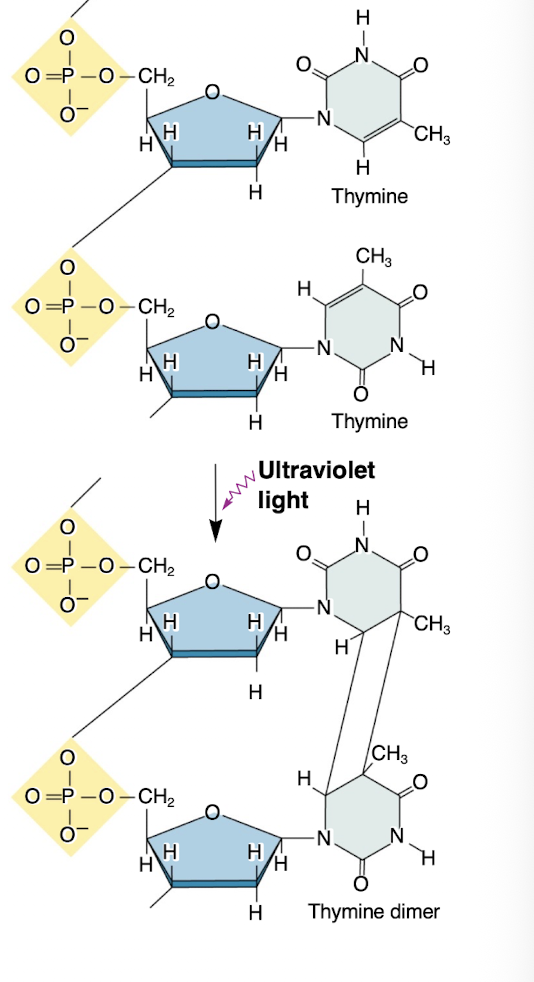
Thymine dimers
-causes by ultraviolet (UV) light
-2 nucleotides that should not be binding bind
-Adjacent thymine bases become crosslinked
-Thymine dimers interfere with transcription and translation
-Sun tanning greatly increases exposure to UV light: can increase risk of skin cancer
DNA Repair Systems
-essential to the maintenance of our genetic integrity and occur thousands and thousands times a day
Base excision repair
-corrects the DNA
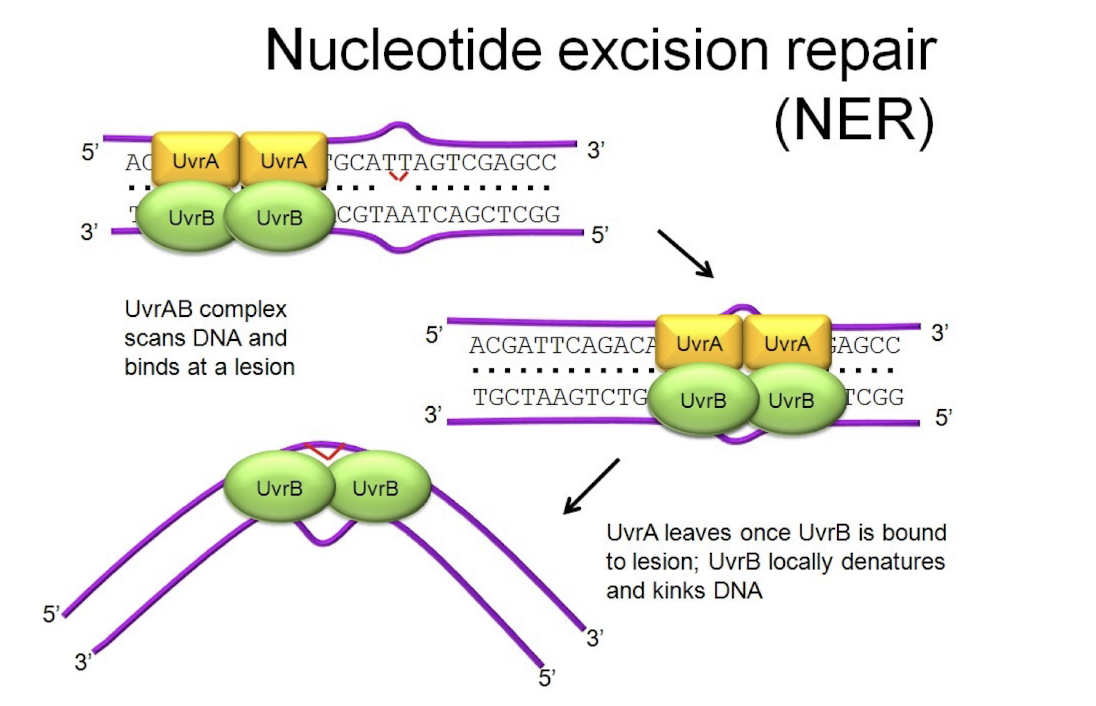
Nucleotide excision repair
-Does not cut DNA at the backbone
-Instead leaves the backbone intact and only takes out and replaces the damaged/wrong nucleotide
Xeroderma Pigmentosum
-a rare autosomal recessive disorder that predisposes individuals to skin cancer/and sometimes neurological disorders
-It is caused by variant in at least 8 genes involved in nucleotide excision repair; multiple errors in DNA replication

