A & P of Speech Processes: Exam 2 Communication Overview & Respiration
 Call Kai
 Learn
Learn Practice Test
 Spaced Repetition
 Match
Match Flashcards
 Knowt Play
1/68

There's no tags or description
Looks like no tags are added yet.
Name | Mastery | Learn | Test | Matching | Spaced | Call with Kai |
|---|
No analytics yet
Send a link to your students to track their progress
69 Terms
the act of speaking; falls within the category of expressive language
speech production
the act of understanding and interpreting spoken content; falls within the category of receptive language
speech perception
the exchange between speech production and perception is often expressed by the…
speech chain model
a spoken message progresses from the…
mind of the speaker to the mind of the listener
Order of The Speech Chain
Speaker’s brain formulates the message
Motor nerves transmit commands to vocal muscles
Vocal muscles produce wound waves
Sound waves travel through the air (acoustic signal)
Listener’s ear collects the acoustic signal
Sensory nerves send the signal to the listener’s brain
A feedback link allows the speaker to hear their own speech and adjust
the 4 levels of communication are…
cognitive
linguistic
physiological
acoustic
initiating verbal communication begins with thinking about a topic or idea
cognitive level
the speech content is summarized in the speaker’s language (word selection, sentence formulation)
linguistic level
we plan and program our speech organs to sequence the strings of words and execute the movements required for speaking
physiological level
the speaker expresses content using various speech sounds
acoustic level
the message is perceived, interpreted, and understood in the…
cognitive level
recieved acoustic signals are sent to the medial geniculate nucleus in the thalamus; thalamus recognizes them as auditory messages and delivers them to the auditory cortex and associate areas in the…
linguistic level
auditory organs collect, receive, and process acoustic signals to send the message to the brain in the…
physiological level
speech output travels from the speaker to the listener’s ears as acoustic signals in the…
acoustic level
what are 3 subsystems of speech production?
respiration
phonation
articulation/resonation
shaping speech sounds has to do with which subsystem?
articulation/resonance
vocal folds vibration to make sounds has to do with which subsystem?
phonation
what subsystem has to do with breath support from your lungs?
respiration
the exchange of oxygen and carbon dioxide at the cellular level; for speech, exhaling air provides the driving force to the vocal fold by sending air pressure
respiration - ENERGY/MOTOR
vocal fold vibration receiving air pressure from respiratory organs
phonation - SOURCE
the process of shaping up voice into a sequence of speech sounds, using the supra laryngeal vocal tract
articulation/resonance - FILTER
This theory explains how speech sounds are produced by combining a sound source (vocal folds) with a filter (vocal tract) that modifies the sound
the source - filter theory
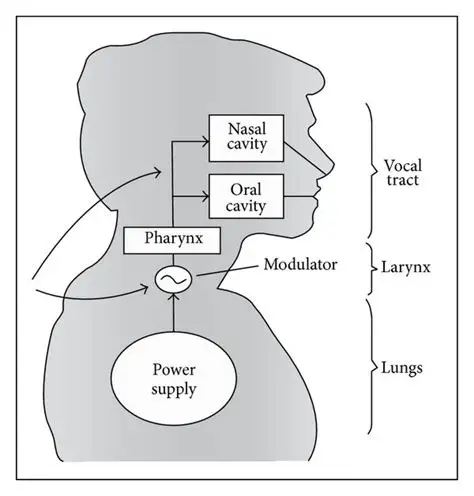
all speech sounds are produced as we breathe out
egressive airstream mechanism - EXIT
some languages use sounds made during inhalation ex. gasping
ingressive airstream mechanism - GO IN
one common metric for cognitive functioning is the…
intelligence quotient (IQ)
what is the relationship between IQ and language ability?
Language relies heavily on left hemisphere structures: Broca’s, Wernicke’s, arcuate fasciculus. General cognition draws upon distributed cortical and subcortical networks (not localized to one hemisphere or region)
What are functions of respiration for speech?
respiration covers gas exchange at the cellular level through breathing, respiration provides the source energy for speech production, non-vital: speaking
moving air into and out of the lower airway
ventilation
movement of air into upper and lower airways
inspiration (inhalation)
movement of air out of lower and upper airways
expiration (exhalation)
Nares open into nasal cavity, separated into…
Left and right sections by nasal septum
Nasal septum formed anteriorly by septal cartilage, and …
posteriorly by ethmoid bone and vomer bones
The floor of nasal cavity is…
har palate (bone, anterior) and soft palate (muscle, posterior)
Air exits via internal…
nares into pharynx
The nasal cavities are also called the..
nasal fossae
Two chambers separated by…
nasal septum
Septum is cartilage at front and ….
bone at back
What are the benefits of nasal breathing?
Filtering of incoming air
Approximate temperature of incoming air to body temperature
Moisturize incoming air
What parts of the body are included in the conducting zone?
Nose and Nasal Cavity
What are major functions of the conducting zone?
route for air
remove debris/pathogens
warm and humidify incoming air
nasal epithelium senses odors
bronchial epithelium metabolizes airborne carcinogens
What is the purpose for cilia and mucus?
Cilia is constantly sweeping materials toward throat to be swallowed. Cold air slows cilia movement —> mucus accumulation —> runny nose in cold weather.
What is the Diaphragm?
A dome-shaped sheet of skeletal muscle that separates thoracic cavity from abdominal cavity
What are functions of the Diaphragm?
Contracts and flattens during inhalation —> expands lungs
Relaxes during exhalation —> reduces lung volume
What are three openings in the diaphragm?
Caval opening (caval hiatus): inferior vena cava passes through this
Esophageal hiatus: esophagus and attached nerves pass through this
Aortic hiatus: aorta, thoracic duct, azygous vein pass through posterior diaphragm
Where does the diaphragm originate?
The bottom of the sternum and lower six ribs and first three or four lumbar vertabrae and inserts into the central tendon
How does the diaphragm work?
Pulls downward on the central tendon to enlarge the thorax vertically and/or elevate the lower six ribs to enlarge the thorax circumferentially
What parts make up the general structure of the Thoracic Cage?
forms thorax (chest)
Consists of 12 pairs of ribs, costal cartilages, sternum T1-T12 vertebrae
Protects heart and lungs
What are three parts of the sternum?
Manubrium (superior)
Body (central)
Xiphoid process (inferior tip)
U-shaped border at top of manubrium; easily felt at anterior base of neck
Jugular notch
Junction of manubrium and body; second rib attaches here (landmark for counting ribs)
Sternal angle
Cartilaginous early in life ossifies by middle age
Xiphoid process
True ribs (1-7)
attach directly to sternum
False ribs (8-12)
do not attach directly to sternum
Floating ribs (11-12)
no anterior attachment
Curved, flattened bones articulating posteriorly with thoracic vertebrae
12 pairs of ribs
The ability of muscles and connected tissues to “snap” back to their original length and shape after being stretched or compressed
Recoil
What is Boyle’s Law?
Pressure is inversely proportional to volume at constant temperature. Formula: P1V1=P2V2. If volume increases, pressure decreases; if volume decreases, pressure increases
How does Boyle’s Law relate to respiration?
Gases move from higher pressure (lower volume) to lower pressure (high volume) - Nature’s equilibrium
Passive force for respiratory system
Natural recoil of muscles, cartilages, ligaments, and lung tissue
Surface tension of the alveoli
Pull of gravity
Active force for the respiratory system
Rib cage wall muscles
Diaphragm muscle
Abdominal wall muscles
Step-by-step process of Respiration
Inspiration: Diaphragm contracts—> moves inferiorly—> chest cavity expands —> pressure decreases—> air flows in
Expiration: Diaphragm relaxes —> moves upward—> chest cavity decreases —> pressure increases —> air flows out
Four lung volumes include:
Tidal Volume (TV): air inhaled/exhaled during normal breathing
Expiratory Reserve Volume (ERV): air forcefully exhaled after normal expiration
Inspiratory Reserve Volume (IRV): air forcefully inhaled after normal inspiration
Residual Volume (RV): air remaining after maximum forceful expiration
Four lung capacities:
Inspiratory Capacity(IC): the maximum volume of air that can be inspired from the resting end-expiratory level
Vital Capacity (VC): the maximum volume of air that can be expired after a maximum inspiration (or inspired after a maximum expiration)
Functional Residual Capacity (FRC): the amount of air in the pulmonary apparatus at the resting tidal end-expiratory level
Total Lung Capacity (TLC): the volume of air in the pulmonary apparatus after a maximum inspiration
The size of a three-dimensional object or space
Volume
Lung volume…
reflects the size of the respiratory system
Lung volume change…
(without pressure change) requires an open larynx and upper airway
Lung volume is…
divided into lung volumes and capacities
Formulas for lung capacities:
Inspiratory capacity (IC)= TV + IRV
Vital capacity (VC) = IC + ERV
Functional residual capacity (FRC)= ERV+ RV
Total lung capacity (TLC)= VC + RV
How speech breathing differs from vital breathing
Vital Breathing ratio: 40% inhalation, 60% exhalation
Speech breathing ratio: 10% inhalation, 90% exhalation

