turning points - wave particle duality
 Call Kai
 Learn
Learn Practice Test
 Spaced Repetition
 Match
Match Flashcards
 Knowt Play
1/26

There's no tags or description
Looks like no tags are added yet.
Name | Mastery | Learn | Test | Matching | Spaced | Call with Kai |
|---|
No analytics yet
Send a link to your students to track their progress
27 Terms
newton’s theory of light
light was formed of tiny particles called corpuscles
huygen’s theory of light
light was a wave and that every point on a wavefront is a point source to secondary wavelets, which spread out to form the next wavefront (Huygen’s principle)
explanations for reflection
newton - corpuscles collide with the surface and a repulsive force pushes them back
this causes the component of velocity perpendicular to the surface to change but the parallel component stays the same
huygens - the whole wavefront will not reach the surface at once (unless it is travelling perpendicular to the surface)
wavelets spread away from the surface once they reach it and rejoin with others to reform the reflected wavefront
explanations for refraction
newton - as the corpuscles approach a denser medium, short-range forces of attraction cause the component of velocity perpendicular to the surface to increase and the parallel component stays the same
light bends towards the normal
light travels faster in denser mediums
huygens - light travels slower in denser mediums
slows down and bends towards the normal
contradiction to newton’s corpuscular theory of light
light travels slower in water
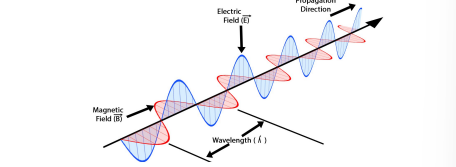
electromagnetic waves
formed of alternating magnetic and electric fields travelling in phase and at right angles to eachother
the direction of wave travel is perpendicular to the oscillations of the fields
permeability of free space
relates the magnetic flux density produced by a wire to the current in the wire
permittivity of free space
relates the electric field strength to the charge on the object, which formed the field.
how did hertz discover radio waves
using apparatus that allowed high voltage sparks to jump across a gap of air
this leads to the production of radio waves
radio waves can be detected by using a dipole receiver
detects the waves’ electric field
made by placing a second set of charged plates parallel to those forming the high voltage sparks
also using a loop of wire with a gap
detects the waves’ alternating magnetic field, as the field will enter the loop
this causes a change in magnetic flux and therefore induces a potential difference, which causes a spark to cross the gap in the wire
how did hertz find the speed of radio waves
place a metal sheet in front of the apparatus
radio waves are reflected back onto themselves
produces stationary waves
calculate wavelength and therefore speed (using the wave equation)
speed found was the same as maxwell’s predicted value of speed of em waves, confirming that radio waves are em waves
how did hertz show that the produced radio waves were polarised
when the receiver is rotated about the line between transmitter and detector the signal varies from max to min after 90 degree rotation
at max the plane of detector is perpendicular to oscillations of e/b field
after rotation of 90, plane of detector is parallel to oscillations of field so no signal detected
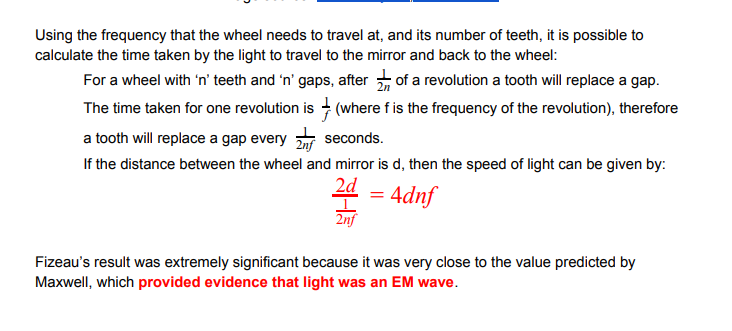
how did fizeau measure the speed of light
pulsed beam of light passed through a gap in a toothed wheel rotating slowly
beam reflects on a mirror a large distance behind the wheel, so it returns through the same gap
increase speed of rotation until light cannot be seen
black body
absorbs and emits all possible wavelengths of radiation
ultraviolet catastrophe
wave theory predicts that as the wavelength of radiation decreases, the intensity of the radiation increases, leading to an infinite amount of uv radiation being emitted
not supported by experimental evidence
how was the uv catastrophe resolved
planck’s interpretation of em waves
em waves travel in discrete packets called quanta
how does the photoelectric effect contradict wave theory
wave theory suggests any frequency of light can cause photoelectric emission so doesn’t explain the existence of a threshold frequency
wave theory suggests a time lag but electron emission is instantaneous
wave theory suggests that increasing the intensity increases the speed of photoelectric emission, but it increases the number of photoelectrons emitted per second
photoelectrons are released with a range of kinetic energies
stopping potential
potential difference needed to stop highest energy electrons
electron diffraction
electron gun accelerates electrons through a vaccum tube towards a crystal lattice
electrons interact with small gaps between atoms
diffraction pattern formed on fluorescent screen
resolving power
as the wavelength of the electrons decrease, the resolving power increases
transmission electron microscope (TEM)
electrons accelerated by an electron gun and pass through a set of magnetic lenses and extremely thin sample (so they don’t slow down and wavelength doesn’t change)
purpose of each lens in TEM
condenser lens - deflects electrons so they form a wide parallel beam
objective lens - forms an image of the sample, which is directly above it
projector lens - magnifies image made by objective lens and projects it onto fluorescent screen
how to increase resolving power of a TEM
increase accelerating voltage
wavelength decreases
what limits the resolving power of a TEM
sample thickness - as electrons pass through the sample they slow down, causing their wavelength to increase so resolving power decreases
electrons travel at a range of speeds - some lose ke when leaving metal in electron gun due to collisions, different wavelengths, diffracted by different amounts, causes blurring of image (aberration)
scanning tunneling microscope (STM)
uses quantum tunnelling of electrons to form an image of the surface of an object
how does quantum tunnelling occur
due to the wave nature of electrons
if the barrier they are trying to cross (physical or potential barrier) is small enough, electrons can mov across it
more likely for smaller gaps
how does an STM work
formed of a very fine tipped prove which moves across the surface of an object and stays at a constant potential so electrons can only travel in one direction
movement of electrons is measured and known as tunnelling current
size of gap varies across surface so tunnelling current varies
two ways an STM can operate
constant height mode - probe kept at constant height as it moves across the surface and tunnelling current is used to image the surface of the object
constant current mode - current is constantly monitored and fed back to microscope, allowing it to adjust the probe’s height so current is constant. movement of probe can be used to image the surface

