Human Anatomy: Respiratory System Structures and Functions
 Call Kai
 Learn
Learn Practice Test
 Spaced Repetition
 Match
Match Flashcards
 Knowt Play
1/38

There's no tags or description
Looks like no tags are added yet.
Name | Mastery | Learn | Test | Matching | Spaced | Call with Kai |
|---|
No analytics yet
Send a link to your students to track their progress
39 Terms
What is the role of the respiratory system?
Move air into the body for cells to respirate, remove waste products (exhaled CO2)
What are the structures of the upper respiratory tract?
Nasal cavity, Pharynx, Larynx
What are the structures of the lower respiratory tract?
Trachea, Primary bronchi, Lungs
What do the nasal conchae do to inhaled air?
Warm up and moisturize inhaled air; filter out dirt, pollen, and other unwanted particles.
What types of cells line the nasal cavity?
Ciliated columnar epithelial cells (Mucosa)
What is unique to the mucosa and how does it relate to the nervous system?
Mucosa has additional nerve cells that process chemical odors and convert them into electric impulses sent to the Olfactory Bulb.
What role do the sinuses play?
Warm and humidify air, produce mucous to trap unwanted particles, lessen the weight of the skull.
What is the oral mucosa?
The moist, protective lining of the mouth made of stratified squamous epithelium.
Describe the tonsils and adenoids.
Lymphoid tissue that plays important roles in immune response; includes adenoid, pharyngeal, and lingual tonsils.
What are the 5 structures comprising the larynx?
Epiglottis, Supraglottis, Vocal cord, Glottis, Subglottis.
What is the glottis?
Part of the larynx consisting of the vocal cords and the tissue creating an opening between them.
What is the function of the epiglottis?
Operates as a flap that opens and closes to let air down into the trachea or food down into the esophagus.
Where are the lungs located?
In the pleural cavity, superior to the diaphragm.
How many lobes does the right lung have?
Three lobes.
How many lobes does the left lung have?
Two lobes.
What does the cardiac notch do and where is it located?
Makes space for the apex of the heart; located in the left lung.
What are the layers of the lung and the cavity within them?
From superficial to deep: Parietal pleura, Pleural cavity, Visceral pleura.
What is the pleural cavity filled with?
Visceral fluid, intrapleural fluid.
What is the purpose of the trachea?
Connects the mouth/nasal cavity to the bronchi/lungs.
What tissue are the bronchi made of?
Ciliated pseudostratified columnar epithelium.
What is cilia?
Tiny hair-like structures on the apical surface of an epithelial cell membrane that maximize surface area for absorption.
Where does the bifurcation of the bronchi occur?
Deep to the manubrium of the sternum.
What are bronchioles?
Smaller divided tubes of bronchi.
Where are alveoli located?
At the terminal branches of bronchioles.
What occurs within alveoli?
Gas exchange (CO2 → O2) between air and bloodstream.
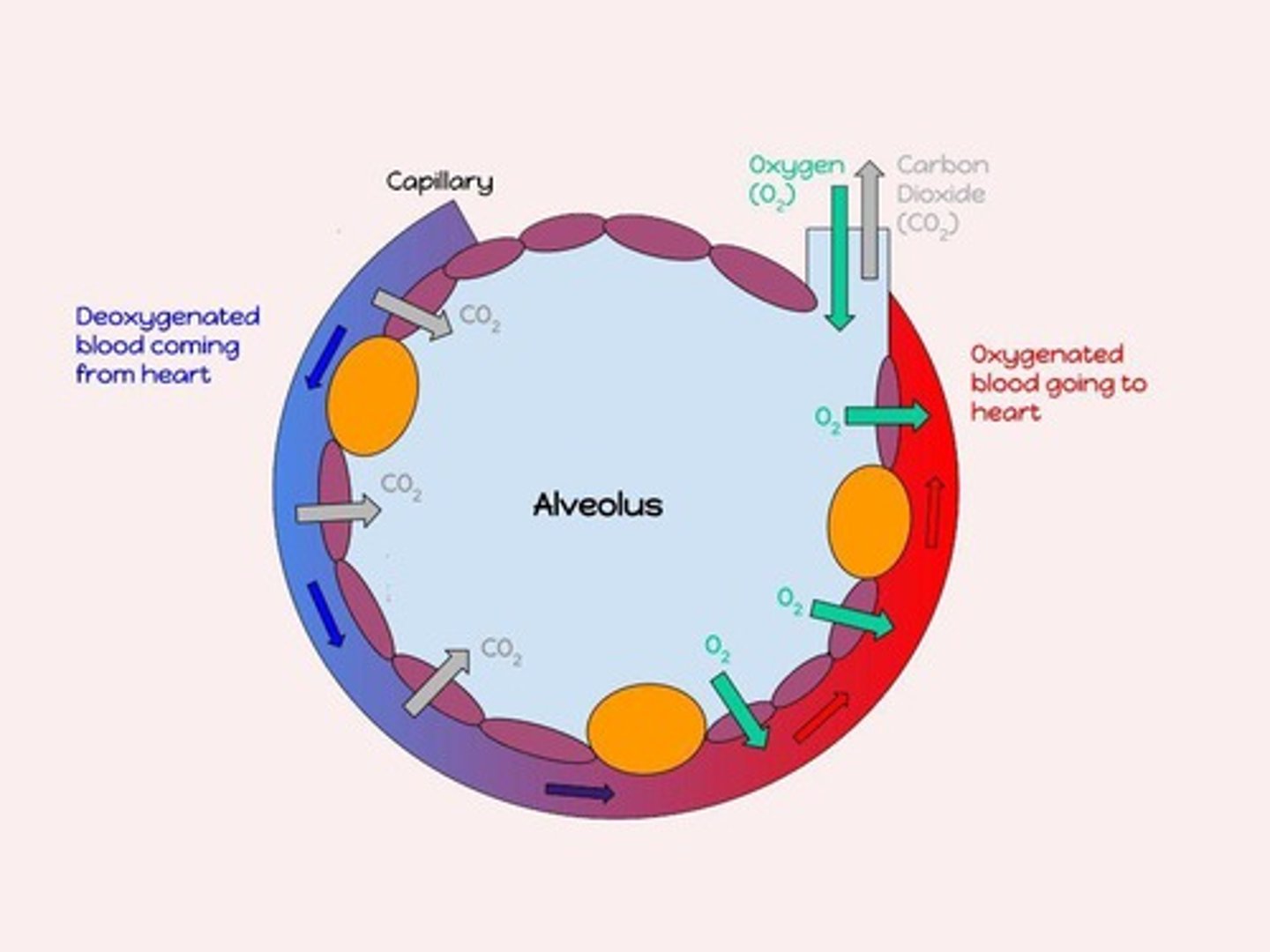
What is the difference between Type I and Type II pneumocytes?
Type I: Thin, flat cells for gas exchange. Type II: Create and secrete surfactant, replicate into Type I cells.
Can Type I cells replicate themselves?
No.
What is surfactant?
A surface action agent secreted by Type II alveolar cells that decreases surface tension within alveoli.
What direction does the diaphragm move when it contracts?
Moves downward and flattens during inhalation.
What direction does the diaphragm move when it relaxes?
Moves upward and curves during exhalation.
What are the muscles of inspiration?
Sternocleidomastoid, Scalenes group, Pectoralis minor, External intercostals, Diaphragm.
What are the muscles of expiration?
Internal intercostals, Abdominals, Quadratus lumborum.
Is there lower pressure in the lungs during inspiration or expiration?
Lower pressure during inspiration.
What are some body regions that provide neural feedback for respiration?
Brain, Carotid and Aortic bodies, Joint and muscle receptors, Stretch receptors in lungs.
What is sinusitis?
Inflammation/swelling of sinus linings that reduces sinus drainage.
What causes pneumothorax?
External air or fluid enters pleural cavity, causing the lung lobe to collapse.
What is the etiology of pneumonia?
Bacteria/virus.
What happens to the alveoli in pneumonia/ARDS?
Fluid and mucous buildup within alveoli, leading to inflamed and swollen bronchioles.
What are treatments for pneumonia and ARDS?
Fluid management, prone ventilation, lung protective ventilation.

