Motivation and Emotion unit 3
 Studied by 0 people
 Call with Kai
 Learn
Learn Practice Test
 Spaced Repetition
 Match
Match Flashcards
 Knowt Play
1/47

Earn XP
Description and Tags
motives
Name | Mastery | Learn | Test | Matching | Spaced | Call with Kai |
|---|
No study sessions yet.
48 Terms
what are motives? 1 pt
internal forces that activate and energize the organism directing it towards a specific goal
what are the types of motives? 2 pts
primary/biological/internal motives
secondary/social/learned/external motives
characteristics of primary motives? 5 pts
familiar to all beings and animals
evolved from genetic components
are not influenced by cultural or social factors
are based on physiological mechanisms
are associated with homeostasis and needs
what is a need? 1 pt
a condition within the person that is essential and necessary for life, growth, and well-being
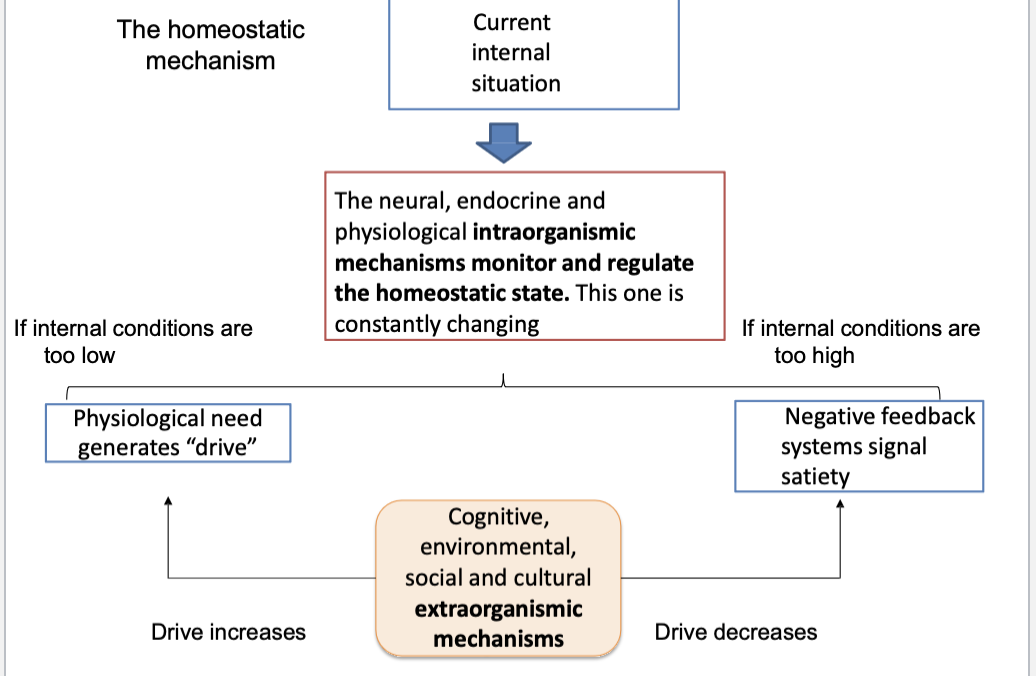
what is the homeostatic mechanism?
starts with our current internal situation that is constantly changing to maintain the homestatic state
A. if the internal conditions are too low:
physiological need generates drive
B. if the internal conditions are too low:
negative feedback system signals satiety
what are the stages of the need-drive-model behavior by Clark Hull?
satiated state
physiological deprivation develops gradually
prolonged physiological deprivation produces bodily need
need intensifies and gives rise to psychological drive
goal-directed motivated behaviors occur as an attempt to gratify drive
consummatory behavior occurs
drive is reduced
back to stage 1
characteristics of secondary motives? 3 pts
have no clear biological basis so are therefore learned through experiences and social interaction
are typical to our species
are acquired through the socialization process and are typically pursued once primary needs have been satisfied
what are the primary motives? 4 pts
hunger
thirst
sex
sleep
what are the secondary motives? 4 pts
achievement motivation
motivation for power
motivation for help
affiliation and intimacy
sex may also be counted as a secondary motive BUT NOT IN HER NOTES
primary motive: hunger- characteristics
essential for survival and shared by all sspecies
belongs to a complex system incharge of maintaining body weight and preventing energy depletion (hunger/satiety)
glucostatic hypothesis accounts for the onset and termination of hunger and eating
lipostatic hypothesis accounts for stored fat mass being available and used as a resource
primary motive: hunger- short-term appetitie
glucostatic hypothesis states that blood sugar levels are critical to hunger; glucose low, hunger high
short-term hunger cues regulate the initiation of meals, their size, and termination
primary motive: hunger- long-term appetitie
lipostatic hypothesis states that when fat percentage drops below homeostasis balance, adipose tissues produce ghrelin into the bloodstream to promote weight gain
when fat percentage rises above homeostatic level adipose tissues release leptin into the bloodstream to promote weight loss
adipose tissue aka fat produces energy like glucose and are monitored by the body
primary motive: hunger- set point theory?
linked to physiology, genetics, and molecular biology
an active mechanism links our adipose tissue to intake and expenditure via a set point encoded in the brain
consistent with biological aspects of balance but fails to explain the environmental and social influences on obesity
the body will always revert to a fixed weight
primary motive: hunger- settling points theory?
linked to psychology and nutrition
replaces the set point model
focuses on the environment and human behavior
argues that body weight is influences by a variety of factors and settles based on the interaction between biological, environmental, and behavioral influences
body stabilises at a weight that reflects personal lifestyle and environment
primary motive: hunger- environmental influences
eating behavior increases when:
we are in the presence of others
there are large portions
there is variety in foods and flavors
we see or smell food
what is counter regulation/counterregulatory eating? 1 pt
the paradoxical pattern displayed by dieters who eat very little as part of their diet but starts to eat very much after breaking their diet rule as they believe they have already failed
primary motive: hunger- restrain-release situations
A. dieting and fasting changes eating into a cognitive thing rather than a physiological need leading to stress and problems with food e.g. binge-eating
B. predictors of counterregulatory eating include:
sugary/hig calory food
when under the influence of drugs
when stressed, anxious, or depressed
hormal changes e.g. menstruation period
primary motive: hunger- obesity and overweight
overweight is anyone over or equal to a BMI of 25 and obese is anyone over or equal to a BMI of 30
different options to prevent this are decreased eating in a healthy way, increasing physical activity and practicing mindfulness over environmental influences
primary motive: thirst- characteristics
a consciously experienced motivational state that readies the body to perform behaviors necesarry to replenish the water deficit below optimal homeostasis level
our bodies are 2/3 water
a 2% drop in water makes us thirsty while a 3% drop means we are dehydrated
osmometric thirst- high solute concentration in the blood; intracellular fluid lost through sweating, urination, breathing, sneezing etc. and is the main cause of thirst
volumetric thirst- fluid loss, low blood or plasma volume; extracellular fluid lost through bleeding or vomiting
there is no set amount of water one should drink and it deends on personal lifestyle
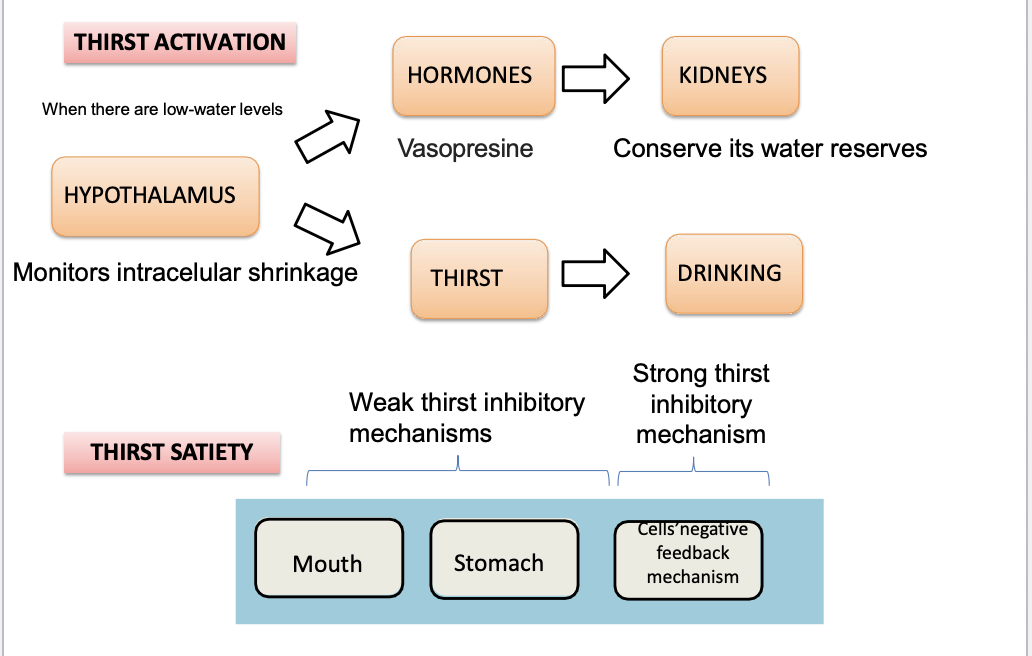
how is thirst activated and stopped?
the hypothalamus monitors intracellular shrinkage
vasopressin is released and goes to the kidneys to conserve water reserves
similarly thirst is activated to initate drinking water
the mouth and stomach have weak thirst inhibitory mechanisms with quick but temporary signals
the cell’s negative feedback mechanism has a strong thirst inhibitory mechanism and is long-term correction
primary motive: thirst- environmental influences
taste
when water is flavoured drinking behavior cahnges based on the incentive value of the fluid
drinking occurs to replenish water levels, sweet taste, or an attraction/addiction to a substance in the drink
food intake contributes to 20% of our total water consumption and can impact hydration levels positvely or negatively
primary motive: sex- characteristics
can be primary or secondary motive
androgens (present in both sexes) contribute to sexual motivation in males while estrogen contributes to sexual stimulation in females
androgens also play a role in regulating sexual motivation in females indirectly
primary motive: sex- physical attractiveness
a woman’s physical attractiveness is linked to a waist-to-hip ratio of 0.7 despite body weight
a man’s physical attractiveness is linked to a 0.9 WHR with broad shoulders and masculinity
attractiveness varies across cultures and is influenced by facial features. symmetry, and perceived health
what are the 3 categories that explain attractive faces? 3 pts
neonatal features- large eyes, small nose, features associated with youth and found attractive in mainly women
sexual maturity features in men- broad shoulders, thick facial hair, prominent cheekbones
sexual maturity features in women- breasts, waist to hip ratio, childbearing hips
expressive features- a wide smile and higher set eyebrows are associated with happiness and openess
primary motive: sex- scripts
individual mental representations of the step-by-step sequence of events that occur during a typical sexual episode
can evolve from independent, fantasy based scripts to more interpersonal team-oriented scripts
failure to coordinate sexual scripts with another can lead to distress, conflict, and anxiety
what are sexual schemas? 1 pt
beliefs about the sexual self derived from past experiences encompassing both positive approach oriented and negative avoidance oriented thoughts and behaviors
male scripts? 3 pts
physical approach to sex
always ready for sex
are tolerated for being sexual
female scripts? 3 pts
emotional approach to sex
gatekeepers of sex
judged for being sexual
primary motive: sleep- characteristics
a normal reoccuring state of changed/partial consciousness from which one can be readily aroused
neurologically dynamic behavior with elevated arousal threshold and a state of rapid reversibilty
during sleep the brain is active and cycles through different stages as multiple neural processes are occuring
sleep can be reversed almost instantly unlike other states of unconsciousness
primary motive: sleep- regulation
regulated by the two-process model for determination of the state of alertness maintained by circadian and homeostatic processes
circadian processes ensure we are awake during the day and asleep during the night
homeostatic processes are reflected in the rise of sleepiness and its dissapation during sleep
the interaction between these 2 systems determines the state of alertness or sleepiness
primary motive: sleep- functions
increased removal of built up waste from our wake moments caused by a higher secretion of CSF during sleep as its passageways increase by 60% during sleep
conservation of energy as body temp and muscular activity decrease
emotional regulation as there is a connection between our emotional centers and the homeostatic sleep system where connectivity is higher when rested and lower when sleeping deprived
memory and learning is facilitated by slow wave sleep which is linked to the reactivation and redistribution of hippocampus dependent memories to the neocortex and random eye movement sleep which further refines and stabilizes these memories
associative synaptic plasticity is recalibrated during sleep
secondary motives: achievement motivation- characteristics
the need for achievement is the desire to perform well relative to the standard of excellence
it motivates individuals to pursue success in competition with this standard
according to atikson achivement behavior is based on the individual dispositional need for achievement, probability of success, and the inventive for suceeding
secondary motives: achievement motivation- behaviors
people who score high in achivement motivation exhibit these behaviors:
choose moderately difficult tasks
demonstrate higher performance levels in tasks requiring high levels of intrinsic motivation
perform better in challenging tasks
interested in receiving feedback on performance
take responsibility for their actions
take calculated risks
introduce innovation to tasks
seek success in their professions
secondary motives: achievement motivation- expectancy-value theory Atkinson’s model
Ts= Ms x Ps x Is
ts- tendancy to approach success
ms- motive to succeed
ps- perceived probability of success from 0-1
is- incentive value of success
secondary motives: achievement motivation- tendancy to avoid failure
tendancy to avoid failure motivates people to defend against loss of self-esteem, social respect, and the fear of embarrassment
Taf= Maf x Pf x If
Taf- tendancy to avoid failure
Pf- probability of failure
Maf- motive to avoid failure
If- negative incentive value of failure
secondary motives: achievement motivation- combined approach and avoidance tendancies
Ta = Ts - Taf = (Ms x Ps x Is) - (Maf x Pf x If)
Ta- tendancy of achievement
Ts- tendancy to approach success
Taf- tendancy to avoid failure
Ms- motivation to succeed
Ps- probability of success
Is- incentive value of success
Maf- motive to avoid failure
Pf- probability of failure
If- negative incentive value for failure
secondary motives: achievement motivation- conditions that involve the need for achievement
moderately difficult tasks- high need achievers outperform low need achievers but the same is not seen with easy or difficult tasks
competition- high need achievers are attracted to competition as it allows them to test their competence and receive feedback
entrepreneurship- appeals to high need achievers as it requires taking moderate risks and assuming responsibility for one’s success and failures as well as providing feedback on performance
secondary motives: achievement motivation- achievement goals
atkinson states that achievement behavior is a choice we either approach or avoid
A. mastery goals focus on the task and are the core of intrinsic motivation as the person learns for personal gain so is therefore unlikely to experience embarrassment and they:
develop one’s competence
make progress
improve the self
overcome difficulties with effort and persistence
B. performance goals focus on the self and are the core of extrinsic motivation as they provide an opportunity for approval, praise and recognition and they:
prove one’s competence
display high ability
outperform others
succeed with little apparent effort
C. mastery goals are mainly to approach success and performance goals are mainly to avoid failure
secondary motives: power- characteristics
the desire for power comes from the desire to have the ability to generate conformity in others
has a distinct physiological pattern that can lead to the chronic activation of the SNS making people more susceptible to heart diseases
secondary motives: power- conditions necessary to satisfy the need for power
leadership to establish influence over others
aggression primarily expressed as impulses rather than actual acts
prestige possessions related to social status
influential occupations where they can exert influence and control over other’s behaviors
secondary motives: help
cognitive perspective- social judgments about good and evil depending on the cognitive developmental state of the individual making the judgement
evolutionary perspective- motivation to help arises as it facilitates genetic transfer and the expectation of a return favor
volunteering is an altruistic activity without financial gain that benefits others
genuine altruism- selfless considerations influence our willingness to help
selfish altruism- we help others obtain a benefit reducing guilt or making us feel better about ourselves
what are the benefits of volunteering? 4 pts
psychological satisfaction
increased useful personal contacts
new and relevant experiences and learning
new frienships
secondary motives: help- modulating factors
bystander effect- decreases likelihood of of helping
social norms
attribution of responsibility- decreases likelihood of helping
rewards- increases likelihood of helping
personality- traits such as empathy increase the likelihood of helping
similarity effect- increases likelihood of of helping
time pressure- decreases likelihood of helping
population density- higher population decreases likelihood of helping
secondary motives: help- theoretical models
evolutionary theories
model of helping (same as the one in social psych; notice, interpret, take responsibility, decide to help)
cost-reward model
secondary motives: affiliation and intimacy- characteristics
the need for affiliation is conceptualized as establishing, maintaining, or restoring a positive affective relationship with another/others
need for affiliation differs from extroversion, friendliness, or sociability
involves building deep and meaningful bonds with others
the revised view of the need of affiliation views affiliation as having the need for approval and the need for intimacy
secondary motives: affiliation and intimacy- affiliation vs intimacy
affiliation is the general desire to establish, maintain, and restore relationships with others and is characterized by seeking social contact, acceptance, and a sense of belonging often without a strong emphasis on emotional depth
intimacy is the motivation fro warm, close, and communicative exchanges with specific individuals and involves a preference for deep meaningful and mutually satisfying interactions often in diadic situations
secondary motives: affiliation and intimacy- conditions create these needs
fear and anxiety- when afraid people seek affiliation for emotional support and to observe how others cope with emotions elicited by fear-inducing stimuli
establishing interpersonal networks- individuals with a high need for intimacy perceive the strengthening bonds of friendship as fulfilling and emotionally satisfying
secondary motives: affiliation and intimacy- conditions that satisfy these needs
maintaining interpersonal networks- once a relationship has been established those with a high need for affiliation and intimacy strive to maintain those relationships and on average report more diadic frienships with depth
positive emotions- individuals with a high need for affiliation and intimacy experience emotions such as relief rather than joy when this need is satisfied because they are more focused on avoiding negative emotions rather than the pursuit of joy\
those with a high need for affiliation and intimacy perform well in jobs where they are fostering positive relationships na dmutual support and when being watched they experience high levels of anxiety due to the fear of rejection
 Note
Note  Flashcards (149)