Synapses
 Studied by 0 people
 Call with Kai
 Learn
Learn Practice Test
 Spaced Repetition
 Match
Match Flashcards
 Knowt Play
1/11

There's no tags or description
Looks like no tags are added yet.
Name | Mastery | Learn | Test | Matching | Spaced | Call with Kai |
|---|
No study sessions yet.
12 Terms
What are Cholinergic synapses?
Synapses that use the neurotransmitter acetylcholine (ACh)
Describe transmission across a cholinergic synapse
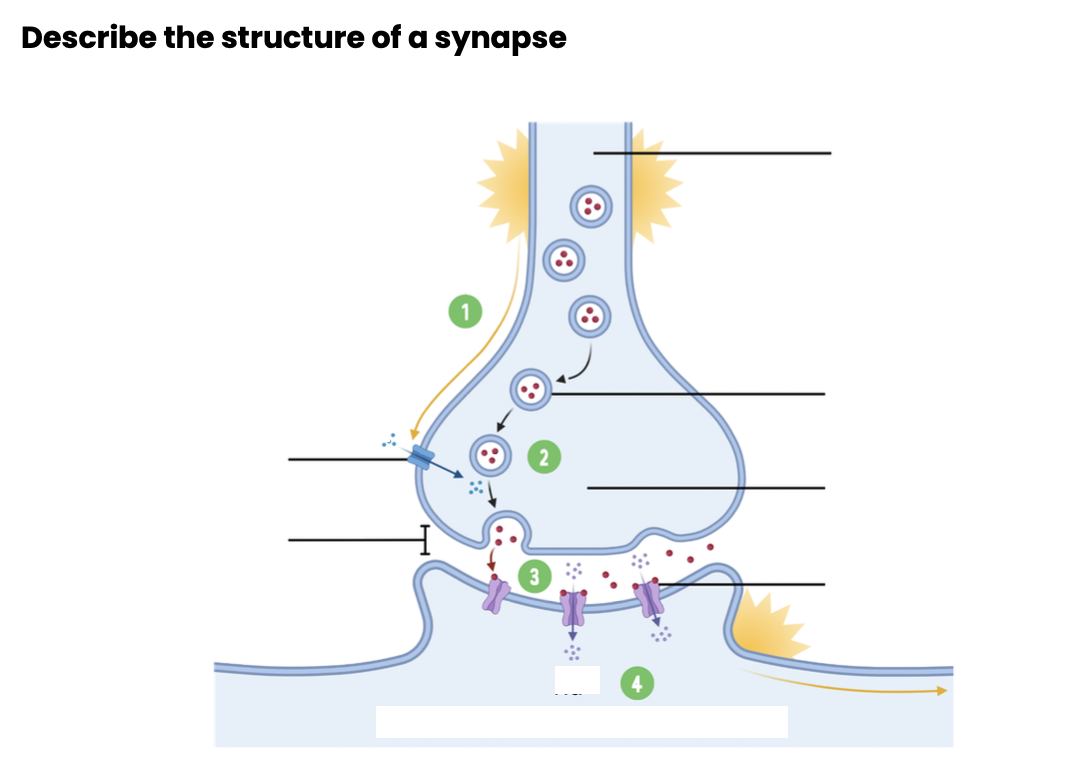
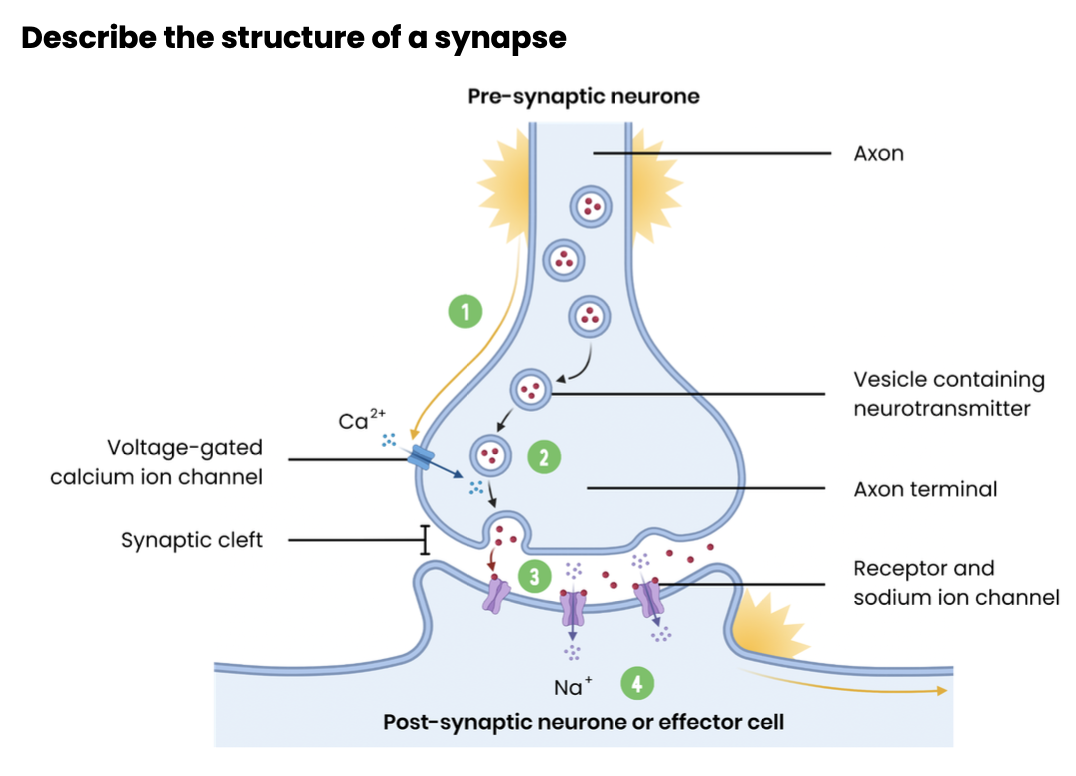
Pre-synaptic neurone: depolarisation of pre-synaptic membrane causes opening of voltage-gated Ca2+ channels - Ca2+ diffuse into pre-synaptic neurone
Causing vesicles containing ACh to move and fuse with pre-synaptic membrane - releasing ACh into the synaptic cleft (by exocytosis)
At post synaptic membrane neurone: ACh diffuses across synaptic cleft to bind to specific receptors on post-synaptic membrane
Causing ligand-gated Na+ channels to open - Na+ diffuse into post-synaptic knob causing depolarisation. If threshold is met, an AP is initiated
Explain what happens to ACh after synaptic transmission
It’s hydrolysed by acetylcholinesterase
Products are reabsorbed by the presynaptic neurone
To stop overstimulation - if not removed it would keep binding to receptors, causing depolarisation
Remaking ACh
ATP released by mitochondria is used to recombine acetyl (ethanoic acid) and choline - recycling ACh
More ACh can be made at the SER
Na+ ion channels close in the absence of ACh at their receptor sites
Explain how synapses result in unidirectional nerve impulses
Neurotransmitter only released from pre-synaptic neurone
Receptors only on post-synaptic membrane
Explain summation by synapses
Addition of a no. of impulses converging on a single post-synaptic neurone
Causing rapid buildup of neurotransmitter (NT)
So threshold more likely to be reached to generate an AP
Describe Spatial summation
Many pre-synaptic neurones share one post-synaptic neurone
Collectively release sufficient NT to reach threshold to trigger an AP
Describe Temporal summation
One pre-synaptic neurone releases NT many times over a short time
Sufficient NT to reach threshold to trigger an AP
Inhibitory synapses
NT can prevent the generation of an AP in a postsynaptic neurone - this is inhibition - the impulses stops at the synapse
Inhibitory NT hyperpolarise postsynaptic membrane as: Cl- channels open → Cl- diffuse in, K+ channels open → K+ diffuse out
More Na+ required for depolarisation
Reduces likelihood of threshold being met at post-synaptic membranes
Explain the effect of drugs on synapses - more APs created
Drugs can stimulate the nervous system by creating more APs in postsynaptic neurones:
Stimulate the release of more NT
Attach to receptors if they’re complementary on shape (mimic the neurotransmitter)
Inhibiting the enzyme that hydrolyses the NT
Explain the effect of drugs on synapses - Fewer APs created
Drugs can stimulate the nervous system by creating fewer APs in postsynaptic neurones:
Inhibit the release of the NT
Block receptors on Na+ channels on the postsynaptic neurone
 Note
Note  Flashcards (98)