micro
 Call Kai
 Learn
Learn Practice Test
 Spaced Repetition
 Match
Match Flashcards
 Knowt Play
1/32

Earn XP
Description and Tags
33 Terms
Law of demand
As price increases, quantity demanded decreases
Law of supply
As price increases, quantity supplied increases
Law of diminishing marginal utility
Less utility as more of a g/s is consumed
Allocative efficiency
Optimal distribution and us of resources to maximize outputs and satisfy wants without waste
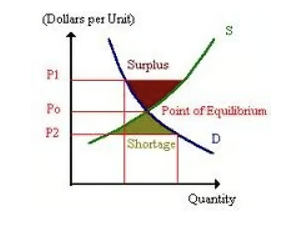
Surplus
excess supply, signals producers to lower price
Shortage
Excess demand, signals producers to raise price
Market equilibrium price
Price at which quantity demanded and supplied are equal
Efficiency
A point at which no individual can be made better off without making another worse off, where MB=MC
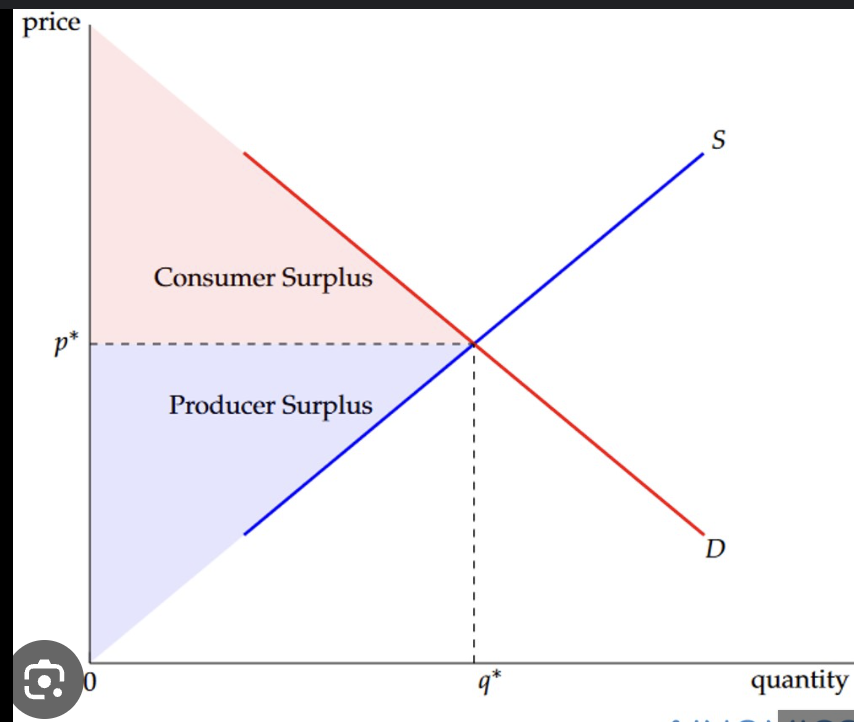
Consumer surplus
When a g/s is bought at a lower price than what they were willing able to (can be called additional savings)
Producer surplus
A g/s is sold at a higher price than what they were willing and able to (additional profit)
Community surplus
Consumer and producer surplus
Total welfare
Community surplus, including utility and other non-monetizable aspects.
Marginal social benefit
Demand for goods represent the benefit society derives from the consumption of that good. Decreases at higher levels of consumption because of decreasing marginal utility.
Marginal social cost
Supply for a good represents cost to society of producing the good. The Greater the amount produced, the more it costs to produce each additional good.
Price Mechanism
The way price changes in response to demand or supply, SIRA can help to explain this
Productive efficiency
Producers are producing at the lowest possible average cost, but allocative efficiency means that they produce the best combination of goods from the society’s point of view.
Supply is not an amount, it is the
sellers behaviour
Price is _____________ related to the quantity supplied.
directly or positively
Profit Motive
The higher the price, the more revenue for the producer and a greater incentive to increase production.
Price DOES NOT change ____________________.
supply or demand, it affects quantity.
normal good
people buy MORE when they have MORE money & less when they have less money
inferior good
people buy MORE when they have LESS money & less when they have more money
where is surplus and shortage on graph
where is consumer and producer surplus
tax
money paid to the government under the force of the law to fund the government
direct tax
taken directly from individuals, eg income tax
specific tax
absolute value, eg. 1.20chf on soda, fixed amount for each unit of g/s sold
ad valorem
added as a % of sale, eg. 19% in germany on most g/s (not necessities)
excise tax
specific tax on a particular type of good, eg. alcohol, cigarette, tourists, car, fuel
Tradable permits
permits to pollute, issued by a governing body, sets a maximum amount of pollution allowable. Firms may trade these permits for money
Public good
Goods or services which would not be provided at all by the market. They have the characteristics of non-rivalry and non-excludability, for example, flood barriers.
non-rivalrous
one consumers enjoyment of the benefits of the good does not diminish others enjoyments of its benefits
non-excludable
once good is provided, cant prevent people from consuming