Music Appreciation Midterm
 Studied by 0 people
 Call Kai
 Learn
Learn Practice Test
 Spaced Repetition
 Match
Match Flashcards
 Knowt Play
1/147

Earn XP
Description and Tags
I hate this sm
Name | Mastery | Learn | Test | Matching | Spaced | Call with Kai |
|---|
No analytics yet
Send a link to your students to track their progress
148 Terms
Leonard B. Meyer refers to the connection between music and its function as musical:
Connotation
T/F: Musical connotation happens when music is associated with extra-musical events or experiences
True
T/F: Music only affects our feelings and thoughts
False
T/F: Evidence of the healing power of music has only been collected recently
False
T/F: Absolutists derive pleasure from listening for the way that the different elements of music relate to each other, independently of any extra-musical connotations
True
T/F: Musical associations remained fixed in time
False
T/F: Music was clinically approved as a medical treatment in 1924
True
T/F: Music’s main power is its ability to symbolize an era of society or culture
False
What cultures mythology is filled with references to the healing power of music?
Greek, Ancient Egyptian, Chinese
T/F: Great performers posses outstanding technique but may not have deep musical understanding
False
T/F: All world music traditions make a distinction between composer and performer
False
T/F: Musical themes cannot represent real or fictional characters
False
T/F: Referential listeners are the most common type of listeners
False
T/F: A referential listener is a person that is mainly concerned with judging the quality of the performance of a piece of music
False
T/F: The critical listener combines the characteristics of all types of listeners
False
T/F: Art music is superior to folk or popular music
False
T/F: Folk music belongs to the community even though it may have been written by an individual
True
Riffs refers to:
Short melodic and rhythmic patterns
Meter organizes ___ and ___ sounds into units called measures
stressed, unstressed
The proper musical term for “increasing the tempo” is ___.
accelerando
T/F: Tempo is an Italian universal musical term that refers to the speed at which a musical composition is played
True
T/F: According to the text, tempo can be described as weak or strong
False
The proper musical term for ‘decreasing the tempo’ is ___.
ritardando
The acoustic guitar can be classified as a:
Chordophone
T/F: According to the text, it can be argued that the human voice was the first instrument
True
The English madrigal is characterized by:
The intensity and intimacy of the choral writing
T/F: According to the text, the term vibrato comes from the Latin vibrare, meaning “violin”.
False
The four most common brass instruments in the traditional symphony orchestra are:
Trombone, trumpet, horn, and tuba
T/F: According to the text, in a manner of speaking, the trombone may be considered a big trumpet
True
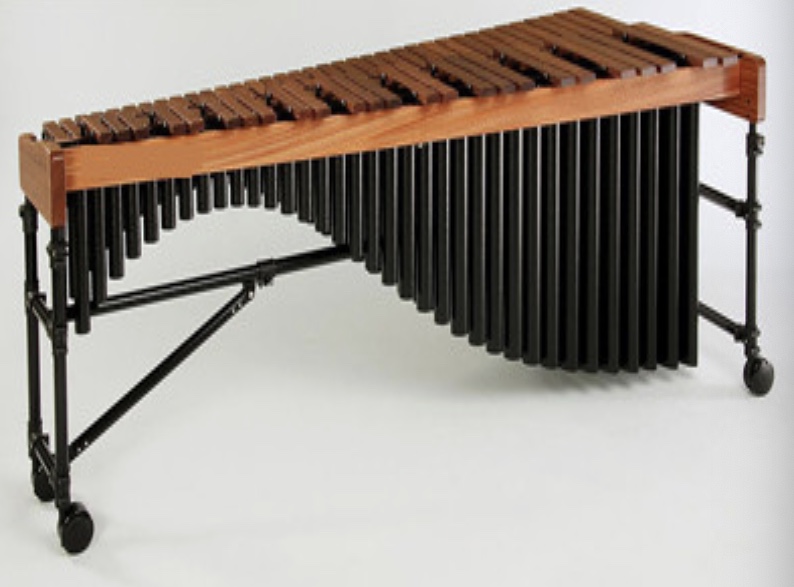
This instrument is called:
Marimba
T/F: The orchestra snare drum is played attached by a sling to the player’s side
False
T/F: Castanets are traditionally played by shaking them
False
T/F: Our ears can perceive the entire range of possible sounds
False
The precise pitch of a sound is determined by how many ___ happen every second.
vibrations
If you take any pitch on the keyboard, the next occurrence of the same letter name going towards the right (up) will vibrate:
Twice as fast
The interval between any two adjacent C’s on the keyboard is called a/an
octave
What are three examples of notation systems?
Numerical notation, staff notation, tablatures
The staff is a system of:
Five lines and four spaces
Music notation can be thought of as a:
Form of communication among musicians
A rest symbol indicates:
A period of silence
T/F: An interval can be thought of as the distance between two letter names
True
T/F: Descending intervals are calculated differently from ascending ones
False
A melody consists of a succession of:
Pitches
The characteristics of a melody may be best described in terms of:
Shape, direction, and range
When a melody acquires significant importance within a given composition, it is called a:
Theme
T/F: Two simultaneous pitches of the same letter name and pitch constitute a harmony
False
T/F: In general, operatic arias of the Romantic period, for example those by Giacomo Puccini (1858-1924), provide good examples of homophonic music
True
The musical texture that consists of a single melody without an accompaniment is called:
Monophony
A musical movement is:
A complete, self-contained section within a larger music composition
T/F: Form is a way of defining the organization of a piece of music
True
T/F: An understanding of form enhances and improves one’s appreciation of music
True
T/F: The term étude refers to pieces that are used to teach a particular technical skill to performers.
True
T/F: According to the text, binary forms are based on the principle of variation
False
What form is not based on the principle of contrast?
Strophic form
Name the famous troubadour who had an imaginative biography written about him and worked in the service of Eleanor of Aquitaine
Bernart de Ventadorn
A unifying factor for social, political, and cultural life in the Medieval period was…
The Roman Catholic Church
Name three chants of the Proper of the Mass?
Introit, Offertory, Gradual
T/F: Léonin and Pérotin were two composers associated with Notre Dame and the development of polyphony.
True
The two most important French composers of organum and discant during the Medieval period were:
Léonin and Pérotin
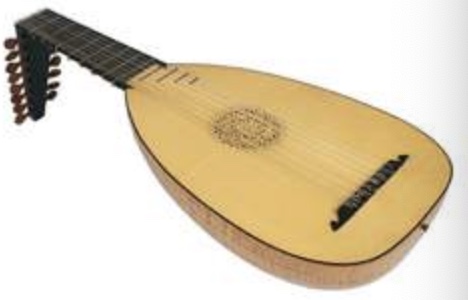
This instrument, which was very popular during the Renaissance, is called a…
lute
The Renaissance was the Golden Age of:
Choral composition for small ensembles
T/F: Concentration on vocal music during the Renaissance period meant that instrumental music continued to be used as a mere accompaniment for voices
False
During the Renaissance, what was the name composers gave to the original chant used as the basis for the main melody in a composition?
Cantus firmus
What are the two main concepts behind Baroque music?
Basso continuo; The Doctrine of Affections
During the Baroque period, the term sonata was used for musical works ___.
to be played
The dates given for the Baroque Period place it between:
1600-1750
T/F: In contrast to the Renaissance, where vocal and choral music took center stage, instrumental music established itself as the most significant genre of the Baroque period
True
The Baroque concerto is…
A piece that contrasts a soloist or group of soloists against an orchestra
During the Baroque period, the musical feature that lent harmonic support to the main melodic line of a composition was called:
Basso continuo
T/F: During the Classical period, opera buffa (comic opera) plots were based on myths and historical figures
False
What are three overtures by Beethoven?
Prometheus, Leonore, Egmont
What are three events that occurred during the Classical period:
Industrial Revolution, American Revolution, French Revolution
T/F: The symphony had its origins in the overture, which was the introductory music for Italian opera
True
What is an example of a composition for a orchestral ensemble?
Symphony
Dance-like characteristics of a piece indicate that it was written by:
Chopin
How did most composers earn a living during the Romantic period?
Independent business persons, earning their living by performing music, writing music for specific occasions and commissions, and collecting royalties on published music
Characterize the “mood” of the Romantic period
Rules and logic are less important than the free expression of human feelings. Humans can only “fully become” by exploring their inner feelings
Describe musical form in the Romantic period
Romantic composers worked with traditional forms but expanded them in innovative ways to meet their expressive needs
T/F: According to the text, composers of the Romantic period were reluctant to stray from the seven tones of the traditional scale (i.e., A, B, C, D, E, F, G).
False
Name three forms of program music
Symphonic poem, concert overture, incidental music
What composer wrote difficult pieces for the violin that (almost) only he could play?
Paganini
What are three general characteristics of Romantic music?
Composers were highly individualistic, composers created new forms or changed existing ones, nationalistic trends started to emerge
Who acts as the bridge between the composer and listener?
The performer
What is the performer’s “interpretation”?
How they choose to communicate the artistry of the music to the audience
What is the difference between a solo and ensemble performer?
Solo plays alone, ensemble plays in an ensemble
What is the most common type of listener?
Casual listener
What is a casual listener?
Uses music to fill the background with sound; passive listener
What is a referential listener?
One who listens to music almost with extra-musical connotations or associations
What is program music?
Music that follows a specific story or program
What is absolute music?
Music not associated with a particular image, object, or event
What was the first symphony to include a detailed story and who composed it?
Symphonie Fantastique; Hector Berlioz
What is the story of Symphonie Fantastique?
Lovesick musician takes a bunch of opium (intending to kill himself) and has crazy hallucinations
What is a critical listener?
Critiques any mistake in a performance; expects perfection; little brats
What is a perceptive listener?
Almost like the perfect combination of the other three listeners; textbook idea of the “ideal” listener
What is folk music?
A type of music rich in oral tradition
What is popular music?
Widely disseminated through mass media
What is art music?
the tradition of Western religious and secular music produced from the eleventh century until the present day
What is jazz?
Relies heavily on syncopated rhythms and a combination of improvisation and riffs
What is rhythm?
The organization of sound in time
What is musical pulse also called?
beat
 Note
Note  Flashcards (84)